Skip to content
Dealing with a landlord dispute after a property sale or foreclosure can be stressful. You may have paid a security deposit to one landlord, signed a lease with another party, and now have no clear answer about who must return your money. For owners and property managers, the same transfer can create immediate exposure if deposit records, funds, and written notices don't line up.
Texas landlord successor liability for a deposit turns on the handoff. The critical questions are when title changed, whether the successor accepted responsibility, what written acknowledgment the tenant received, and whether the transfer occurred through foreclosure. This guide explains the practical rules under the Texas Property Code, including what tenants should demand and what landlords should document before and after closing.
When a Property Changes Owners and the Deposit Question Hits You
A week after closing, the for-sale sign is gone. The new owner has mailed a transfer acknowledgment, and the tenant is looking at a deposit she paid to a landlord she has never met. She knows the money was part of her lease, but she doesn't know whether the seller transferred it, whether the buyer received a credit at closing, or whether the former landlord spent it long ago.
That uncertainty is common, but the legal issue isn't vague. Texas law focuses on the ownership-transfer point and the responsibility attached to it. A tenant shouldn't have to solve the private accounting dispute between the seller and buyer before asserting a deposit claim.
Three pressure points usually decide the dispute:
- The handoff date: The new owner's statutory responsibility can attach when title is acquired.
- The written acknowledgment: The successor must give the tenant a signed statement identifying the transfer, responsibility for the deposit, and the exact deposit amount.
- The foreclosure exception: A mortgage lienholder that acquires title by foreclosure is treated differently under the statute.
Maria, the tenant in this example, should preserve the lease, proof of payment, transfer letter, and every message exchanged with both owners. The buyer should gather the closing statement, deposit ledger, tenant roster, and proof of any funds transferred. A missing document can turn a straightforward refund into a dispute involving multiple parties.
Practical rule: The closing file should answer one question without guesswork: who accepted legal responsibility for each tenant's deposit, and on what date?
For broader context on ownership disputes, leases, and property transfers, readers can also review these real estate law categories. That resource can help organize the estate issues surrounding a sale, but a Texas deposit dispute still requires applying the specific rules in Chapter 92.
What Texas Property Code 92.105 Actually Says About Successor Liability
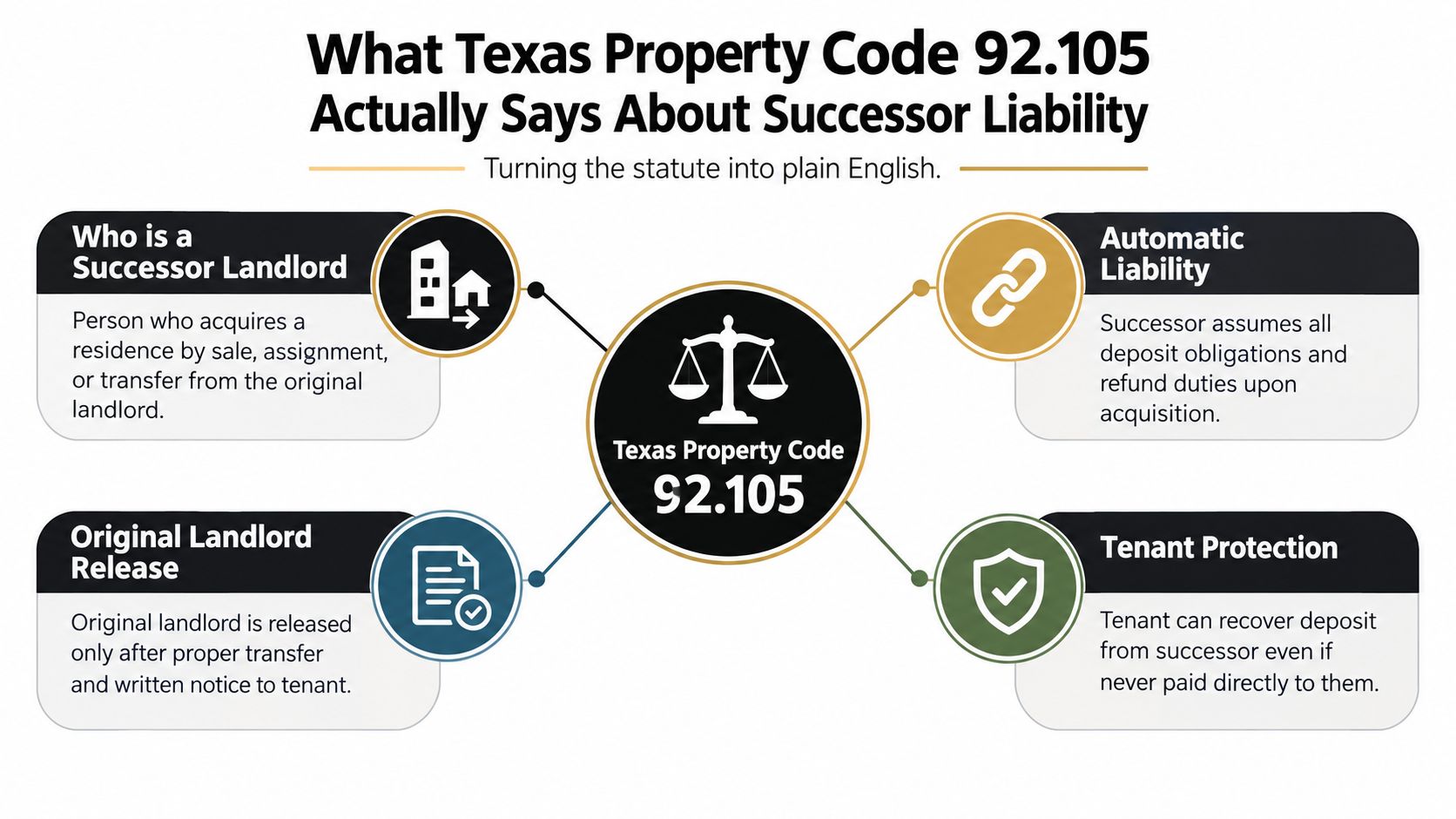
Texas Property Code § 92.105 creates a successor-liability rule for a residential security deposit. If ownership ends through a sale, assignment, death, receivership, bankruptcy, or another transfer, the new owner becomes liable for the deposit from the date title is acquired. The rule applies even when the tenant originally paid the deposit to someone else. (Texas Property Code § 92.105)
The new owner must provide the tenant with a signed written statement acknowledging three things: the property transfer, responsibility for the security deposit, and the exact dollar amount involved. That acknowledgment gives the tenant a clear party to contact and creates an important record of what the successor says it owes.
The former owner doesn't disappear automatically
The former owner remains liable for a deposit received during that owner's period of ownership until the deposit is transferred to the new owner or the new owner assumes liability in writing. That matters when the seller says, “The buyer was supposed to handle it,” while the buyer says, “The seller never sent the money.”
The tenant shouldn't accept those statements as the final answer. Request the signed acknowledgment, the deposit amount, and written confirmation of whether funds were transferred or responsibility was assumed. A closing adjustment between the parties may help establish reimbursement between them, but it doesn't replace the tenant-facing documentation required by § 92.105.
The foreclosure exception must be analyzed first
A mortgage lienholder that acquires title by foreclosure is excluded from the ordinary successor rule in subsection (a). That exception can change who the tenant pursues and prevents a reader from treating every new property owner like a voluntary buyer.
A tenant should identify whether the new party acquired the residence through an ordinary sale, assignment, receivership, bankruptcy process, or foreclosure. A landlord should identify the same transfer path before promising a refund or denying responsibility. For a focused review of permitted and impermissible charges, see What a Landlord Can and Cannot Deduct From a Deposit.
Timelines, Written Acknowledgments, and Bad-Faith Penalties
The ownership transfer and the move-out refund are related, but they aren't the same event. The successor-liability rule identifies who carries the deposit obligation after title changes. The separate refund framework controls what happens after the tenant surrenders the premises.
Texas law requires the landlord to refund the deposit within 30 days after the tenant surrenders the premises. If the landlord acts in bad faith, the landlord may owe $100 plus three times the portion of the deposit wrongfully withheld, along with the tenant's reasonable attorney's fees. Texas also presumes bad faith when the landlord fails to return the deposit or provide a written itemization within that 30-day period. (Texas security-deposit rules)
The statute doesn't turn every disagreement about damage into bad faith. A landlord may have a genuine dispute about deductions, but the landlord still needs a timely refund or written itemization. Successor status makes the record more important because the former and new owners may have overlapping responsibility during the transfer period.
Key Timelines Under Texas Property Code 92.105
| Action | Deadline | Penalty If Missed in Bad Faith |
|---|---|---|
| New owner provides a signed transfer acknowledgment | Within a reasonable time after the ownership transfer | The missing record can make responsibility and the deposit amount harder to prove |
| Landlord returns the security deposit after surrender | Within 30 days after surrender | $100 plus three times the wrongfully withheld portion and reasonable attorney's fees |
| Landlord provides a written itemization when withholding money | Within 30 days after surrender | Texas presumes bad faith if the landlord fails to return the deposit or provide the itemization within that period |
The Texas security-deposit bad-faith presumption deserves careful attention. A tenant should send a written demand after the deadline, while a landlord should preserve proof of the refund, itemization, forwarding-address records, and communications.
Sales, Assignments, Foreclosures, and Bankruptcy Compared
Not every transfer produces the same result. The first step is to classify how the property changed hands, then apply the deposit rule to that path.
| Transfer Type | Is Successor a “Landlord”? | Deposit Liability Shifts? | Key Caveat |
|---|---|---|---|
| Voluntary sale | Generally, yes | The new owner becomes liable when title is acquired under § 92.105 | The signed acknowledgment should identify responsibility and the exact deposit amount |
| Assignment of the landlord's interest | Generally, yes | The assignee steps into the landlord's role | The transfer documents and tenant-facing notice should match |
| Foreclosure | The foreclosure purchaser requires separate analysis | The ordinary subsection (a) rule doesn't apply to a mortgage lienholder acquiring title by foreclosure | The foreclosure exception can leave the former landlord responsible for the deposit |
| Bankruptcy or receivership transfer | It depends on the transfer and party's role | The statute identifies bankruptcy and receivership among transfers requiring analysis | The order, sale terms, and written assumption documents matter |
Ordinary sales and assignments
In a voluntary sale, the buyer takes the property and becomes responsible for the deposit under the statutory rule. The seller should not assume that a private agreement alone solves the tenant's problem. The transaction should include a deposit inventory, a fund transfer or closing credit, and tenant-facing written acknowledgments.
An assignment of the landlord's interest creates a similar concern. The assignee should know which leases exist, what deposits were collected, and what condition records support future deductions. For tenants facing a foreclosure transfer, the Texas tenant rights after foreclosure issue should be analyzed separately from the deposit question.
Foreclosure is the trap
A foreclosure purchaser isn't automatically treated like a voluntary buyer for purposes of subsection (a). The mortgage lienholder exception matters because the foreclosure process may not include the same negotiated deposit handoff as an ordinary sale.
That doesn't mean a tenant should abandon the claim. It means the tenant should identify the former landlord, the foreclosure purchaser, any written assumption, and the exact transfer documents. A landlord or buyer dealing with insolvency issues may also need to separate deposit questions from broader tax and bankruptcy matters, including the differences discussed in Chapter 7 vs 13 tax debts.
Two Real Scenarios That Show How This Plays Out
The outcome often turns on paperwork rather than a dramatic legal argument. Consider two different ownership transfers.
Scenario A shows a clean handoff
Maria rents a duplex in Houston. The property sells during her lease, and the buyer sends her a signed acknowledgment identifying the transfer, stating responsibility for the deposit, and listing the exact amount. Maria keeps the letter with her lease and payment records.
When she later surrenders the premises, she gives the successor her forwarding address and requests the deposit accounting in writing. The successor returns the deposit within the statutory period and keeps the transfer documents with the tenant file. Maria has a clear responsible party, and the new owner has a clear record showing what was accepted.
The useful lesson isn't that every move-out ends without disagreement. It is that the tenant and successor can identify the obligation without reconstructing the entire sale.
Scenario B shows the cost of skipping the letter
A small investor in Dallas sells a fourplex but never sends the tenants a signed acknowledgment. The closing file doesn't clearly identify each deposit, and the seller and buyer disagree about whether the deposits were transferred or merely addressed through a general closing adjustment.
After the tenants move out, they request their deposits and written explanations for any deductions. The missing acknowledgment leaves the parties arguing over who assumed responsibility and what amount was owed. The tenants may pursue the responsible parties and assert available statutory remedies if the withholding was in bad faith.
The lesson for sellers is simple: don't leave deposit liability buried in a closing statement. The lesson for buyers is equally direct: don't accept a property without a tenant-by-tenant deposit ledger and written transfer process.
A one-page acknowledgment can prevent a multi-party dispute, but only if it identifies the property, the tenant, the deposit, and the successor's responsibility.
Your Tenant Recovery Checklist and Landlord Compliance Checklist
Tenants and landlords have different jobs after a transfer. A tenant's priority is proving the deposit and identifying the party responsible. A landlord's priority is creating a reliable chain of records before the property changes hands.
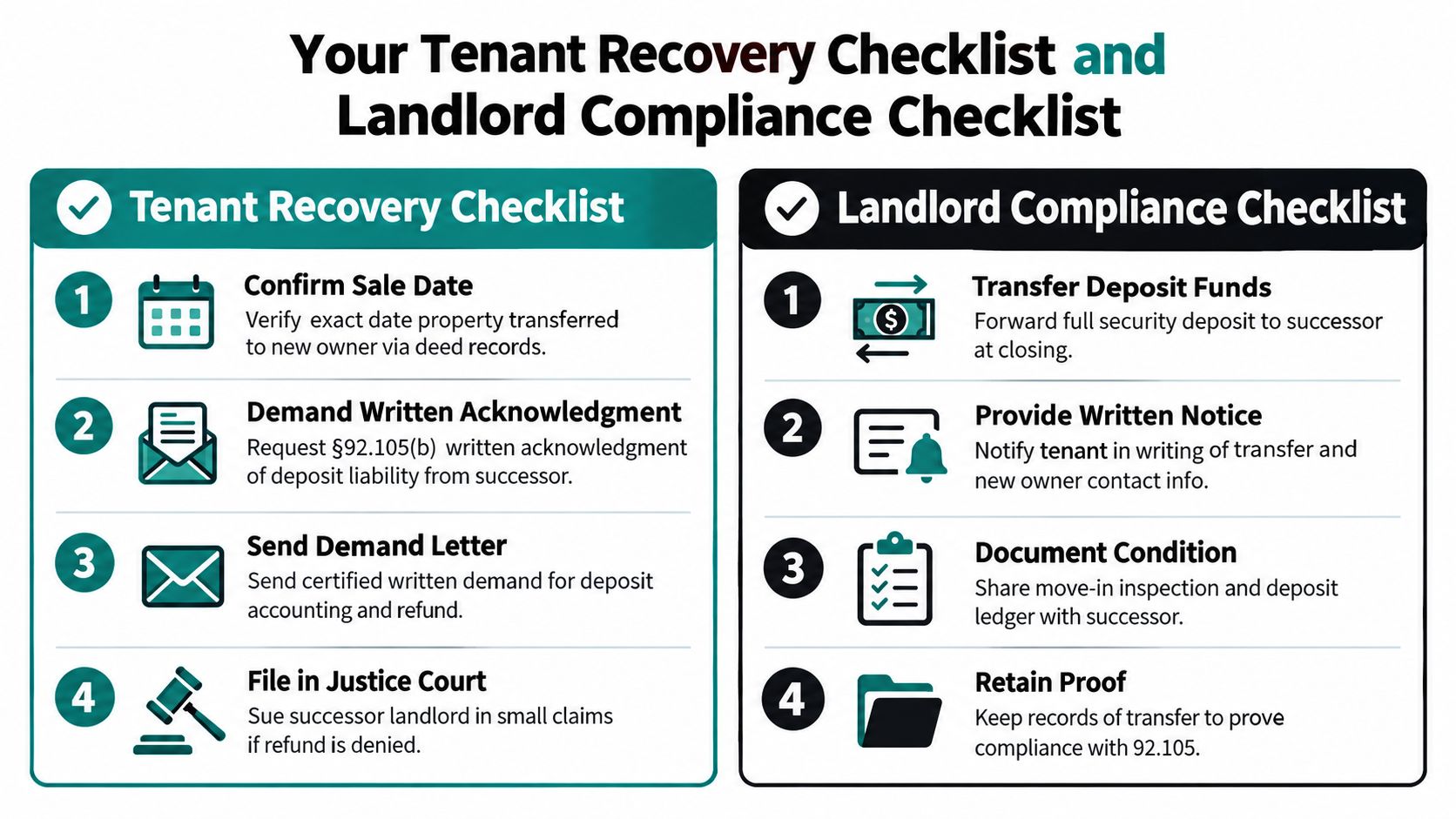
Tenant recovery checklist
Confirm the transfer date. Obtain the deed record, closing communication, or other reliable proof showing when ownership changed. The date matters because § 92.105 assigns responsibility from the title-acquisition point.
Request the signed acknowledgment. Ask the successor to identify the transfer, accept responsibility for the deposit, and state the exact amount. Keep the request and any response in writing.
Build the deposit file. Collect the lease, payment receipt, bank record, move-in photographs, move-out photographs, inspection reports, and forwarding-address notice. These records help separate legitimate damage disputes from unsupported deductions.
Send a written demand. After the refund deadline passes, demand the deposit and any required written itemization. Address the demand to the successor named in the acknowledgment and copy the former landlord when the transfer record is unclear.
Escalate deliberately. If the parties refuse to pay or explain the withholding, consider Justice Court or another appropriate legal remedy. Preserve the documents needed to show the deposit amount, surrender date, notices, and communications.
Landlord compliance checklist
The seller should inventory every deposit before closing and reconcile the ledger against the leases. The buyer should verify that the funds are transferred or that the buyer assumes responsibility in a document the tenant can understand.
- Prepare the acknowledgment: List each tenant, unit, deposit amount, transfer information, and contact details.
- Document the handoff: Keep the signed transfer records, closing statement, deposit ledger, and proof that the successor received the information.
- Coordinate condition evidence: Share move-in reports, photographs, repair records, and any prior deduction documentation with the successor.
- Resolve disputed deductions: Don't let a disagreement about damage prevent a timely written accounting and refund of any undisputed amount.
The safest process is tenant-specific. A general statement that “all leases transfer” doesn't identify the exact deposit or prove that the tenant received the required acknowledgment.
How 92.105 Connects to Repairs Notices and Lease Assignment
A property transfer moves more than a deposit ledger. If the lease continues or the landlord's interest is assigned, the new owner may also become the person responsible for responding to repair requests, maintaining the premises, and handling notices tied to the tenancy.
Texas Property Code § 92.056 addresses the landlord's repair duties, while § 92.0561 addresses a tenant's repair-and-deduct remedy. A successor who takes over the rental relationship should review open repair requests and unresolved habitability complaints instead of treating the deposit as an isolated accounting item.
The deposit return rule under § 92.103 also needs to be coordinated with the § 92.105 acknowledgment. The tenant must know which owner is handling the deposit after the transfer, and the landlord must know which records support the final accounting. A lease assignment generally carries the deposit responsibility with the landlord's interest, while a sublease doesn't automatically create the same transfer of the original landlord's obligations.
Texas Property Code Cross-References at an Ownership Transfer
| Statute | Topic | Effect at Transfer |
|---|---|---|
| § 92.056 | Landlord repairs | The successor should address continuing repair duties tied to the rental relationship |
| § 92.0561 | Repair and deduct | A tenant's statutory repair remedy may affect the successor's review of unresolved conditions |
| § 92.103 | Return of deposit | The responsible landlord must coordinate the refund and accounting with the transfer records |
| § 91.001 | Notice to vacate | Notice mechanics remain separate from deposit liability and should be directed to the identified successor |
| § 91.101 | Landlord's interest and assignment | An assignment can pass rental and deposit responsibilities to the assignee |
For a clearer distinction between these arrangements, review Texas lease assignment vs. sublease difference. The practical point is that the party receiving the landlord's interest should also receive the records needed to perform every continuing obligation, not just collect rent.
Take the Next Step With a Texas Landlord-Tenant Attorney
After a sale, assignment, bankruptcy transfer, receivership, or foreclosure, don't guess about the deposit. Determine the transfer path, identify the date title changed, and review the written acknowledgment. Those facts usually establish whether the new owner qualifies as a successor, whether responsibility was assumed in writing, and whether the foreclosure exception changes the analysis.
Tenants should preserve proof of payment, the lease, transfer notices, move-out records, and written demands. The security deposit doesn't become irrelevant because the property changed hands, and the statutory refund framework still matters when the tenant surrenders the premises.
Landlords should treat the deposit file as a closing deliverable. Inventory the funds, reconcile every tenant ledger, document the handoff, and send a signed acknowledgment that states the exact amount. Clean records at the closing table reduce disputes later, especially when the seller and buyer have different understandings of what the transaction included.
The Law Office of Bryan Fagan, PLLC helps Texas tenants pursue deposit recovery and helps landlords review transfer records, lease obligations, and compliance procedures. A consultation can focus on the documents that control liability, the proper demand or response, and the next practical step in the dispute.
If you need help with a security deposit transfer, foreclosure-related tenant issue, lease dispute, or landlord compliance review, contact The Law Office of Bryan Fagan, PLLC for a free consultation. The firm helps tenants and landlords across Texas evaluate ownership-transfer records, deposit claims, and related rental disputes with clear, practical guidance.