Skip to content
Dealing with a landlord dispute or eviction can be stressful, especially when a repair request seems to trigger a notice to vacate. Texas law gives residential tenants important protections against this kind of retaliation. Understanding the retaliation six-month presumption under Texas Property Code § 92.331 can help you identify the key dates, preserve evidence, and respond before a routine rental dispute becomes a larger legal problem.
The rule also matters to landlords and property managers. A legitimate lease violation or rent dispute doesn't automatically become retaliation, but adverse action taken soon after a protected tenant complaint creates a legal presumption that the landlord must address with reliable evidence. The practical question is often simple: what did the tenant do, when did the tenant do it, and what did the landlord do next?
When a Repair Request Suddenly Turns Into a Notice to Vacate
Maria, a Houston renter, sends her landlord an email about a broken air conditioner in July. She explains that the unit is not cooling properly and asks when a repair technician will come. Two weeks later, she receives a 30-day notice to vacate.
Maria's first reaction is understandable. She may wonder whether the notice is legal, whether she should keep paying rent, and whether the landlord can force her out immediately. The notice itself doesn't prove retaliation, but the timing raises a serious question under Texas Property Code § 92.331.
Texas law creates a rebuttable presumption of retaliation when a landlord takes certain adverse actions within six months after a tenant's protected action, such as a good-faith repair complaint or a code complaint. The listed actions include filing an eviction, reducing services, increasing rent, terminating the lease, depriving the tenant of use of the premises, or interfering with lease rights in bad faith. Texas Law Help explains the six-month anti-retaliation window, including the fact that the presumption can be rebutted by a legitimate non-retaliatory reason.
For Maria, the date of her repair email becomes important. She shouldn't delete it, rely only on a phone conversation, or move out without understanding the consequences. She should also review guidance about what a notice to vacate means in Texas and keep the notice with the original envelope or delivery record.
A broken air conditioner may also point to a larger property condition issue. If water damage, hidden moisture, or a slab leak is part of the problem, a specialized resource such as San Antonio hidden water leak solutions may help identify the underlying condition, although a plumbing inspection doesn't replace legal advice.
The rest of this guide follows the order a real case often takes: the statutory language, the three trigger elements, the landlord's rebuttal, practical evidence steps, and available monetary remedies.
What Texas Property Code Section 92.331 Actually Says
Section 92.331 protects residential tenants who exercise specified rights. The operative statutory language includes:
“A landlord of a dwelling may not retaliate against a tenant by taking an action described by Subsection (b) because the tenant: (1) in good faith exercises or attempts to exercise against a landlord a right or remedy granted by a lease, municipal ordinance, or federal or state statute; (2) gives a notice to repair or exercise a remedy under this subchapter; (3) complains to a governmental entity responsible for enforcing building or housing codes, a public utility, or a civic or nonprofit organization, and the complaint concerns a building or housing code violation, utility problem, or condition that materially affects the health or safety of an ordinary tenant; (4) establishes, attempts to establish, or participates in a tenants' organization; or (5) testifies against the landlord in a court proceeding.”
The statute's categories are easier to apply when separated into practical actions:
- Reporting a code violation to a housing agency or police.
- Complaining to the landlord about repair or maintenance duties.
- Requesting repairs the landlord must provide under the lease.
- Organizing or joining a tenants' association.
- Testifying in a court proceeding involving the property.
- Exercising a legal right or remedy available under a lease, ordinance, or law.
The prohibited landlord conduct includes increasing rent, decreasing services, terminating the lease, filing an eviction, threatening those actions, or refusing to renew when the action is retaliatory and falls within the statutory framework. The presumption applies when the adverse action occurs within six months of the protected act. The Texas Property Code text for § 92.331 provides the statutory wording and related limitations.
The law generally covers residential tenants, not commercial tenants. It also contains statutory exceptions and limits, so a landlord's action isn't automatically unlawful just because it occurs during the six-month period. A landlord can still prevail by proving a legitimate reason unrelated to the tenant's protected conduct.
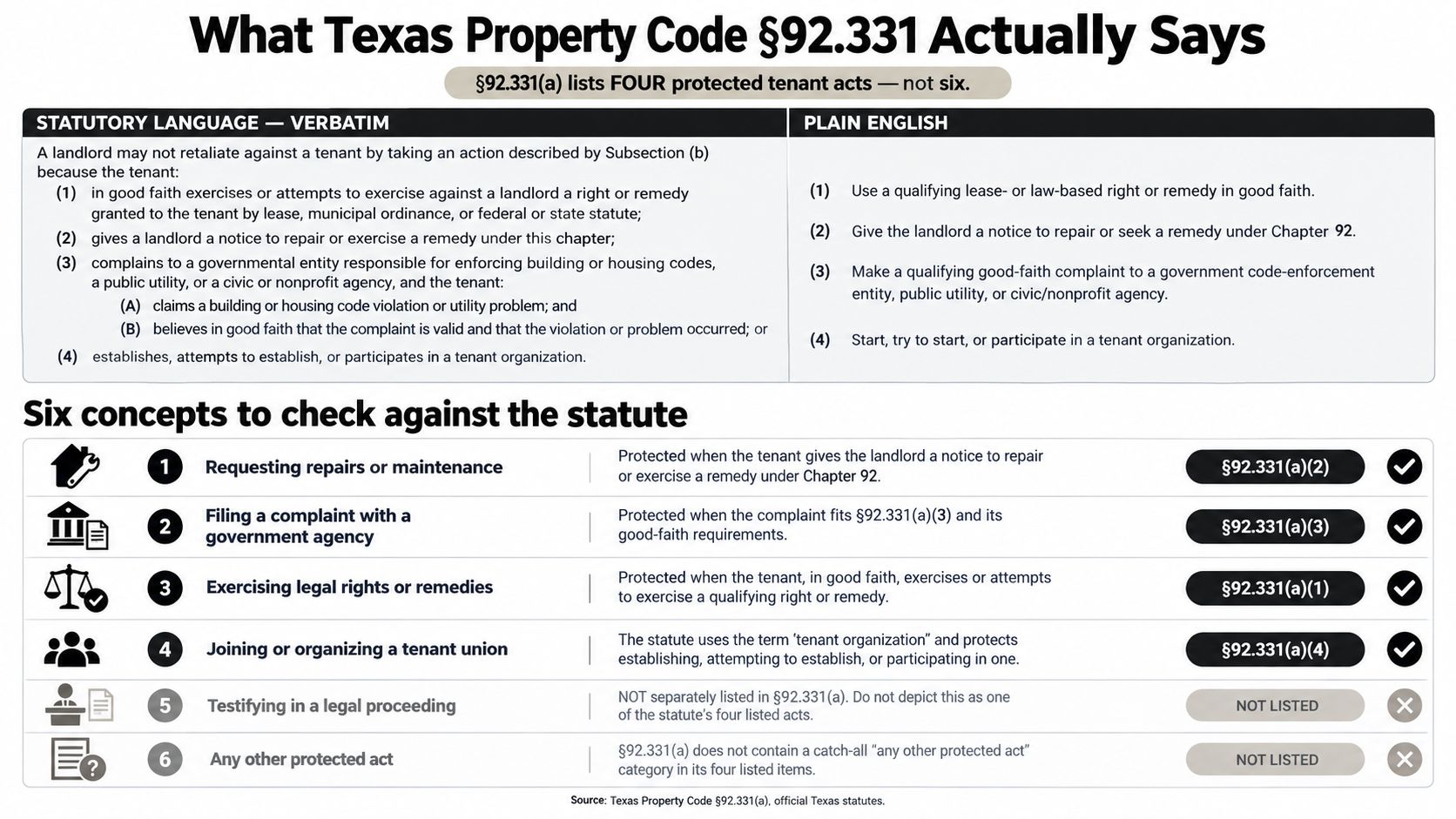
For a broader explanation of the chapter's residential protections, review Texas Property Code § 92 tenant rights. The important point is that § 92.331 doesn't protect only tenants who win a repair dispute. It protects good-faith efforts to exercise rights, make qualifying complaints, and participate in protected tenant activity.
The Three Elements That Trigger the Six-Month Presumption
A tenant usually needs to organize the claim around three basic elements. The tenant must identify the protected conduct, identify the landlord's adverse action, and connect the two through the statutory timing and surrounding facts.
First, identify the protected act
The protected act might be an email requesting a repair, a complaint to code enforcement, participation in a tenants' association, testimony in a property-related court case, or another good-faith exercise of a legal right. The trigger date is tied to the act and the landlord's knowledge of it. In practice, the date the landlord learned or should have learned about the act can matter, so a dated email or delivery record is useful.
Second, identify the adverse action
The next question is what the landlord did. Possible examples include an eviction filing, reduced services, a rent increase, lease termination, non-renewal, or a threat of one of those actions.
A lease-end non-renewal can still raise the presumption if it occurs inside the six-month window. The fact that the lease reached its natural expiration doesn't erase the timing issue. The landlord may have a valid reason, but the reason needs to be supported.
Third, connect the timing and conduct
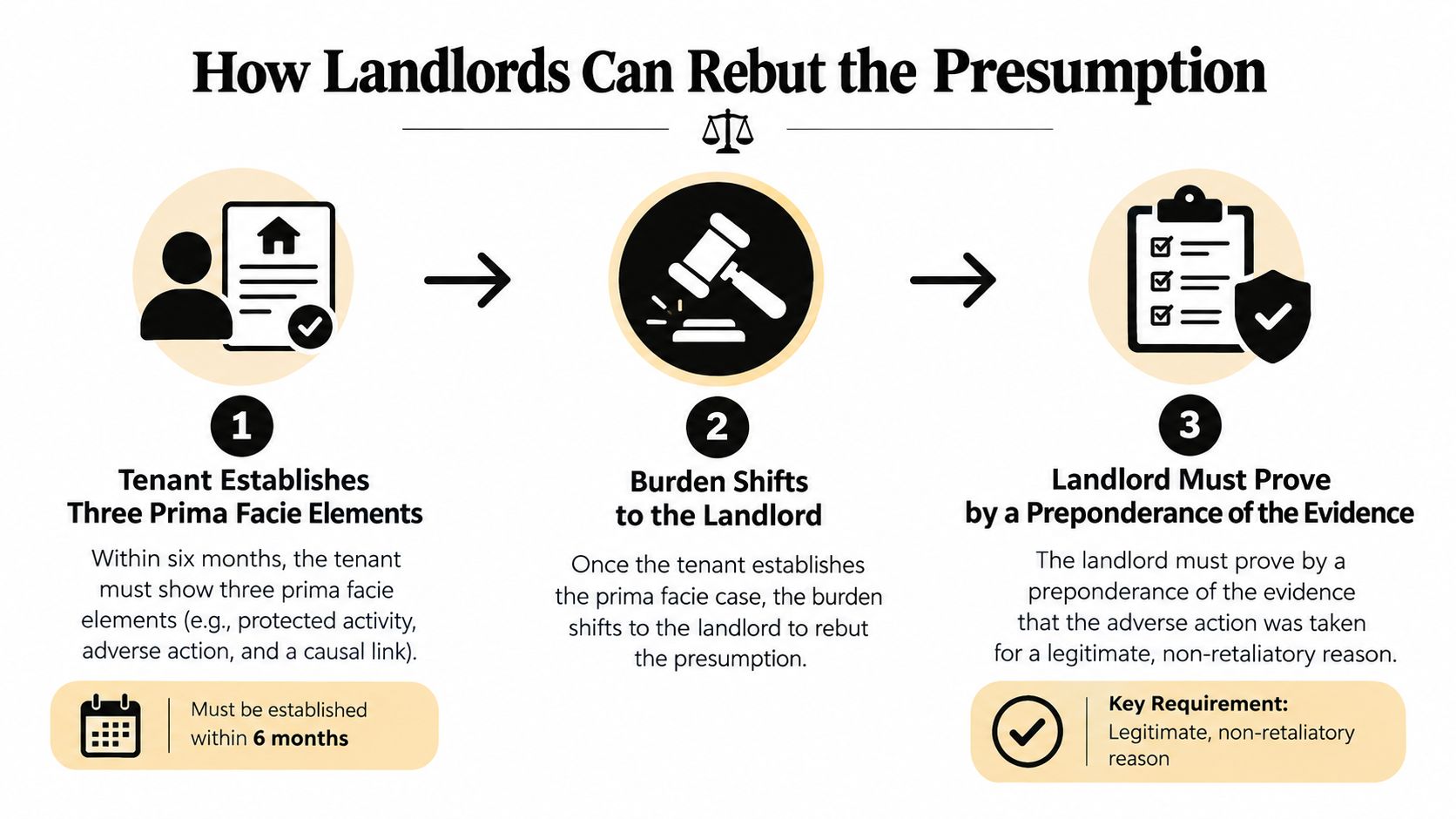
If the adverse action occurs within six months, the law presumes retaliation. That doesn't mean the tenant automatically wins. It means the landlord must provide a legitimate, non-retaliatory explanation and supporting evidence.
For example, a landlord might send a non-renewal notice shortly after a repair complaint, but have a dated contract showing that the property was already scheduled for substantial renovation. The renovation evidence may rebut the presumption if it shows the decision was independent of the complaint.
| Element | What Tenant Must Show | Example |
|---|---|---|
| Protected act | A qualifying good-faith complaint or legal action | Tenant emails the landlord about a serious repair |
| Adverse action | A listed landlord action affecting the tenancy | Landlord files an eviction or refuses renewal |
| Timing and connection | The action occurred within six months and the circumstances support the statutory inference | Notice arrives shortly after the repair complaint |
The Texas landlord retaliation information focuses on the six-month protection and the conduct that may qualify as retaliation. The timing starts the analysis, but the evidence determines whether the presumption survives rebuttal.
How Landlords Can Rebut the Presumption
The six-month presumption shifts the burden of explanation to the landlord. The landlord can still avoid liability by proving that the adverse action had a legitimate, non-retaliatory reason and would have occurred despite the tenant's protected act. The strength of that defense usually depends on records created before the dispute became contentious.
Documentation should come first
A landlord's strongest file often includes dated material that predates the tenant's complaint. Examples include inspection reports, lease-violation notices, rent records, photographs, or a renovation agreement. A document created only after the tenant raises retaliation may look like an attempt to justify a decision already made for another reason.
The reason must stand on its own
A property sale, owner move-in, substantial renovation, or repeated lease violations may provide a legitimate explanation, depending on the facts. A landlord arguing chronic nonpayment should be able to show the payment history, notices, and consistent treatment of similar defaults. A landlord relying on a sale should preserve the listing, contract, or internal decision record showing that the sale process wasn't a response to the complaint.
Procedure can support credibility
Regular procedures matter. The landlord should show that the same notice process, cure opportunity, renewal standards, and lease-enforcement practices apply to similarly situated tenants. Inconsistent treatment can make an otherwise plausible explanation less persuasive.
For landlords: A legitimate reason is more credible when the records show it existed before the tenant complained, the landlord followed the usual process, and similar tenants received similar treatment.
A judge may examine the sequence of events, internal communications, notices, and business records more closely than a witness's general statement that the decision was unrelated. The practical defense isn't to say, “This wasn't retaliation.” It is to show why the decision was made, when it was made, and how the landlord normally handles the same problem.
Common Scenarios Tenants and Landlords Actually Face
Retaliation disputes often involve facts that support two competing stories. The tenant points to the protected complaint and the later adverse action. The landlord points to an independent default, property decision, or pre-existing policy.
Consider three examples.
Mold complaint and eviction. A tenant reports mold to a health department. The landlord files an eviction for unpaid rent soon afterward. The tenant needs the complaint, proof of the landlord's knowledge, and the filing date. The landlord's defense would depend on a reliable rent ledger and earlier non-sufficient-funds notices that existed before the mold complaint, along with proof that the same payment policy applied to other tenants.
Broken heater and non-renewal. A tenant contacts code enforcement about a broken heater. The landlord declines to renew a month-to-month tenancy. The tenant's strongest evidence may include the complaint and notice dates. The landlord's evidence could include a property listing, seller communications, or other records showing that the decision to sell was already underway before the code complaint.
If a building has recurring moisture or maintenance conditions, resources about detecting systemic issues in multifamily homes may help document whether a problem appears isolated or property-wide. That inspection evidence can be relevant to the underlying condition, while the legal issue remains whether the landlord's response was retaliatory.
Court testimony and rent increase. A tenant testifies against a landlord in a property-related court case. The landlord then increases rent. The tenant may argue that the short timing supports the presumption. The landlord may rely on a pre-printed rent escalation schedule tied to the lease anniversary and evidence that the schedule was used consistently.
| Scenario | Tenant Evidence | Landlord Evidence | Likely Trigger Date |
|---|---|---|---|
| Mold complaint followed by eviction | Health complaint, repair records, eviction filing | Earlier payment defaults and consistent collection records | Date the landlord learned of the mold complaint |
| Code complaint followed by non-renewal | Code report, notice, messages about the heater | Earlier sale listing or documented property decision | Date of the code complaint or landlord's notice of it |
| Testimony followed by rent increase | Court record, testimony date, rent notice | Existing escalation schedule and consistent application | Date of the tenant's testimony |
In each scenario, timing matters, but timing alone doesn't resolve the dispute. The documents show whether the landlord's explanation was already developing before the protected act.
Practical Steps to Protect Your Claim Inside Six Months
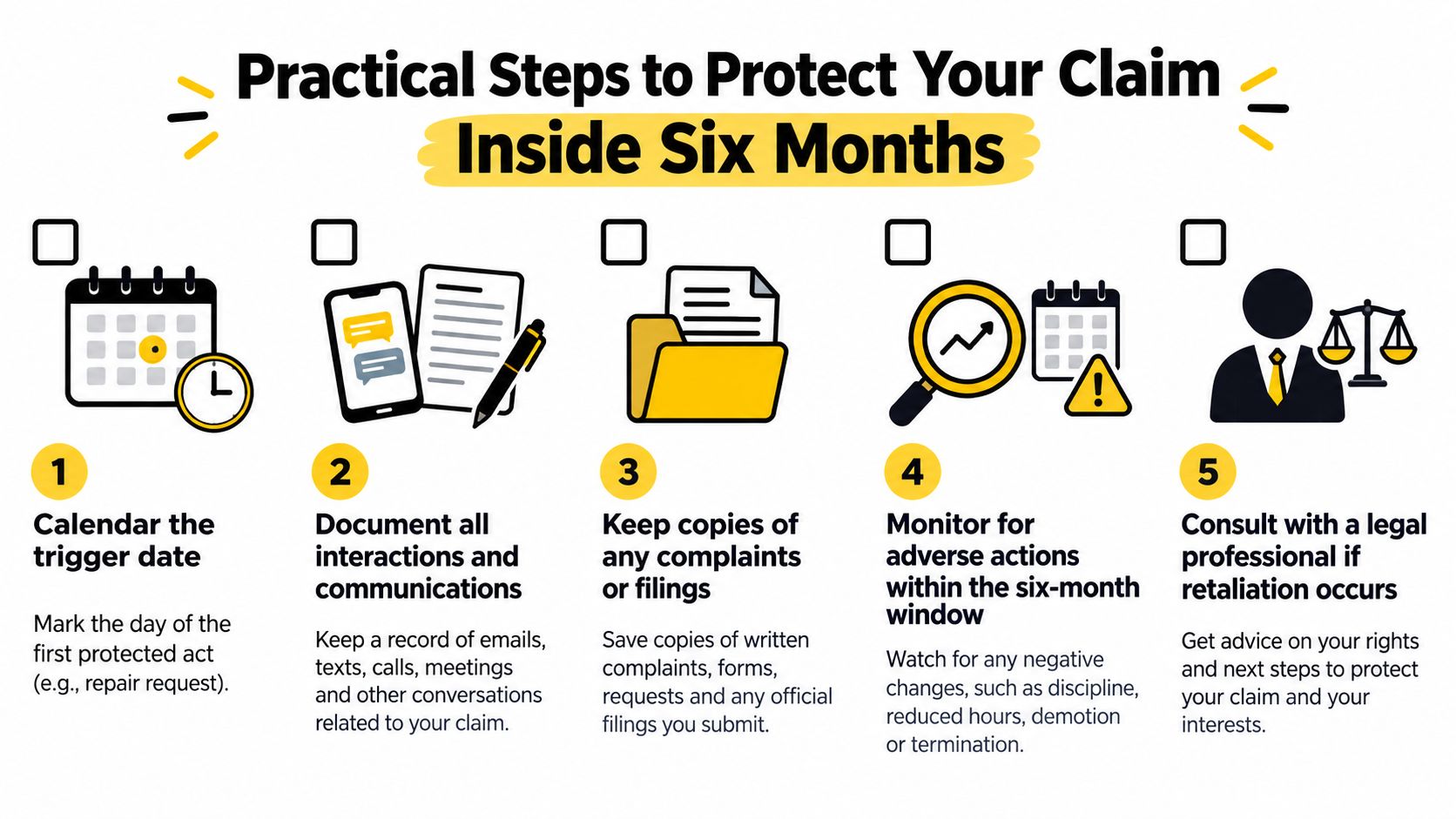
A tenant who suspects retaliation should treat the six-month period as an evidence-preservation period. Don't wait until an eviction hearing to search for the email that started the dispute.
1. Calendar the trigger date
Write down the date of the repair request, government complaint, tenants' association activity, testimony, or other protected act. Mark the date six months forward, but remember that the exact legal calculation can depend on the facts and the specific action.
2. Preserve every communication
Keep the original repair request and every response. Save emails, text messages, notices to vacate, rent increase letters, lease termination notices, and any lockout communication. Don't edit screenshots or rely on a single copy stored on a phone that may be lost.
3. Record the property condition
Take photographs and videos of the repair issue and surrounding areas. Keep inspection reports, code-enforcement correspondence, work orders, and receipts. A dated record can show both the seriousness of the complaint and what the landlord knew.
4. Ask for the reason in writing
If the landlord takes adverse action during the window, request a written explanation. Keep the request professional and ask for the specific non-retaliatory basis, such as nonpayment, a documented lease violation, a sale, or a renovation decision.
5. Send a focused written notice
A cease-and-desist letter can identify the protected act, its date, the adverse action, and the tenant's position under § 92.331. Attach only key exhibits, request withdrawal of the adverse action when appropriate, and avoid threats or unsupported accusations.
6. Get advice before filing deadlines pass
A Texas landlord tenant lawyer can evaluate the timeline, help preserve evidence, and determine whether retaliation should be raised as a defense or pursued through a separate claim. If an eviction has been filed, don't ignore the court papers while waiting for the landlord to respond.
A simple letter outline can look like this:
- Identify the tenancy: State the property address and lease relationship.
- State the protected act: Describe the repair request or complaint and its date.
- State the adverse action: Identify the notice, filing, rent increase, service reduction, or other action.
- Explain the timing: Note that the action occurred within the statutory six-month period.
- Request a response: Ask the landlord to withdraw the action or provide the specific legitimate reason in writing.
- Preserve proof: Attach copies and retain the complete delivery record.
Remedies and Money Damages Under Section 92.333
When retaliation is proven, Texas law provides a defined monetary remedy. A tenant may recover one month's rent plus $500, as well as actual damages, court costs, and attorney's fees under § 92.333. Texas renters' rights guidance confirms that retaliation protections run for six months from a good-faith repair complaint under the relevant provisions.
The fixed amount is only part of the potential claim. Actual damages depend on what the tenant can prove resulted from the retaliatory conduct. For example, a tenant may need to document moving expenses, temporary housing, or other direct losses caused by an unlawful action. The tenant shouldn't assume that every inconvenience qualifies, and shouldn't claim costs without receipts or another reliable record.
Attorney's fees and court costs can also matter. Fee-shifting means a proven retaliation claim can expose the landlord to litigation costs beyond the underlying rent dispute. That makes careful documentation important for both sides.
| Remedy Component | What It Covers | When Awarded |
|---|---|---|
| One month's rent | Statutory monetary remedy | When retaliation is proven |
| $500 | Additional statutory amount | When retaliation is proven |
| Actual damages | Proven losses caused by the retaliation | When supported by evidence |
| Court costs | Eligible litigation expenses | When awarded by the court |
| Attorney's fees | Reasonable legal fees under the statute | When the statutory requirements are met |
The remedy doesn't mean every tenant automatically receives the same total. The court still considers proof of the violation and the actual losses. A tenant should preserve lease records, rent information, receipts, notices, and communications so the damages request is tied to documented facts.
When to Call a Texas Landlord Tenant Lawyer
Call a lawyer promptly when a repair complaint, code complaint, housing-agency complaint, tenant organization activity, or property-related testimony is followed by a notice to vacate, lease termination, rent increase, service reduction, eviction filing, or lockout threat within the six-month period.
Tenants shouldn't ignore an eviction citation or assume a landlord's notice is the final word. Gather the lease, complaint, delivery records, photographs, notices, rent ledger, and all messages in date order. A lawyer can assess whether the facts support a retaliation defense, a damages claim, or another tenant-rights issue.
Landlords also benefit from advice before taking adverse action against a complaining tenant. A landlord considering non-renewal, rent changes, termination, or eviction should review the tenant's recent protected activity, confirm the independent basis for the decision, and preserve records created before that activity. A legitimate reason can be difficult to prove when the file is incomplete.
The Texas landlord-tenant law overview can provide broader context, but it can't replace advice about your specific timeline. The six-month presumption is a legal framework, not an automatic verdict. Your documents, notices, lease terms, and sequence of events will shape the analysis.
For renters: Don't wait for the presumption window to become a court deadline. Save the proof while the events are still fresh.
The Law Office of Bryan Fagan, PLLC can review your repair complaints, notices, lease records, and eviction documents during a free consultation and help you understand the next legal step. Visit The Law Office of Bryan Fagan, PLLC to discuss a possible retaliation claim, eviction defense, or landlord-side compliance strategy.