Skip to content
A tenant in Houston needs to demand repairs, but the lease names only an LLC and never identifies the person or company authorized to receive legal notices. An Austin landlord then files an eviction against the wrong entity because the ownership record was never clearly documented. These problems are more than administrative annoyances. They can determine whether the right person receives notice, whether a claim moves forward, and whether a court awards fees or other remedies.
Texas Property Code Section 92.201 creates a straightforward ownership-transparency rule for residential rentals. Landlords must identify the record-title holder and the responsible management company, if one exists. Tenants need that information before serving serious repair demands, defending an eviction, pursuing retaliation claims, or filing suit. Landlords need it to avoid defective notices, misidentified parties, and exposure under related enforcement provisions.
This guide explains landlord disclosure of ownership in Texas under Section 92.201, including who must disclose, the available compliance methods, the seven-day response deadline, and the courtroom consequences of getting the information wrong.
Why Texas Landlords Must Disclose Ownership
A tenant usually deals with a leasing office, maintenance coordinator, or property manager. That person may collect rent and arrange repairs, but may not own the building or have authority to accept every legal notice. When the tenant later needs to sue, serve a demand, or identify the proper defendant in Justice Court, the difference matters.
Consider a Houston renter whose ceiling leaks repeatedly. The tenant sends repair notices to a management company using the only contact information available. The company says the owner is a separate LLC and refuses to identify its members or authorized representative. If the tenant files against the wrong party, the repair case may be delayed, dismissed, or forced into an avoidable amendment process.
The same risk affects landlords. An Austin owner who fails to identify the record-title holder may discover that an eviction petition names a management company that doesn't own the property and can't properly prosecute the case. A court may question service, standing, or the parties listed in the pleadings. Good disclosure protects the owner by creating a clear record of who owns the premises and who handles tenant communications.
Practical rule: Ownership disclosure is the starting point for deciding who must receive a notice and who belongs in a lawsuit.
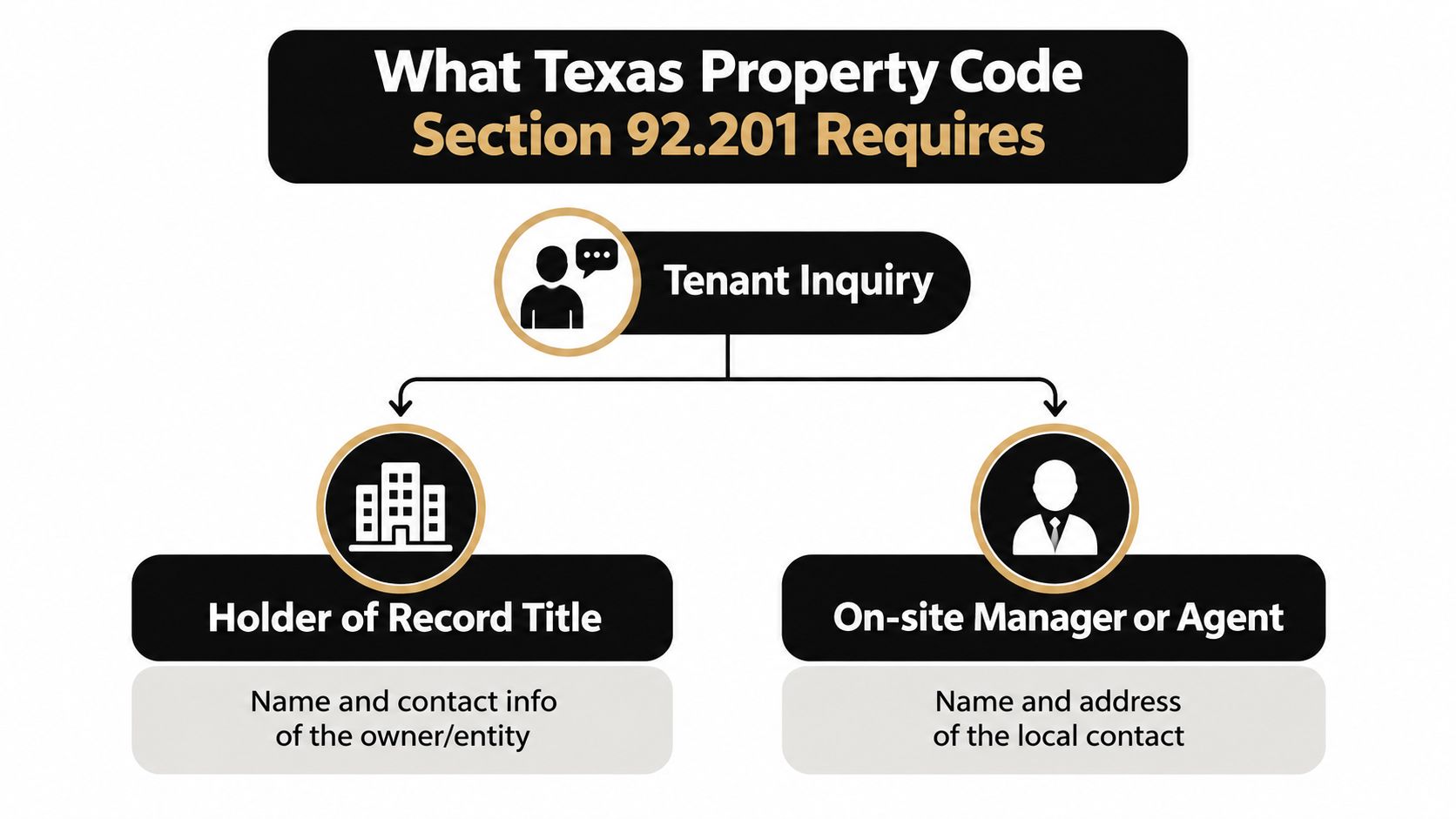
Section 92.201 requires two core disclosures:
- The record-title holder: The name and either a street address or post office box for the person or entity holding record title.
- The responsible off-site manager: The name and street address of the management company primarily responsible for the dwelling, if management is handled away from the property.
The statute gives landlords several ways to provide this information. It also connects the disclosure duty to Sections 92.202 through 92.205, which provide consequences when the landlord refuses to disclose, supplies incorrect information in bad faith, or fails to correct a defective disclosure.
That makes the rule a gateway to practical tenant rights. A tenant can't make an effective repair demand, retaliation claim, or eviction defense if the responsible party remains hidden. A landlord who treats the disclosure as lease paperwork may create a record that later undermines the landlord's own case.
What Texas Property Code Section 92.201 Requires
Section 92.201 is easier to apply when you separate the required information into two questions.
First, who holds record title? The disclosure must identify that person or entity by name and provide either a street address or a post office box. For a rental owned by an LLC, the LLC is generally the relevant record-title holder. The statute doesn't require a tenant to guess which individual stands behind the entity.
Second, who primarily manages the property if that management occurs off-site? The disclosure must identify the management company by name and provide its street address. This gives the tenant a real recipient for notices, complaints, and property communications instead of leaving the tenant with an untraceable brand name or informal contact.
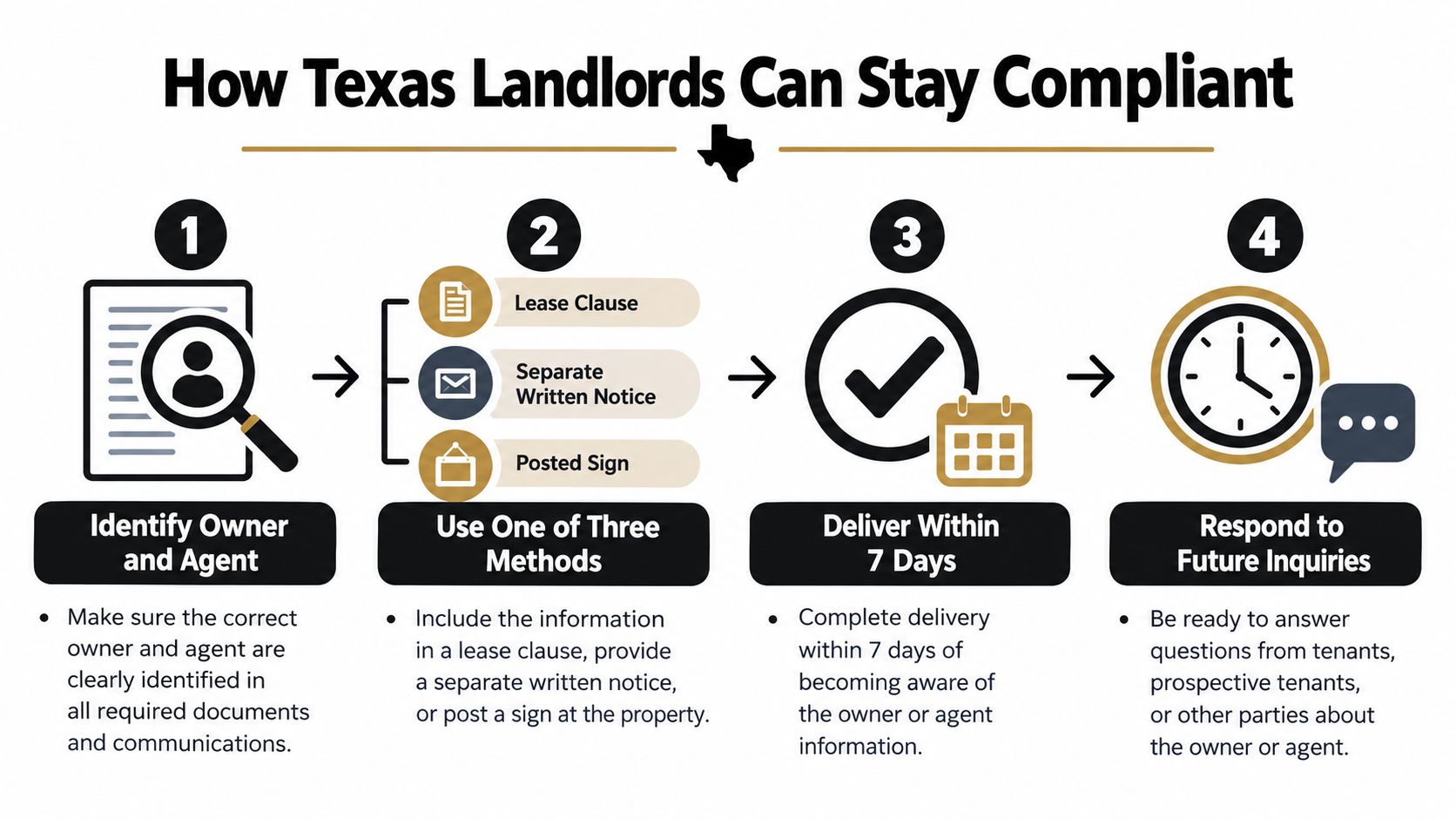
Texas law provides three compliance paths. A landlord may:
- Include the information in the lease or written rules before the tenant makes a request.
- Provide the information in writing within seven days after the tenant's written request.
- Continuously post the information in a conspicuous place at the dwelling.
The statute also requires government officials or employees acting in an official capacity to receive the information in writing within seven days after a request. That provision matters when a housing inspector or another official needs to identify the responsible owner or manager.
The seven-day deadline and updates
The seven-day period is the operational deadline that property managers should build into their records system. If a tenant sends a written request, the landlord should calendar the response immediately, verify the title and management information, and deliver a dated written response.
The same principle applies when facts change. A property sale, transfer to a different LLC, new off-site management company, or replacement of the designated management contact can make an earlier disclosure inaccurate. Texas law allows the information to be corrected through the same methods used for the original disclosure.
A consultation about When to Consult a Texas Landlord-Tenant Attorney can help either side evaluate whether an existing disclosure identifies the correct parties and supports the next legal step.
The required format may vary. The required substance doesn't. The tenant needs a genuine, reachable ownership and management contact, not a vague reference to “the landlord.”
Who Must Provide the Disclosure and When It Applies
The duty generally falls on the holder of record title when that person or entity rents a residential dwelling in Texas. That can include an individual owner, partnership, LLC, corporation, or trustee acting as the title holder. A property manager doesn't replace the owner in the disclosure. The manager may have a separate obligation to identify both the owner and the manager's own address when the management arrangement falls within the statute.
An off-site owner should identify the record-title holder and the off-site management company primarily responsible for the dwelling. An on-site manager may be the tenant's practical contact, but the ownership information still needs to be clear. A lease that names only a local employee or apartment brand leaves an important gap if the tenant needs to identify the actual owner.
The verified statute does not support treating every rental arrangement as identical. Owner-occupied duplexes, short-term arrangements, and a manager who lives at the property can raise different questions about whether the statutory framework applies in the same way. Don't assume an exemption without reviewing the actual arrangement, lease, and statutory language.
| Landlord Type | Disclosure Required? | What Must Be Provided |
|---|---|---|
| Individual record owner | Yes, when covered by Section 92.201 | Owner's name and street address or post office box |
| LLC, corporation, partnership, or trustee holding title | Yes, when covered by Section 92.201 | Entity's name and street address or post office box |
| Off-site management company | Yes, when primarily responsible for the dwelling | Company's name and street address |
| On-site manager or leasing agent | May have management-contact duties | The owner and the manager's applicable contact information |
| Owner-occupied or short-term arrangement | Depends on the facts and statutory coverage | Review the arrangement instead of assuming the rule applies or doesn't apply |
A landlord should provide the disclosure through the lease before the tenancy begins whenever possible. That approach gives both sides a fixed record. If ownership or management changes later, the landlord should correct the information rather than relying on a lease that has become inaccurate.
For title and party-identification issues, tenants and owners can review proof of ownership in Texas rental disputes before sending a demand or filing a case. The proper defendant question can affect whether a Justice Court can issue process against an LLC or other entity.
How Texas Landlords Can Stay Compliant Step by Step
Landlords should handle Section 92.201 as a repeatable compliance task, not an item someone remembers only after a dispute begins.
Build the disclosure record
Start by identifying the holder of record title. Confirm the exact legal name, not merely the property brand or a shortened company name. Then identify the off-site management company primarily responsible for the dwelling and the street address associated with that company.
Choose one of the three statutory delivery paths:
- Lease language: Put the information in the lease or written rules before the tenant requests it.
- Separate written notice: Deliver a standalone ownership and management statement.
- Conspicuous posting: Keep the information posted where tenants can readily see it, when that method fits the property.
A lease rider is often the cleanest option for a single-family rental. A consistent posted notice may work better for a managed residential property, but the landlord still needs a reliable process for keeping the notice accurate.
Document delivery and changes
Use precise language. State the owner's legal name, mailing address, and the contact responsible for maintenance and tenant notices. Keep the signed lease, delivery confirmation, or dated photograph of a posting in the tenant's file.
Property managers should maintain a disclosure log with the date delivered, the method used, the information provided, and the person responsible for updates. A sale or management transition should trigger an immediate review. If a tenant submits a written request, the response deadline is seven days under Texas Property Code Section 92.201.
Teams managing many properties may also use API-driven due diligence workflows to organize ownership and property-record checks. Technology can support verification, but it doesn't replace the landlord's duty to provide a legally sufficient written disclosure.
An annual audit is sensible, especially after a property sale, a new management contract, or a change in the mailing address. The audit should compare the lease, posted notice, property records, and management file. If those documents don't identify the same responsible parties, fix the inconsistency before a tenant has to rely on it in court.
Enforcement Rights and Remedies Under Related Sections
Section 92.201 matters because the disclosure duty connects to enforcement provisions in the same subchapter. Sections 92.202 through 92.205 address what can happen when a landlord doesn't provide the required information or supplies information that is incorrect.
A tenant may seek remedies when the landlord fails to disclose or correct the information. The statute specifically contemplates liability when incorrect ownership information is provided in bad faith. That distinction matters. A clerical mistake may require correction, while a deliberate refusal to identify the owner can create a more serious exposure.
The law also recognizes that ownership can change. A landlord shouldn't rely on an old notice after a sale or management transfer if the information no longer identifies the current responsible parties. The correction should use one of the same disclosure methods available for the original information.
| Compliance Status | Landlord Exposure | Tenant Remedy |
|---|---|---|
| Accurate disclosure provided | Lower risk of party and notice disputes | Clear owner and management contacts |
| No disclosure after a written request | Potential statutory remedies under the related subchapter | Preserve the request and nonresponse as evidence |
| Inaccurate information supplied in bad faith | Potential liability under the related enforcement provisions | Seek available statutory relief and related damages |
| Ownership or management information changes | Continued risk if the record isn't corrected | Request updated information in writing |
A tenant can't waive this disclosure right through a lease provision. A clause saying the tenant accepts an unidentified owner doesn't eliminate the statutory obligation. The same facts may also affect a repair dispute, retaliation claim, eviction defense, or security-deposit controversy.
Landlords and tenants dealing with a transfer should also review landlord successor liability for a Texas security deposit. Ownership changes can create several legal questions at once, and the disclosure issue may be only one part of the dispute.
Real-World Scenarios Where Disclosure Shapes the Outcome
The legal consequence usually appears when someone needs to act quickly.
A Houston tenant has repeated water damage and sends written repair demands to the company listed on a rent portal. The tenant later files suit against that company, but the company never held record title and wasn't the responsible landlord under the relevant claim. The court identifies the party problem, and the tenant must redirect or refile the case. The tenant's repair evidence may be strong, but the wrong defendant still creates delay and procedural risk.
Takeaway: Before filing a repair, retaliation, or habitability claim, match the defendant's legal name to the ownership and management records. A tenant should preserve the lease, written requests, replies, photographs, and any ownership disclosure.
In Dallas, a landlord files an eviction for nonpayment while the lease fails to identify the required ownership information. The tenant raises the disclosure problem. Under the related enforcement framework, the landlord can face limitations on recovering certain litigation-related amounts, including attorney fees or eviction costs, when the statutory requirements aren't satisfied.
Takeaway: A landlord should review the disclosure before filing an eviction, not after the tenant challenges the petition. Correct party identification and a complete file support a cleaner case.
A San Antonio tenant sees a posted notice but can't use it to identify the owner or responsible management contact. The tenant sends a written notice explaining the defect. The landlord doesn't correct the information. The tenant then evaluates the statutory remedy, including the possibility of $100 plus statutory damages and attorney's fees for a qualifying bad-faith violation, as described in the related enforcement provisions and Texas Law Help's explanation of landlord identity rights.
Takeaway: A tenant should not rely on a defective posting or informal oral response. Send a dated written request and keep proof of delivery.
Ownership changes create another pressure point. A tenant whose property is sold should request updated ownership and management information before assuming the old leasing contact remains authorized. Guidance on tenant rights when a landlord sells a property in Texas can help organize the issues, but the tenant should still preserve the actual documents and communications from the transfer.
Common Misconceptions About Section 92.201 in Texas
Several shortcuts create avoidable problems.
“A posted sign always solves the issue.” No. Posting is one statutory compliance path, not a universal safe harbor. The information must be conspicuous and accurate, and the landlord must keep it current when ownership or management changes.
“The duty ends when the tenant moves in.” No. The statute provides a written-response process after a tenant's request, and the information may need correction when the responsible owner or manager changes. A move-in disclosure isn't permission to keep outdated information indefinitely.
“The tenant must be behind on rent before asking.” That confuses disclosure rights with other landlord-tenant disputes. The verified Texas Law Help guidance states that the tenant must be current on rent for the landlord's disclosure obligation to apply, so tenants should confirm their rent status and request the information in writing. The request itself should be preserved carefully.
“The manager's name replaces the owner's name.” It doesn't. The record-title holder remains a core disclosure item. A property manager's contact information can be important, but it doesn't identify who owns the dwelling.
“Out-of-state owners are exempt.” Geography doesn't erase the ownership-transparency question. An owner outside Texas still needs to evaluate the statute and identify the required owner and management contacts for a covered Texas rental.
The safest practice is simple. Don't rely on a generic leasing brand, an old sign, or an oral statement. Compare the disclosure to the current ownership and management records, then correct any mismatch promptly.
Practical Next Steps and Where to Get Legal Help
Landlords should choose a disclosure method that fits the property, include the information in the lease when practical, and keep proof of delivery. They should also maintain a current file showing the record owner, the management company, the date of each disclosure, and any later correction.
For a tenant, the process should be deliberate:
- Send a written request: Ask for the record-title holder's name and street address or post office box, along with the off-site management company's name and street address if applicable.
- Preserve delivery evidence: Keep the request, mailing records, portal confirmation, and any response.
- Compare the response: Check whether the names and addresses identify a real legal party rather than only a brand or employee.
- Calendar the deadline: The statutory response period is seven days after the written request.
- Get advice before filing: A Texas landlord tenant lawyer or eviction attorney can help evaluate the proper defendant, notice recipient, and available remedy.
Landlords should use legally appropriate delivery practices, including in-hand delivery, regular mail, or a conspicuous posting on the inside of the front door when that method applies to the property. Text messages or email shouldn't be treated as a substitute for the statutory written methods unless the lease and applicable law support that approach.
The Law Office of Bryan Fagan, PLLC helps Texas landlords and tenants evaluate ownership disclosures, lease disputes, repair demands, evictions, and related property-rights claims. A legal review can be useful when an owner is undisclosed, a management company has changed, or a party is preparing to file in Justice Court.
If you need help identifying the proper landlord, correcting a Section 92.201 disclosure, defending an eviction, or addressing a related repair or lease dispute, contact The Law Office of Bryan Fagan, PLLC for a free consultation. The firm can review your documents, explain your tenant rights or landlord obligations, and help you choose a practical next step.