Skip to content
Dealing with an eviction judgment can leave everyone watching the clock. A tenant may find a writ of possession and a removal notice posted on the door, while a landlord may have a signed judgment but still be told that the constable can't remove anyone yet. The confusion usually comes from treating several separate deadlines as one rule.
Texas Property Code Section 24.0061 creates a sequence for moving from a possession judgment to physical removal. The writ of possession five day rule in Texas is only the first clock. After that, service and the notice before removal create separate timing requirements. Understanding which clock is running can help protect tenant rights and help landlords avoid taking action before the law allows it.
When the Five Day Rule Kicks In After an Eviction Judgment
Consider a tenant who loses a forcible detainer case on a Monday. The landlord has a judgment for possession and expects the constable to arrive immediately. The tenant sees a notice on the door and assumes the lockout will happen that same day. Neither assumption is necessarily correct.
Section 24.0061 controls the post-judgment process. A landlord who wins an eviction suit is entitled to a judgment for possession and, subject to the statute's timing rules, a writ of possession. The writ is the document that authorizes the appropriate law-enforcement officer to enforce the possession judgment.
The first clock starts with the date the judgment is rendered. Under the statute, the writ generally can't be issued before the sixth day after judgment, unless a possession bond applies. That means the judgment itself doesn't authorize an immediate private lockout. A landlord can't change the locks, remove belongings, or physically exclude the tenant because the court ruled in the landlord's favor.
Practical rule: A possession judgment and a writ of possession are related, but they aren't the same document and they don't have the same legal effect.
The five-day wait isn't a favor granted to the tenant, and it isn't an optional delay for the landlord. It's the statutory order of events between judgment, writ issuance, law-enforcement service, and execution. The Texas eviction process also involves questions about the judgment, appeal, and possession that may affect what happens next.
What this rule does not decide
The waiting period doesn't answer every post-judgment question. An appeal, an agreed judgment, a possession bond, a clerical mistake, or another court order may change whether enforcement can proceed. A writ connected to a nonpayment bond forfeiture may also involve different procedural circumstances.
The safest approach is to read the actual judgment and docket rather than relying on a notice posted at the property. If you're a tenant facing removal, contact a Texas landlord tenant lawyer quickly. If you're a landlord, don't assume that winning possession means you can bypass the constable or sheriff.
What Texas Property Code 24.0061 Actually Says
Section 24.0061 is easier to understand when divided into its functions. The statute gives the prevailing landlord a right to possession enforcement, but it also sets limits on when and how that enforcement occurs. The Texas Landlord-Tenant Law: An Overview places Chapter 24 alongside Chapters 91 through 94, which govern different parts of the rental relationship.
The issuance rule
In plain English, the statute says that a writ of possession generally may not be issued until the sixth day after the judgment for possession is rendered, unless the statute's possession-bond exception applies. The judgment date is the starting point. The clerk can't treat the judgment as an immediate writ.
This is why people often refer to a five-day rule. Five full days must pass after the judgment date before the sixth day arrives. The judgment day itself isn't treated as the first full waiting day for this purpose.
The issuance period is separate from any appeal procedure. A tenant who believes the judgment is wrong should not wait for the writ to appear before seeking advice. A landlord who believes the judgment is final should still confirm the court record and the applicable enforcement requirements before applying.
The officer and the command
The writ is directed to the sheriff or constable, not to the landlord personally. Its purpose is to command the officer to enforce the judgment and place the person entitled to possession in possession of the premises. That distinction prevents private self-help from replacing court-supervised enforcement.
Once the writ is served, the occupant receives a warning before physical removal. Section 24.0061 provides for removal within 24 hours after service. The notice is therefore tied to service of the writ, not to the date the judge signed the judgment and not automatically to the date the landlord applied for the writ.
The Texas statute and related guidance should be read together with the actual court paperwork. Wording on a notice can be confusing, and a defective writ or service problem may require prompt legal review.
The Three Clocks That Control Possession
A post-judgment eviction has three separate timing points. Combining them creates the most common misunderstanding about the Texas procedure.
Clock one, issuance
The first clock is the five-day issuance wait. It begins on the judgment date. The writ generally cannot issue until the sixth day after judgment, unless a possession bond exception applies. During this period, the landlord may prepare paperwork and the tenant may evaluate available legal options, but physical removal can't occur under a writ that hasn't yet been issued.
Clock two, service
The second clock begins when the clerk issues the writ. Texas guidance states that if the constable hasn't served it within five business days after issuance, the landlord may request service by another qualified law-enforcement officer. This is a service problem, not a second five-day waiting period before issuance.
The service clock uses business days in the guidance, while the issuance wait is described by the judgment-to-issuance sequence. That distinction matters when weekends or court closures fall between events. A landlord should keep the judgment date, issuance date, and service attempts separate in the file.
Clock three, removal
The third clock begins when the writ is served on the occupant. The occupant then receives at least 24 hours before physical removal, as described in the Texas guidance on the eviction process and writ of possession. The notice isn't the same as the writ. It tells the occupant when enforcement may occur after service.
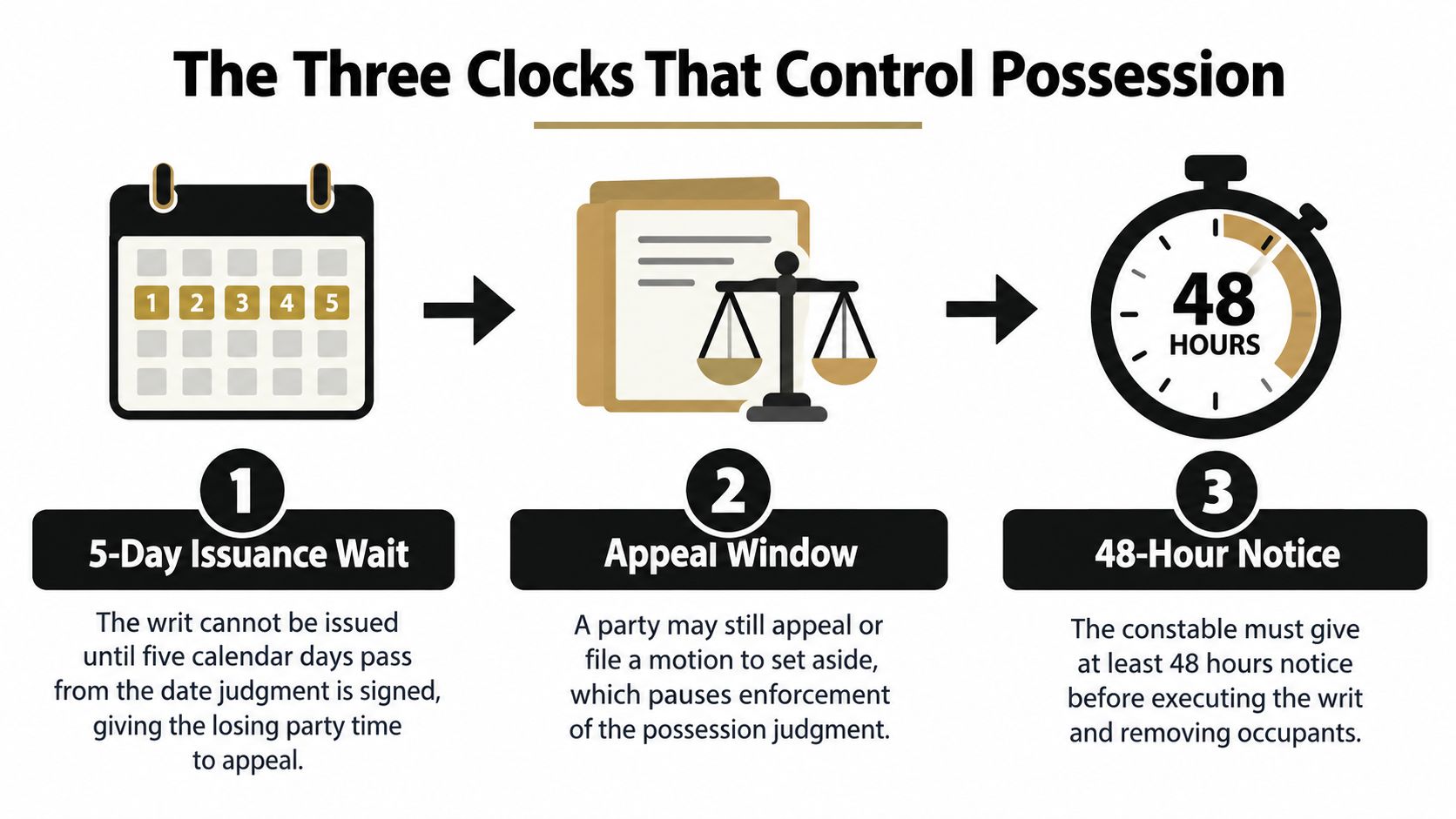
Suppose judgment is entered on Monday. The earliest ordinary issuance point is the sixth day after that judgment. After issuance, the constable's service period runs separately. Once service occurs, the 24-hour removal notice starts. If issuance is delayed, service can't begin. If service is delayed, the 24-hour removal period can't begin. One missed event therefore pushes the later events forward.
For a broader explanation of timing questions, review how long eviction takes in Texas, then compare that general information with the dates on your own court documents.
A Day by Day Timeline of Writ of Possession
A timeline helps, but court calendars and enforcement activity don't always fit neatly into a predictable daily schedule. The following sequence describes the ordinary statutory order without treating it as a guaranteed lockout date.
Day 0 and the waiting period
Day 0 is the date the court renders the possession judgment. The landlord has prevailed on the right to possession, but the writ generally can't issue immediately.
During Days 1 through 5, the statutory waiting period runs. The writ generally can't issue before the sixth day after judgment. Weekends and holidays do not create additional waiting days just because the parties prefer more time, although court operations and legal filings may affect what happens in practice.
The tenant should use this time to review the judgment, identify whether an appeal or other challenge is available, and make a move-out plan. The landlord should verify the judgment, confirm the correct property and parties, and prepare the application rather than attempting a private lockout.
Day 6 and later
On the sixth day after judgment, the landlord may generally seek issuance of the writ if no exception or other legal issue prevents it. The clerk issues the writ for execution by the appropriate law-enforcement officer.
After issuance, the constable or sheriff must serve the writ. If the constable hasn't served it within five business days after issuance, Texas guidance allows the landlord to request service by another qualified law-enforcement officer. That alternative doesn't authorize the landlord or a private mover to carry out the removal.
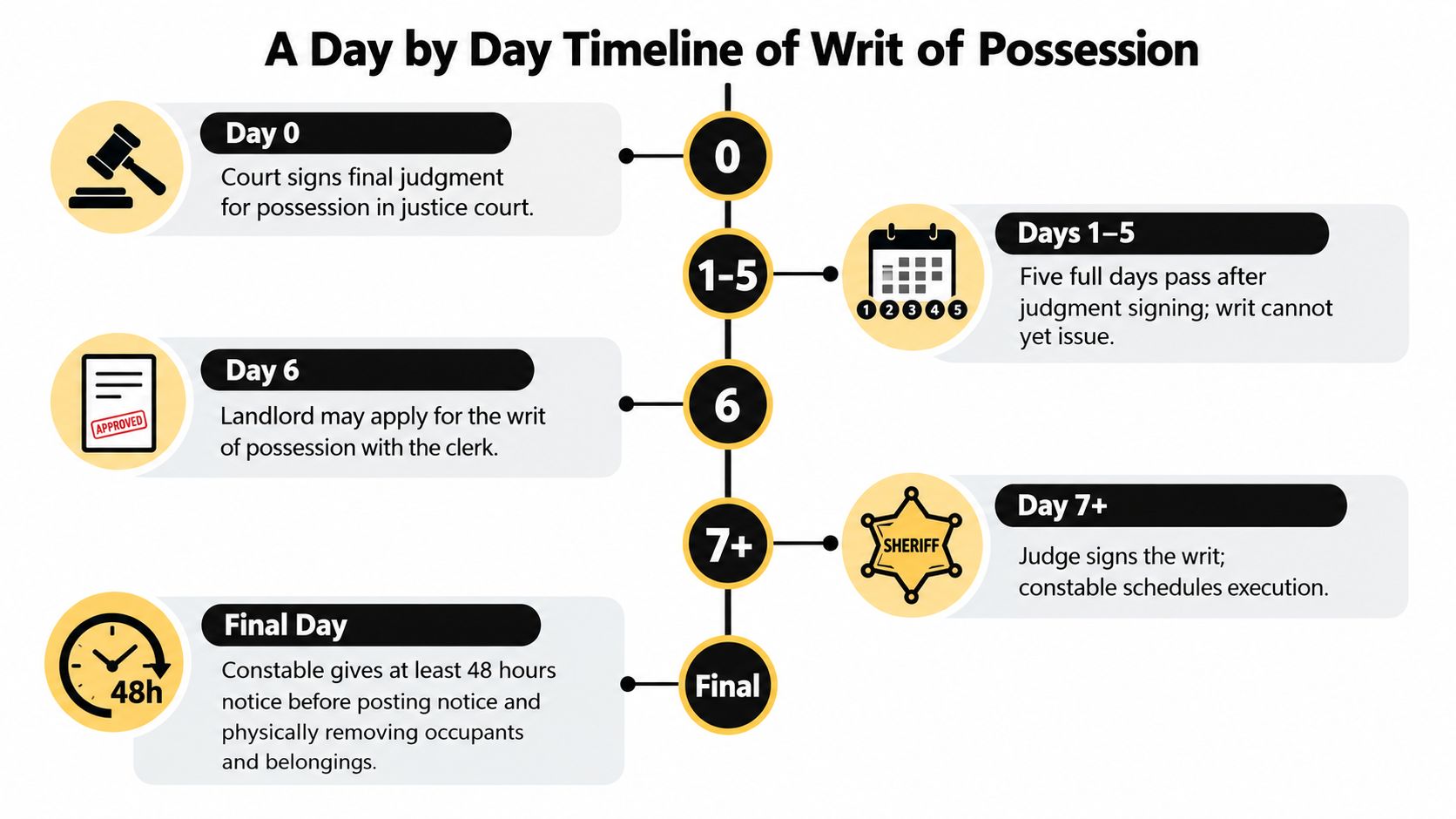
When service occurs, the occupant receives the statutory 24-hour warning before physical removal. The actual execution date depends on when service occurs and how the officer schedules enforcement. Property left behind may raise separate issues under Property Code Section 24.0062, so landlords and tenants should not assume that a lockout resolves every question about personal belongings.
The writ of possession guidance can help explain the document itself, but the dates on the writ and the constable's notice control the immediate situation.
Real World Scenarios From Texas Eviction Cases
A timeline becomes clearer when applied to ordinary disputes. These examples are hypothetical illustrations, not descriptions of particular reported cases.
A residential nonpayment dispute
A tenant in Harris County loses a nonpayment case but pays the amount demanded before the writ issues. Payment may not automatically erase the judgment or end the case. The tenant should document the payment and ask the court or an attorney whether the judgment, possession order, or appeal procedure has changed.
If the tenant files an appeal bond or another authorized challenge, enforcement may be affected. The landlord shouldn't treat the original judgment as an unlimited authorization to remove the tenant while that issue is pending.
A commercial holdover
A commercial tenant in Travis County remains after the lease ends and takes no legal action after judgment. The landlord applies for the writ when permitted. The constable issues and serves the writ, and the 24-hour removal period begins upon service.
If service is delayed, the landlord must account for the service window rather than counting from the judgment date. If the constable hasn't served the writ within five business days after issuance, the landlord may ask about service by another qualified law-enforcement officer.
Belongings and a correction
A manufactured-home occupant may choose to leave after receiving the notice, while arranging to retrieve personal property. Leaving the premises doesn't automatically answer who may access the property or how remaining belongings should be handled. Written communication and an organized inventory can reduce disputes.
In another case, the landlord discovers that the judgment contains a clerical error identifying the wrong unit. The landlord should ask the court about correcting or recalling the writ before enforcement. A writ based on inaccurate information can create serious problems for everyone involved.
For lawyers or self-represented parties researching related decisions, find precedents with AI can be one research resource. It shouldn't replace checking the controlling statute, court record, and current procedural rules.
Exceptions Appeals and Other Ways to Stop the Writ
The five-day issuance rule is not the only issue that can affect enforcement. A tenant may have an appeal, a motion, a service challenge, or another legal basis for asking the court to pause or correct the process. A landlord may also need clarification when the judgment, writ, or service record contains an error.
A timely appeal from a justice court eviction judgment can move the dispute into the county court process and may interrupt immediate enforcement. In a residential case, the tenant may also have obligations connected with rent payments into the court registry while the appeal continues. Because missed filing or payment requirements can change the result, a tenant should seek advice immediately rather than relying on a general deadline remembered from another case.
A supersedeas bond or other approved security may stay enforcement under the applicable appellate procedure. A motion to set aside a default judgment, a request for a new trial where available, or a motion addressing a defective judgment may also matter. Whether any motion stops the writ depends on the court's authority, the filing, and the facts.
| Mechanism | Deadline | Effect on Writ |
|---|---|---|
| Appeal from the possession judgment | Must be filed within the applicable appellate period | May move the case for further review and affect enforcement |
| Possession or supersedeas bond | Follow the court's order and applicable procedure | May suspend or secure enforcement while the matter is reviewed |
| Motion challenging a default or defective judgment | File promptly under the governing rules | May lead the court to correct, set aside, or clarify the judgment |
| Service or writ challenge | Raise it as soon as the defect is discovered | May delay execution until the court or officer resolves the issue |
| Bankruptcy filing or other emergency relief | Depends on the specific proceeding | May impose a stay or require immediate legal analysis |
The Texas tenant eviction appeal information explains why a tenant should not wait until the removal notice expires. An eviction attorney can also help a landlord determine whether enforcement is valid, whether a writ needs correction, or whether abandoned property creates a separate obligation.
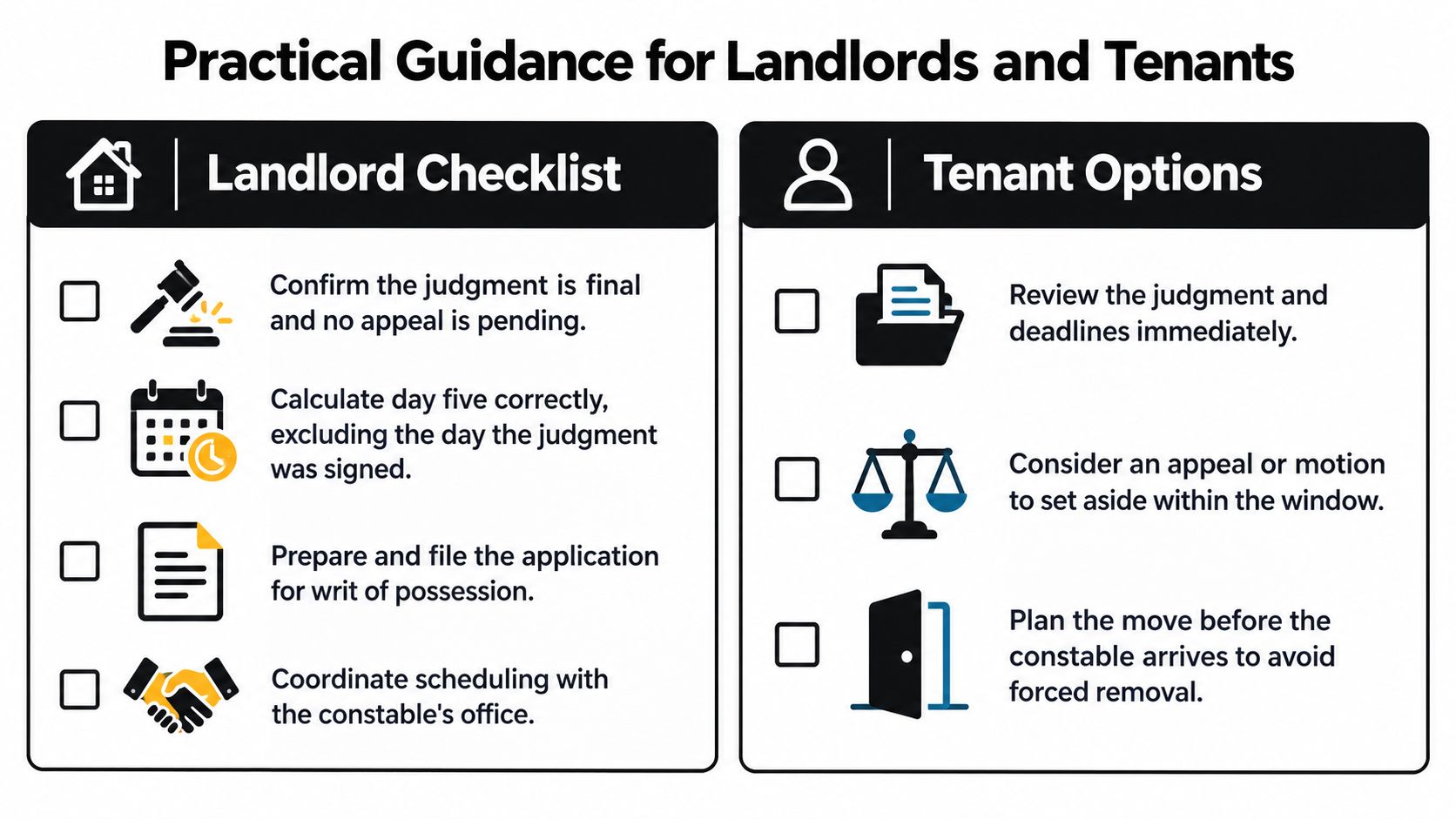
Practical Guidance for Landlords and Tenants
The safest approach is to treat every date as its own record. Landlords should preserve the signed judgment, writ application, issued writ, constable's return of service, and removal notice affidavit or other enforcement paperwork. Tenants should keep copies of the judgment, notices, payment records, appeal filings, and written communications with the landlord or court.
A landlord's working checklist
- Confirm the judgment: Verify that the judgment identifies the right parties, premises, and possession result.
- Calculate the issuance date: Count the statutory waiting sequence from the judgment date. Don't treat the judgment day as the first full waiting day.
- Prepare the writ application: Use the court and clerk process rather than attempting self-help.
- Track service: Record the issuance date and communicate with the constable's office if service has not occurred within five business days.
- Plan the turnover: Coordinate lawful access, property handling, and documentation without promising a lockout date the officer hasn't set.
A tenant's immediate options
A tenant may decide to vacate before the writ issues, negotiate a written move-out agreement, pursue an appeal or bond, or challenge defective notice, service, or judgment paperwork. A verbal promise that the landlord will wait isn't enough. Put any agreement about possession, payment, keys, belongings, or access in writing.
Don't ignore a notice because you believe the landlord made a mistake. A procedural defect may help only if it's raised through the proper court process. A tenant facing imminent removal should contact a Texas landlord tenant lawyer, while a landlord should obtain advice before dealing with disputed occupants or property left behind.
The Law Office of Bryan Fagan, PLLC helps Texas landlords and tenants evaluate possession judgments, writs of possession, appeals, lease disputes, and removal notices. Visit The Law Office of Bryan Fagan, PLLC to schedule a free consultation and receive a clear strategy for your situation.