Skip to content
An eviction judgment can leave a tenant with very little time to choose between two very different paths. You may be deciding whether to post an eviction appeal bond or file a pauper affidavit, while a landlord is watching to see whether the appeal was properly filed and whether rent deposits will continue.
Texas Property Code Section 24.0053 makes the filing date critical. The appeal process doesn't end when you submit paperwork. A bond or affidavit affects the financial security required to appeal, but rent-payment obligations can continue after filing. This guide explains the eviction appeal bond and pauper affidavit in Texas under Section 24.0053, including the practical choices facing both tenants and landlords.
When the Judge Rules Against You and the Clock Starts
A Houston tenant loses a residential eviction case on a Wednesday morning. She leaves the justice court worried about losing her home and learns that she must act quickly. Her choices are not interchangeable forms. She must decide whether to pursue an appeal bond or seek permission to appeal through a pauper affidavit.
Under Texas law, the appeal bond or pauper's affidavit must be filed no later than the fifth day after the justice court judgment is signed. The filing deadline matters more than the date of the hearing. A tenant who waits for another hearing or assumes the county court will automatically review the case may lose the opportunity to preserve the appeal. The controlling statute is Texas Property Code Section 24.0053.
The tenant also needs to understand that an appeal has two separate concerns. The first is perfecting the appeal through the required bond or affidavit. The second is complying with rent-deposit obligations after filing. A tenant may qualify to proceed without an upfront bond, yet still lose protection by failing to pay rent as the law requires.
What the landlord should watch
A landlord should not assume that every document labeled “appeal” stops enforcement. Check the filing date, the type of security filed, and whether the tenant received and follows the rent-payment instructions. A defective or late filing can create a serious problem for the tenant, while a landlord who overlooks a missed required payment may delay enforcement.
A tenant should gather the judgment, lease, rent records, proof of income, benefit information, and any court paperwork immediately. Don't rely on verbal instructions from another party. The Texas eviction appeal guidance can help you identify the issues to raise with counsel, but your justice court's filing requirements and deadlines still control.
The practical rule is simple: act on the judgment date, confirm what was filed, and calendar every later rent obligation. Waiting to see what happens is not an appeal strategy.
What Texas Property Code 24.0053 Actually Requires
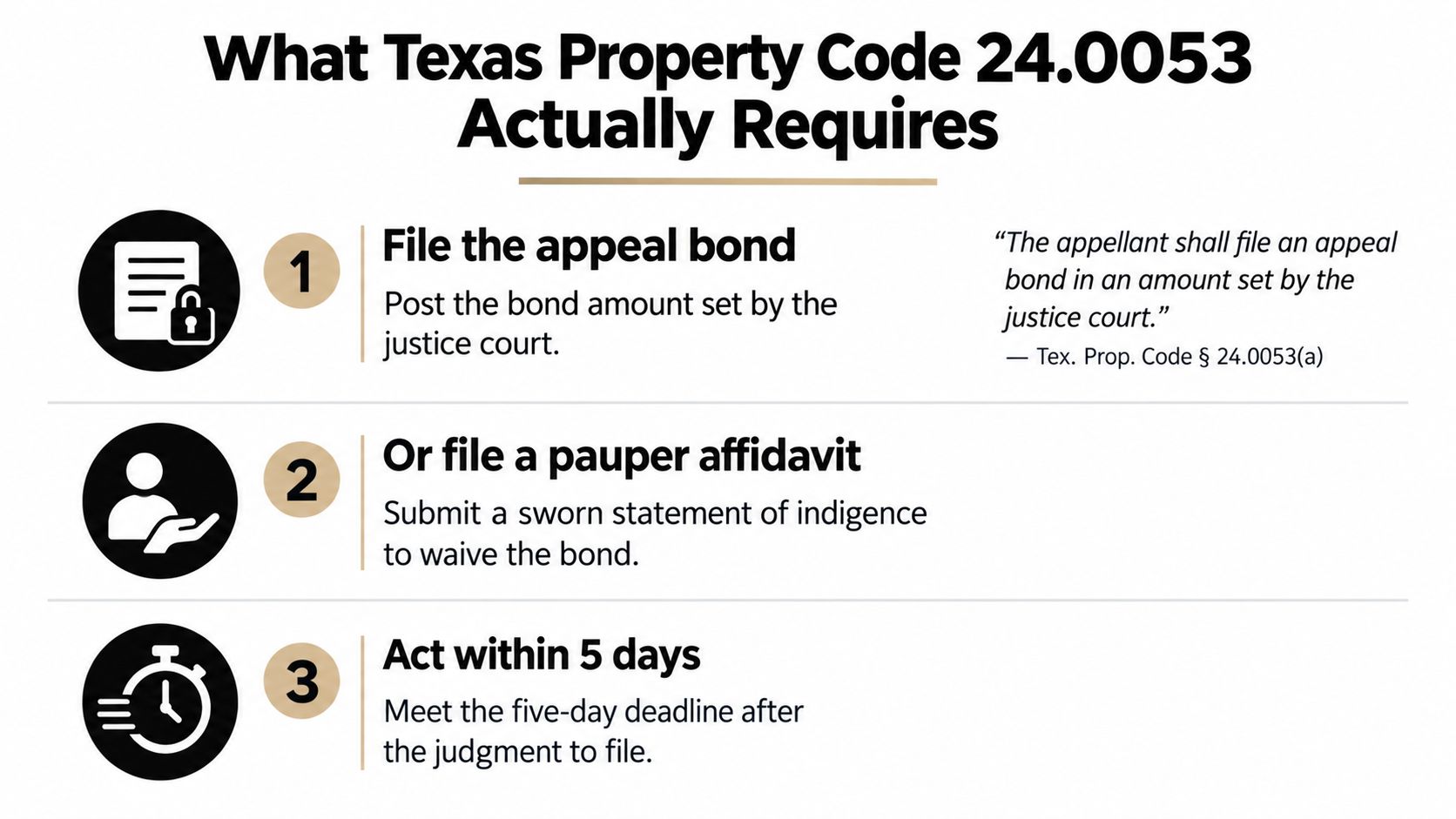
Section 24.0053 creates a strict financial framework for a residential eviction appeal involving nonpayment of rent. A tenant appealing by bond must pay into the justice court registry, within five days after filing the bond, one rental payment period's rent as determined by the court. A tenant appealing by pauper's affidavit must continue paying rent as it becomes due during the appeal.
That means the tenant has two different paths:
- Bond path: File the appeal bond and make the required registry payment within the statutory period.
- Pauper affidavit path: File a sworn affidavit stating that the tenant cannot pay the appeal costs or file an appeal bond, then continue paying rent as it becomes due.
- Compliance after filing: Follow the written notice and payment instructions from the court. Filing the appeal paperwork alone isn't enough.
The justice court must provide written notice at filing explaining the rent-deposit obligations that follow. The court also has to consider and rule on a pauper affidavit before sending the case materials to the county court. A pauper affidavit isn't automatically accepted merely because a tenant signs it. The court can examine whether the affidavit sufficiently states the tenant's inability to pay.
Section 24.0053 and Rule 749a
Section 24.0053 addresses the statutory appeal requirements and rent protection for the landlord. Rule 749a concerns procedural mechanics connected with the appeal and possession process. Don't treat the rule as a substitute for the statute. The safest approach is to identify which requirement concerns perfecting the appeal and which concerns what happens while possession remains disputed.
For a broader explanation of the statute, see Texas Property Code Section 24.005. Appealing a Texas Eviction Judgment describes how either party can appeal a Justice of the Peace eviction ruling.
Calculating and Posting the Appeal Bond
The appeal bond isn't a standard amount that applies to every Texas eviction. The justice court sets the bond amount, and Texas guidance explains that the bond may require sureties. The amount is intended to protect the landlord while the appeal proceeds, but the tenant should not guess what the judge will require.
A surety is a person or company that stands behind the bond obligation. A cash deposit is different. It involves placing the required amount with the court rather than arranging for another party to provide bond security. Before choosing either path, ask the clerk or an attorney exactly what the judgment requires and where the payment must be made.
A practical comparison
The figures below avoid pretending that a judge will use a fixed formula. The verified Texas rule establishes the filing deadline and the rental-payment obligation, but it doesn't establish a universal bond range, premium, or fee.
| Monthly Rent | Likely Bond Range | Surety Premium | Cash Deposit Option |
|---|---|---|---|
| Your actual monthly rent | Set by the justice court | Confirm directly with the surety | Deposit the amount ordered by the court |
| Your actual monthly rent | May differ from another case | Terms vary by provider | Cash may require substantial funds immediately |
The important question isn't whether a bond is merely affordable on paper. Ask whether you can provide the required security and still make the registry payment that follows. A tenant who can obtain bond security but can't meet the rent obligation may remain exposed to enforcement.
Challenge the amount promptly
If the bond appears unreasonable or doesn't reflect the tenant's actual circumstances, raise the issue promptly through the proper court procedure. Don't assume that a later challenge automatically pauses possession enforcement. A motion about the amount and compliance with the judgment are separate issues.
Landlords should review the bond amount because it protects against rent loss and other financial exposure during the appeal. Commercial tenants face a different statutory framework, so Commercial Lease Disputes in Texas should not be used as a substitute for residential eviction advice.
Filing a Pauper Affidavit Instead of a Bond
A pauper affidavit is designed for a tenant who can't pay the appeal costs or file an appeal bond. The tenant must file a sworn statement of inability to pay, and the affidavit must be filed within the same five-day period after the judgment. It should be complete, truthful, and consistent with the tenant's financial records.
The affidavit doesn't erase the case's financial obligations. It offers an alternative to upfront bond security. The tenant still has to follow the court's rent-payment requirements during the appeal, and the court can scrutinize whether the affidavit is sufficient.
Bond or affidavit
| Question | Appeal Bond | Pauper Affidavit |
|---|---|---|
| What must be shown? | The required security must be filed in the form ordered by the court. | A sworn statement that the tenant cannot pay appeal costs or file an appeal bond. |
| What happens to upfront security? | The tenant must provide the bond or other approved security. | The tenant may proceed without upfront bond security if the affidavit is accepted. |
| What happens after filing? | The tenant must make the required rent deposit within the statutory period. | The tenant must continue paying rent as it becomes due. |
| What is the main risk? | The tenant may be unable to obtain or maintain the required security. | The court may reject or question the affidavit, and missed rent payments can still threaten possession. |
A tenant should attach or prepare reliable proof of the financial facts stated in the affidavit. That may include income records, benefit information, bank information, household expenses, and documents showing why the tenant can't pay the bond. The precise documents vary by court, so confirm the accepted form with the justice court.
Practical rule: A pauper affidavit is not a shortcut around the appeal deadline. It is a different financial route that still demands accuracy and follow-through.
Landlords may challenge an affidavit when they have credible evidence that the tenant can provide the required security. Avoid unsupported accusations. Review the tenant's filing, compare it with available lease and payment records, and respond through the court rather than relying on informal pressure.
The Rent Deposit Rule That Decides the Appeal
The rent deposit is often the part of the appeal that determines whether the tenant remains protected. For a tenant who appeals by bond, Texas law requires payment into the justice court registry, within five days after filing the bond, one rental payment period's rent as determined by the court. For a tenant who appeals by pauper's affidavit, rent must continue to be paid as it becomes due during the appeal.
The court's written notice should explain the payment obligations. Read it carefully. The amount and destination of the payment matter, and the tenant should keep proof of every deposit.
The two paths side by side
| Obligation | Bond Path | Pauper Affidavit Path |
|---|---|---|
| Appeal security | File the appeal bond required by the justice court. | File a sworn pauper affidavit stating inability to pay appeal costs or file a bond. |
| Initial rent protection | Pay one rental payment period's rent into the justice court registry within five days after filing the bond, as determined by the court. | Continue paying rent as it becomes due during the appeal. |
| Court involvement | The judgment and court instructions control the required security and payment. | The justice court must determine whether the affidavit is sufficient. |
| Ongoing responsibility | Follow all rent-payment instructions during the appeal. | Keep paying rent as it becomes due and preserve receipts. |
| Consequence of noncompliance | The appeal and possession may be placed at risk. | Approval of the affidavit doesn't eliminate the rent-payment duty. |
A tenant should use a written calendar, not memory. Record the due date, the payment amount ordered by the court, the payment method, and the confirmation number or receipt. If a payment problem arises, contact the court and an attorney immediately. Don't wait until the landlord files a motion.
For landlords, the registry is a record of compliance. Review whether the tenant paid the required amount and whether later payments arrived when due. If the payment chain breaks, act quickly and use the statutory process rather than attempting a lockout or other self-help measure.
Why an Approved Affidavit Does Not Guarantee Possession
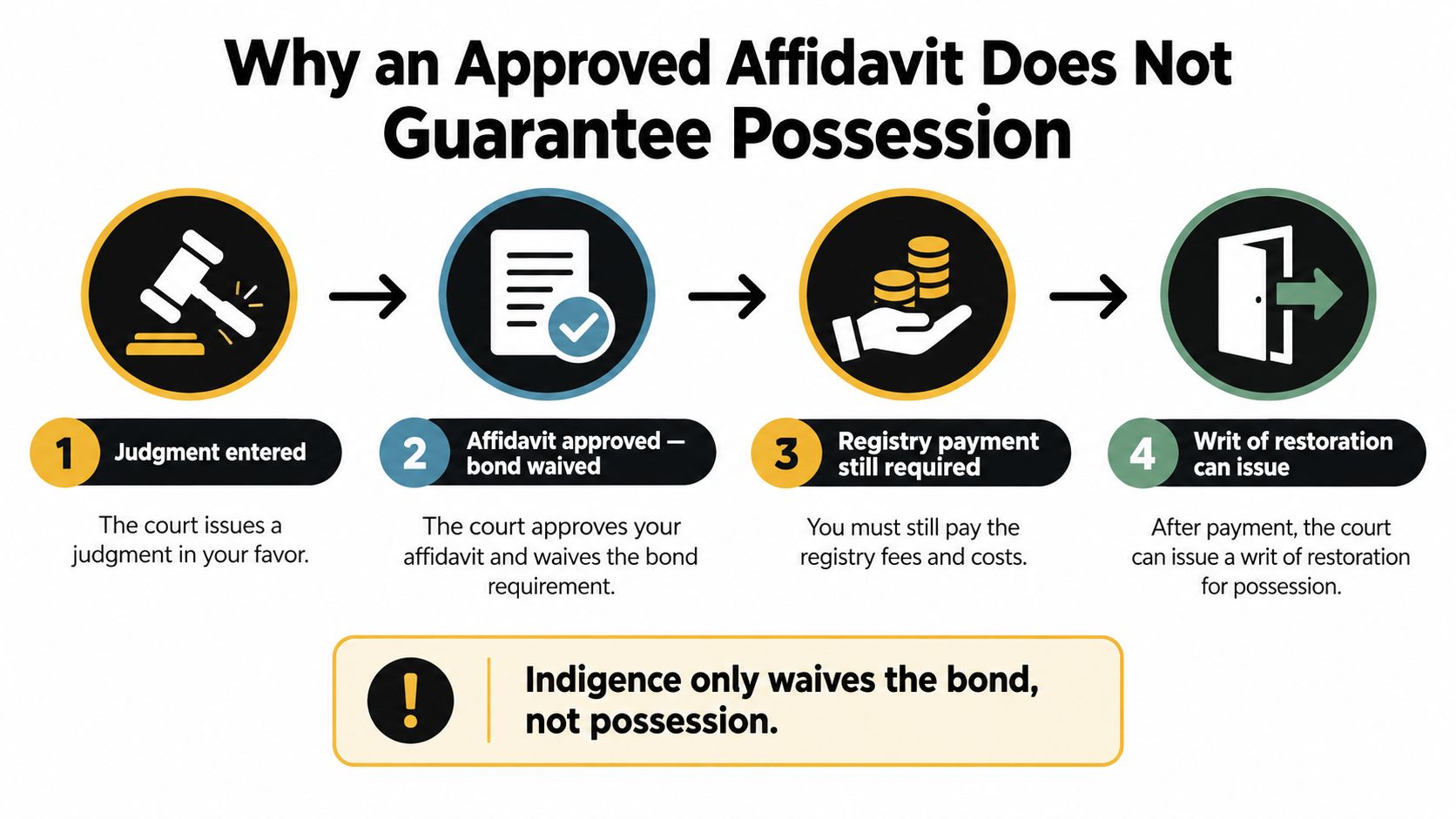
An approved pauper affidavit waives the need for upfront bond security. It doesn't guarantee that the tenant can remain in possession throughout the appeal. Texas law ties the appeal to continuing rent protection, and separate statutory provisions allow writ-of-possession consequences when required deposits aren't timely made.
Consider a tenant whose affidavit is approved. The tenant believes the approval freezes the eviction and stops tracking payment dates. A required rent payment arrives late, and the landlord asks the court to enforce the missed-payment consequences. The affidavit may remain valid as a statement of inability to pay, but it doesn't excuse the missed rent obligation.
Protect the record
Tenants should take four practical steps:
- Calendar every due date: Use reminders before rent becomes due, not after.
- Save every receipt: Keep registry confirmations, clerk-stamped filings, and payment records together.
- Read every court notice: Written instructions may identify where and how payment must be made.
- Respond to problems immediately: A missed or disputed payment needs prompt legal attention.
Landlords should also preserve the record. Keep copies of the judgment, written notices, registry information, and proof of any missed payment. A clear payment history gives the court something concrete to review.
The answer to “If my pauper affidavit is approved, am I safe from eviction while the appeal is pending?” is no, not automatically. The affidavit addresses the bond. It doesn't remove the separate duty to comply with rent-deposit requirements.
The video below provides additional visual context about the appeal process.
Strategic Takeaways and When to Call an Attorney
Tenants and landlords should approach the appeal as a live possession dispute, not a paperwork exercise.
A tenant's playbook
First, identify the filing deadline and choose the route you can actually maintain. A bond may require security that you can't provide. A pauper affidavit may avoid that upfront burden, but it doesn't remove rent-payment duties.
Next, prepare a complete filing and ask the court what it needs to rule on the affidavit. Then create a payment system that someone else can help monitor if necessary. Keep all proof in one file, and don't assume that submitting an affidavit ends the landlord's ability to seek possession.
The right question isn't “Can I avoid the bond?” It's, “Can I comply with every obligation that follows the route I choose?”
A landlord's playbook
A landlord should review the appeal filing as soon as it arrives. Check whether the bond or affidavit was timely, whether the document appears complete, and whether the tenant is making the required registry payments. If the tenant misses a required payment, preserve the evidence and pursue the available court remedy.
A landlord shouldn't treat the appeal as permission to bypass legal process. Don't change locks, remove property, or use threats. A Texas eviction appeal lawyer can help evaluate the filing, payment history, and next procedural step.
When advice is worth the cost
Call a Texas landlord tenant lawyer when the appeal affects housing, significant rent exposure, uncertain financial records, or a disputed affidavit. Tenants need help before filing if they aren't sure which route they can afford to maintain. Landlords need help when the filing appears defective, the affidavit is disputed, or a registry payment was missed.
A Texas eviction attorney can help organize the judgment and filings, explain tenant rights and landlord remedies under the Texas Property Code, and identify the next lawful step. The Law Office of Bryan Fagan, PLLC provides legal guidance for Texas landlords and tenants dealing with eviction appeals, lease disputes, rent issues, and related property conflicts.
If you need help choosing between an eviction appeal bond and pauper affidavit, reviewing registry-payment duties, or responding to a disputed filing, The Law Office of Bryan Fagan, PLLC offers a free consultation to discuss your situation. Contact the firm promptly after judgment so an attorney can evaluate the deadline, paperwork, and possession risks with you.