Skip to content
You turn the key, pull the front door closed, and feel the lock give more than it should. Maybe the deadbolt has a short throw, the strike plate is loose, or the door has no keyed lock at all. You shouldn't have to choose between staying in an unsafe home and risking a lease dispute.
Texas law addresses this problem directly. The Texas Property Code creates specific requirements for residential security devices, including keyed deadbolts, and Section 92.164 gives tenants remedies when a landlord fails to install or rekey required devices. The technical details matter. A lock can look substantial and still fail to meet the statute.
Understanding Your Right to a Secure Home
A broken lock is more than an ordinary maintenance complaint. If your front door doesn't close securely or the deadbolt doesn't anchor properly, you may feel exposed every time you leave for work or go to sleep. That concern is reasonable, and Texas law treats certain security devices as required features of a rental home rather than optional upgrades.
Section 92.153 requires qualifying residential dwellings to have specified security devices, including a doorknob lock or keyed dead bolt on each exterior door, subject to the statutory exception discussed below. It also requires a keyless bolting device and door viewer on each exterior door. The landlord must install these devices at the landlord's expense and keep them operable while you possess the property. The Texas Property Code and tenant-rights guide provides useful context for how Chapter 92 protects renters.
Section 92.164 is the enforcement mechanism. If the landlord doesn't comply with installation or rekeying requirements, you may have more than the right to keep sending maintenance requests. Depending on the circumstances and proper notice, you may install or rekey the device and deduct the reasonable cost from rent, terminate the lease, or file suit.
Practical rule: Treat a defective deadbolt as a legal security-device issue, not just a repair ticket.
Consider a tenant who moves into an apartment and discovers that the front door has a keyed knob but no functioning deadbolt. The tenant sends written notice describing the missing or defective device. If the landlord ignores the request, the tenant may have a statutory path to cure the problem, end the lease, or seek judicial relief. The tenant still needs to follow the notice and documentation requirements carefully.
Landlords should take the same lesson seriously. Installing a lock that doesn't meet the statutory specifications can leave a property owner arguing about compliance after a break-in, lease termination, or lawsuit. A property manager should inspect the hardware itself, not just assume that a labeled “deadbolt” satisfies Texas law.
Technical Requirements for Compliant Keyed Deadbolts
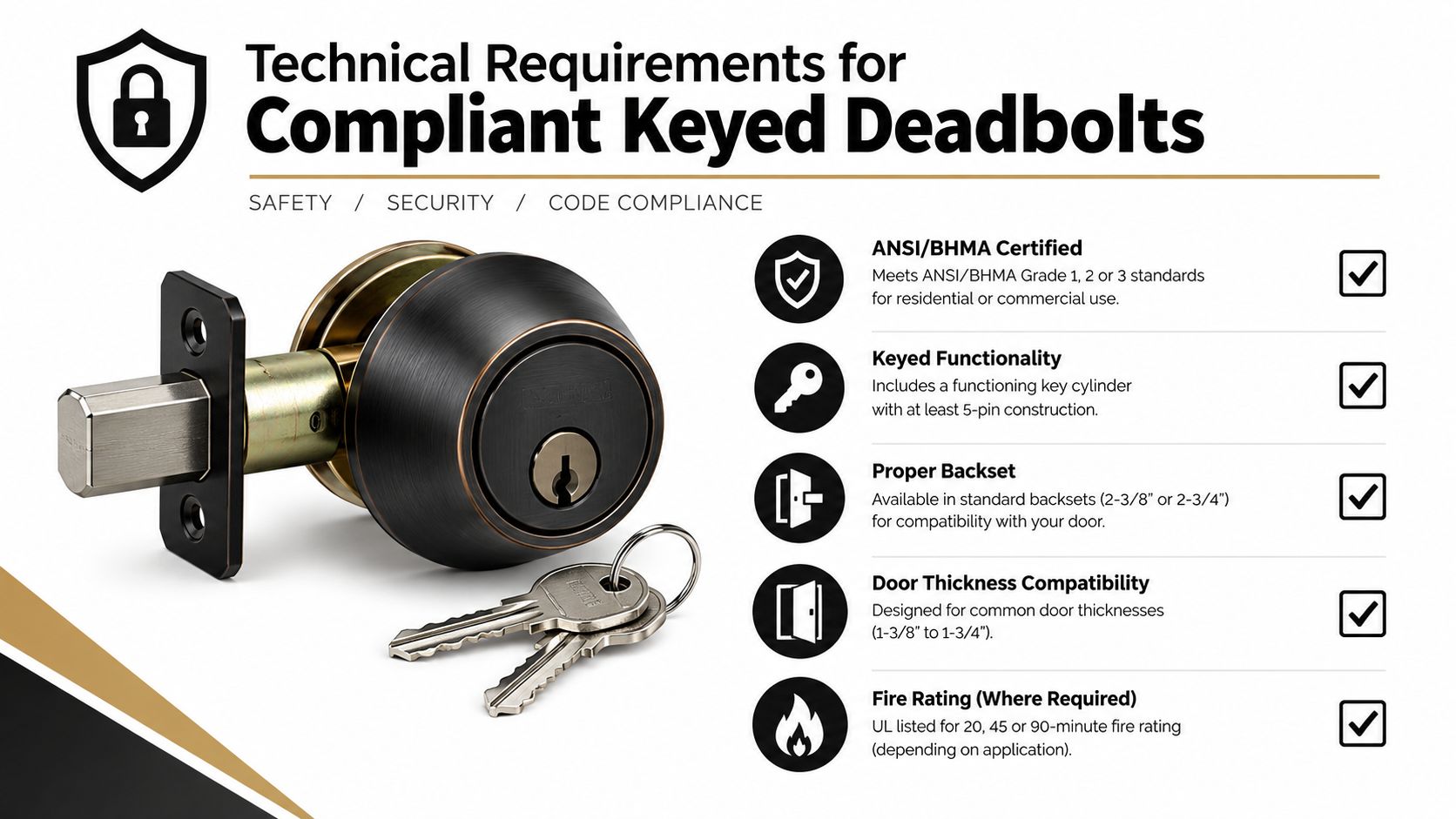
Texas doesn't measure compliance by appearance. Subchapter D establishes specific requirements for keyed deadbolts, and those requirements determine whether the device is legally adequate before a tenant relies on Section 92.164.
Check the deadbolt height
For a keyed deadbolt or keyless bolting device installed on or after September 1, 1993, the device must be at least 36 inches from the floor and no more than 48 inches from the floor. The statutory height range is designed to create a consistent placement standard and avoid installations that are difficult to operate or vulnerable because of poor positioning. See the Texas security-device statute for the statutory framework.
Measure from the floor to the relevant part of the device, and document the measurement with a photograph. Don't rely on a leasing advertisement, a maintenance note, or a verbal assurance that the lock is compliant.
Inspect the bolt and strike plate
The bolt must have at least a one-inch throw. In plain English, the bolt needs to extend far enough into the doorjamb to provide meaningful resistance. A decorative deadbolt with a shallow bolt may look secure but fail to provide the protection the statute expects.
The strike plate must be screwed into the face of the doorjamb, or the door must use a metal doorjamb. This connection matters because the strike plate transfers force from the bolt into the frame. A plate attached poorly, or only to weak trim, can pull away when someone applies pressure to the door.
The Texas keyed deadbolt installation requirements explain these technical details and why tenants should examine the complete assembly, not just the lock cylinder. If your rental has a modern metal entry door, information about modern metal front door insights may also help you understand how the door material and frame interact with the locking hardware.
Document the defect before touching it
Take clear photographs of the lock, bolt, strike plate, screws, doorjamb, and measurement. Record whether the bolt extends fully when the door is closed. If the door won't align with the strike plate, note that condition in writing.
Don't replace the device immediately unless you understand the remedy you may use and the notice requirements that come first. A locksmith's invoice can support a reasonable-cost deduction, but an unsupported rent deduction can create an avoidable dispute.
The Statutory Exception for Multiple Exterior Doors
Tenants often hear that every exterior door must have a keyed deadbolt. That isn't always the rule. Texas law includes a specific arrangement for properties with multiple exterior doors, and both sides should check the exception before demanding or installing additional hardware.
The ordinary baseline calls for a doorknob lock or keyed dead bolt on each exterior door, along with a keyless bolting device and door viewer on each exterior door. But the statutory arrangement can be satisfied when one normal entry door has both a keyed deadbolt and a keyless bolting device, while the remaining exterior doors have keyless bolting devices.
That distinction matters in homes with a front entrance, rear entrance, side door, or other exterior access point. A tenant might see a keyless device on the back door and assume the landlord violated the law. If the main normal entry door has the required combination and the other doors have the required keyless devices, the tenant may not be entitled to demand another keyed deadbolt solely because the other door lacks one.
Apply the exception to the actual doors
Start with the property layout. Identify which door functions as the normal entry door. Then inspect whether that door has both a keyed deadbolt and a keyless bolting device. Finally, check whether the remaining exterior doors have functioning keyless devices.
The exception doesn't excuse a defective device. A keyless bolt that doesn't engage, a missing door viewer, or a main entry deadbolt that fails the technical requirements can still create a compliance problem. The landlord must evaluate the entire security-device setup, not point to the existence of one lock.
A lock arrangement is compliant only when the required combination is present and operable.
For landlords, this exception can prevent unnecessary installations, but it shouldn't become a shortcut around inspection. For tenants, it prevents an overbroad demand that may weaken an otherwise valid claim. If you're uncertain, photograph every exterior door and describe each device separately in your written notice.
The safest approach is precise language. State which door lacks which device, identify whether the concern is absence, damage, improper operation, height, bolt throw, or strike-plate anchoring, and ask the landlord to confirm how the property satisfies the statutory arrangement.
How to Deliver Proper Written Notice to Your Landlord
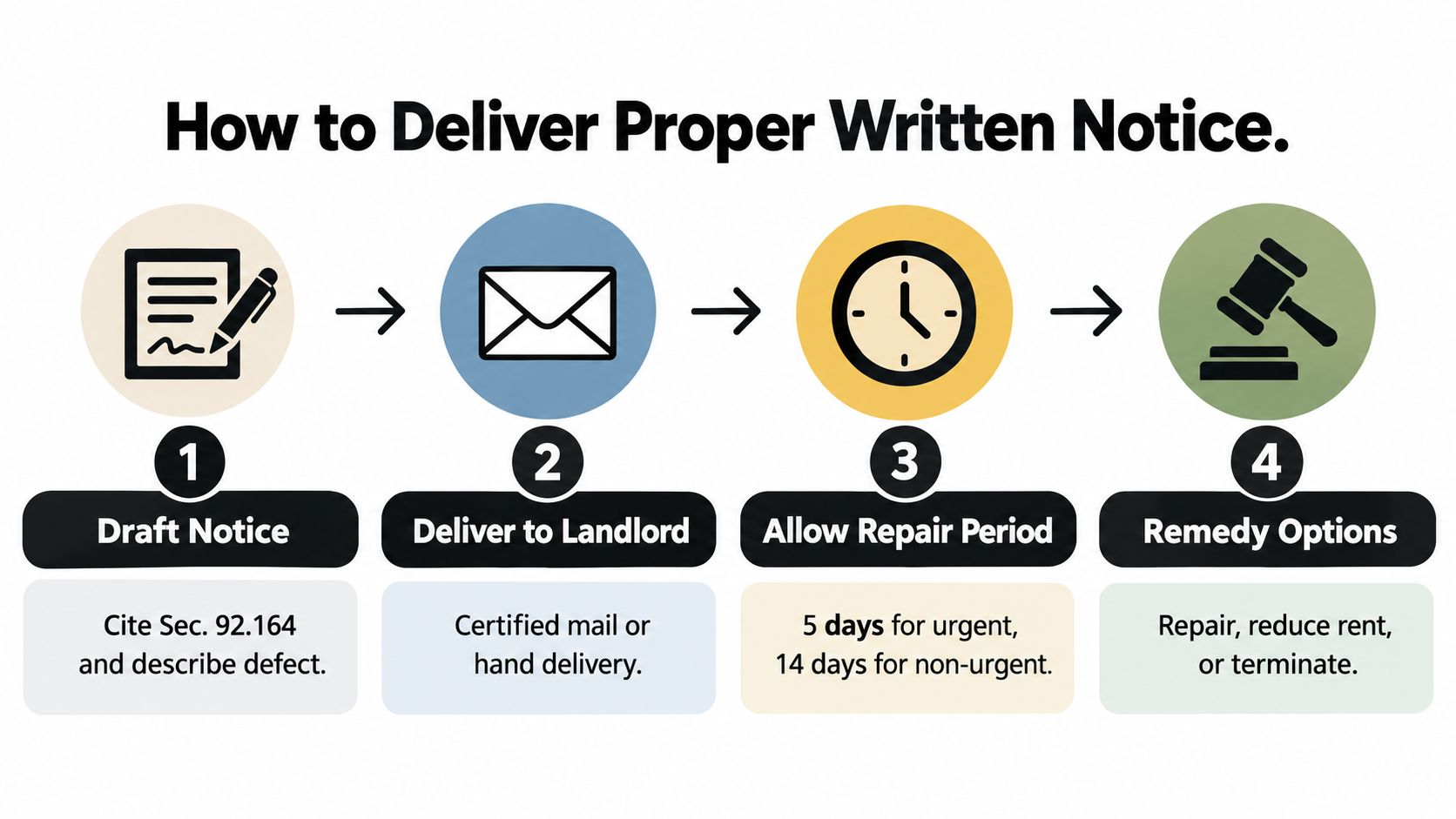
Section 92.164 depends on notice. A phone call to a leasing agent may alert someone to the problem, but it can be difficult to prove later. Use a written request that identifies the security defect and preserves evidence of when the landlord received it.
Build a useful notice
Your notice should include:
- The property address and unit number. Make clear which rental home is affected.
- A description of the defect. State whether the keyed deadbolt is missing, broken, improperly positioned, short in throw, or attached to an inadequate strike plate.
- A reference to Section 92.164. Tell the landlord that you're requesting installation, repair, or rekeying of a required security device.
- A request for prompt compliance. The statute generally gives the landlord three days after a written request before a tenant may pursue unilateral lease termination under the described remedy. Confirm the deadline based on the exact facts and delivery method.
- A request for written confirmation. Ask the landlord to state when a qualified person will inspect or repair the device.
The notice should be factual, not threatening. Avoid exaggerating the condition or accusing the landlord of criminal conduct. A clear record helps a Texas landlord tenant lawyer, court, or property manager understand exactly what happened.
This overview of Texas Landlord-Tenant Law explains how Texas Property Code Chapters 91 through 94 and Chapter 24 govern the rental relationship.
Deliver it in a provable way
Send the notice through the method required by your lease and any method that creates reliable proof of delivery. Certified mail can establish mailing and delivery records. Hand delivery can work if you obtain a signed acknowledgment. If you use an electronic resident portal or email, save the submission confirmation, the full message, photographs, and any reply.
Keep copies outside the tenant portal if possible. Save the lease, inspection report, photographs, videos, locksmith evaluation, and every response in one folder. Write down the date and time you discovered the defect and the date and time you sent notice.
The notice process is not a substitute for emergency protection. If the door cannot be secured and you face an immediate safety threat, use reasonable temporary measures and contact appropriate emergency services or a qualified locksmith. Avoid making permanent changes without documenting the condition and understanding how the expense will be handled.
The following video may help you organize the practical notice process:
Don't assume that a general repair timeline controls a Section 92.164 security-device request. The statute's three-day compliance period is central to the remedy described here, and a lawyer should review the timing before you terminate a lease or deduct a cost.
Evaluating Your Legal Remedies Under Section 92.164
If the landlord doesn't install or rekey the required device after proper written notice, Section 92.164 gives you several possible courses of action. The right choice depends on the defect, your need to remain in the home, the cost of correction, and your ability to prove compliance with the notice process.
| Remedy Option | How It Works | Best Used When |
|---|---|---|
| Repair or rekey and deduct | You arrange for the device to be installed or rekeyed and deduct the reasonable cost from rent, while preserving the invoice and receipt. | The problem is specific, a qualified professional can correct it, and you want to remain in the property. |
| Lease termination | After a written request and the landlord's failure to comply within three days, you may have a path to terminate without court proceedings. | The security failure is serious enough that remaining in the home no longer makes sense. |
| File suit | You may seek actual damages, court costs, attorney's fees, and, through the applicable judicial remedy, a civil penalty equal to one month's rent plus $500. | The landlord disputes the violation, refuses to act, or the defect caused measurable loss. |
Repair and deduct requires discipline
Repair and deduct may be practical when a locksmith can correct the issue quickly. Obtain a written estimate or invoice that identifies the work performed and the device involved. Use a qualified professional, pay the reasonable amount, and provide the landlord with the relevant documentation.
Don't deduct an inflated amount, unrelated expenses, or a full rent payment without a legal basis. A landlord may challenge the deduction, and the tenant must be prepared to show the original defect, written notice, delivery, failure to comply, and reasonable cost.
Termination carries its own risks
Lease termination can be the cleanest solution when the home cannot be secured, but don't treat it as an informal move-out. Send the required written notice, keep proof of delivery, identify the statutory basis, and document the condition when you leave. Return keys and preserve evidence of the date possession ended.
If the landlord claims that the lock arrangement falls within the multiple-door exception, the dispute may turn on measurements, photographs, and the actual condition of each device. A Texas tenant-rights lawyer can assess the evidence before you make a decision that affects housing and potential liability.
Litigation can recover more than the repair bill
A lawsuit may seek actual damages and statutory relief when the landlord fails to meet the security-device obligations. The civil penalty described by Section 92.164 is one month's rent plus $500, in addition to the other relief authorized by the statute. You should connect each requested amount to documented loss and preserve court-related records.
Don't confuse an illegal lockout with a defective deadbolt claim. A separate discussion of illegal lockout remedies under Texas law addresses a landlord's unlawful exclusion of a residential tenant.
Why Landlords Cannot Waive Your Security Rights
A lease clause cannot erase Texas security-device duties. Section 92.006 states that a landlord's duty and a tenant's remedy concerning security devices may not be waived. That rule prevents a landlord from shifting a statutory installation obligation onto the tenant through fine print.
A clause saying that the tenant accepts the locks “as is” doesn't automatically excuse a missing or noncompliant device. Nor does a provision requiring the tenant to pay for the landlord's required initial installation override the statutory duty. The parties can still agree on many lease terms, but they can't contract away these security protections.
What this means for tenants
Read the lease, but don't assume every clause is enforceable. If the agreement tries to make you surrender the right to required security devices, save a copy and raise the issue in writing. You don't need to argue about the clause at the front door. Identify the defect, send notice, and keep your records.
A landlord's refusal to recognize the statute is a signal to get advice. Contact a Texas landlord tenant lawyer when the landlord threatens eviction, rejects a properly documented request, demands that you pay for a required device, or insists that a waiver defeats your rights.
What this means for landlords
Landlords and property managers should audit their standard leases and inspection procedures. Train staff to record the location and condition of deadbolts, keyless devices, door viewers, strike plates, and doorjambs. A repair policy should route security-device requests quickly because the statutory timeline can be shorter than ordinary maintenance scheduling.
For landlords: Compliance is cheaper and clearer when the property record shows what was installed, where it was installed, and how the device was tested.
The statute makes these requirements durable parts of Texas residential housing law. A lease can allocate responsibilities for tenant-caused damage, but it can't remove the landlord's required security-device duties or the tenant's statutory remedies.
Taking the Next Step to Protect Your Rights
The central lesson is simple. A keyed deadbolt must be evaluated as a complete security assembly, including its height, bolt throw, strike plate, and doorjamb connection. A property can have a lock and still have a statutory problem.
If you're a tenant, photograph the condition, measure the device, send a precise written request, and preserve proof of delivery. Don't stop paying rent casually, don't terminate without documenting the statutory steps, and don't let a lease clause convince you that safety rights are negotiable. If the landlord responds with an eviction threat or refuses to repair, seek legal advice promptly.
Landlords should inspect before a tenant complains. Confirm that the property meets the applicable arrangement for exterior doors, that each device operates correctly, and that staff understand how to escalate a security request. A written inspection record can resolve misunderstandings before they become a lease dispute.
The Law Office of Bryan Fagan, PLLC assists Texas tenants and landlords with repairs, lease disputes, evictions, security deposits, retaliation claims, and property-rights questions. A free consultation can help you evaluate the evidence, understand your options, and choose a practical next step.
If your keyed deadbolt is missing, defective, improperly installed, or not rekeyed as required, The Law Office of Bryan Fagan, PLLC can review your notice, lease, photographs, and potential remedies. Visit The Law Office of Bryan Fagan, PLLC to schedule a free consultation and get clear guidance about protecting your home and your rights.