If your landlord locks you out unlawfully in Texas, you may recover possession of the home or terminate the lease, plus a civil penalty of one month's rent plus $1,000, actual damages, court costs, and reasonable attorney's fees, reduced by any delinquent rent you owe. If the landlord also refuses to give you a key after a lockout, there may be an additional one-month-rent penalty.
You get home after work, still upset from an argument about repairs or late rent, and your key suddenly doesn't work. Maybe your child's medicine is inside. Maybe your work laptop is on the kitchen table. Maybe the landlord is texting that you can come back only after you pay. That situation feels chaotic, but Texas law treats it as a specific legal problem with a specific remedy.
For tenants, that means you may have a fast path back inside and a real damages claim under the Texas Property Code. For landlords and property managers, it means a bad decision made in frustration can turn into a costly lawsuit quickly. The practical issue in most cases isn't whether lockouts are “wrong” in the abstract. It's whether the facts fit Texas Property Code § 92.0081, what proof exists, how rent offsets work, and how to calculate the claim in a way a court will use.
This article focuses on the math behind the illegal lockout remedy Texas 92.0081 tenant damages issue, because that's where many readers get stuck.
When a Lockout Crosses the Line in Texas
A common fact pattern looks like this. A tenant is behind on rent, has also been complaining about mold or a broken air conditioner, and comes home to changed locks after a heated exchange with management. In that situation, the tenant's legal claim usually centers on Texas Property Code § 92.0081, which allows the tenant to seek possession back or end the lease and pursue the statutory remedy package described in the opening. If you're dealing with that problem, this overview of Texas landlord lockout rules gives additional context about how these disputes are framed.
What pushes a dispute into illegal lockout territory
Not every entry dispute is the same. The legal line is crossed when a landlord intentionally keeps a residential tenant out without proper legal authority. In practice, that can include acts like these:
- Changing the locks and blocking normal entry
- Removing doors, locks, or similar hardware to force the tenant out
- Cutting off access in a way that makes the unit unusable
- Refusing to return a key after the tenant demands reentry
The point is simple. A landlord doesn't get to use self-help as a shortcut because the tenant owes money, argued with staff, or complained about conditions.
Practical rule: If the landlord is using exclusion as pressure instead of using court process, the case often moves toward a lockout claim.
Why the details matter
That said, Texas law does recognize narrow exceptions in some lock-change situations. Repairs, emergencies, abandoned property, and certain rent-delinquency lock changes can change the analysis if the landlord follows strict rules. That's why these cases are very fact-specific.
What works in court is careful proof. What doesn't work is broad language like “they basically evicted me” without photos, messages, dates, and a clear timeline. Tenants often need speed. Landlords often need to show they stayed inside the statute. Both sides are usually better served by documentation than by arguing from memory.
What Texas Property Code 92.0081 Actually Says
Texas Property Code § 92.0081 gives residential tenants a concrete civil remedy when a landlord unlawfully excludes them. The statute allows the tenant to recover possession of the premises or terminate the lease, and also recover a civil penalty equal to one month's rent plus $1,000, plus actual damages, court costs, and reasonable attorney's fees, reduced by delinquent rent or other sums owed under Texas Property Code § 92.0081.
Plain-English reading of the rule
In ordinary language, the statute says a landlord can't intentionally keep a residential tenant out unless the landlord has legal authority or fits within a narrow exception recognized by Texas law. This isn't just about deadbolts. It covers conduct that blocks access in substance, not just in form.
The reason readers get confused is that Texas does allow some lock changes in limited rent-delinquency situations if strict procedures are followed. But those situations are not the same as an eviction, and they do not let a landlord permanently exclude a tenant at will.
What §92.0081 allows and prohibits
| Lawful Conduct | Illegal Lockout Conduct |
|---|---|
| Using court process to remove a tenant after obtaining the proper order | Changing locks to force move-out without proper legal authority |
| Temporary access restrictions for bona fide repairs, construction, or emergencies when the facts actually support that reason | Removing doors, hardware, or appliances to pressure the tenant to leave |
| Handling abandonment or holdover issues under the correct rules. For related issues, see Abandoned Property and Holdover Tenancies in Texas for how Texas handles tenant property left behind and holdover situations | Refusing to provide a key after a lock change when the law requires reentry access |
A lockout case is usually a civil problem first, not a criminal one. The question is whether the landlord complied with the Texas Property Code, not whether the police will arrest someone at the door.
One more point matters. Texas materials discussing lockouts note that if a landlord refuses to provide a key after a lockout, an additional civil penalty of one month's rent may apply under TexasLawHelp's lockout guidance. That extra penalty is often missed by both tenants and landlords.
Breaking Down the Damages You Can Recover
The biggest mistake people make is treating § 92.0081 like a single fine. It isn't. It's a package of remedies, and each part works differently.
The statutory amount
The baseline civil penalty is one month's rent plus $1,000. Texas also treats unlawful lockouts as a distinct statutory wrong with a predictable remedy structure rather than leaving tenants only to general contract or tort theories, which is part of why these cases have real settlement value under the Texas lockout framework summarized with related statutory context.
That amount matters because it creates a floor. Even before you start adding actual losses, fees, and costs, the claim has a concrete statutory anchor.
Actual damages and proof
Actual damages depend on what the tenant lost because of the exclusion. In real cases, tenants often claim things like:
- Hotel or temporary lodging costs
- Locksmith or replacement key expenses
- Spoiled food or property loss
- Missed work and related out-of-pocket losses
- Storage or emergency moving costs
Courts usually want simple proof. Bring receipts, screenshots, bank statements, text messages, photos, and a short written timeline. If an item was paid in cash, document when, to whom, and why.
| Damage Category | How It Is Calculated | Reduced by Rent Owed? |
|---|---|---|
| Civil penalty | One month's rent plus $1,000 | Yes |
| Actual damages | Proven out-of-pocket losses caused by the lockout | Yes |
| Court costs | Filing and court-related costs awarded by statute | Yes |
| Attorney's fees | Reasonable fees allowed by statute | Yes |
How offsets change the final number
The statute doesn't ignore unpaid rent. Recovery is reduced by any delinquent rent or other sums the tenant owes. That offset rule is what makes calculation so important.
Here is the practical takeaway. A tenant can still have a valid lockout claim even if rent is owed. But the unpaid amount will affect the bottom-line judgment. Texas materials also emphasize this math problem and the extra penalty issue when a key is withheld, which is why careful calculation matters under the related discussion of lockout remedies and offsets.
How to Get Back Into Your Home Fast
If you're standing outside your apartment with no access, damages aren't your first problem. Reentry is.
Texas treats unlawful exclusion as a fast-moving justice court issue. A tenant can seek a writ of re-entry from the justice court in the precinct where the rental property is located, and the process can move quickly, sometimes the same day, according to TexasLawHelp's disaster manual section on landlord-tenant issues. If you need a practical companion guide, this article on what to do if your landlord changed locks without notice in Texas addresses the same emergency from a tenant's point of view.
A simple visual can help if you're trying to act fast.
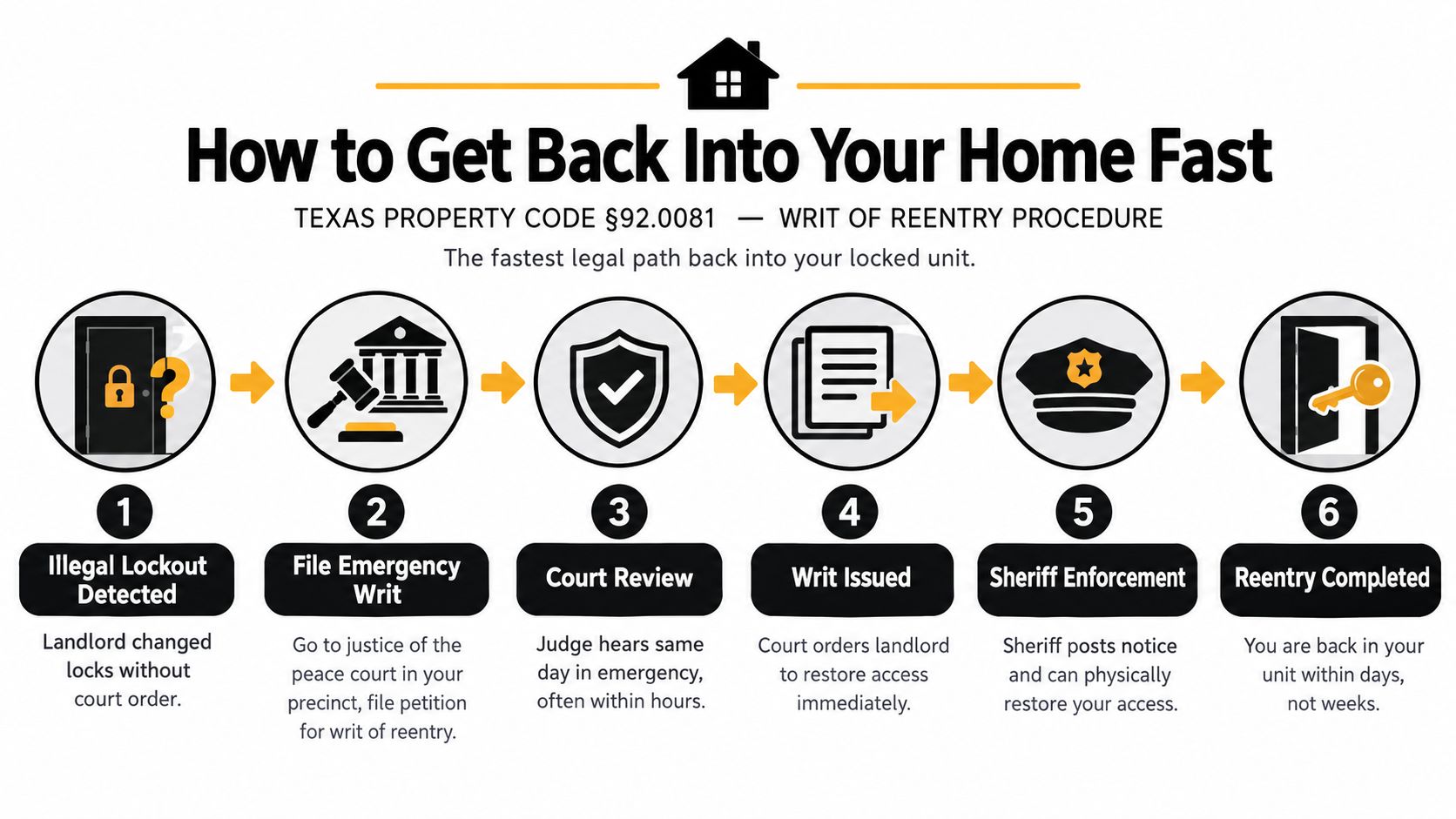
What to bring to court
Go to the justice of the peace court for the precinct where the property sits. Bring what proves three things: you live there, you were excluded, and the landlord did it.
- Your lease or rental agreement
- A photo ID
- Screenshots of texts, emails, or portal messages
- Photos of changed locks, posted notices, or blocked doors
- Proof of rent payments or payment history
- Any witness contact information
The best filing is usually the simplest one. Show the court that you have a right to occupy the unit and that someone intentionally shut you out.
This video gives a general visual primer on the process and timing issues people run into.
What happens next
If the judge believes the lockout was unlawful, the court can issue a writ directing reentry. Service and enforcement are typically handled by a constable or sheriff. That gets you focused on access first.
A separate damages claim may still be necessary after reentry. Restoring possession doesn't automatically resolve money damages, offsets, or attorney's fees. It just stops the immediate harm.
Real Scenarios Tenants and Landlords Face
The easiest way to understand these cases is to run the numbers.
Scenario A with straightforward math
A Houston tenant pays $1,400 per month. She complains about mold, argues with management, and comes home to changed locks. She files quickly, gets back in, and proves the lockout was unlawful.
Her baseline statutory amount is easy to calculate:
- One month's rent: $1,400
- Fixed statutory amount: $1,000
- Baseline civil penalty total: $2,400
If she also proves hotel costs, spoiled groceries, locksmith charges, and lost work time as actual damages, those are added. Then the court subtracts any delinquent rent she owed.
Scenario B with the extra key issue
A San Antonio landlord changes the locks after the tenant falls behind. The landlord assumes late rent gives the right to keep the tenant out until payment is made. That assumption creates the biggest risk in these cases.
If the landlord then refuses to provide a key after the tenant demands reentry, the claim may include an additional one month's rent penalty on top of the baseline package. That extra month is what often changes a “manageable” dispute into one that makes settlement much harder.
| Damage Category | Scenario A Houston Tenant | Scenario B San Antonio Landlord's Loss |
|---|---|---|
| Baseline civil penalty | One month's rent plus $1,000 | One month's rent plus $1,000 |
| Actual damages | Added if proved with receipts and records | Added if the tenant proves out-of-pocket losses |
| Extra penalty for refusing key | Not triggered if key was provided as required | May add one more month's rent if the key was refused |
| Offset for rent owed | Any delinquent rent reduces recovery | Any delinquent rent still reduces recovery |
| Attorney's fees and costs | Can materially increase the final judgment | Can materially increase the final judgment |
Many landlords focus only on the back rent. Courts often focus on the method used to regain control of the property.
These examples are why the illegal lockout remedy Texas 92.0081 tenant damages issue is really a math-and-proof problem, not just an emotions problem.
Evidence That Strengthens Your Case
Good lockout cases are built in the first day or two. Weak ones are built from memory weeks later.
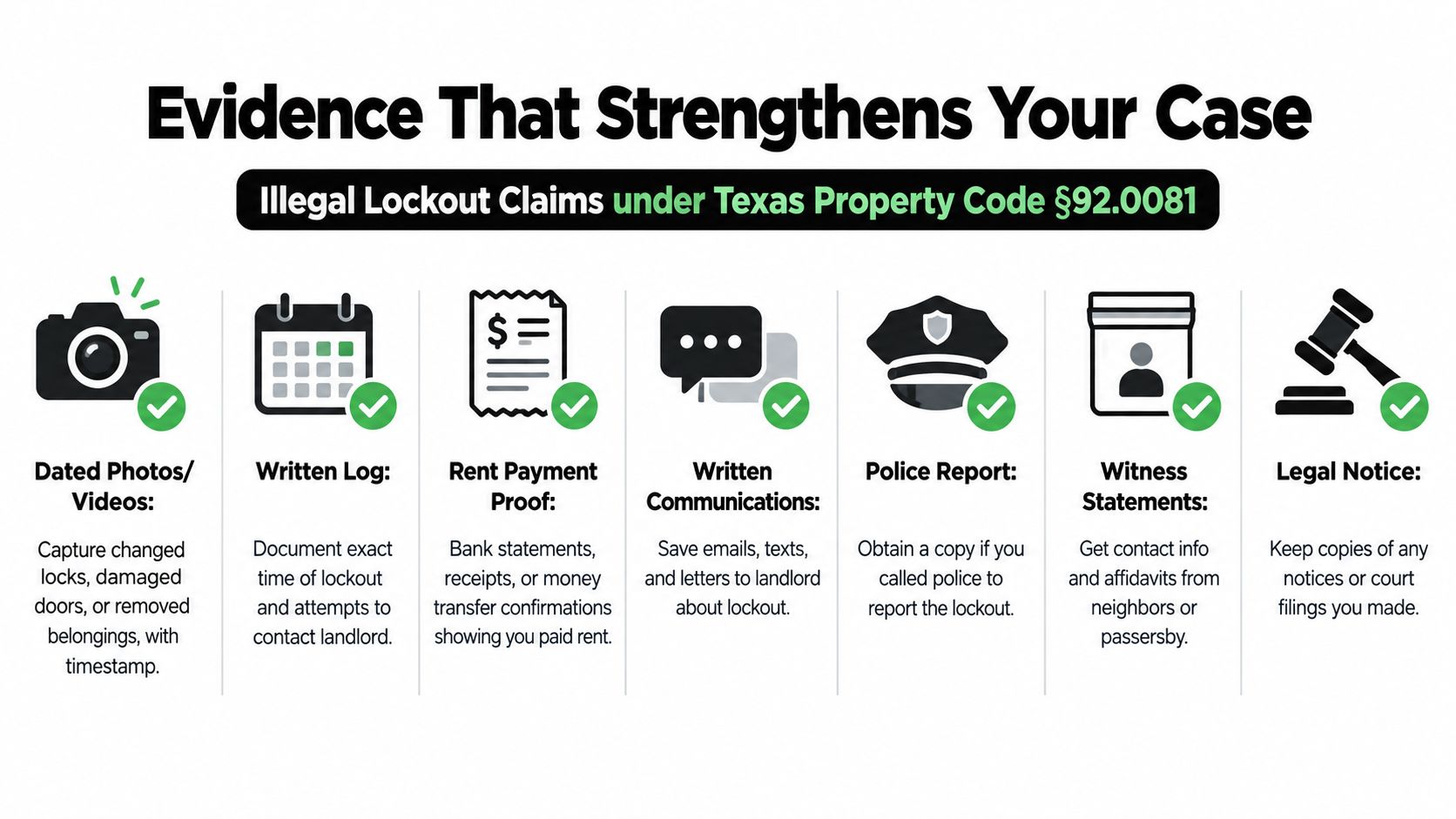
Start with the proof that disappears fastest
Take photos and video of the lock, the front door, any posted notice, and anything removed or damaged. Save screenshots of every text, email, and portal message. Back those screenshots up somewhere other than your phone.
Then gather occupancy proof and payment proof:
- Lease documents that show you're an authorized occupant
- Rent receipts or bank records showing what was paid
- Messages discussing late rent, repairs, or move-out pressure
- Photos of belongings still inside or disturbed
- Receipts for hotel stays, food, childcare, or transportation caused by the lockout
Build a short timeline
Write down the events while they're fresh. Include dates, times, who you spoke with, what they said, and when you asked for reentry or a key. Keep it plain. Courts like clear timelines more than dramatic ones.
If police came to the property, ask for the report or incident number. If utilities were affected, request records showing when service changed. If a neighbor or maintenance worker saw what happened, get a name and contact number before memory fades.
Keep it simple: a judge should be able to understand your lockout story by reading your timeline and looking at five to ten core documents.
Common Misconceptions That Cost Landlords
Some lockout cases begin with bad legal advice. Others begin with a landlord saying, “I thought I could do that.” Texas law is less forgiving than many people expect.
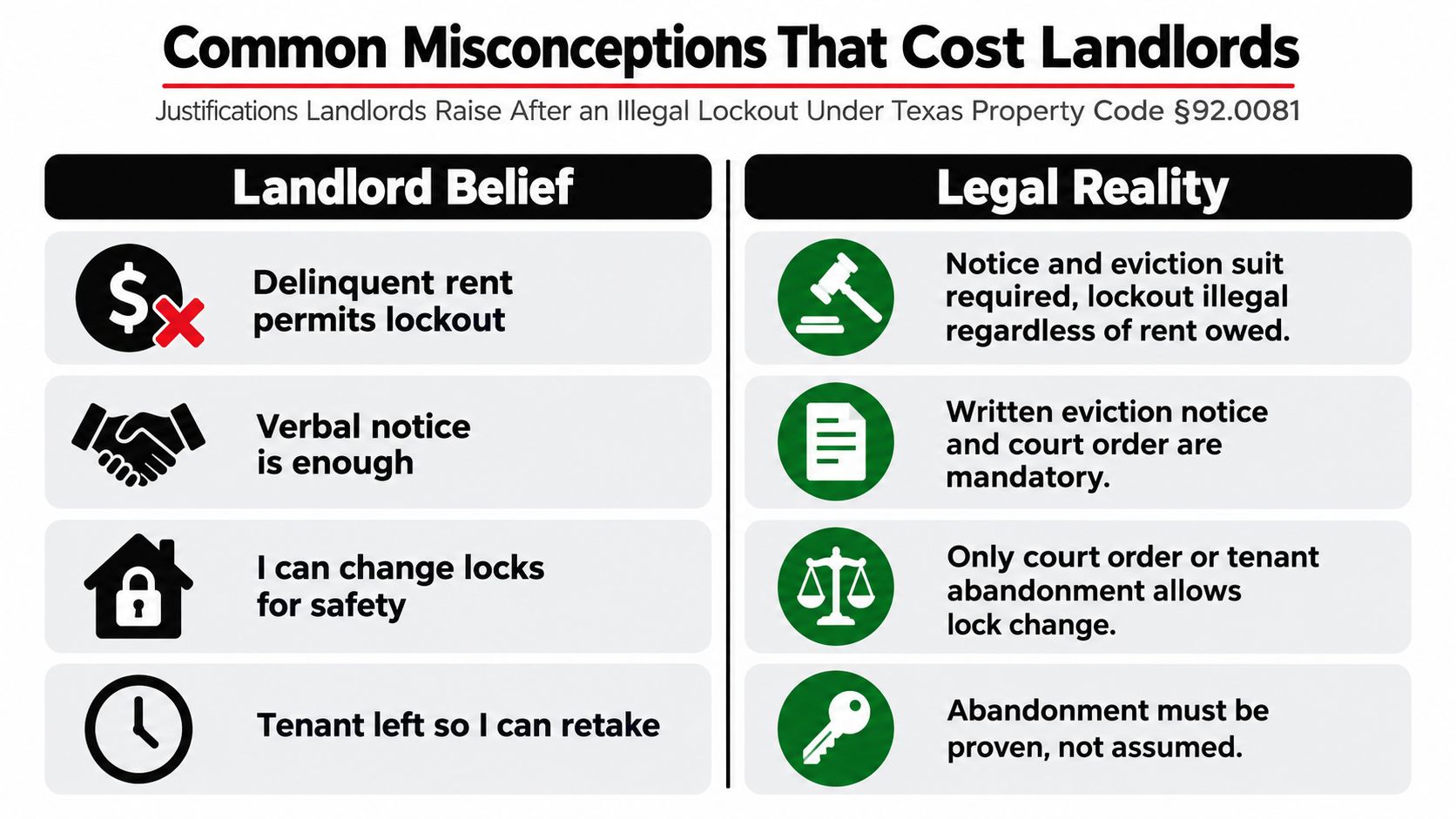
The usual bad assumptions
These are the ones that show up over and over:
- “They owe rent, so I can lock them out until they pay.” Owing rent does not create a free pass for self-help exclusion.
- “It was temporary, not an eviction.” Temporary pressure can still be an unlawful lockout.
- “I gave verbal notice.” Verbal warnings usually don't solve statutory compliance problems.
- “I kept the deposit, so I'm covered.” A security deposit dispute does not authorize exclusion from the unit.
- “I posted a notice to vacate.” A notice to vacate is not the same thing as a writ of possession.
Why self-help is usually a strategic mistake
Texas has long treated unlawful residential lockouts as a separate statutory wrong instead of forcing tenants to rely only on contract or tort theories. That design matters because the remedy is concrete and the reentry process is available before a full damages trial, as reflected in Texas Property Code discussions tied to the unlawful exclusion framework.
For landlords, the lesson is practical. Even if the tenant owes money, using the wrong method can hand the tenant a statutory claim with fees attached. For tenants, the lesson is to preserve every excuse the landlord gives. Save texts. Save voicemails. Ask for written explanations. The landlord's own words often become key evidence.
Get Help Protecting Your Rights Today
Timing decides many lockout cases. Waiting too long can make reentry harder, documents harder to collect, and witnesses harder to pin down. If you're dealing with an urgent exclusion problem, this guide on illegal eviction in Texas and what tenants should do is a useful place to start.
What to gather before you make the call
Before you speak with a Texas landlord tenant lawyer or eviction attorney, pull together the file that matters most:
- Your lease and any renewals
- Rent receipts, bank records, or payment screenshots
- Texts, emails, notices, and portal messages
- Photos of the changed lock, door, or unit condition
- A timeline of the lockout and your reentry requests
If you're a landlord, gather the lease, notices, payment ledger, and any written explanation for the lock change. Fast legal review matters on both sides because these cases move quickly and often turn on small procedural details.
When legal help changes the outcome
Some disputes can be resolved through immediate demand letters and reentry coordination. Others need a writ filing, a damages suit, or both. The Law Office of Bryan Fagan, PLLC helps Texans evaluate landlord-tenant disputes, including lockouts, lease enforcement, and related tenant rights claims under the Texas Property Code.
If you need help with an eviction, lease issue, or rental dispute, contact The Law Office of Bryan Fagan, PLLC for a free consultation today.
If you're facing a lockout, need to calculate damages under § 92.0081, or want to respond before a small dispute becomes a lawsuit, The Law Office of Bryan Fagan, PLLC offers practical guidance for Texas tenants and landlords dealing with rental conflicts. Bring your lease, payment records, lockout messages, and photos to the consultation so the legal analysis can start right away.