
Dealing with an eviction notice in Austin can leave you staring at a paper taped to your door, wondering whether you have days or weeks to respond. A landlord may be looking at months of unpaid rent and trying to recover possession before the property problem grows. In both situations, the first notice and the next filing deadline can shape the entire case.
Austin's eviction system is moving at record volume. Travis County recorded 13,210 eviction filings in 2024, a 26% increase from 2023, according to local reporting tied to Eviction Lab and city records. Austin later reported 15,092 filings from 2024 to 2025, affecting about one in every twenty renter households. That pace leaves little room for an incorrect notice, a missed answer date, or a delayed appeal.
Whether you need an eviction lawyer in Austin, TX, a Texas landlord tenant lawyer, or an eviction attorney to defend your tenant rights, treat the matter as urgent. Texas procedure is technical, and Travis County cases can move before an unrepresented party understands what happened.
When to Call an Eviction Lawyer in Austin
A South Lamar landlord discovers that a tenant hasn't paid rent for three months. The landlord wants to file immediately. Across town, a tenant comes home to find a notice taped to the door and assumes there's time to think about it. Both people are at the point where legal advice matters most.
The deadline that usually controls the case is the notice to vacate. Under Texas Property Code Section 24.005, a landlord generally must give at least three days of written notice before filing an eviction case, unless the lease provides a different period. The clock starts when the notice is delivered, not when the recipient finally reads it. Texas justice court guidance also recognizes that cases generally belong in the precinct where the rental property sits, and that notice may be delivered through permitted personal or mail methods, as explained by Texas justice court eviction filing guidance.
That sounds simple. It isn't. The lease may change the notice period. The delivery method may not comply with the lease or statute. The notice may identify the wrong tenant, property, amount, or deadline. A landlord who files too soon can face dismissal. A tenant who ignores a defective-looking notice may still lose the chance to raise the issue properly.
What to do during the notice period
If you're a landlord, have counsel review the lease, rent ledger, notice language, and delivery proof before filing. If you're a tenant, preserve the envelope, photograph the notice where you found it, and write down the date and time you received it.
Practical rule: Call before the notice period expires. Once a petition, citation, or judgment enters the picture, your options become narrower and your response must be faster.
An attorney can identify notice defects, evaluate payment records, preserve defenses, and determine whether settlement is more practical than litigation. A tenant may have defenses involving improper notice, retaliation, repairs, or habitability. A landlord may need help proving possession, rent owed, lease violations, and proper service.
For a broader explanation of when legal advice becomes useful, review when to hire a Texas rental lawyer for your dispute. You don't need to wait for a court date. An attorney is valuable whether you're filing the case or fighting it.
Why Austin Evictions Move Faster Than You Think
Austin's volume changes the practical meaning of every deadline. Eviction Lab's Austin tracker reports 15,683 filings, a 5% filing rate, and a 35% increase against its baseline in the most recent tracking period. The Austin eviction tracker measures filings against renter households and uses a 2023 to 2024 baseline, which makes it useful for spotting demand spikes and court pressure.
Separate reporting found that Austin-area landlords filed about 1,300 evictions in July 2025, compared with roughly 1,125 in July 2024. The same verified reporting noted 10,732 filings by August 2026, about 900 more than at the same point in 2025. Those figures show recurring volume, not an isolated surge.
The local pace also affects response time. Historical reporting has placed a typical Travis County eviction case at 20 days from filing to eviction, a timeline that leaves a tenant little time to find counsel, gather documents, negotiate, or appeal. The conclusion is straightforward. Austin eviction strategy depends on speed and procedural accuracy.
What the filing volume changes
A landlord can't assume a defective filing will be harmless because the tenant owes rent. A tenant can't assume the court will pause the case while the tenant looks for records. In a high-volume docket, the court relies on pleadings, service records, deadlines, and evidence presented at the proper time.
The comparison below is intentionally limited. The verified data provides Austin and Travis County figures, but it does not provide comparable average-day, docket-hearing, or notes data for Harris, Bexar, or Dallas Counties. Those fields should not be guessed.
| County | Avg. Days Filing to Judgment | Hearings per Docket | Notes |
|---|---|---|---|
| Travis County | Not provided in the verified data | Not provided in the verified data | Austin has high filing volume and historically compressed case timing |
| Harris County | Not provided in the verified data | Not provided in the verified data | No verified comparison supplied |
| Bexar County | Not provided in the verified data | Not provided in the verified data | No verified comparison supplied |
| Dallas County | Not provided in the verified data | Not provided in the verified data | No verified comparison supplied |
A party who receives a Justice of the Peace ruling should review Appealing a Texas Eviction Judgment promptly. An appeal is governed by short deadlines, and waiting for the court process to feel familiar can cost the time needed to protect possession.
Tenant and Landlord Triggers for Legal Help
The right time to call a lawyer is tied to a milestone, not to a level of panic. Landlords should seek advice before serving a notice to vacate, before filing the petition, and immediately after receiving an answer, jury request, repair counterclaim, or other response.
A landlord's file should answer basic questions before the case starts. What lease provision was violated? Which notice period applies? How was notice delivered? What does the payment ledger show? Does the tenant's repair history create a possible counterclaim? If a landlord waits until the hearing to ask those questions, counsel may have less room to correct the record.
Tenants should call the day they receive a notice, the moment a petition is served, and before the answer deadline. Under Texas Rule of Civil Procedure 510.6, the answer deadline is typically the Monday after the citation is posted or served, depending on the circumstances. Don't assume that paying part of the rent, sending a text, or explaining the situation informally counts as a proper court response.
Milestones that require immediate attention
- Before filing: A landlord should confirm venue, notice, lease terms, rent calculations, and service evidence.
- After service: A tenant should calendar the answer deadline, gather defenses, and decide whether to request a jury trial.
- After a response: A landlord should review counterclaims involving repairs, retaliation, habitability, or money damages.
- After judgment: A landlord may need counsel for a writ of possession under Texas Property Code Chapter 24. A tenant may need counsel to evaluate an appeal, possession bond, registry obligations, or other post-judgment relief.
- When property remains behind: Both sides should handle abandoned property and holdover issues carefully. Abandoned Property and Holdover Tenancies in Texas addresses how Texas treats belongings left behind and holdover situations.
A tenant's possible defense depends on evidence. A dated repair request, photographs, payment records, and communications may matter more than a general statement that the unit was unsafe. For repair disputes, the Texas Attorney General recommends a dated request delivered by certified mail, registered mail, or in person, while keeping a copy. The landlord is generally presumed to have a reasonable seven days to make the repair, subject to the facts, as described in the Texas Attorney General's renters' rights guidance.
Use this quick self-check. If the notice has been served, the petition has arrived, an answer date is approaching, a jury trial is being considered, or a judgment has already been entered, you're past the safe point for casual advice. Contact a Texas landlord tenant lawyer now.
Documents to Bring to Your Consultation
A lawyer can move faster when the file is complete. A landlord should bring the signed lease, every addendum, the full payment ledger, communications with the tenant, the original notice to vacate, proof of delivery, photographs, inspection records, and repair logs.
A tenant should bring the lease, rent receipts, bank records, repair requests, photographs or videos of property conditions, the notice received, the citation or petition, and documents supporting possible counterclaims. Don't delete texts or emails because they seem embarrassing or incomplete. A short message can help establish notice, timing, payment, or the condition of the property.
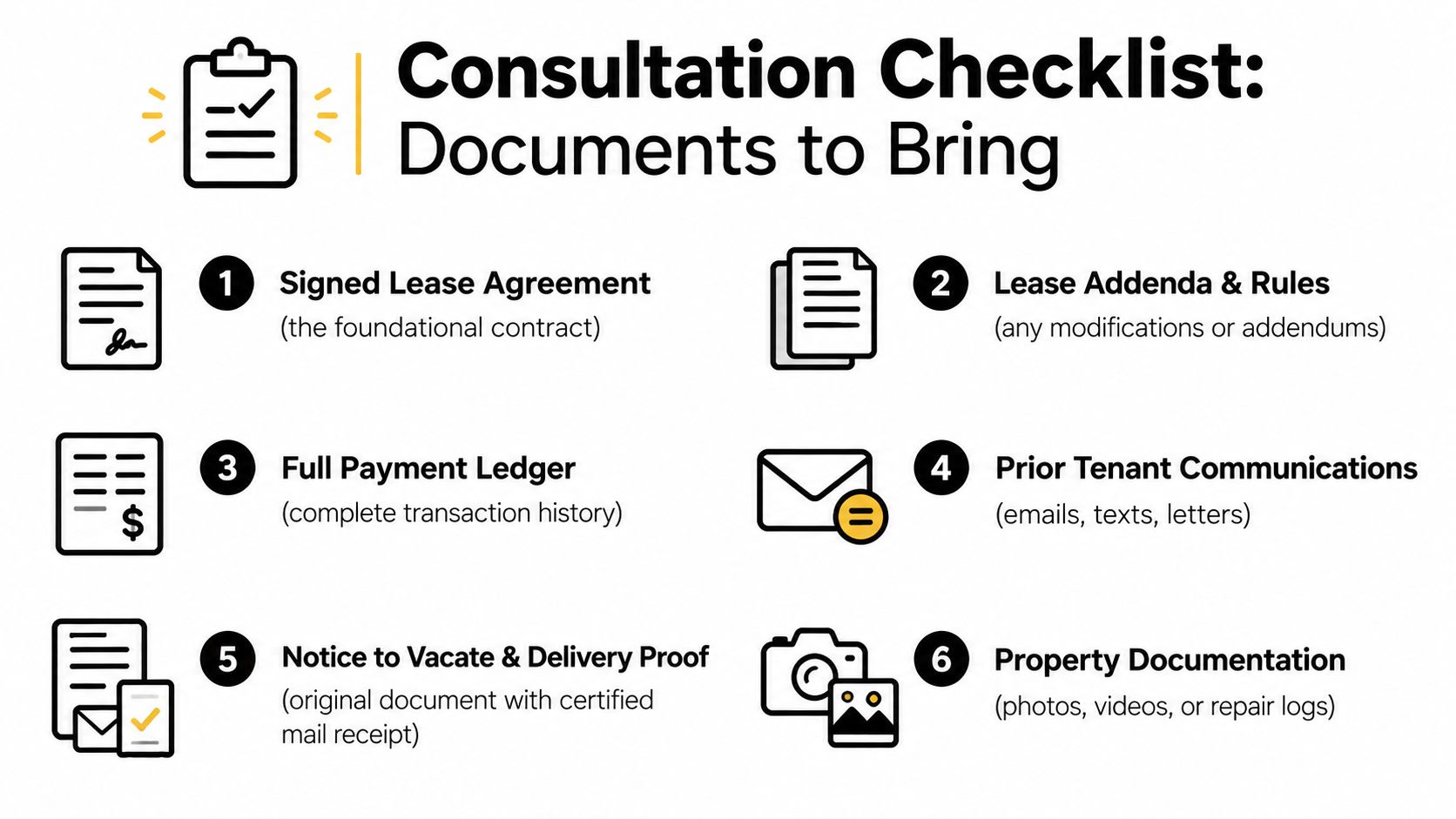
Use this preparation checklist
Before the consultation, confirm that the:
- Lease is signed: Include the complete agreement, not only the signature page.
- Ledger is current: Show charges, payments, credits, late fees, and the balance claimed.
- Notice is preserved: Bring the original document and delivery evidence.
- Communications remain available: Export or print important emails, texts, letters, and portal messages.
- Condition evidence is organized: Label photographs, videos, inspection reports, and repair records by date.
- Court papers are complete: Include the citation, petition, answer, judgment, and any appeal documents.
For tenants, documenting the case before the first hearing can protect tenant documentation for Texas eviction defense. For landlords, organized records help counsel identify missing proof before filing rather than after a judge asks for it.
A missing notice, incomplete ledger, or unclear service record can force a rushed investigation in a Travis County case. The practical goal is simple: give the lawyer enough information to assess possession, money claims, defenses, and settlement options at the first meeting.
Fee Structures and What to Budget
Austin eviction fees depend on who is hiring counsel and how complicated the dispute becomes. Landlord filings are often handled through a flat-fee arrangement because a standard case follows a recognizable procedural path. Tenant defense is more often hourly because the lawyer may need to investigate repairs, retaliation, habitability, payment disputes, counterclaims, and trial issues.
The ranges below are the figures provided for this article's fee comparison. They are not a quote for a specific case.
| Fee Structure | Typical Cost Range | Best For |
|---|---|---|
| Landlord flat-fee filing | $400 to $800 | A standard possession filing with a relatively clear record |
| Added trial work | $200 to $500 | A case that proceeds beyond the basic filing stage |
| Tenant hourly defense | $200 to $400 per hour | Defenses or counterclaims requiring variable investigation and court work |
| Contingency arrangement | Not assigned a typical range | Certain habitability or security-deposit matters involving recoverable damages |
A flat fee gives a landlord more predictable budgeting, but the engagement letter may define what happens if the tenant answers, requests a jury, files counterclaims, or requires a trial. An hourly arrangement gives a tenant flexibility to use counsel for specific tasks, but costs can increase when the case becomes heavily contested.
Contingency work is uncommon in ordinary possession cases. It may be considered in a habitability or security-deposit dispute where the client seeks damages, but it isn't a standard way to fund an eviction defense or filing.
Questions to ask before signing
Ask whether the quoted fee includes drafting the notice, filing, service coordination, hearing preparation, trial, appeal, writ work, and court costs. Request a written engagement letter that separates court costs, filing fees, and attorney fees. Also ask what communication and document review the lawyer includes.
For tenants, don't wait to seek help because you assume you can't afford full representation. Ask whether counsel can review the notice, prepare an answer, assess an appeal, or advise on settlement. The important financial decision is often made before the first hearing, when a smaller scope of work may still preserve meaningful options.
Inside the Austin Eviction Court Timeline
An Austin eviction begins with the notice, but the case can move through several separate deadlines. Texas Property Code Chapter 24 governs the possession process, and Section 24.005 generally requires a three-day notice to vacate unless the lease changes the period.
If the tenant doesn't leave, the landlord files a forcible detainer case in the justice court precinct where the property is located. The court issues a citation and sets a hearing. The exact setting depends on the court and service, so no party should rely on an assumed date instead of reading the citation.

The deadlines after judgment
Texas law gives a tenant generally five days to appeal a possession judgment. A writ of possession cannot issue before the sixth day after judgment. If an appeal is requested, most tenants in nonpayment cases must deposit one month's rent into the justice court registry within five days, and a failure to make the required deposit can allow the writ process to continue. The Travis County Law Library's eviction appeal guidance explains these registry and appeal requirements.
After a writ issues, it must be served within five business days and executed only after a 24-hour notice window. These rules make the post-judgment period just as important as the hearing itself. A tenant who wants to appeal must act immediately. A landlord seeking possession must request and coordinate the writ correctly.
The sequence is therefore:
- Notice: The landlord serves the notice to vacate under the lease and Section 24.005.
- Filing: The landlord files in the proper justice court if possession isn't surrendered.
- Hearing: The parties present evidence on possession, lease violations, payment, notice, and defenses.
- Appeal: The losing party evaluates the five-day appeal period and any required bond or registry deposit.
- Writ: If legally available, the landlord requests the writ, which the constable serves and executes under the statutory notice rules.
Watch the timeline explanation below for a visual overview of the major stages.
A Texas eviction process guide can help organize the sequence, but it cannot replace reviewing the actual lease, citation, judgment, and docket. In Austin, counsel should track the case from the first notice date, because a missed calendar day can change possession rights.
What Happens After You Hire Counsel
After the consultation, an Austin eviction attorney should turn the facts into a controlled procedure. The first task is not automatically filing. Counsel reviews the lease, notice requirements, payment history, service evidence, property condition, and the relief each side wants.
For a landlord, the attorney may draft and serve a compliant notice to vacate under Texas Property Code Section 24.005, then file the petition in the correct Justice Court if the tenant remains. Counsel coordinates service of process and prepares evidence showing the right to possession. For a tenant, counsel analyzes the notice, citation, lease, payment records, repairs, retaliation concerns, and possible counterclaims.
The legal playbook
- Notice review or preparation: The lawyer checks the lease, statutory timing, names, property description, amounts, and delivery proof.
- Court filing: If possession isn't returned, counsel files or responds in Justice Court and confirms service.
- Response planning: The tenant's answer, defenses, jury request, and counterclaims receive attention before the court deadline. The landlord prepares responses and supporting records.
- Hearing strategy: Counsel organizes witnesses, documents, payment evidence, repair records, and arguments. Depending on the response, the case may involve negotiation, mediation, continuance requests, default judgment, or trial.
- Judgment and possession: After judgment, counsel evaluates appeal rights, registry deposits, bond requirements, attorney's fees, rent recovery, and any writ of possession under Chapter 24.

Settlement is part of the strategy
Settlement doesn't mean a party was wrong. A landlord may want possession, payment, and a clean turnover date. A tenant may need time to move, correct a payment issue, protect a housing record, or resolve repair-related claims. Counsel evaluates the strength created by the documents and deadlines, then negotiates from that record instead of emotion.
The Law Office of Bryan Fagan, PLLC handles landlord and tenant disputes involving evictions, lease enforcement, repairs, habitability, wrongful eviction, security deposits, and related Texas Property Code issues. Schedule a free consultation through The Law Office of Bryan Fagan, PLLC so the intake team can review your Austin situation, identify the controlling deadline, and help build a practical plan for the Travis County court process.