
Dealing with a landlord dispute or eviction can be stressful, especially when a notice gives you only a short time to respond. In San Antonio, the difference between ignoring paperwork and taking action can affect possession of a home, rental income, court costs, and the ability to negotiate before a Justice of the Peace hearing.
Texas eviction procedure changed on January 1, 2026, when Senate Bill 38 took effect for eviction suits filed on or after that date. The updated rules affect the three-day notice to vacate, how notice periods are counted, electronic delivery, and a tenant's right to cure certain late-rent cases. This guide explains what a tenant, landlord, or property manager should do this week when an eviction issue arises.
When a San Antonio Eviction Notice Changes Everything
A landlord on San Antonio's South Side sees that rent is missing and serves a written notice to vacate. Near the Medical Center, a tenant receives similar paperwork after a difficult month. Both may expect time to resolve the problem, yet the filing window can open quickly once notice is properly delivered and the required period ends.
The notice is not a court judgment. It gives the landlord a basis to file a forcible detainer case if the tenant neither leaves nor fixes the stated default. Under the updated Texas procedure, the general rule is at least three days' written notice before filing, unless the written lease sets a different period. The actual deadline depends on the lease, delivery method, and rules governing that notice.
Practical rule: Treat the day you receive or discover a notice as the day to review the lease, payment records, and delivery details.
These cases are heard in the Justice of the Peace courts serving Bexar County, including Precincts 1 through 4. A landlord may need to establish the lease, default or holdover, proper notice, delivery, and the tenant's failure to surrender possession. A tenant may raise defenses involving payment, defective notice, retaliation, discrimination, repairs, or an agreement that changed the amount or timing of rent.
The January 1, 2026 changes make document review more urgent. A landlord using an outdated form, or unable to prove electronic delivery, may face a procedural challenge. A tenant who follows the old rules may miss a chance to cure qualifying late rent or negotiate before judgment. This week, landlords should confirm the lease language and approved delivery method. Tenants should preserve every notice, payment record, message, and agreement.
Bexar County's filing volume shows the practical stakes. In 2024, 27,012 eviction cases were filed against Bexar County residents, a level Texas Housers says equaled about 9 in every 100 renter households in the county (Bexar County eviction data). Of those filings, 12% came from 30 high-evicting properties, and nearly 15% of the 21,852 cases filed inside San Antonio came from District 8, according to the same dashboard. Concentrated filings can warrant a closer review of recurring lease, notice, payment, and property-management practices.
How Eviction Works Under the Texas Property Code
A Texas eviction is a possession case. The landlord is asking the court to decide who has the right to occupy the property, not just asking for a money judgment. The process usually follows a sequence, and missing a step can weaken the case or reduce settlement power.
The timeline from notice to possession
First, the landlord delivers a notice to vacate. Texas Property Code § 24.005 generally requires written notice before filing a forcible detainer suit when a tenant defaults or remains after the lease ends. The lease may provide a shorter or longer notice period by written agreement. The notice should identify the property, state the required action, and be delivered through a legally permitted method.
For a plain-language explanation of what a valid notice must contain, see The Notice to Vacate: Requirements and Timing. A tenant should compare the notice with the lease and preserve the envelope, photograph, email, text message, or posting.

Next, the notice period expires. The statutory default is generally three days, unless the lease changes it. Under the post-2026 rules, counting and delivery details matter. A landlord shouldn't file based on a rough estimate, and a tenant shouldn't assume that paying part of the balance automatically ends the case.
Then the landlord files in the proper Bexar County Justice Court. The petition identifies the property, the lease relationship, the grounds for eviction, and the landlord's right to possession. The tenant must be served with the citation and petition. Service problems can create a defense or require the court to reset the matter.
At the hearing, both sides present documents and testimony. The judge may consider the lease, payment records, notices, delivery proof, communications, and evidence about the tenant's right to remain. If the landlord wins, a writ of possession may issue after the statutory waiting period. Texas guidance states that a writ may issue after six days following a final judgment, and the tenant must receive at least 24 hours' notice before removal (Texas eviction process guidance).
A landlord must also consider mitigation duties after a unit becomes vacant. Texas Property Code § 24.006 addresses possession remedies, while § 92.058 concerns mitigation when a tenant abandons leased property. In practice, a landlord shouldn't leave a vacant unit unmanaged or continue claiming losses without examining reasonable steps to limit damages.
For broader procedural background, review Texas eviction laws. A tenant who needs temporary help meeting rent while working irregular hours may also review this resource on rent payment for gig workers, while still treating the court deadline as separate from any financing decision.
What Changed on January 1, 2026 for Texas Evictions
Senate Bill 38 changed the practical decisions both sides must make before a case reaches a Bexar County Justice Court. The statute applies to eviction suits filed on or after January 1, 2026 (2026 Texas eviction procedure updates).
The standard notice remains at least three days in writing, unless the lease provides another period. The important change is that landlords and tenants must calculate the period under the updated rules rather than rely on an old template or informal custom. Weekends, holidays, the delivery date, and the lease language can affect whether the notice period has expired.
The law also recognizes a right to pay late rent in qualifying eviction cases filed after the effective date. That right can change defense and settlement strategy. A tenant who receives a nonpayment notice should promptly determine the exact amount required, whether the statutory cure option applies, and how payment must be documented. A landlord should calculate the amount carefully and avoid treating a partial payment, disputed fee, or unverified electronic transfer as automatically resolving the case.
Electronic delivery has also expanded where the lease authorizes it. That may make email or another electronic method available for certain notices, but the landlord still needs proof of what was sent, when it was sent, where it was sent, and why that method was authorized. A screenshot without reliable context may not answer every service question at a hearing.
Before and after January 1, 2026
| Rule | Before Jan 1, 2026 | After Jan 1, 2026 |
|---|---|---|
| Standard notice | Texas generally required written notice before filing, subject to the lease and applicable law. | The standard rule generally requires at least three days' written notice, unless the lease provides a different period. |
| Counting time | Parties relied on the prior statutory and lease rules. | Updated counting rules require careful review of dates, weekends, holidays, and the delivery method. |
| Late rent | Tenants and landlords evaluated cure rights under the prior framework. | A statutory right to cure qualifying late-rent evictions can affect whether the case continues before judgment. |
| Electronic delivery | Electronic methods depended heavily on lease authorization and applicable service rules. | Expanded service options can include electronic delivery when the lease authorizes it, with proof still required. |
Tenants should read the current three-day eviction notice rules rather than rely on advice from an older case. Landlords should replace outdated forms and train staff to preserve delivery records.
What Landlords and Tenants Should Do Right Now
The first decision after a notice arrives is whether the underlying problem can be cured, challenged, or resolved without waiting for a court date. Landlords and tenants need different checklists, but both should work from the same documents and the same deadline.
The landlord's action track
Start by matching the notice to the written lease. Review the rent due date, grace provisions, notice period, default language, electronic-service authorization, and any required delivery method. Then verify compliance with Texas Property Code §§ 24.005 and 24.0051 before filing.
A useful file should contain:
- Lease copy: Include every addendum, renewal, fee provision, and electronic-notice clause.
- Payment ledger: Show charges, credits, payments, returned payments, and the balance claimed.
- Notice record: Keep the signed notice, delivery date, method, recipient information, and proof of posting or transmission.
- Property photographs: Photograph a posted notice and preserve the original file with its date information.
- Communication history: Save relevant texts, emails, payment arrangements, and repair discussions.
- Court materials: Prepare the Original Petition and supporting exhibits for the correct Bexar County Justice Court precinct.
Don't use a lockout, remove belongings, shut off utilities, or take other self-help action to force possession. If the tenant pays or offers payment, document the offer and determine whether the 2026 cure rules affect the filing or the requested relief.
The tenant's action track
Read the stated ground for eviction first. Is the landlord alleging nonpayment, a lease violation, or holding over after the lease ended? Then compare the notice with the lease and check the amount claimed, including any late fee or other charge.
Gather these records immediately:
- Lease and renewals: Look for notice and payment terms.
- Payment proof: Save bank records, receipts, money-order information, and electronic confirmations.
- Repair history: Keep written requests, photographs, inspection records, and responses.
- Notice evidence: Preserve every page, envelope, email, text, and photograph.
- Defense facts: Write down possible retaliation, discrimination, illegal entry, or agreed payment-plan facts.
- Court paperwork: Keep the citation and petition together and identify the answer and hearing deadlines.
If the case involves late rent, ask whether the statutory cure right applies and what payment would fully resolve the qualifying claim. Don't assume that sending money without confirming receipt or documenting the amount will stop the lawsuit.
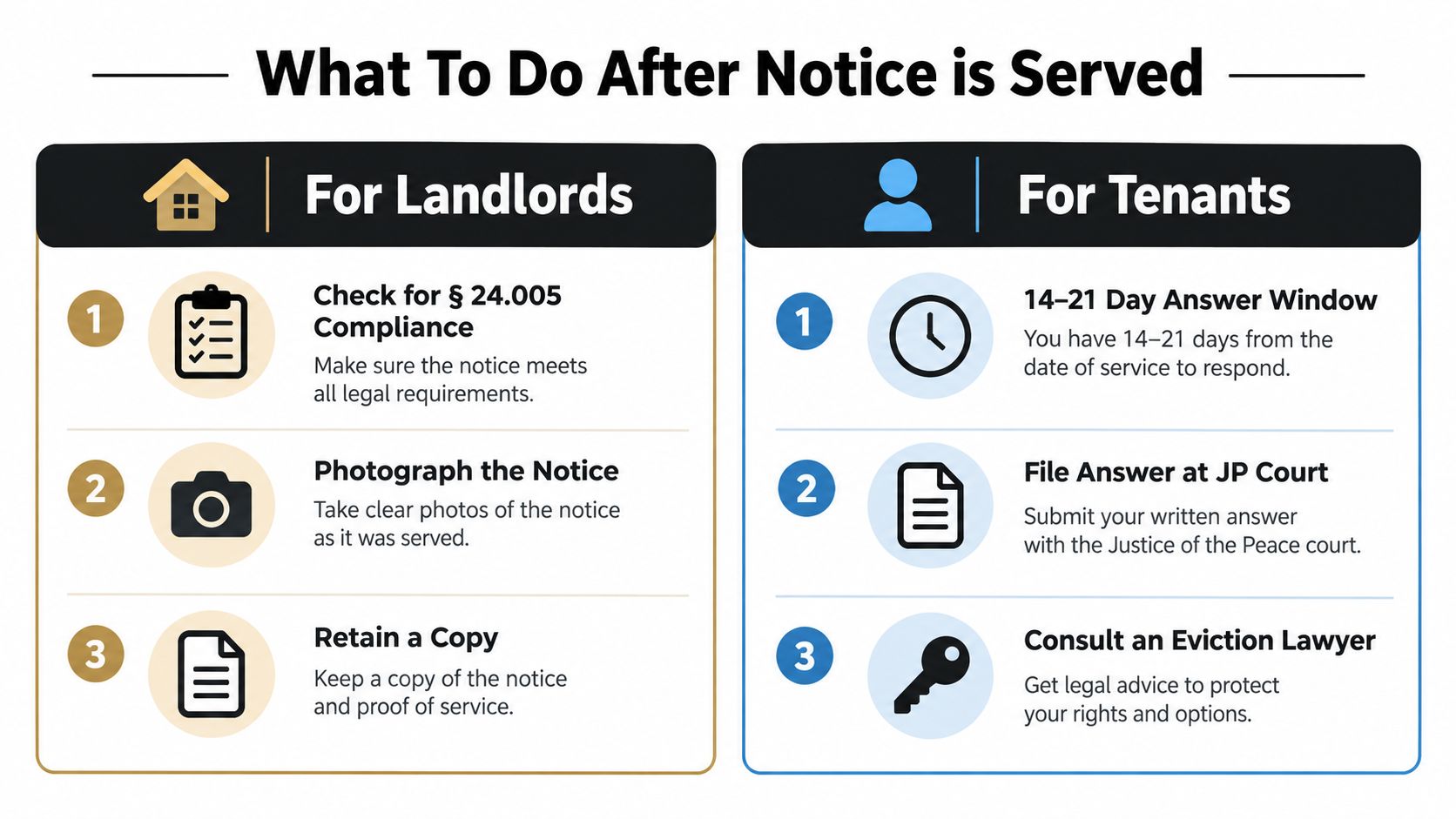
A written request for a hearing, a timely answer, or a prompt attorney review can preserve options. Waiting until the constable posts a removal notice usually leaves far less room to negotiate.
Inside a Bexar County Eviction Hearing
A Bexar County eviction hearing usually begins with the filing in the Justice Court precinct that serves the property. Publicly available local guidance identifies a $104 filing fee, with service and writ costs commonly bringing the out-of-pocket total to roughly $243 to $254 before attorney fees (Bexar County eviction cost and timing guidance). Hearings are typically scheduled two to three weeks after filing, although the actual date depends on the court and service.
The tenant should not treat the answer period as optional. The citation controls the response deadline, and the tenant should file the answer with the correct JP court while preparing evidence. A landlord should confirm service before assuming a default will be available.

What happens in the courtroom
The landlord generally presents the lease, payment ledger, notice to vacate, and proof that the notice was delivered. The tenant may present payment records, lease language, communications, evidence of a cure, or facts supporting a legal defense. The judge may ask who signed the lease, what amount was owed, when notice was delivered, whether the tenant paid, and whether the tenant still occupies the property.
Bring organized exhibits, not a phone full of unsorted screenshots. Label documents, keep originals available, and explain the timeline in plain language. A tenant can review practical evidence guidance in what evidence helps tenants win eviction cases in Texas.
If the landlord prevails, the judgment starts the possession process. A writ may issue after six days, and the tenant must receive at least 24 hours' notice before removal under the statutory process. An appeal requires attention to the applicable deadline and bond requirements, including the five-day appeal-bond period described in the court process guidance.
Before hearing day, counsel should test the notice, service, lease terms, payment history, and requested relief against the documents. The strongest preparation often identifies a missing element before anyone enters the courtroom.
What the San Antonio Eviction Numbers Actually Show
Bexar County's eviction filings show how quickly a rent dispute can become a court matter. In 2024, 27,012 eviction cases were filed against residents of Bexar County, equal to about 9 out of every 100 renter households, according to the previously cited Texas Housers data.
The filings were concentrated among a relatively small group of properties. Twelve percent of filings came from 30 high-evicting properties. For landlords, that pattern calls for an audit of recurring notices, ledgers, delivery records, and maintenance complaints. For tenants, repeated filings at one property may indicate a recurring management or notice problem rather than a one-time disagreement.
San Antonio accounted for 21,852 eviction cases, and nearly 15% were filed in District 8 in 2024. These figures do not predict the result of a particular case. They do show why a landlord or tenant should identify the correct Justice Court, preserve documents, and act before a judgment limits the available options. The January 1, 2026 rule changes make that timing more important, especially where a three-day notice, a late-rent cure right, or expanded service method may affect the next step.
| Metric | Bexar County Figure | What It Means |
|---|---|---|
| Eviction cases filed against county residents in 2024 | 27,012 | Eviction exposure can spread quickly across a large rental market. |
| Share equal to renter households | About 9 in every 100 | Treat a notice as a legal deadline, not routine paperwork. |
| Filings from 30 high-evicting properties | 12% | Filing activity can center on particular properties and management practices. |
| Cases filed inside San Antonio | 21,852 | City landlords and tenants must follow the local Justice Court process. |
| Share filed in District 8 | Nearly 15% | Local concentration can help identify recurring property-level issues. |
The practical response is specific. Landlords should review notice forms, payment ledgers, service records, and cure handling under the current rules. Tenants should preserve payment proof and communications, respond to the citation, and raise any notice or service defect before judgment.
Hiring an Eviction Lawyer in San Antonio
The right eviction attorney should be able to explain the immediate decision, the likely court step, and the documents needed to support it. Ask whether the lawyer regularly handles Bexar County Justice Court cases, understands the January 2026 changes, and can represent you through the hearing rather than only prepare a form.
For a consultation, gather:
- The lease: Include amendments and renewal documents.
- The notice: Bring the exact version delivered and proof of delivery.
- Payment records: Include the full ledger and proof of disputed payments.
- Communications: Provide relevant emails, texts, letters, and payment agreements.
- Property evidence: Add photographs, inspection records, and repair requests.
- Court papers: Bring the citation, petition, hearing notice, and any judgment.
The Law Office of Bryan Fagan, PLLC offers a free 30-minute consultation to evaluate a landlord-tenant matter, explain rights, and discuss a practical strategy. Representation may include reviewing the lease and notice, preparing pleadings, communicating with the opposing party, preparing testimony and exhibits, appearing at the Justice Court hearing, and addressing possession issues after judgment.
Fee structures vary by case. Some lawyers use a flat fee for a straightforward eviction filing, while complex disputes, appeals, contested evidence, or related claims may involve hourly billing. Contingency arrangements generally aren't the usual structure for a possession case because the dispute often turns on immediate court deadlines rather than a recoverable damages award.
Ask direct questions before hiring counsel:
- How often do you appear in the Bexar County JP precinct handling this property?
- How will you analyze the post-2026 notice, cure, and service rules?
- Who will appear at the hearing?
- What documents do you need today?
- What happens if the landlord wins or the tenant appeals?
A lawyer who cannot give a clear answer about deadlines and scope may not be the right fit for a fast-moving eviction.
Frequently Asked Questions and Next Steps
Can a tenant pay late rent and stop an eviction?
For qualifying eviction suits filed after January 1, 2026, Texas law provides a statutory right to cure certain late-rent cases. The tenant should identify the exact cure amount, confirm how payment must be made, and preserve proof. Paying without a written record can create a new dispute about whether the cure was complete or timely.
When must a landlord return a security deposit?
Texas Property Code § 92.103 generally requires the landlord to refund the security deposit on or before the 30th day after the tenant surrenders the premises, unless another rule applies under § 92.107. The landlord may provide a written, itemized accounting of deductions and return the balance within that same period (Texas security deposit rule). A tenant should return keys and provide a forwarding address in writing.
Can someone appeal a Justice Court eviction judgment?
An appeal may be available through the county court, but the deadline and bond requirements are strict. The tenant should obtain the judgment, ask the clerk for the applicable appeal instructions, and speak with an eviction attorney immediately rather than waiting for the writ.
Is self-representation reasonable?
Self-representation may be reasonable in a simple, uncontested nonpayment case where the documents are accurate and neither side disputes possession. It becomes riskier when notice, service, payment, repairs, retaliation, discrimination, lease interpretation, or an appeal is involved. Today, create a dated timeline and collect every document before deciding whether you need counsel.
The Law Office of Bryan Fagan, PLLC helps San Antonio landlords and tenants review notices, evaluate late-rent cure rights, prepare for Justice Court hearings, and address lease, repair, and security-deposit disputes. Visit The Law Office of Bryan Fagan, PLLC to schedule a free consultation and get a clear plan for your eviction or rental dispute.