Under Texas Property Code § 92.0561, the repair-and-deduct limit is the greater of one month's rent or $500 per month in total, and you may use the remedy repeatedly as long as the total for that month stays within the cap. The limit applies to all qualifying deductions during that month, not to each repair separately.
A broken air conditioner, leaking pipe, or unsafe plumbing problem can turn a normal rental dispute into an urgent health and safety concern. You may be wondering whether you can hire someone yourself and subtract the bill from rent. Landlords, meanwhile, may worry that a tenant will reduce rent without following the law.
Texas Property Code § 92.0561 gives tenants a narrow repair-and-deduct remedy. It doesn't give anyone permission to ignore the lease, skip notice, or treat rent as optional. The condition, notice, repair, contractor, deduction, and paperwork all matter.
This guide explains the Texas Property Code 92.0561 repair and deduct dollar limit in plain language. It's educational information, not a substitute for advice from a Texas landlord tenant lawyer who can review your lease and documents.
When Repairs Stall and You Consider Repair and Deduct
Your air conditioner stops working during a hot Texas week. You send a message to the property manager, call the office, and follow up again. Days pass, the indoor temperature becomes difficult to manage, and you start looking at repair companies. One company gives you a bill that you could pay, but only if you reduce your next rent payment.
That's where the dollar limit becomes important. A tenant might have a qualifying health or safety issue but still lose the protection of repair and deduct by taking too much off rent in one month. The remedy isn't a blank check. It's a limited legal tool with a monthly ceiling and strict procedural requirements.
Practical rule: Never assume that a repair bill automatically becomes a lawful rent deduction.
Texas law generally places repair responsibility on the landlord when a condition materially affects the physical health or safety of an ordinary tenant, subject to the requirements of the statute. The repair-and-deduct remedy applies only after the landlord is legally responsible and receives proper notice. A cosmetic concern, personal preference, or improvement request may not qualify.
A careful tenant should first create a written record of the problem. Describe what happened, when it started, how it affects the home, and what access the landlord has to inspect or repair. Keep copies of messages, photographs, invoices, and payment records. For broader maintenance planning, landlords and renters may also benefit from these practical maintenance tips from Edinhart Realty and Property Management.
If the landlord ignores repair requests, review the required notice and available remedies before hiring anyone through this guide on what to do if a landlord ignores repair requests in Texas. The exact steps matter because an improper deduction may look like ordinary rent nonpayment.
The Law Office of Bryan Fagan, PLLC approaches these disputes from both sides. Tenants need to understand their tenant rights before acting. Landlords need a reliable process for receiving notices, arranging repairs, and challenging deductions that don't comply with the Texas Property Code.
What Texas Property Code 92.0561 Covers and Who Can Use It
A broken water line leaves your rental unsafe, and the landlord does not arrange a repair after proper notice. Texas Property Code § 92.0561 may let you hire someone and subtract the allowable cost from rent. The statute works as a limited remedy for qualifying conditions, not as a general fund for home improvements.
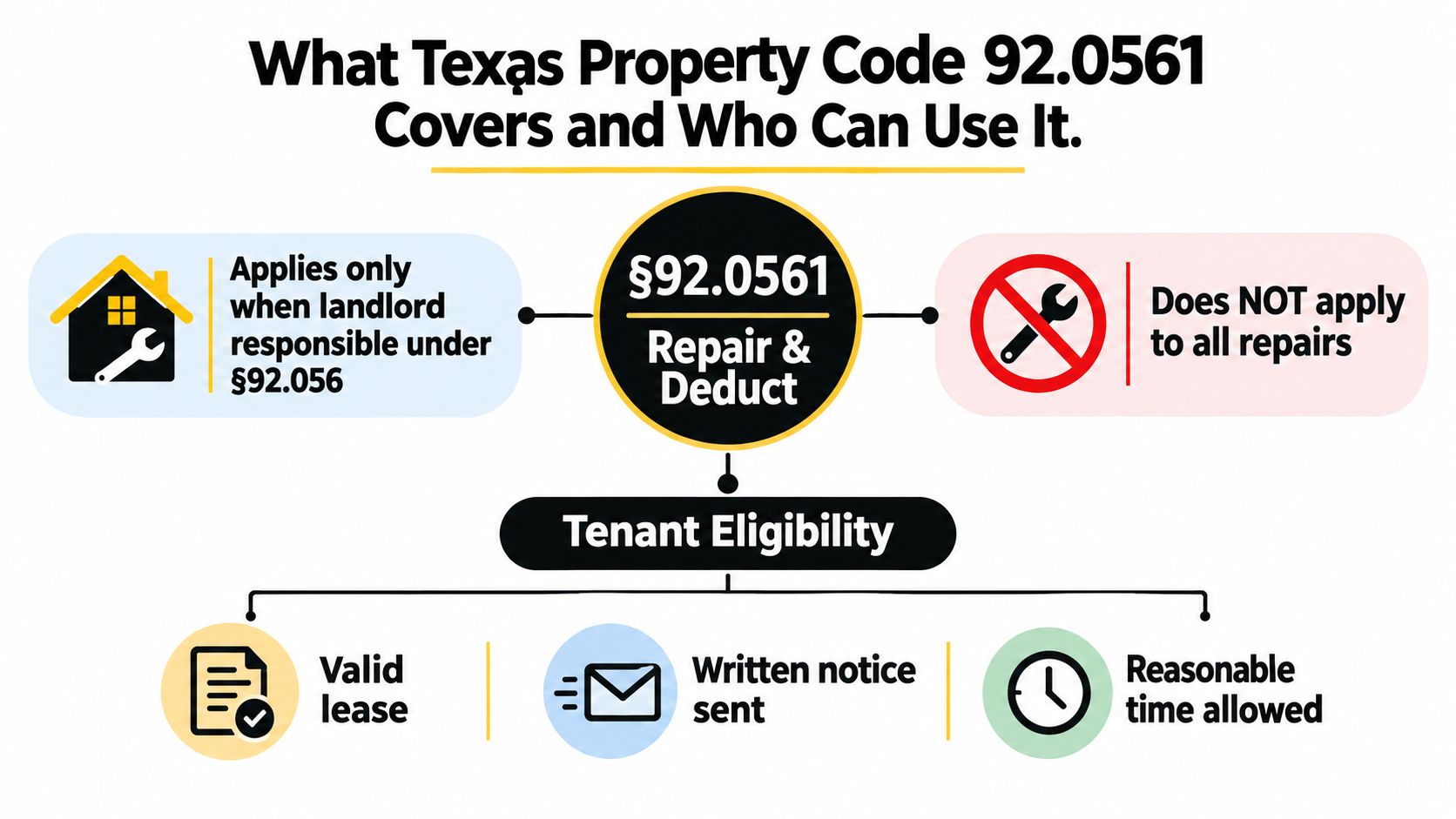
Eligibility begins with the landlord's legal duty to repair. The condition must materially affect the physical health or safety of an ordinary tenant. That standard separates a dangerous plumbing failure from an outdated fixture or an inconvenience. The repair-and-deduct rule connects to § 92.056, and you must follow the required notice process before hiring a repair person. This explanation of repair and deduct under Texas Property Code § 92.056 provides related guidance.
Start with the health and safety trigger
A tenant cannot use § 92.0561 because a condition looks unattractive or feels inconvenient. The problem must be one for which the landlord has a legal repair obligation. A major plumbing failure may meet that test. A request for upgraded cabinets usually does not.
Notice matters just as much. Give it in the form required by the law and lease, and state the problem clearly. Written notice creates a record of what you reported, when the landlord received it, and whether the landlord had a fair chance to respond. Keep messages, photographs, invoices, and payment records together. The monthly limit later applies to the total qualifying repair deductions, so rent records should show exactly what you deducted and when.
For a broader explanation of Texas tenant rights under Chapter 92, review the related overview. The Landlord's Duty to Repair in Texas also explains when health or safety conditions can create a repair duty under § 92.052.
Eligibility depends on the facts
Your lease, the condition, your notice, and the landlord's response all affect the analysis. Damage caused by the tenant may be treated differently from a problem caused by ordinary use. A landlord who responds promptly and makes a diligent repair effort may have defenses to a later deduction.
Repair and deduct is only one possible remedy. Depending on the facts, court relief, lease termination, damages, or another response may fit better. A mistaken deduction can become a rent dispute or eviction issue, so obtain legal advice before treating rent as a repair account.
How the Dollar Limit Is Calculated Each Month
The formula is simple, but tenants often apply it incorrectly. Under § 92.0561, compare one month's rent under the lease with $500. The larger amount is the maximum total that may be deducted for qualifying repairs during that month. The ceiling applies to the month's combined deductions, not to every individual repair, and the remedy may be used as often as necessary if the monthly total remains within the limit. See the statutory text in Texas Property Code § 92.0561.
The basic comparison
If your monthly rent is $800, one month's rent is larger than $500. Your monthly repair-and-deduct ceiling is therefore $800.
If your monthly rent is $1,200, the ceiling is $1,200 because that amount is greater than $500.
If your monthly rent is $450, the $500 minimum is larger. Your monthly ceiling is $500, not $450.
The word total matters. Suppose you have two qualifying repairs in the same month. You can't automatically deduct the full cost of both because each repair is individually related to health or safety. Add the allowable deductions together and compare the combined amount with the applicable monthly cap.
| Monthly Rent Scenario | Monthly Deduction Cap | What It Means |
|---|---|---|
| $800 monthly rent | $800 | One month's rent is greater than $500, so the total monthly cap is $800. |
| $1,200 monthly rent | $1,200 | One month's rent is greater than $500, so the total monthly cap is $1,200. |
| $450 monthly rent | $500 | The statutory $500 amount is greater than one month's rent, so the total monthly cap is $500. |
These examples address only the dollar ceiling. They don't establish that a condition qualifies, that notice was proper, that the landlord failed to act, or that the repair cost was reasonable. The tenant still has to satisfy the rest of the statute.
Subsidized housing uses a different rent benchmark
Subsidized housing creates a separate calculation issue. When the tenant's rent is reduced through a subsidy, the one-month-rent benchmark is measured using the fair market rent, rather than only the tenant's reduced out-of-pocket payment. That difference can materially change the cap in Texas housing markets where rents vary widely.
A tenant in subsidized housing shouldn't calculate the limit by looking only at the amount paid from personal funds. Confirm the applicable fair market rent and keep records showing how the figure was determined. A landlord or property manager should also review the subsidy terms before accepting or disputing a deduction.
The cap renews by month, but that doesn't eliminate the need to qualify each repair or document each deduction.
If the repair cost exceeds the monthly ceiling, don't subtract the entire bill from rent. Paying the excess separately, dividing work over time where legally appropriate, or pursuing another remedy may be safer options. Because the consequences can include a nonpayment dispute, a tenant should speak with an eviction attorney or Texas landlord tenant lawyer before making the deduction.
How to Follow the Legal Process and Document Your Repair
The dollar calculation is only one part of repair and deduct. The paperwork must connect the condition, the notice, the repair, and the later rent accounting. Texas law requires the tenant to deduct the repair cost from a subsequent rent payment and provide proof of the cost, including the bill and receipt or similar itemized records. The Texas State Law Library's failure-to-repair guide explains this documentation requirement.

Build the record before hiring a contractor
1. Give written notice. Describe the problem clearly and send the notice using a method that creates reliable proof of delivery. Save the message, attachment, mailing record, or delivery confirmation.
2. Allow a reasonable opportunity to repair. The landlord needs a fair chance to inspect the condition and arrange the work. Acting too quickly can give the landlord an argument that the statutory process wasn't followed.
3. Obtain a written estimate. Use a qualified repair professional and request a description of the work, labor, materials, and total charge. The estimate should address the actual health or safety condition, not unrelated upgrades.
4. Notify the landlord of your intended deduction. Before the work proceeds when practical, send the estimate and explain the amount you expect to deduct. This gives the landlord another opportunity to make the repair and creates a clear record of your position.
5. Complete the repair and preserve proof. Keep the final bill, payment receipt, itemized records, photographs, and communications with the contractor. The final deduction should be tied to a subsequent rent payment and should stay within the applicable monthly cap.
Organize documents as if a judge may review them
Put the records in date order. Start with the first report, then add the landlord's responses, contractor communications, invoices, receipts, and the rent ledger showing the deduction. Avoid relying on memory when a written record can answer the question.
Tenants preparing for a dispute can review this resource on tenant documentation for court and Texas eviction defense. Landlords should maintain a maintenance log that records each notice, response, appointment, inspection, and completed repair.
A clean file helps both sides separate a legitimate deduction from an unsupported rent withholding claim. If the landlord repairs the condition before the tenant hires a contractor, keep the agreement and completion confirmation in writing.
Rights Risks and Protections for Tenants and Landlords
Repair and deduct can protect a tenant who follows the statute, but it can also create serious conflict when the tenant skips a required step. The same facts that help a tenant, such as detailed notice and reliable receipts, may help a landlord evaluate whether the deduction is valid.
The tenant's position
A tenant who properly invokes the remedy may have a defense to a claim that the full rent was unpaid. That protection depends on the underlying condition, the landlord's legal duty, proper notice, the repair, the monthly cap, and the supporting records.
The risk rises when the tenant hires someone and subtracts the bill. A landlord may argue that the condition didn't affect health or safety, notice was inadequate, the landlord was already responding, the cost was unreasonable, or the total deduction exceeded the monthly limit. Those arguments can lead to a rent dispute or eviction filing.
Tenants should also avoid confusing repair and deduct with a general right to stop paying rent. If you're facing a notice to vacate or a nonpayment claim, speak with an eviction attorney before assuming the repair issue resolves the case.
The landlord's position
Landlords have a right to review and challenge an improper deduction. They should compare the tenant's notice with the lease, maintenance records, contractor documents, and rent ledger. A prompt written response can clarify whether the landlord accepts responsibility, disputes the condition, or has scheduled the repair.
Landlords also need to take health and safety complaints seriously. Ignoring a notice may strengthen the tenant's position, while a documented repair effort can show that the landlord acted responsibly. Retaliatory conduct or a rushed eviction response can create additional legal concerns.

For landlords: Treat every written repair notice as a document that may later appear in court. Record what you did, when you did it, and why.
A balanced review often resolves confusion early. Tenants should ask for legal review before deducting. Landlords should ask for legal review before filing an eviction based on a disputed deduction. The Texas Property Code protects rights, but it rewards careful compliance rather than rushed action.
Real World Examples of the Dollar Limit in Action
A monthly total is easier to understand through ordinary rental problems. The following examples show how the calculation and paperwork work together. They're illustrations of the rule, not legal conclusions about any particular dispute.

A deduction spread across months
A tenant pays $900 in monthly rent. After proper notice and the required opportunity to respond, a qualifying plumbing problem remains unresolved. A competent repair professional completes work costing $700, and the tenant keeps the written estimate, final bill, and receipt.
The tenant doesn't have to treat the entire $700 as an immediate deduction if timing or other qualifying work creates a concern about the monthly total. The tenant may structure the deduction across two months, provided the rent accounting and documentation accurately show what was deducted and when. The tenant should also confirm that every procedural requirement has been met before reducing either payment.
The important point is that the tenant checks the monthly ceiling first, then keeps a paper trail that matches the deduction.
The video below offers another visual way to think about the repair-and-deduct process.
Multiple repairs exceed the monthly total
A different tenant pays $500 in monthly rent and faces several qualifying repair issues. The tenant spends $650 on multiple fixes and subtracts the entire amount from rent in the same month.
That deduction exceeds the applicable monthly ceiling because the statute uses the greater of one month's rent or $500, and the total is above that amount. Even if each repair relates to a genuine problem, combining them in one month doesn't allow the tenant to exceed the cap.
The tenant may face a dispute over the unpaid balance, especially if the tenant can't show proper notice, itemized bills, receipts, or a clear rent ledger. Before deducting, calculate the combined amount and obtain advice if the repair costs won't fit within the monthly limit.
Get Clear Guidance Before You Repair and Deduct
A repair-and-deduct decision starts with the monthly math. The tenant may deduct the greater of one month's rent or $500, calculated as one monthly total, not a separate allowance for each repair. Eligibility still depends on the condition affecting an ordinary tenant's physical health or safety, the landlord's legal responsibility, proper notice, and records showing the work and payment.
Subsidized housing can require a closer review because the applicable fair-market-rent figure may affect the monthly limit. Rent accounting matters too. Keep invoices, receipts, notice letters, repair dates, and a ledger showing the rent charged, amount deducted, and remaining balance. The ledger works like a bank statement: each entry should let both sides trace the calculation.
Landlords can reduce disputes by responding promptly, arranging qualified repairs, and preserving maintenance records. Tenants should communicate in writing, allow a reasonable opportunity to act, and check the monthly cap before reducing rent.
If the facts remain uncertain, review Texas habitability and health-and-safety conditions. The Law Office of Bryan Fagan, PLLC can review documents in a free 30-minute consultation. Visit The Law Office of Bryan Fagan, PLLC for guidance about repair deductions, eviction, or lease disputes.