Hire a tenant lawyer in Houston when you've received a written notice to vacate, been locked out, faced a health or safety repair dispute, or believe your landlord is retaliating. Texas eviction cases can move from a 3-day notice to a judgment and then a 5-day appeal window, so quick action and strong records matter more than abstract legal arguments.
You may be sitting in your apartment with a notice taped to the door, waiting for a landlord to fix a broken air conditioner, or trying to understand why your security deposit suddenly became a list of deductions. Houston renters face a large and fast-moving housing system. The City of Houston's 2024 housing-tenure tables report 930,404 occupied housing units, with 58% renter-occupied and 42% owner-occupied. Some districts are even more renter-heavy, including District J at 84% renter-occupied and District F at 68%. Houston's housing-tenure tables help explain why lease, repair, deposit, and eviction disputes are common.
You don't always need to pay for a lawyer. A hotline, a 311 complaint, or a carefully written demand letter may solve a straightforward problem. But once your housing, court deadline, health, money, or future rental history is at risk, a Texas landlord tenant lawyer can help you choose the right remedy and avoid a mistake that makes the dispute harder to fix.
Why Houston Renters End Up Searching for a Tenant Lawyer
A Midtown renter gets home after work and finds a 3-day notice to vacate taped to the door. The tenant hasn't paid rent for a week because the apartment's air conditioner stopped working and the property manager hasn't completed the repair. The tenant assumes the repair problem explains the missed payment. It may not. Texas tenants generally can't withhold rent solely because repairs are unfinished, and Texas has no statewide grace period requiring a landlord to accept late rent before filing.
That renter needs a decision, not a lecture. A lawyer should review the lease, payment records, repair notices, and the exact wording and delivery of the notice immediately. If the tenant has no court filing and the dispute is mainly about documenting the repair, a hotline or demand letter may be the better first move. If a notice to vacate has arrived, paid legal advice becomes much more valuable.
Common triggers for legal help
Houston renters often look for a tenant lawyer Houston TX search result after:
- A sudden non-renewal: A corporate landlord may decline to renew after a tenant reports repeated maintenance failures. The timing, prior communications, and lease language matter.
- A habitability emergency: Leaks, mold, broken locks, unsafe wiring, or lost air conditioning can create a serious repair dispute when the condition affects health or safety.
- A disputed deposit: After move-out, the landlord may claim cleaning, damage, or unpaid charges. The tenant needs the move-out records, lease terms, photographs, and a written demand.
- An illegal lockout: A landlord may change locks or interrupt utilities after a rent disagreement. Don't try to force entry or retaliate. Preserve proof and get advice.
- Retaliation: A rent increase, threatened eviction, service interruption, or non-renewal after a repair or code complaint deserves prompt review.
Houston's rental market also operates at substantial scale. Realtor.com reported about 13.6K rental listings, a median rent near $1.8K, and for-rent inventory down 26.66% year over year, even as monthly listings rose 1.22%. Realtor.com's Houston rental-market reporting should be treated as market context, not a substitute for reading your lease.
Most tenants don't want a lawsuit. They want to stay housed, stop unsafe conditions, or recover money without spending more than the dispute is worth. The right question is whether your facts have reached the point where a missed legal step could cost more than early counsel.
What a Tenant Lawyer in Houston Actually Does for You
A Houston tenant lawyer turns a stressful rental dispute into a timeline, evidence file, and legal strategy. The work usually starts with documents, not courtroom arguments.
Eviction defense and court procedure
Under Texas Property Code Chapter 24, an eviction lawyer reviews the notice to vacate, the lease, payment history, and the court citation. The lawyer can prepare an answer, identify defects, request a jury trial where appropriate in Harris County Justice Court, seek a continuance when legally justified, negotiate with the landlord's attorney, and represent you at the eviction trial. You can also review The Texas Eviction Process Explained for a factual overview of how a forcible detainer case proceeds under Chapter 24.
Repair and habitability disputes
For serious repair problems, Texas Property Code § 92.056 controls much of the notice-and-remedy process. A lawyer can help you send a dated notice through a provable delivery method, determine whether a second notice is required, organize photographs and repair records, and evaluate repair orders, rent reduction, lease termination, or repair-and-deduct options.
Do not deduct repair costs from rent casually. Section 92.0561 has strict conditions, and the amount and type of deduction can depend on the facts, the lease, the repair, and official written notice. A lawyer's job is to prevent a repair complaint from turning into a nonpayment eviction.
Deposits, lockouts, and retaliation
For a security deposit dispute under Texas Property Code §§ 92.101 through 92.109, counsel can send a demand letter, test deductions against the lease and the law, and determine whether a justice court case is appropriate. The landlord generally has 30 days after surrender and receipt of a written forwarding address to return the deposit, as explained by the Texas State Law Library's security-deposit guidance.
Section 92.0081 restricts self-help lockouts and certain utility interruptions. A lawyer can communicate with management, preserve evidence, and pursue the remedy that fits the facts. The limits on self-help lockouts and utility interruptions are also described in Illegal Lockouts and Utility Shutoffs in Texas.
Under Section 92.331, a lawyer evaluates whether a landlord's conduct followed a protected repair, code, utility, or tenant-organizing complaint. Counsel can also review a lease before you sign it, explain renewal and default clauses, and communicate with the landlord's attorney so you aren't negotiating under pressure.
When You Truly Need a Lawyer and When You Do Not
Use the least expensive resource that can safely solve the problem. A routine question about a lease clause may not justify paid representation. A written eviction notice, lockout, serious repair condition, or retaliation claim usually does.
Start with self-help when the risk is low
The Houston Bar Association tenant hotline can provide information and referrals, but Houston's Fair Housing and Tenant-Landlord hotline states that it doesn't give legal advice. The City of Houston's 311 system may help create a record of a housing-code complaint, and Texas Law Help offers self-help information and forms for some disputes. These tools can be useful when you're still gathering facts and no court deadline is running.
For a basic deposit dispute, begin by collecting the lease, forwarding-address proof, move-out photographs, payment records, and the landlord's itemization. Send a clear written demand before paying for litigation.
Use legal aid when you qualify
Lone Star Legal Aid may be an option for income-qualified tenants facing eviction. UT Law's Consumer Law Project may assist with certain consumer, deposit, or warranty matters. Availability and eligibility vary, so contact the program promptly rather than waiting for a hearing date.
The need for early help is clear in Houston's eviction system. Eviction Lab reports 78,853 eviction filings in Houston over the past 12 months, while Harris County had 76,321 filings in 2024, approximately one filing for every 10 renter households. Eviction Lab's Houston tracking page provides the local filing benchmark.

Houston Public Media reported that only 2.1% of Harris County tenants had legal representation in 2023, and Texas tenants don't have a constitutional right to counsel in civil eviction cases. Houston Public Media's eviction reporting explains why tenants often face a serious procedural disadvantage.
Practical rule: If you have a written notice to vacate, a lockout, a health-affecting repair dispute, or suspected retaliation, hire a lawyer or obtain immediate legal advice. Don't wait to see what happens.
For paid counsel, a Texas rental lawyer can assess the lease, deadlines, evidence, and likely remedy. The consultation should answer whether you need representation, a demand letter, or a faster referral.
What to Bring to a Tenant Lawyer Consultation in Houston
Bring one organized folder, either on paper or as a PDF. A lawyer can make a faster and more accurate assessment when the facts are in date order instead of scattered across text messages and email accounts.
Build the core file
Start with the signed lease and every addendum. Include renewal documents, written rules, notices about fees, and any clause addressing repairs, deposits, default, or termination.
Next, include every written notice. That means notices to vacate, repair requests, rent demands, inspection notices, non-renewal letters, lockout messages, and communications from the property manager. Preserve the original dates and delivery method. Don't edit screenshots.
Bring a rent ledger covering the relevant payment history, along with bank records, receipts, money-order stubs, payment-portal records, and written agreements about payment plans. A landlord's balance may not match your records, and the difference can affect an eviction defense.
Document conditions and conduct
Use dated photographs and video for leaks, mold, broken appliances, unsafe wiring, missing locks, water damage, or other conditions. Keep repair invoices, hotel or temporary lodging receipts, food or medication-loss records, and police or fire reports when unsafe conditions caused an emergency.
Create a one-page timeline:
- What happened: List the date of the first problem and each later event.
- Who received notice: Identify the landlord, manager, maintenance office, or person who normally receives rent.
- What response followed: Record promises, missed appointments, repairs, threats, and payment discussions.
- Where you stand now: State whether you're housed, locked out, negotiating, or already in court.
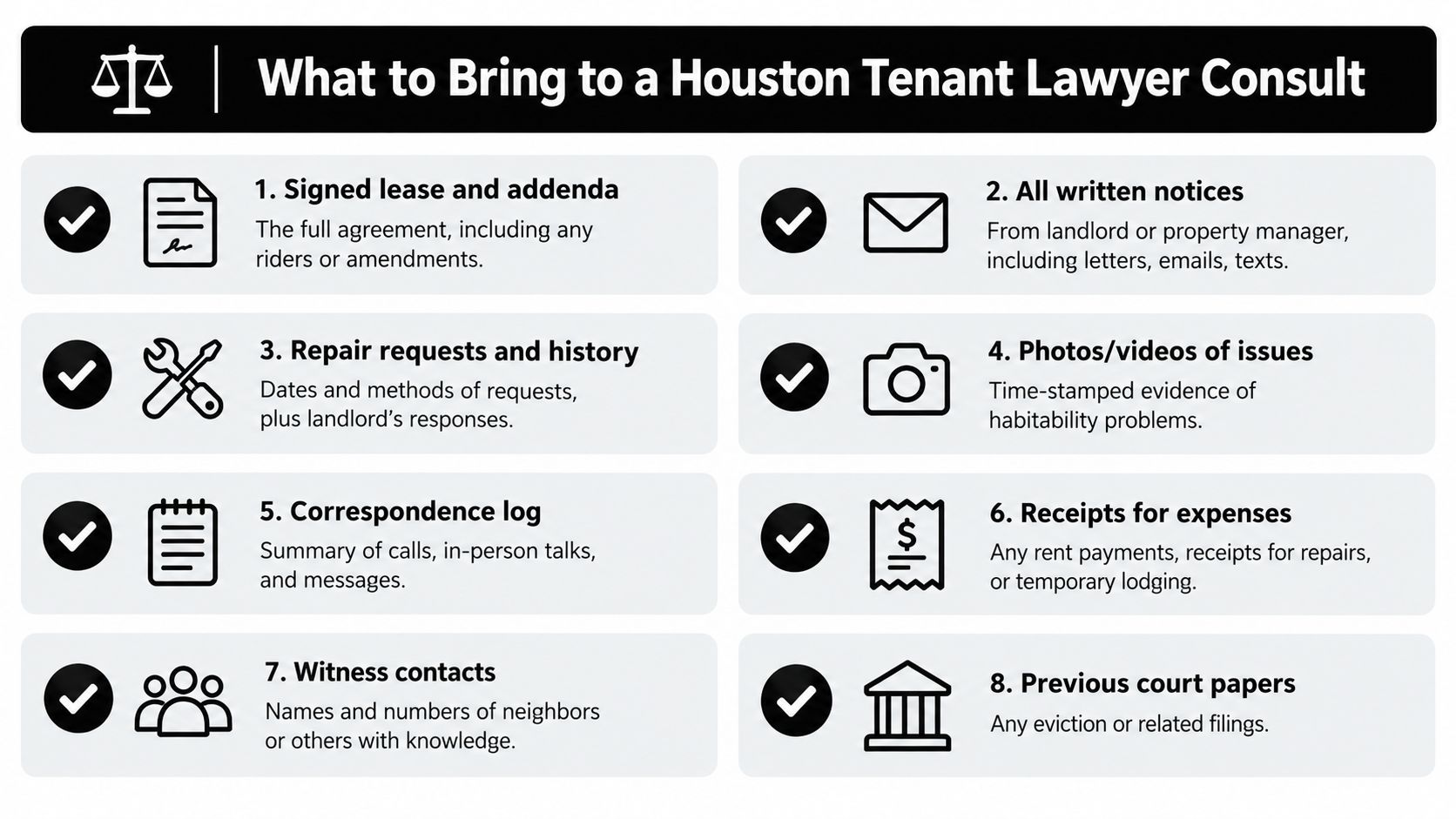
A short cover note with your name, property address, current status, and immediate deadline helps the attorney focus on strategy and fees. For court-focused organization, see tenant documentation for Texas eviction defense.
Keep the originals. Send copies unless your lawyer asks for the original documents.
Key Texas Property Code Rules That Shape Your Case
Texas rental disputes often turn on procedure. You may have a legitimate complaint, but the court will still examine notice, payment status, delivery, timing, and the remedy you chose.
Under Texas Property Code § 24.005, a landlord generally must give at least 3 days' written notice to vacate before filing a forcible detainer case, unless the lease provides a different period. If the justice court rules for the landlord, the tenant usually has 5 days to appeal before enforcement, making prompt review essential.
Repair claims follow a separate path. Chapter 92, including Sections 92.052 and 92.056, provides a route for serious conditions that materially affect health or safety when the tenant gives proper notice and is current on rent. Texas Attorney General guidance says tenants should send a dated notice by certified or registered mail, keep a copy, and generally allow a reasonable repair period that the law presumes to be 7 days. The Texas Attorney General's renters' rights guidance explains these procedural requirements.
Security deposits have their own deadline. Section 92.103 generally gives the landlord 30 days after surrender and receipt of a written forwarding address to return the deposit, subject to lawful deductions. When deductions are made and the tenant has paid rent in full with no rent dispute, Section 92.104 requires an itemized list.
Texas Property Code timelines at a glance
| Issue | Statute | Deadline / Rule |
|---|---|---|
| Notice before eviction filing | Texas Property Code § 24.005 | At least 3 days unless the lease says otherwise |
| Appeal after justice court judgment | Texas eviction procedure | Usually 5 days |
| Repair notice and response | Texas Property Code §§ 92.052 and 92.056 | Reasonable time, with 7 days generally presumed reasonable |
| Deposit return | Texas Property Code § 92.103 | 30 days after surrender and written forwarding address |
| Deposit deductions | Texas Property Code § 92.104 | Itemized list when the statutory conditions apply |
For a plain-language review of tenant protections, read Texas Property Code Section 92 tenant rights. Don't assume that knowing a statute number is enough. Your lawyer must connect the rule to the notice you sent, the lease you signed, and the evidence you preserved.
Typical Fees and Fee Structures for Houston Tenant Attorneys
Ask about the fee structure before you share sensitive documents or sign an engagement agreement. A lawyer should tell you what the initial consultation covers, what work is included, and what happens if the dispute expands.
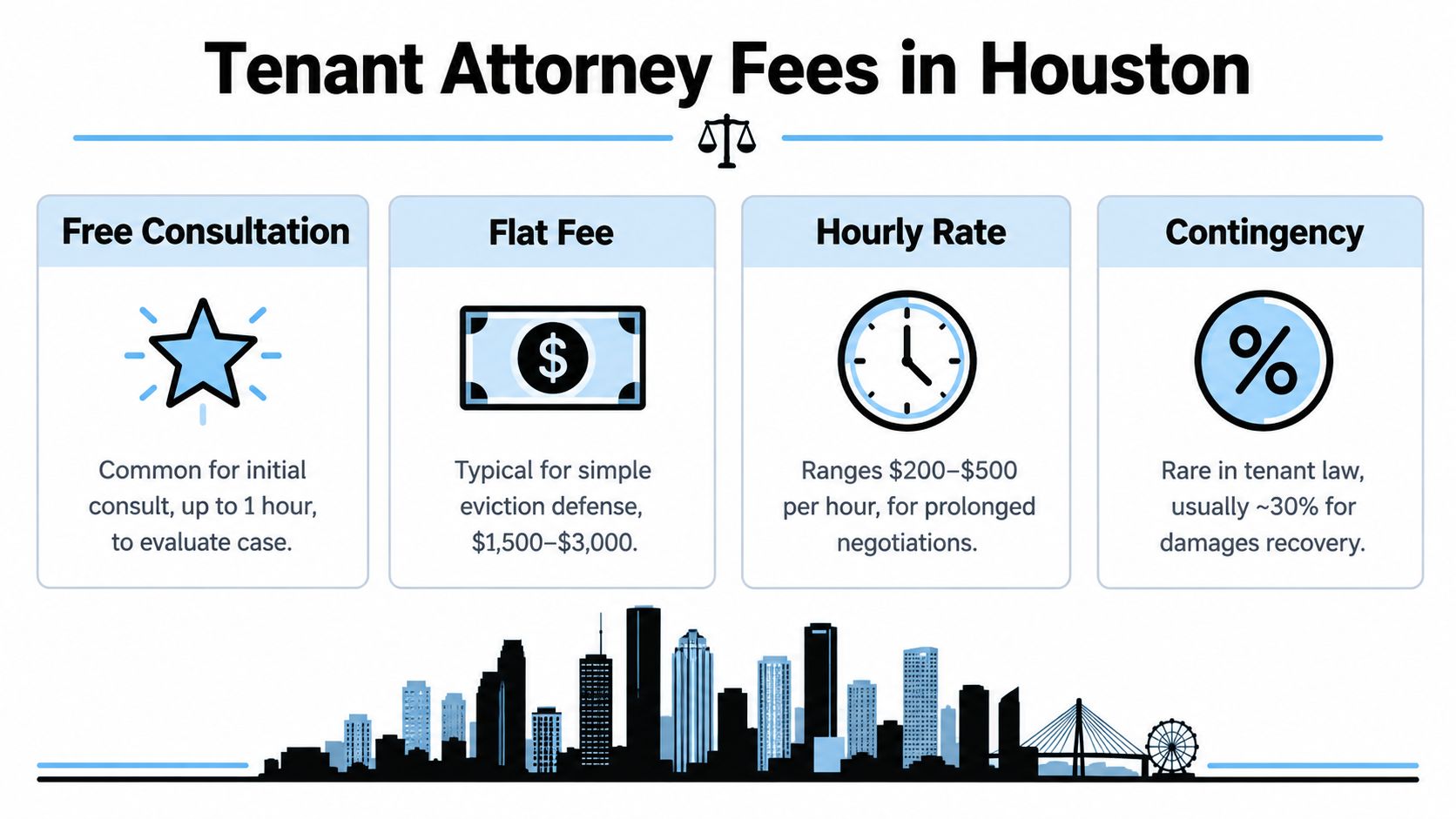
The most common structures are:
- Free consultation: Some firms offer an initial consultation to identify deadlines, documents, and possible strategies. Confirm the time limit and whether a full lease review is included.
- Flat fee: A flat fee may fit a straightforward eviction defense, lease review, or demand letter. Ask whether it covers the answer, court filings, negotiation, hearing attendance, and any appeal.
- Hourly billing: Hourly work may fit a complicated repair, retaliation, lease, or damages dispute that requires continuing communication and filings. Ask for the hourly rate, billing increments, retainer amount, and a budget estimate.
- Contingency arrangement: Some deposit or damages claims may be evaluated for contingency representation, but this depends heavily on the facts and potential recovery. Confirm responsibility for filing fees, service costs, experts, and litigation expenses.
Do not rely on a verbal quote. The written agreement should identify the lawyer or firm handling the case, the scope of representation, the payment schedule, excluded services, and the cost of an appeal or county-court proceeding.
Match the cost to the risk
A demand letter may be enough when the landlord owes a clearly documented deposit and there's no court case. Paid representation becomes more sensible when a missed deadline could lead to displacement, when a lockout has occurred, or when a health and safety claim requires strict repair notices.
Ask these questions before hiring:
- What exactly does the fee cover?
- Who will appear at the hearing?
- Will the lawyer negotiate with the landlord's attorney?
- Are discovery, trial preparation, and an appeal excluded?
- What costs will you pay separately?
A low quote that excludes the hearing may not be cheaper than a higher quote that includes preparation and courtroom representation. Choose based on the work your case requires, not the first number you hear.
Choosing the Right Tenant Lawyer and Booking a Free Consult
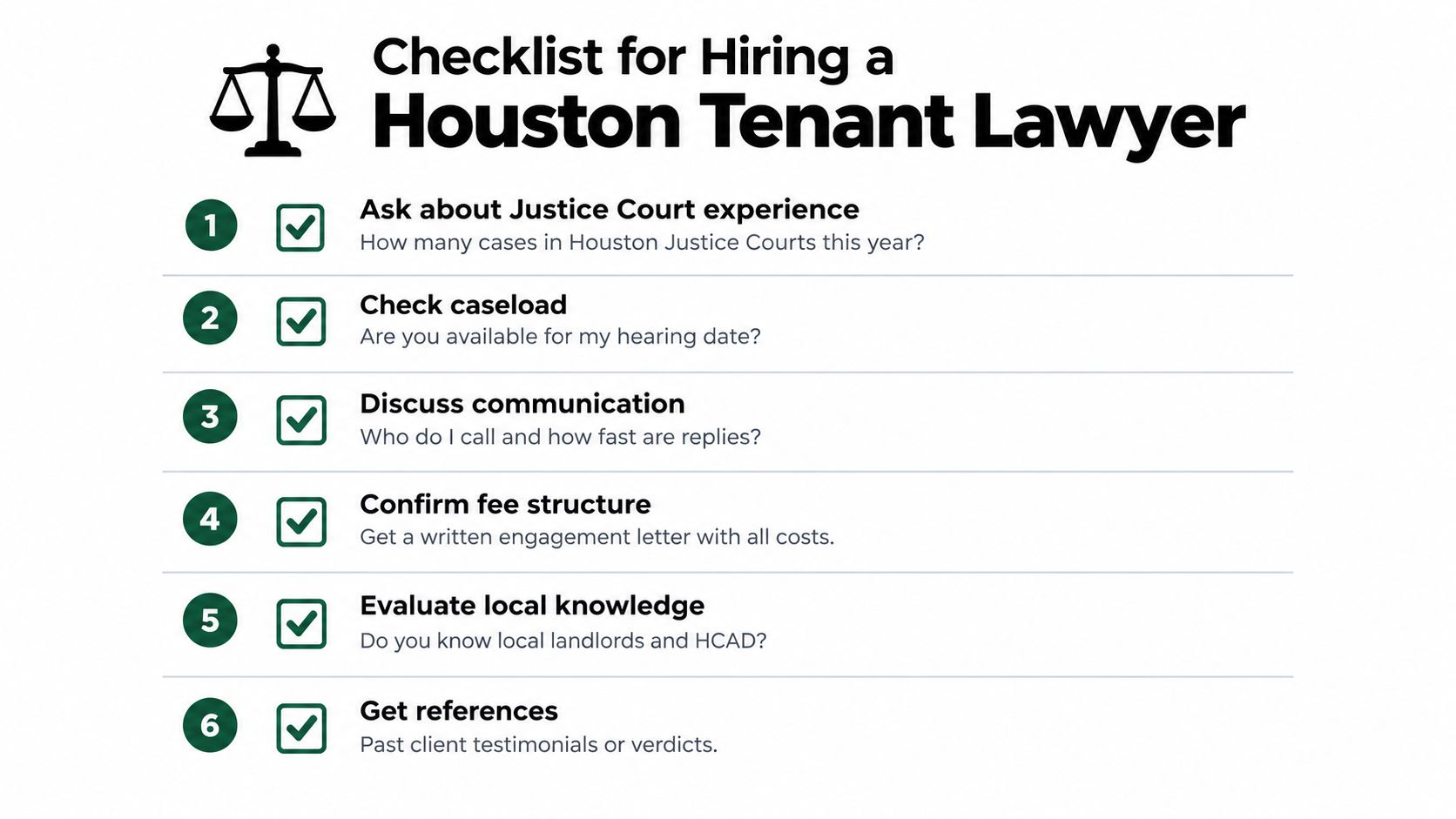
Treat the free consultation as a two-way interview. You're deciding whether the lawyer understands Houston Justice Court procedure, Texas landlord-tenant law, and the practical urgency of your situation.
Ask six direct questions:
- How much Justice Court eviction experience do you have in Harris County? Ask for a clear description of recent experience rather than a general statement that the lawyer handles evictions.
- Will you review my lease and notice before recommending a defense? A lawyer should want the documents that control the dispute.
- Who will appear in court? Confirm whether the consulting lawyer, another attorney, or an associate will handle the hearing.
- What does representation cost? Ask for the fee structure, included work, additional expenses, and appeal terms in writing.
- How quickly will you respond to a repair or retaliation issue? A delay can matter when a notice or unsafe condition is already active.
- What should I do today? You should leave with a practical list of documents, payments, notices, and deadlines.
Watch for avoidable red flags
Be cautious if a lawyer demands full payment before reviewing basic documents, gives vague answers about the Texas Property Code, has no courtroom plan, cannot explain who will handle the hearing, or refuses to provide a written fee agreement. You're entitled to understand the scope of representation before you commit.
If you're facing a notice to vacate, send the lawyer your lease, notice, rent records, and repair communications immediately. Book the consultation within 48 hours when possible, because the default notice period and appeal deadline can expire before you've finished gathering every document.
The Law Office of Bryan Fagan, PLLC offers a free 30-minute consultation to evaluate Texas landlord-tenant disputes, explain your rights, and discuss a practical strategy for eviction, repairs, retaliation, or deposit issues. Contact The Law Office of Bryan Fagan, PLLC with your lease and notice ready so you can get focused guidance before the next deadline passes.