
Dealing with a landlord dispute or eviction can be stressful, especially when you're standing at a justice court clerk's window with incomplete paperwork, limited time, and no clear idea what happens next. A landlord may be trying to recover possession of a rental property, while a tenant may be holding repair records, payment receipts, or proof that the notice was defective.
Filing an eviction in Texas justice court is a fast civil process with strict procedural steps. The case usually starts with written notice, continues through a petition and service of citation, and ends with a hearing where the judge decides possession. This guide explains the practical filing requirements, the 2026 sworn-petition changes, high-volume docket concerns, hearing strategy, and appeal deadlines in plain English.
What It Means to File an Eviction in a Texas Justice Court
On a typical weekday morning, a Harris County justice court may have a landlord carrying a lease and Notice to Vacate in one hand, while a tenant waits nearby with payment receipts and repair photographs. Both people may be anxious, but they're entering the same civil process. In Texas, a landlord starts a residential eviction by filing a forcible detainer action in the justice court precinct where the rental property is located. Texas Property Code Chapter 24 provides the statutory framework.
A forcible detainer is not a criminal prosecution. It's a summary civil lawsuit asking one narrow question: who has the present right to possess the property? The justice court can decide possession and related matters within its jurisdiction, but complicated title disputes generally belong in a higher court. A landlord cannot lawfully skip the lawsuit by changing the locks, removing the tenant, or shutting off utilities.
Practical rule: A lease violation may justify seeking possession, but it doesn't give a landlord permission to conduct a self-help eviction.
The process usually follows this sequence:
- The landlord gives the required written notice.
- The landlord files a sworn petition in the correct precinct.
- The court issues a citation.
- A sheriff or constable serves the tenant.
- The court holds a hearing.
- The judge enters a judgment for possession or against the landlord.
- If the landlord wins and the tenant doesn't timely appeal, the court may issue a writ of possession.
The justice court process is designed to move quickly. That speed creates a real trade-off. A landlord may recover possession without waiting through a lengthy civil lawsuit, but a tenant must act promptly to preserve defenses, request relief, or appeal. Claims involving rent, damages, or other charges may require separate treatment, and local jurisdictional rules matter before a landlord adds money claims to the case.
For tenants, receiving a citation is not the same as being physically removed from the property. For landlords, filing the petition is not the same as winning possession. Each side still has to satisfy notice, service, evidence, and deadline requirements.
The Legal Foundation for a Forcible Detainer Suit in Texas
Before filing, identify three things: the legal basis for removal, the correct notice, and the proper venue. A forcible detainer case commonly involves nonpayment, a lease violation, or a tenant who remains after the right to possess the property has ended. The justice court decides immediate possession, not every dispute that may exist between the parties.
Under Texas Property Code Section 24.002, a forcible detainer concerns possession after a person wrongfully holds over or remains after the right to occupy has ended. The court shouldn't decide a complicated ownership dispute inside a simple eviction case. If the tenant claims the landlord has no title and that issue requires a full title determination, the matter may need to proceed elsewhere.
Texas Property Code Section 24.005 generally requires at least three days' written notice to vacate, unless the written lease provides a different period. The notice period is a default rule, so the lease must be reviewed before the landlord prepares the notice. A landlord should also confirm how the lease permits delivery, then keep proof of when and how the notice was delivered.
For a practical explanation of the notice rule, review Texas Property Code Section 24.005 and eviction notice requirements. The date calculation matters. Filing too early can lead to dismissal and force the landlord to restart the process.
Choosing the notice and venue
A landlord terminating a month-to-month tenancy must examine the agreement and the applicable statutory rules rather than automatically using a nonpayment form. A nonpayment case should identify the rent allegedly due and explain the notice given. A holdover case should identify when the tenancy ended and why the tenant no longer has a right to remain.
The case belongs in the justice court precinct where the property sits. The tenant's residence and the landlord's business address don't control venue. Section 24.004 governs the venue framework, while local clerk instructions determine the practical filing process.
| Notice Type | Statutory Basis | Required Form | Who Can Be Served |
|---|---|---|---|
| Nonpayment notice | Texas Property Code Section 24.005 and the lease | Written notice to vacate, or a pay-or-vacate notice when applicable | The tenant and other permitted occupants under the lease and delivery rules |
| Holdover or tenancy termination notice | The lease and applicable Texas Property Code provisions | Written notice stating the tenancy is ending and when possession must be surrendered | The tenant through a legally permitted delivery method |
| Lease-violation notice | The lease and applicable statutory requirements | Written notice identifying the violation and required action | The tenant through the method authorized by law or the lease |
The safest approach is to match the notice to the actual ground for eviction. A notice that says too little, uses the wrong deadline, or misstates the rental unit can become the tenant's strongest defense.
Preparing the Filing Packet and Required Forms
A filing packet can fail at the clerk's window because one document uses a different address or the petition lacks the required verification. The petition opens the case, so its details must match the lease, notice, and property records. Identify the plaintiff, every defendant who should be named, the complete rental address, the unit number, the ground for removal, the date and delivery method of notice, and the possession requested. In a multi-unit property, omitting the unit number can create service problems.
For cases filed on or after January 1, 2026, SB 38 and the new Texas eviction rules require the petition to be sworn. The plaintiff or authorized representative must verify the facts stated in the pleading. A rent-default filing should accurately state the rent allegedly owed. An unsigned or unsworn petition may be rejected or require correction before the case proceeds. The Texas Justice Court Training Center forms and resources provide current procedural materials for this framework.
Assemble the documents before visiting the clerk
A practical filing packet usually includes:
- Sworn Petition for Forcible Detainer: State who owns or controls the right to possession, who occupies the property, why possession is sought, and how the required notice was delivered.
- Lease and addenda: Include the signed agreement, renewals, rules, notices, and provisions that alter the default notice period.
- Notice to Vacate and proof of delivery: Keep the notice itself, delivery record, photographs, mailing documentation, or other proof supporting the stated date and method.
- Civil case information materials: Confirm whether the justice court requires a civil case information sheet or a local substitute.
- Servicemember affidavit: Determine whether each defendant's military status requires an affidavit under the federal Servicemembers Civil Relief Act.
- Filing fee or fee-waiver request: Verify the current local amount and any required waiver forms before submission.
Local courts may use different checklists or request additional paperwork. Before visiting the clerk, review the Texas Justice Court Training Center forms and resources and the applicable precinct instructions. For a broader landlord-side walkthrough, see this guide on how to evict a tenant in Texas. A plain-language overview of the Chapter 24 process is also available in The Texas Eviction Process Explained, but neither resource replaces the local clerk's checklist or legal advice in a contested case.
Use a pre-filing quality check
Before submitting the packet, compare every name and address across the lease, notice, and petition. Confirm the precinct from the property location, not the landlord's mailing address. Check that the petition is signed and sworn, the correct defendants are named, the unit number is complete, the military affidavit is included when required, and the fee or waiver paperwork is acceptable.
These checks address the problems that most often delay acceptance: filing in the wrong precinct, leaving out an apartment or unit number, submitting an unsigned or unsworn petition, omitting required military-status paperwork, or presenting an incorrect fee or waiver request. Correcting them before filing is usually easier than fixing the case after service or at the hearing.
Filing Fees, Service of Citation, and the Hearing Timeline
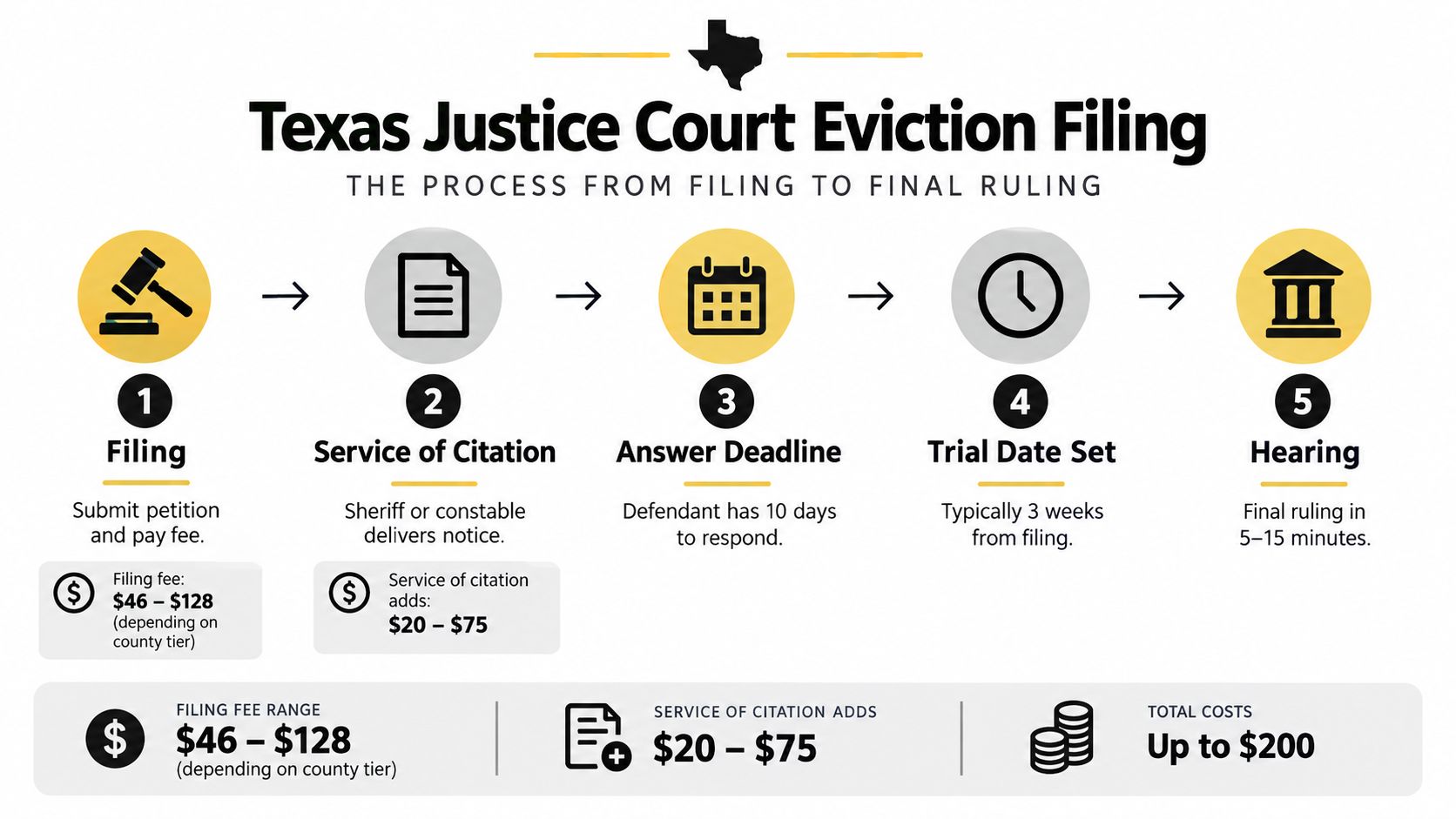
After the notice period expires, the landlord files the petition in the proper justice court. Filing costs vary by county and court. For example, Travis County states that filing and service on one person cost $144.00, with $90.00 for each additional person, according to its justice court eviction guidance. That local example is more useful than relying on a statewide estimate because each precinct's fee and service process may differ.
The clerk issues a citation after accepting the case. In an eviction case, service generally must occur at least six days before the hearing, and the hearing date is commonly set between 10 and 21 days after filing. The citation tells the tenant where and when to appear. A landlord should track issuance and service rather than assuming the tenant received the paperwork.
Service and scheduling choices
The constable or sheriff usually handles service. A private process server may be useful in some circumstances, but the filer must confirm what the particular court permits for an eviction citation. If service fails, the landlord should promptly ask the clerk or constable what additional process is available.
The basic planning sequence looks like this:
- Notice expires: The landlord confirms the tenant hasn't surrendered possession and that filing is permitted.
- Petition filed: The landlord submits the sworn petition, supporting documents, fee, and required affidavits.
- Citation issued: The clerk prepares the official court papers.
- Service completed: The tenant receives the citation and petition under the applicable service rules.
- Hearing held: Both sides present evidence and defenses.
Because dates can be short, landlords and tenants benefit from a written deadline calendar. A digital system such as Attorney Assistant deadline tracking tools can help organize notice dates, filing dates, service status, hearing dates, and appeal deadlines, but it doesn't determine the legally correct deadline for a specific case.
A tenant shouldn't ignore the citation because the hearing is scheduled quickly. A landlord shouldn't assume an uncontested case is guaranteed to succeed. A defective notice, incomplete service record, or missing sworn verification can change the result before the judge reaches the underlying rent dispute.
What High-Volume Dockets Mean for Your Case
A busy justice court changes how an eviction filing unfolds in practice. In Harris County, Texas Housers reported more than 76,500 eviction filings in 2023 and 225,994 filings since the start of 2020. Only 2.02% of defendants were represented by counsel. The Harris County eviction analysis also reported a countywide filing rate of 10%, rates reaching 13% in some precincts, and 52% of filings concentrated in two precincts. 43% of cases ended in dismissal.
Dallas County also handles a substantial number of cases. A 2026 housing-law summary cited 50,117 eviction cases filed in 2024, described as the highest volume in 25 years of available data, with roughly 200 filings per business day and about 10.5% of renter households facing a filing that year. At that volume, a filing that appears simple on paper can create practical delays or confusion for clerks, constables, judges, landlords, and tenants.
Eviction Lab reported 1.23 million eviction cases nationwide in 2025. Its 2025 report described Travis County filings as 27% above normal and Austin-area filings as reaching a five-year high. Eviction Lab's 2025 Eviction Tracking System report places Texas filing activity within that broader national and regional context.
Practical effects of a crowded docket
In a high-volume precinct, parties may have less time for informal discussion and more pressure to identify the controlling issue immediately. A landlord with an organized filing packet can explain the possession claim without searching for documents at the counter or in the courtroom. A tenant with a payment history, notice objection, or repair record should identify the specific dates and documents supporting that position.
The figures do not establish a uniform hearing schedule for every precinct. They do show why local workload matters to the practical experience of the case.
| County or market | Reported activity | Other data |
|---|---|---|
| Harris County | More than 76,500 filings in 2023 | Data not reported |
| Dallas County | 50,117 filings in 2024 | Data not reported |
| Travis County and Austin area | 2025 activity above normal and at a reported five-year high | Data not reported |
There is no verified statewide rule that every crowded precinct sets hearings on one fixed timetable. The law establishes the hearing window, while local workload affects scheduling, clerk interactions, and the pace of the docket. File with a complete packet, confirm that service has been completed, and prepare to state the key issue promptly. A short, organized explanation is more useful than expecting the judge to reconstruct the entire history from scattered papers.
Hearing Day, Common Defenses, and Judgment Outcomes
Hearing day is usually more structured than people expect. Check in, confirm the courtroom, and keep the lease, notice, payment ledger, photographs, messages, inspection records, and service documents organized. The judge generally needs proof of the right to possession, the notice, the tenant's continued possession, and any response to the tenant's defenses.
A landlord should be ready to explain how business records were created and maintained. A property manager can identify the lease and ledger if the manager has personal knowledge of the account. A tenant should bring original receipts or clear copies, identify disputed payments by date, and connect repair photographs to written requests and the landlord's response.
Defenses that require focused proof
A tenant may raise several defenses, but a defense succeeds only when the evidence fits the legal rule and the facts of the case. Common issues include:
- Improper notice: The notice used the wrong deadline, identified the wrong unit, failed to follow the lease, or wasn't delivered as required.
- Payment dispute: The tenant paid, the landlord accepted an amount that changed the balance, or the ledger doesn't match bank records.
- Habitability and repairs: Conditions may implicate Texas Property Code Section 92.056, but the tenant generally needs proof of notice, the condition, the landlord's failure to make required repairs, and the legal effect on the eviction.
- Retaliation: A tenant may argue the eviction followed a protected complaint or legal action. The timing and documents matter, and retaliation doesn't automatically defeat a nonpayment case.
- Lease status: The tenant may show that the lease was renewed, the landlord agreed to more time, or the alleged violation was cured under the agreement.
A tenant should file an answer when possible, but shouldn't assume the absence of an answer means no defense exists. Appearing at the hearing, bringing evidence, and responding directly to the allegations are critical.
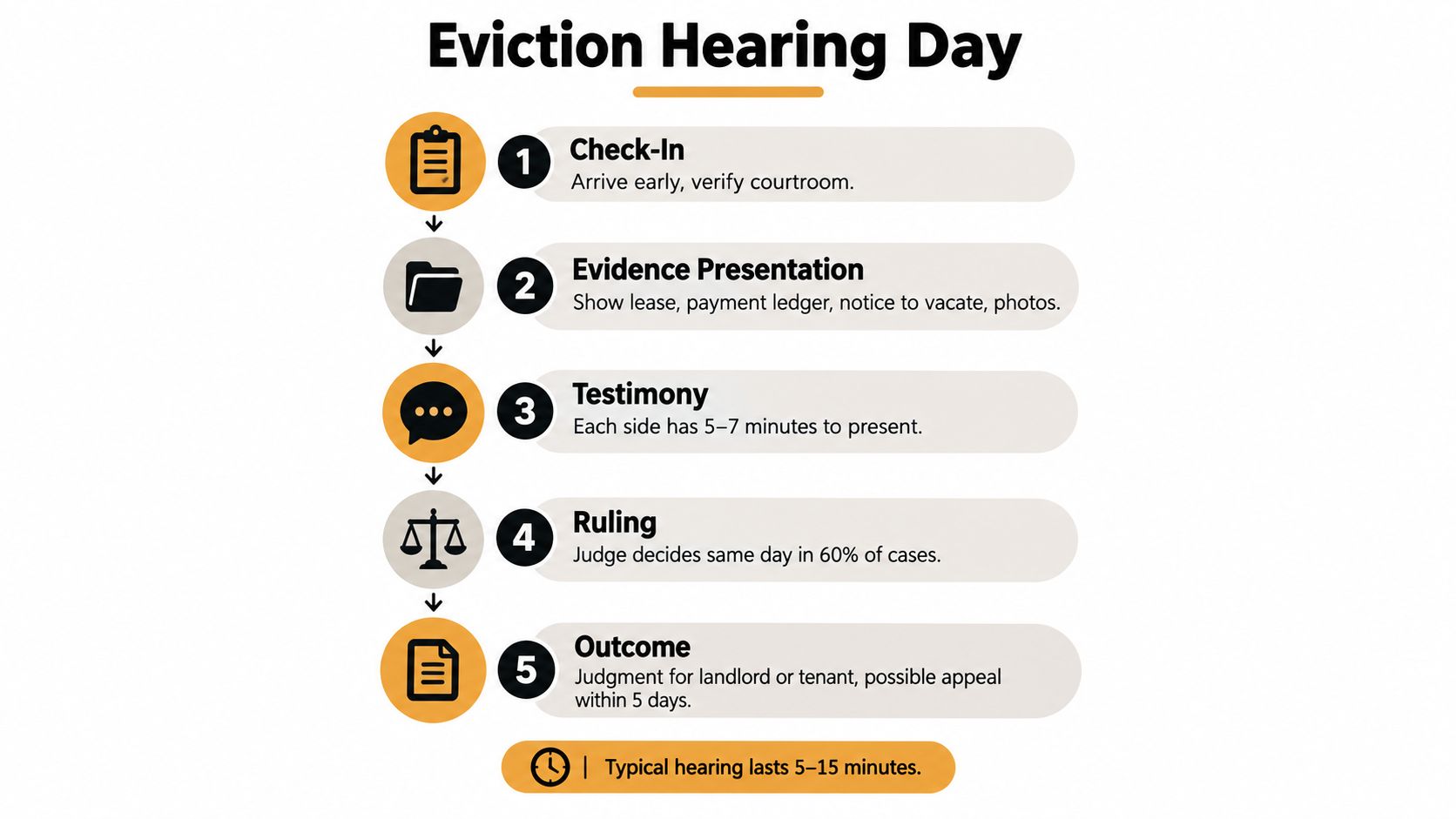
The judge may rule for possession, deny the eviction, or dismiss the case because the landlord failed to prove a required procedural element. A default judgment is possible when the tenant doesn't appear and the landlord proves proper service and the case requirements. The justice court's central question remains possession, even when the parties have additional financial disputes.
A judgment isn't the same as an immediate physical lockout. Post-judgment deadlines control what happens next. If the landlord obtains possession, the tenant should read the judgment and citation carefully, then act immediately if an appeal or other relief is appropriate.
Appeals, Writs of Possession, and When to Get Help
The most dangerous post-judgment mistake is waiting to decide whether to appeal. Texas materials state that a tenant must file an appeal bond, cash deposit, or statement of inability within five calendar days after the judgment is signed. Weekends and holidays count. The appeal is perfected when the required filing is made in the justice court, not merely when someone says they intend to appeal. Review how to appeal a Texas eviction immediately after judgment if you're considering that option.
In a nonpayment case, the judge sets the bond amount to cover rent accruing during the appeal. A tenant who files the wrong document, posts the bond in the wrong place, or misses the deadline can lose the appeal opportunity. A landlord should also treat an appeal as an active case rather than assuming the judgment ends every issue.
Writs and the physical move-out
If the judgment stands and the tenant doesn't obtain a stay, the landlord may request a writ of possession. The constable executes the writ under the governing procedure and provides at least 24 hours' notice before the physical removal. The tenant should not wait for the officer to arrive before arranging legal help, transportation, medication, pets, documents, and essential property.
Landlords should never treat a writ as permission to improvise. Changing locks before lawful authority, removing belongings without following the required process, or using threats can create separate liability. Tenants should photograph the condition of the unit, preserve the judgment and writ, and ask the constable or court clerk about the exact timeline.
Legal help is especially important when the case involves:
- Complex habitability evidence: Repair records, inspection reports, health concerns, or disputed access.
- Servicemember questions: A defendant may have protections that affect default and procedure.
- Multiple units or defendants: Service and identification errors can affect part of the case.
- Competing ownership or contract claims: The dispute may exceed the narrow possession question.
- An urgent appeal: The five-day deadline leaves little room for correction.
Property owners handling broader financial administration may also need separate guidance, such as how to protest Texas property valuation. That issue is distinct from an eviction, but keeping property-tax records separate from possession litigation can prevent confusion.
For landlords, a Texas eviction attorney can review the notice, verify venue, prepare the sworn petition, organize service, and present the evidence. For tenants, a Texas landlord tenant lawyer can assess notice defects, payment disputes, retaliation, habitability concerns, and appeal options. Court-approved forms and local self-help resources can help with basic filings, but they don't replace case-specific advice when possession is at risk.
The Law Office of Bryan Fagan, PLLC helps Texas landlords and tenants evaluate eviction filings, sworn-petition requirements, notice problems, courtroom defenses, and five-day appeal deadlines. Schedule a free consultation through The Law Office of Bryan Fagan, PLLC to discuss your justice court case, lease dispute, repair issue, or property-rights concern and receive a practical strategy for the next step.