
Dealing with an adult child, sibling, parent, or other relative who refuses to leave your Texas home is both a legal problem and a family crisis. You may own the house, pay the mortgage, and have stopped giving permission, but those facts alone don't decide whether you can remove the person immediately.
The central issue in evicting a family member in Texas is occupancy status. A relative who moved in with permission may be treated as a tenant even without rent or a written lease. If that happens, you generally need written notice, a Justice Court case, and a court-authorized writ before a constable can carry out a lockout. A Texas landlord tenant lawyer can help you classify the arrangement before one bad notice creates weeks of delay.
When a Family Member Refuses to Leave and You Own the House
A Houston homeowner lets her adult child move in after a job loss. She doesn't charge rent, covers the utilities, and tells the child to stay as long as necessary. Months later, the relationship breaks down. The homeowner asks the child to move out, but the answer is, “Make me.”
The homeowner's first instinct may be that family members are guests and guests can be removed whenever permission ends. That assumption can be dangerous. The question that controls the next move is simple: did the family member become a tenant under Texas law, even without a lease or rent?
Texas law focuses on possession and occupancy, not the family relationship. A person who lives in a home with permission may be treated as a tenant at will or, after permission ends, a tenant at sufferance. The homeowner usually can't put the person's belongings outside, change the locks, or call the police to force a permanent resident out. The formal forcible detainer process may be required under Texas Property Code Section 24.005.
Why informal arrangements create legal risk
A family member can acquire tenant-like protections through conduct. Keys, a bedroom, mail delivered to the address, shared bills, regular contributions, or an understanding that the person can live there indefinitely can all help establish permitted occupancy. Even when nobody used the word “rent,” the facts may support an oral or implied rental relationship.
Some arrangements are closer to a short-term guest relationship. A visitor who never established the home as a residence may be treated differently from a relative who moved in, stored property, receives mail, and has lived there for an extended period. But don't gamble on that distinction after the conflict begins.
Practical rule: Treat a permitted family resident as a possible tenant until the facts and Texas law support a different conclusion.
The safest course is to document the arrangement, identify the correct notice period, and use the court process if the person won't leave. Blood relation doesn't override the Texas Property Code, and ownership doesn't authorize self-help removal.
Legal Status of the Family Member Under Texas Law
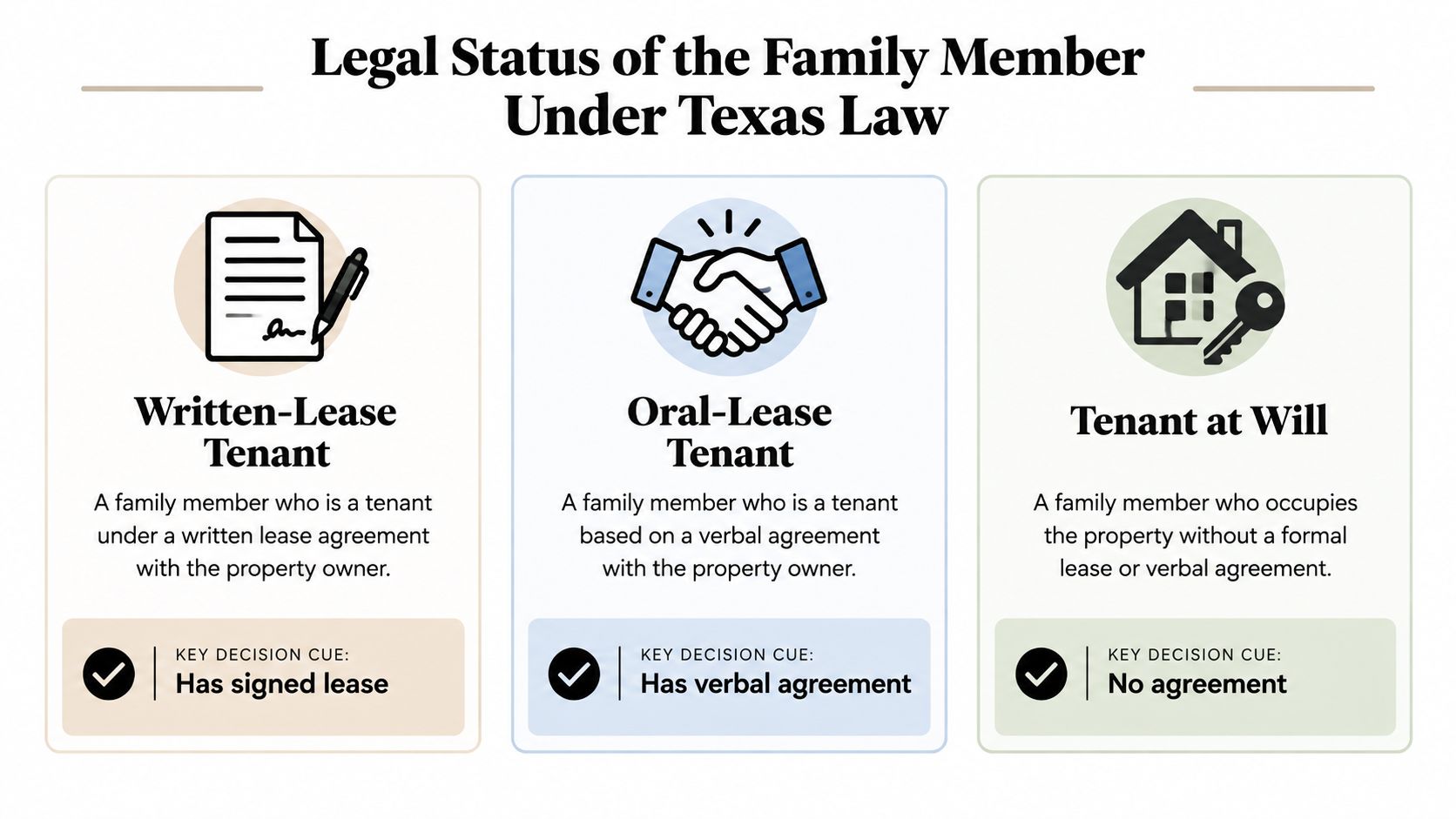
Texas family-member occupancy usually falls into one of three practical categories: a tenant under a written lease, a tenant under an oral or implied agreement, or an occupant at will or by sufferance. A genuine guest may fall outside those categories, but misclassifying a resident is one of the most common ways a homeowner damages an otherwise valid case.
The three categories that matter
A written-lease tenant has a signed agreement identifying the right to occupy the property, rent or other obligations, and termination terms. The document usually provides the starting point for deciding whether the owner has grounds to end possession and how much notice is required.
An oral-lease tenant may have no signed paper but still have an agreement to live in the home. The agreement can involve money, services, shared bills, or other exchanged obligations. A zero-dollar arrangement can still create permitted occupancy and may be analyzed under Chapter 24.
A tenant at will lives there with the owner's permission but without a fixed lease term. Once permission ends, the person may become a tenant at sufferance if they remain. The owner still needs to follow the applicable notice and forcible-detainer procedure in many situations. Texas Property Code Chapters 91 through 94 and Chapter 24 govern the rental relationship, as summarized in Texas Landlord-Tenant Law: An Overview.
Questions that help classify the relationship
Review the facts before drafting anything:
- Payment or services: Did the family member pay money, utilities, groceries, repairs, or other expenses?
- Access: Did you give the person keys, a code, or unrestricted access?
- Residence evidence: Does the person receive mail, keep substantial belongings there, or identify the address as home?
- Agreement: Did you discuss how long the person could stay, house rules, contributions, or a move-out condition?
- Duration: Has the person stayed briefly, or has the arrangement become an established residence?
A short-term guest may sometimes be handled as a trespass matter after permission ends. A family member who has lived in the home with permission is often treated as a tenant rather than a mere guest. The Texas State Law Library's guidance on removing an unwanted guest also distinguishes at-will occupancy from month-to-month arrangements, which can require different notice.
Don't label someone a squatter just because there isn't a lease. A person who entered with permission isn't transformed into a trespasser merely because the owner later wants possession back. If the classification is unclear, have an eviction attorney review the evidence before serving notice.
Written Notice to Vacate That Holds Up in Court
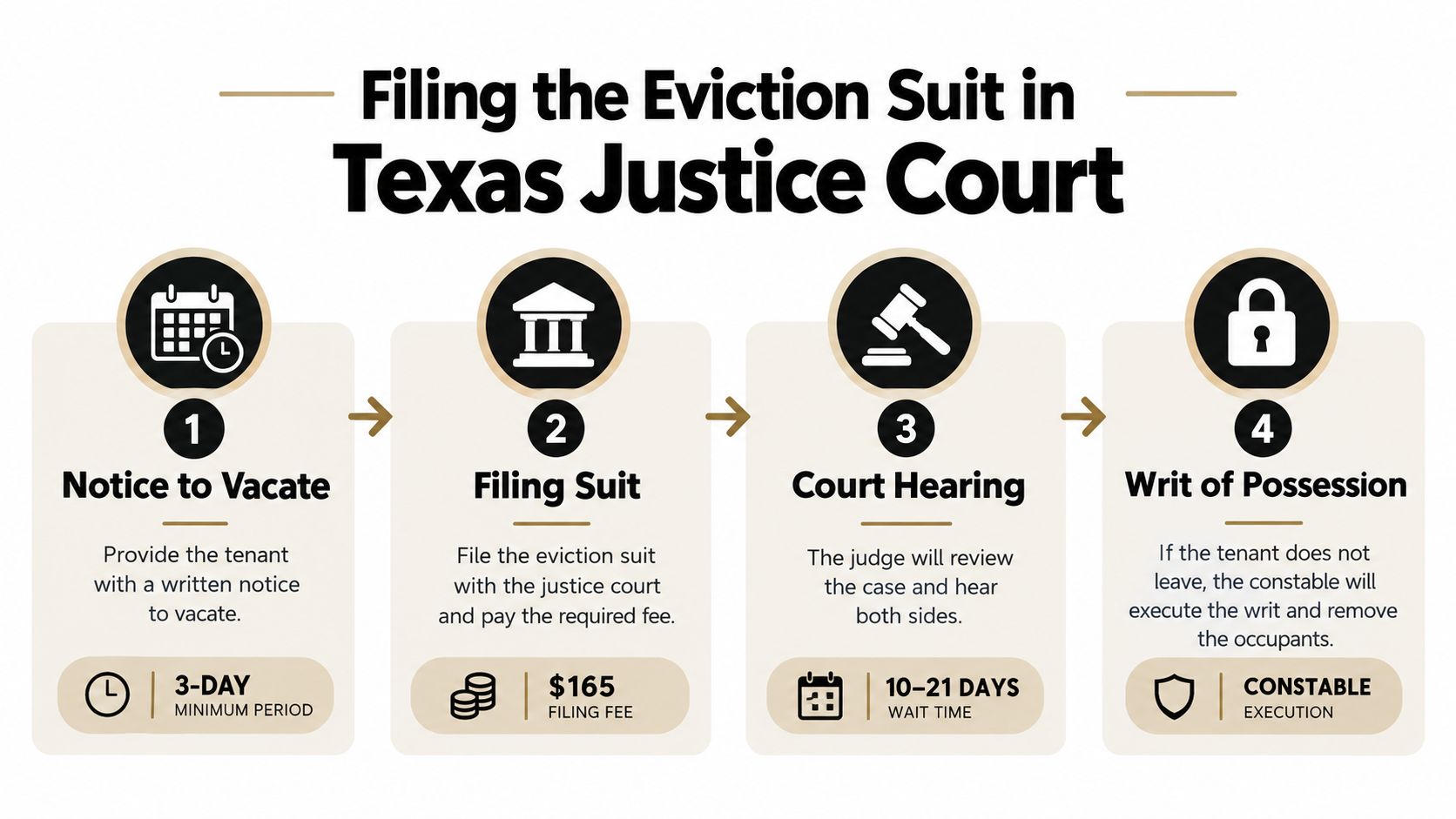
The notice is the foundation of a forcible detainer case. Under Texas Property Code Section 24.005, the default rule generally requires at least three days' written notice to vacate before filing, unless a written lease or agreement sets a different period. The statutory text is available through this Texas Property Code Section 24.005 resource.
Don't automatically use a three-day notice just because there's no written lease. If the facts show a month-to-month arrangement, Texas guidance generally treats the relationship as requiring 30 days' notice. A written or oral rental agreement may also control if it establishes a longer or shorter notice period. The correct period depends on the agreement and the occupant's legal status.
Draft the notice around proof, not emotion
A useful notice should identify:
- The person receiving notice: Use the family member's legal name when known.
- The property: State the complete address and identify the residence clearly.
- The demand: Say that the person must vacate and surrender possession.
- The deadline: Give the exact date by which possession must be returned.
- The basis: State that permission or the tenancy is ending, or identify the relevant lease violation when applicable.
- The consequences: Explain that a forcible detainer case may follow if the person remains.
Avoid insults, threats, family history, and statements suggesting that you intend to remove the person physically. The notice should help a judge understand possession, deadline, and service. It shouldn't become evidence of harassment or retaliation.
Serve it in a way you can prove
Texas law permits specific delivery methods, and the method matters as much as the wording. Follow the statute and any agreement governing notice. Keep the original, prepare a sworn return or other service proof, and preserve photographs, mailing records, and messages.
Photograph the notice after lawful posting when that method applies. Send a duplicate by certified mail, keep the receipt and tracking history, and save a copy of every page. For guidance on elements of a binding document, focus on clear parties, obligations, dates, and signatures, while remembering that a notice to vacate has its own statutory service requirements.
If the deadline passes and the family member stays, don't argue at the doorway. The next move is a forcible detainer filing, not a lock change.
Filing the Eviction Suit in Texas Justice Court
If the family member doesn't leave by the notice deadline, file the forcible detainer case in the Justice of the Peace court for the precinct where the property is located. The petition is designed to identify the property, the occupant, the basis for the right to possession, and the demand that the occupant leave. It isn't a place to tell the entire family story.
Expect filing fees to run roughly $46 to $54, depending on the court and required charges, as described in the Texas eviction-process materials available through Texas eviction procedure guidance. Service fees and local court requirements can add to the amount. A constable or process server must deliver the citation properly before the court can proceed.
Prepare the evidence before the hearing
Bring an organized file, not a stack of loose papers. Include:
- The deed or other evidence of your right to possession.
- Any written lease, roommate agreement, or messages describing the arrangement.
- The notice to vacate.
- Proof of delivery and the service return.
- Photographs showing occupancy and the property.
- Text messages, emails, or other records showing permission, termination, or refusal to leave.
- A clear timeline of when the person moved in and what happened afterward.
The hearing may be scheduled no sooner than 10 days and no later than 21 days after filing, under the Texas eviction process described in the cited court guidance. Justice Court hearings are less formal than many people expect, but the judgment is legally meaningful. Be concise. Answer the judge's questions directly, and don't interrupt the other party.
This video provides another visual explanation of the court workflow:
What happens after judgment
If the court awards possession, the occupant can appeal during the five-day appeal window described in the Texas eviction materials. After that period expires, the homeowner may request a writ of possession. The writ gives the constable authority to carry out the physical removal.
The constable generally posts a 24-hour warning before executing the writ. Only then should the owner coordinate lock changes and possession recovery through the officer's instructions. Do not substitute a personal lockout for the writ.
Common Self-Help Mistakes That Can Derail Your Case
Changing the locks before a court-authorized writ is one of the fastest ways to turn a difficult case into a worse one. If the family member is legally a tenant, shutting them out, removing doors, interrupting essential services, or taking their belongings can expose the homeowner to liability and give the occupant claims that complicate possession.
Texas Property Code Section 92.0081 restricts landlord lockouts and other self-help conduct. The available remedies can include actual damages, attorney's fees, and a $500 civil penalty per violation, as outlined in the Texas tenant guidance on illegal eviction. The precise remedy depends on the facts, but the risk is not worth the shortcut.
Actions to avoid while the case is pending
Don't:
- Change the locks: A new lock can look like an unlawful exclusion before judgment.
- Shut off utilities: Water, electricity, or other essential services can create separate legal exposure.
- Remove belongings: Boxing, dumping, or withholding property can trigger disputes over damage and loss.
- Disable access selectively: Changing codes, issuing new keys, or blocking storage access can appear retaliatory.
- Use threats: Angry texts and confrontations can become evidence against you.
The storage and notice rules under Texas Property Code Section 92.006 may still matter when personal property remains behind. Keep belongings secure, don't destroy or sell anything, and seek legal guidance before moving property.
Protect the house lawfully
Document the condition of the home with dated photographs. Secure your own valuables, communicate in writing, and send calm reminders of the existing deadline. Security cameras can document interactions, but disable audio unless you have confirmed that your recording method complies with Texas wiretap rules and the circumstances of the conversation.
A court order is slower than a spare key, but it gives you enforceable possession instead of creating a second legal dispute.
If you rent the property rather than own it, review your lease before taking action. Your landlord may have rights and obligations that affect the case, and a family member's occupancy could also create a lease violation.
Eviction Alternatives Worth Considering First
Eviction is a legal remedy, not always the smartest first move. When the dispute isn't dangerous, a written move-out agreement can resolve possession without forcing relatives through a public court fight. The decision should turn on safety, speed, cost, and whether the relationship is worth preserving.
Compare the available paths
| Option | Typical Timeline | Approx. Cost | Best When |
|---|---|---|---|
| Negotiated buyout or cash-for-keys | Negotiated, often faster than litigation | Agreed payment and document costs | Both sides can communicate and the homeowner wants a definite move-out |
| Mediation | Depends on mediator and scheduling | Often under $200 | The parties need a neutral person and a written settlement |
| Forcible detainer | Notice, hearing, appeal period, and writ execution | Court, service, and legal costs | The occupant won't agree and the owner needs enforceable possession |
| Protective-order kick-out | Can be faster than ordinary eviction in an emergency | Court and legal costs vary | Threats, violence, harassment, or immediate safety concerns |
| Supported conservatorship | Depends on probate proceedings and facts | Court and legal costs vary | An adult's incapacity creates a need for lawful third-party support |
For a buyout, don't hand over money based on a handshake. Use a written agreement identifying the payment, move-out date, transfer of keys, personal-property terms, and what happens if either side fails to perform. A Texas landlord tenant lawyer can help ensure the document matches the arrangement and doesn't accidentally create a new tenancy.
Mediation can be useful when both parties want a controlled conversation. A settlement should be written, signed, and specific enough to enforce. It won't solve an immediate safety threat, and it shouldn't replace emergency protection.
Safety changes the remedy
If the family member threatens, stalks, harasses, or assaults someone, treat the situation as a safety problem first. Texas Law Help explains that a protective order may include a kick-out provision allowing a court to order law enforcement to remove the respondent from the residence. That is a different remedy from a standard eviction and may be the safer route. Review Texas Law Help's explanation of kick-out orders and contact emergency services when someone faces immediate danger.
A parent dealing with substance abuse or mental-health concerns shouldn't improvise a removal or rely on a conservatorship assumption. Probate and protective proceedings involve different legal standards. Get advice from counsel who can identify the appropriate court and remedy.
Typical Timeline, Costs, and a Clear Next Step
A straightforward, uncontested Texas family-member removal commonly takes roughly three to six weeks from notice to physical removal, based on the benchmark timeline for notice, hearing, appeal, and writ execution in How Long Does Eviction Take in Texas. The case can take longer when the occupant contests possession, service is defective, the court has a backlog, or the parties appeal. County-level appellate or contested litigation can add four to eight weeks or more.
Harris County data also illustrates why filing quality matters. Forty-three percent of eviction filings were dismissals, according to the cited Texas eviction timeline source. That figure doesn't predict the result of an individual family case, but it reinforces the need to prove the occupancy status, deadline, and service method before filing.
The practical planning table
| Phase | Typical Days | Approximate Cost |
|---|---|---|
| Draft and serve notice | 3 days or the applicable contractual period | Notice preparation and delivery costs vary |
| Filing and citation | Up to one week in the stated planning scenario | Filing fees may range from $46 to $130 by county |
| Justice Court hearing | 10 to 21 days after filing | Service of process may cost $75 to $100 |
| Appeal period and writ request | 5 days for the appeal window, then processing time | Writ and execution charges vary by court |
| Constable execution | Often additional scheduling time, with a 24-hour warning before removal | Attorney fees depend on representation and case complexity |
These figures are planning benchmarks, not guarantees. The notice period may be longer if the relationship is month-to-month or an agreement controls. The hearing may be delayed by contested issues, and the constable controls the physical execution schedule.
Know when legal review is worth it
Get counsel before serving notice if the person claims a month-to-month tenancy, disputes ownership, alleges retaliation, has a disability-related defense, or threatens a protective-order response. Review the documents before you spend money on filing. A Texas landlord tenant lawyer can identify a defective notice, organize proof, and tell you whether eviction, mediation, or a protective order fits the actual problem.
The Law Office of Bryan Fagan, PLLC offers landlord-tenant guidance for Texas property disputes, including notice review, eviction strategy, and tenant-rights concerns. Schedule the firm's free 30-minute consultation before serving notice so you can review the occupancy facts and choose a lawful next step.
If you need help removing a family member, defending against an improper lockout, or preparing a Texas eviction notice, The Law Office of Bryan Fagan, PLLC can review your documents and explain your options during a free consultation. Contact the firm before changing locks or filing suit, especially when the resident's legal status or safety issues are unclear.