
You've just left justice court after losing an eviction case. Your hands are shaking, your landlord is asking when you'll leave, and someone has mentioned an appeal. In Texas, you may have only five days after the judgment is signed to act, and weekends and holidays count toward that deadline. The appeal process moves quickly, so waiting for perfect information can cost you the right to fight.
A Texas tenant appeal can give you a new hearing in county court, but it doesn't automatically let you stay in the home. You'll need to file the correct paperwork, choose the right payment method, and follow strict rent-payment rules if you want possession during the appeal. This guide explains the mechanics, the defenses that may matter, and the practical decision between appealing, negotiating, and moving on.
What an Eviction Appeal Means in Texas
The justice court has ruled against you, and your landlord may already be demanding a move-out date. Treat the judgment as urgent, not final. You generally have five days after the judgment is signed to perfect an appeal by filing an appeal bond, cash deposit, or statement of inability to pay court costs. Miss that deadline, and you may lose the right to pursue the appeal. Texas Property Code Section 24.005 sets out this short timeline.
Suppose Maria loses because the justice court finds unpaid rent. She has evidence that the landlord ignored serious plumbing problems and served the wrong notice. Those facts may support a defense, but disagreement alone changes nothing. Maria must file the required paperwork promptly, then meet the financial conditions that protect the landlord while the case continues.
An appeal usually creates a trial de novo in county court. The county judge hears the eviction dispute again instead of merely deciding whether the justice court made a legal or factual mistake. The landlord must prove the right to possession in that new proceeding, while the tenant can present relevant leases, notices, payment records, repair communications, photographs, witnesses, and defenses.
The original judgment does not disappear, and filing an appeal does not automatically let you remain in the home. If staying matters, set up the required bond and rent payments immediately.
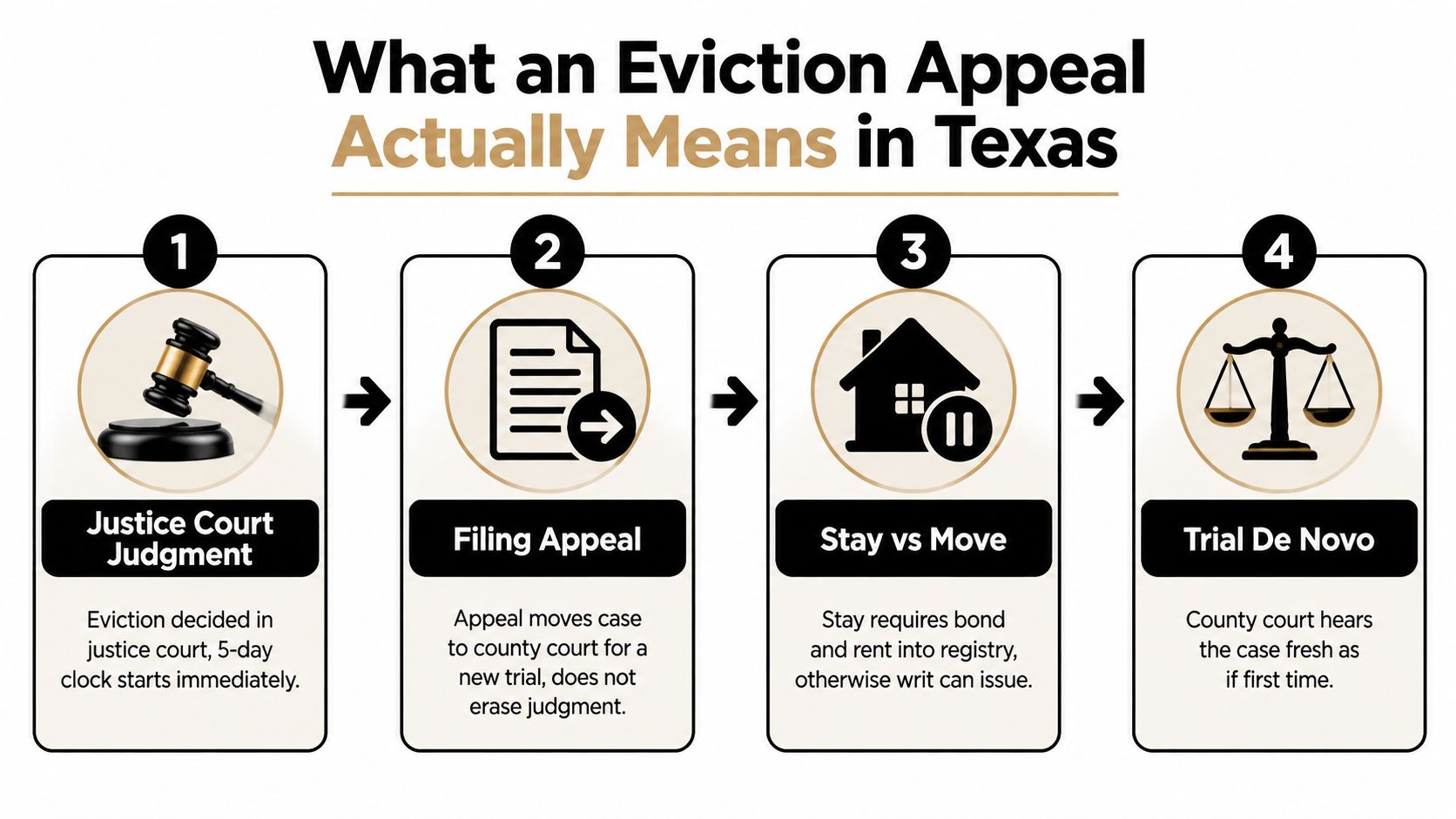
The choices after judgment
A tenant appeal seeks a fresh county-court trial on possession. A landlord may appeal too, but the landlord's reasons and financial obligations can differ. A motion for new trial is a separate request in justice court, and pursuing it must not distract you from the appeal deadline.
Choose based on your evidence, money, and housing plan:
- Stay during the appeal: You remain in the property only if you satisfy the bond and court-registry rent requirements.
- Fight in county court: Appeal when the landlord's notice, rent claim, lease enforcement, or condition-of-the-property evidence gives you a real defense.
- Negotiate: Seek a written move-out agreement, payment arrangement, or other resolution when the risks of trial outweigh the benefit of staying.
- Move on: If your defense is weak or you cannot fund the appeal, leaving voluntarily can protect your belongings and give you control over the transition.
- Lose in county court: The court can award possession and address financial consequences allowed in the case.
For a focused explanation of appealing a justice court eviction ruling, see Appealing a Texas Eviction Judgment. Treat the appeal as a housing and financial decision, not routine paperwork. Call a Texas tenant-rights lawyer quickly if you need help choosing whether to fight, settle, or leave.
How the Texas Property Code Frames an Eviction Appeal
Texas Property Code Chapter 24 supplies the framework for forcible detainer cases and appeals. The justice court decides who has the immediate right to possess the property. If a party properly appeals, the county court generally hears the eviction again through a trial de novo, rather than conducting a narrow appellate review of the justice court's reasoning.
That distinction matters. County court isn't asking whether the justice court acted reasonably. It hears the possession dispute from the beginning, considers the parties' evidence, and decides whether the landlord has established the legal right to remove the tenant. The tenant's lease, notices, payment records, repair communications, photographs, and witness testimony can become important again.
What the key provisions do
Texas Property Code Section 24.005 establishes the short deadline and basic appeal methods after a justice court eviction judgment. For residential nonpayment cases, the opposing party can contest the bond within five days, and the justice court must hold a hearing within five days after that contest, as described in the Texas Property Code appeal provisions.
Section 24.004 addresses the contest process referenced in the statutory framework, while Section 24.603 governs the appeal bond in county court. Texas uses this accelerated process because eviction cases concern immediate possession. The rules don't give parties the same leisurely schedule found in many ordinary civil disputes.
A county court eviction appeal generally concerns possession of the property, not every disagreement between the parties. Related damages claims may be separated from the possession case. For example, a landlord might pursue alleged property damage or other money claims separately, while the appeal focuses on whether the tenant has the right to remain.
Justice Court vs. County Court on Appeal
| Issue | Justice Court, trial | County Court, trial de novo |
|---|---|---|
| Main question | Who has the right to immediate possession? | Who has the right to immediate possession after a fresh hearing? |
| Evidence | Lease, notices, payment records, and defenses | New evidence may be presented again |
| Judge's role | Decides the original eviction case | Decides the appealed eviction case from scratch |
| Prior ruling | Initial judgment | The justice court ruling doesn't receive ordinary deference |
| Scope | Eviction and possession | Usually possession, while related damages may be separated |
You can review the broader process in The Texas Eviction Process Explained, but don't rely on general information to calculate your personal deadline. The signed judgment controls the appeal clock.
Filing Your Appeal Within the 5-Day Window
The deadline is the first problem to solve. A party must perfect a Texas eviction appeal within five days after the justice court judgment is signed, and the period includes weekends and holidays. The safest approach is to treat the judgment date as the starting point and contact the justice court clerk immediately to confirm the exact filing procedure.
You'll generally choose among an appeal bond, a cash deposit, or a Statement of Inability to Afford Payment of Court Costs. The right choice depends on your finances, the court's requirements, and whether you can arrange a surety bond. Don't assume that saying you can't afford the bond is enough. You must file the required sworn statement or other accepted paperwork.
Your filing checklist
- Confirm the signed judgment date. Ask the justice court clerk for a copy if you don't have one. Calendar the fifth day immediately, counting weekends and holidays.
- Select the payment method. Use the appeal bond form and bond required by the court, make a cash deposit if that's feasible, or file the statutory inability-to-pay statement.
- File with the justice court. Submit the appeal filing to the same justice court that issued the eviction judgment. Ask for a file-stamped copy and keep every receipt.
- Prepare for a contest. In a residential nonpayment case, the opposing party can contest the bond within five days, and the court must hold a hearing within five days after the contest. The statutory contest procedure is described in Texas Property Code Section 24.00512.
- Check the county court record. Confirm that the appeal has been transmitted or docketed as required. Don't assume the clerk's acceptance of one document means every step is complete.

Some courts provide forms or local instructions, but procedures vary. Filing fees and bond requirements also vary by county, so ask the clerk for the current amount rather than relying on an online estimate. A Texas tenant-rights lawyer can help identify whether your filing is complete, but a lawyer can't revive an appeal after the deadline has passed.
Practical rule: File first, then keep solving the remaining procedural problems. Waiting until you understand every detail can leave you with no appeal at all.
A late filing can end your chance at a county-court trial de novo and may allow a writ of possession to issue. If the justice court disapproves the bond in a residential nonpayment case, the appealing party has another five-day opportunity to correct the problem through a cash deposit, a sworn inability-to-pay statement, or an appeal of the disapproval to county court. Treat every clerk notice as urgent.
Paying Rent Into the Court Registry to Stay
Filing an appeal doesn't automatically protect your possession. If you want to remain in the unit during the appeal, Texas procedure can require you to pay rent into the county court registry, rather than directly to the landlord. A tenant often must make the initial payment within five days after the appeal bond ruling and continue making monthly payments as required.
The registry is a court-controlled account. It isn't a substitute for rent, and it isn't permission to pay whenever convenient. The Travis County tenant appeal materials explain the bond and registry framework, including the requirement to continue paying rent during the appeal. Review the tenant appeal kit for the type of procedure that may apply.
How to protect your stay
- Confirm the amount: Ask the county clerk what amount qualifies as rent under the order. Don't assume late fees, deposits, or other charges belong in the registry payment.
- Use an accepted payment method: Courts commonly require a cashier's check or money order rather than a personal check. Confirm the local rule before you go.
- Pay the clerk: Direct payment to the landlord may not satisfy a registry order. Obtain a receipt every time.
- Track the lease due date: Continue monthly payments on or before the date required by the lease or court order.
- Keep proof: Save receipts, money-order stubs, clerk instructions, and copies of every filing.
Suppose Daniel makes the initial registry payment, but misses the second monthly payment. Even if his appeal has a strong notice defense, the court may address the missed payment through a show-cause process and issue a writ of possession if he doesn't correct the problem. A strong legal argument won't protect a tenant who ignores the financial conditions of staying.
The money generally remains in the registry until the county court judge orders it released to the landlord or returned to the tenant. Before deciding whether to appeal, read Can You Stop Eviction by Paying Rent in Texas? and ask the clerk exactly what the appeal order requires.
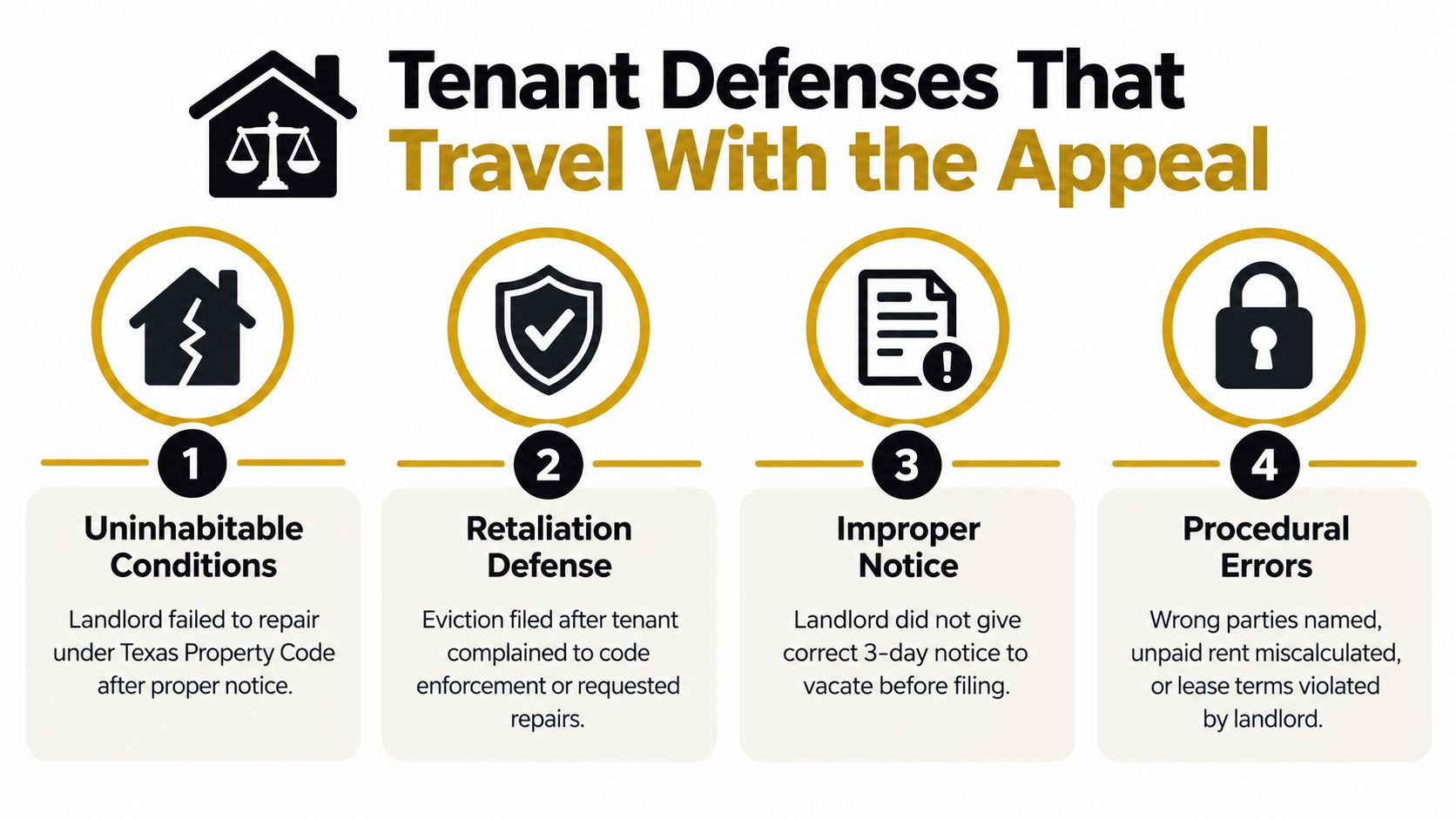
Tenant Defenses That Travel With the Appeal
A trial de novo gives you a chance to present facts again, but an appeal doesn't create a defense that never existed. The best cases usually have documents that tell a consistent story. Start with the lease, notices, court papers, payment history, photographs, messages, and repair requests.
Conditions and repair disputes
A tenant may raise uninhabitable conditions under Texas Property Code Section 92.056 when the landlord failed to address a condition affecting health or safety after proper notice. Mold, lack of heat, or serious plumbing problems can matter when the tenant can show the condition, notice, and the landlord's failure to make a diligent repair effort. Photos with dates, certified-mail records, work orders, texts, and witness statements are more persuasive than a general statement that the apartment was unsafe.
Texas law provides an escalation path before filing suit. The Attorney General's renter guidance says a tenant should send a dated repair notice by certified mail with return receipt requested, registered mail, or personal delivery while keeping a copy. That guidance presumes seven days is a reasonable time for a diligent repair effort, although the presumption can be rebutted. Read the Texas Attorney General's renters' rights guidance.
For a plain-language discussion of when conditions affect a landlord's repair obligations under Section 92.052, see The Landlord's Duty to Repair in Texas.
Notice and retaliation problems
A notice defense can be decisive if the landlord served the wrong document, used an incorrect address, misstated the amount allegedly owed, or failed to include a required claim for attorney's fees. Compare the notice with the lease and the petition. A tenant who has the envelope, photographs of where the notice was posted, and messages showing the landlord used another address gives the county court something concrete to evaluate.
A pay-or-quit defect may also matter when the landlord refused a payment that would have cured the alleged default, or when the notice demanded an amount the tenant didn't owe. Gather payment offers, receipts, bank records, and written responses. Don't rely on an oral conversation that no one else can verify.
Retaliation under Section 92.331 can apply when an eviction follows protected conduct such as a repair complaint or contact with code enforcement. Timing alone doesn't prove retaliation, but a sequence of repair requests, inspection records, hostile messages, and a sudden eviction filing can support the defense. Texas repair-and-reduce or repair-and-deduct procedures under Section 92.058 also require careful compliance before a landlord files in response to a repair dispute.
Use Texas eviction court defenses that may work to organize your documents. A judge is more likely to credit a fact-based defense supported by records than a broad claim that the landlord treated you unfairly.
When to Appeal, Negotiate, or Move On
Appealing is not automatically the brave choice. It's the right choice when you have a real defense, can meet the bond and registry obligations, and have a practical reason to remain or clear the judgment. If you lack evidence and can't keep up with registry payments, an appeal may delay the problem without improving the outcome.
Use three honest decision paths
Appeal when your defense is supported by documents, witnesses, or a clear procedural defect. Examples include a defective notice, proof that the landlord accepted or refused a cure payment, or a documented repair and retaliation timeline. You must also be able to comply with the financial conditions that protect your possession.
Negotiate a move-out when the landlord will sign a written agreement addressing possession, back rent, the writ, and any release of claims. A negotiated move-out within 14 days can be preferable when the landlord agrees to drop the writ and waive back rent, but never rely on an oral promise. Put the agreement in writing before turning over the keys.
Move on when the defense is thin, the paperwork appears sound, and you can't post the required bond or maintain registry payments. Leaving voluntarily doesn't erase every possible financial issue, but it may let you protect your belongings and avoid the disruption of a forced removal.
| Option | Best when | Cost & time | Rental record impact |
|---|---|---|---|
| Appeal | Evidence supports a genuine defense and you can meet payment conditions | Bond plus continuing registry rent, with no guaranteed result | May offer a path to dismissal with prejudice if the defense succeeds |
| Negotiate | The landlord will sign enforceable move-out terms | May involve cash-for-keys or waived claims, with a defined move-out date | Often gives you more control than an eviction judgment |
| Move on | The defense is weak and enforcement appears likely | Moving costs and relocation pressure, but no prolonged appeal | Avoids adding further appeal-related risk, though the existing judgment still matters |
Don't measure the decision only by the apartment. Consider your rental record, housing alternatives, transportation, school, work, money, and the consequences of staying without a reliable legal defense. A short consultation with a Texas landlord tenant lawyer can help you compare those outcomes before the deadline closes.
Your Next 72 Hours and When to Call a Lawyer
The next three days should be practical, not passive. Confusion won't pause the five-day clock, and a missed deadline usually ends the appeal. Start by creating one folder, paper or electronic, for every court and rental document.
Day 1
Find the signed judgment and write the appeal deadline on your calendar. Get copies of the lease, petition, citation, notice to vacate, payment records, repair requests, photos, texts, emails, and any code-enforcement material. Write a short timeline in date order while the details are fresh.
Day 2
Contact the justice court and county court clerks. Ask what form to file, which payment methods are accepted, how the bond is calculated, how to request a contest hearing, and how registry rent must be paid. Request written instructions or a web address for the court's official forms, and save proof of every call and filing.
Contact two Texas tenant-side attorneys for a same-week consultation. A useful consultation checklist includes:
- Fee structure: Ask what the consultation covers, what additional work may cost, and whether court appearances are included.
- Trial de novo experience: Ask whether the lawyer handles county-court eviction appeals, not only original justice court cases.
- Bond assistance: Ask whether the lawyer will prepare or file the appeal bond and whether you remain responsible for posting the money.
- Defense review: Ask which facts support your position and which facts create risk.
- Housing strategy: Ask whether negotiation, relocation, or an appeal best protects your long-term rental record.
The Texas eviction appeal lawyer resource can help you identify the questions to raise during that conversation.
Day 3
Make a go-or-no-go decision based on three issues: Can you meet the bond and registry requirements? Do you have an evidence-backed defense? What housing alternatives exist if you lose? Call a lawyer immediately if the notice appears defective, the case involves habitability or retaliation, or the judgment is over $1,000. The amount alone doesn't decide the case, but it makes prompt legal review especially important.
Don't wait for the landlord or constable to explain your options. Collect the judgment, contact the clerk, preserve your evidence, and schedule a consultation before the appeal window closes.
If you're facing a Texas eviction judgment, The Law Office of Bryan Fagan, PLLC can review the deadlines, bond requirements, registry-payment obligations, and defenses that may support a trial de novo. Schedule a free consultation by visiting The Law Office of Bryan Fagan, PLLC and bring your judgment, lease, notices, and evidence so you can receive a clear next-step strategy.