Skip to content
Dealing with a landlord dispute or eviction can be stressful, especially when several renters are experiencing the same repair, safety, or service problem. You may be trying to bring neighbors together, only to receive a warning from management, a rent increase, or a sudden threat not to renew your lease. Understanding the tenant right to organize a tenant association in Texas can help you respond carefully instead of reacting out of fear.
Texas law recognizes tenant organizing as protected activity. But the protection isn't unlimited, and the statute number matters. Many renters search for “tenant right to organize a tenant association Texas 92.351,” even though the organizing and retaliation provisions are found in Texas Property Code Section 92.331, while Section 92.351 addresses application deposits and application fees. That distinction can prevent you from relying on the wrong rule when you need help quickly.
Understanding Your Right to Organize in Texas
Consider a common situation. Several tenants in an apartment community have reported water intrusion and unsafe conditions. Management responds to each renter separately, but the problems continue. The tenants begin sharing dated photographs, compare repair requests, and discuss sending one written notice together. Before the group meets, one tenant receives a warning that “group activity” violates the lease.
That warning doesn't automatically make the organizing unlawful. Section 92.331 of the Texas Property Code expressly protects a tenant who establishes, attempts to establish, or participates in a tenant organization. The protection applies to the organizing itself. A tenant doesn't have to wait until an association has officers, bylaws, or a formal name before protected activity begins. An attempt to create the group can matter.
What counts as organizing
A tenant association can be a practical group of renters who communicate about shared housing concerns and act together. The group might focus on repairs, safety, maintenance, services, lease administration, or communication with the property owner. You don't need to use legal language in every message, but you should make the group's purpose clear.
For example, tenants might:
- Identify shared concerns: Compare repair records and identify a building-wide issue.
- Coordinate communications: Prepare a written request that accurately describes the problem.
- Attend meetings: Meet offsite or communicate digitally to discuss goals.
- Participate together: Sign or send a notice without threatening staff or disrupting other residents.
The law protects collective advocacy, not harassment, violence, property damage, or refusal to follow valid lease terms. Organizing also doesn't cancel a tenant's duty to pay rent or comply with the lease. The safest approach is calm, factual, and focused on specific conditions.
Practical rule: Keep the association's purpose tied to lawful tenant concerns, and preserve the records that show what the group did and why.
A tenant group can also support a broader rights strategy. Texas tenant guidance recognizes that protections can extend beyond individual repair complaints to tenants who join or form tenant groups, complain to government agencies about housing conditions, or assert rights under Chapter 92. You can review the Texas Landlord-Tenant Law: An Overview for background on how Texas Property Code Chapters 91 through 94 and Chapter 24 govern the rental relationship.
How the Texas Property Code Protects Tenant Groups
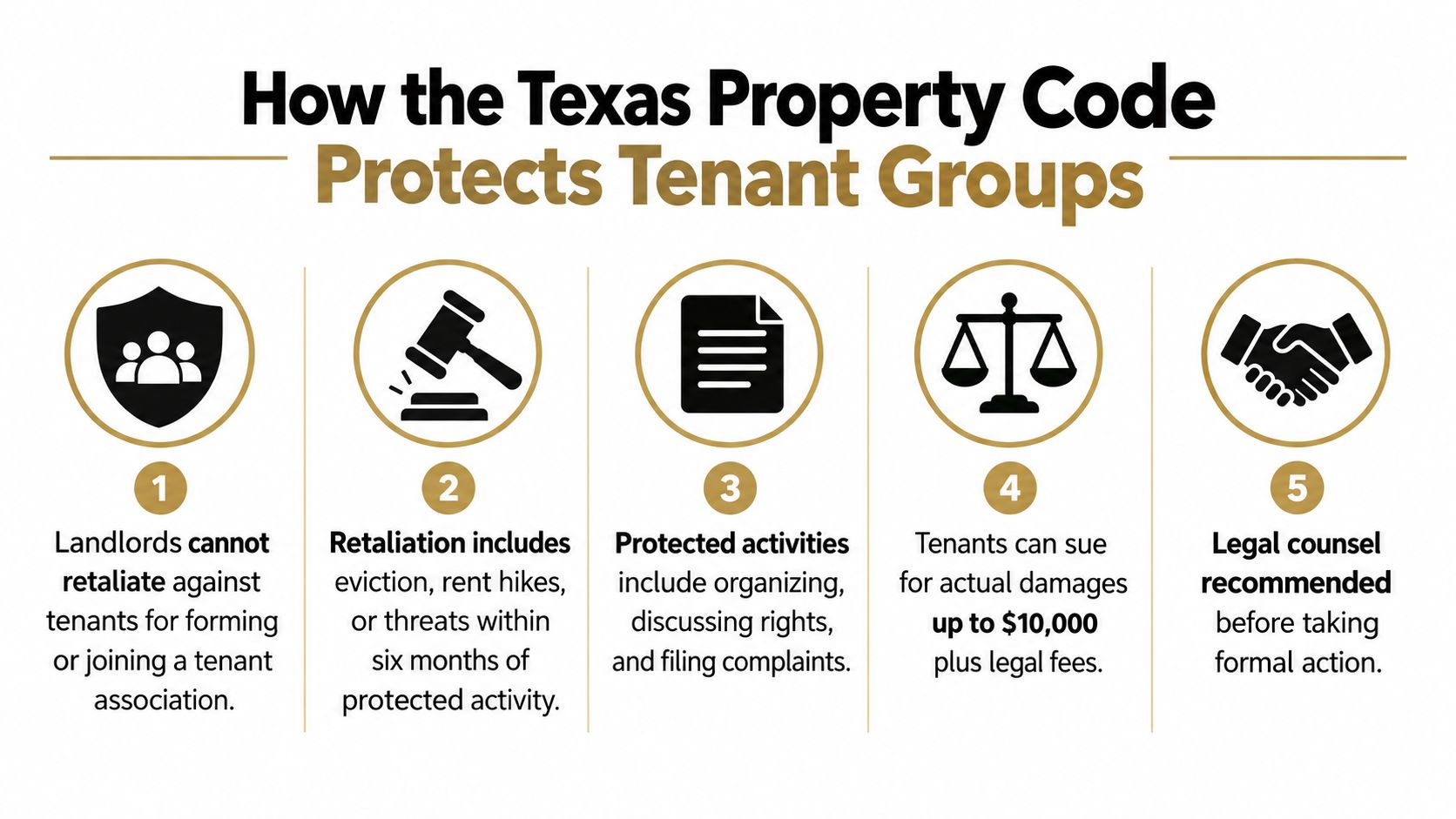
The core rule is straightforward. A landlord may not retaliate against a tenant for establishing, attempting to establish, or participating in a tenant organization. Under Texas Property Code Section 92 and tenant rights, the protection applies during the six months after the tenant's protected activity. The statute identifies specific adverse actions that can signal retaliation.
Actions the statute prohibits
Within that protection window, the statute bars a landlord from retaliating by:
- Filing eviction: Starting an eviction because the tenant organized or participated.
- Taking away use of the premises: Depriving the tenant of the home or otherwise interfering with possession.
- Reducing services: Cutting services because of the protected activity.
- Increasing rent: Raising rent as punishment for organizing.
- Terminating the lease: Ending the lease for the retaliatory reason.
- Interfering with lease rights: Materially interfering in bad faith with the tenant's rights under the lease.
The timing is important, but timing alone doesn't decide every dispute. A landlord can still enforce a lease for a lawful, documented reason, such as genuine nonpayment of rent or a serious lease violation. The question is whether the stated reason is real and supported, or whether it is a cover for punishing protected conduct.
Why the remedy matters
The remedy provision gives the statute practical weight. If retaliation is established, a tenant can recover a civil penalty equal to one month's rent plus $500, together with actual damages, court costs, and reasonable attorney's fees. For subsidized housing, the penalty is tied to the fair market rent rather than the tenant's out-of-pocket rent, which can increase the landlord's exposure in lower-income housing markets. Those remedies are described in Texas Property Code Section 92.333.
That doesn't mean a tenant should make unsupported threats. A strong claim usually depends on a clear timeline, proof of protected activity, evidence of the landlord's adverse action, and facts connecting the two. Save notices, rent ledgers, texts, emails, portal messages, photographs, inspection records, and witness information.
The distinction between organizing and enforcement also protects responsible landlords. A property manager can respond to legitimate lease violations, collect rent, schedule repairs, and enforce neutral policies. What the landlord can't do is change those rules or apply them selectively because tenants acted together.
Steps to Form and Run Your Tenant Association
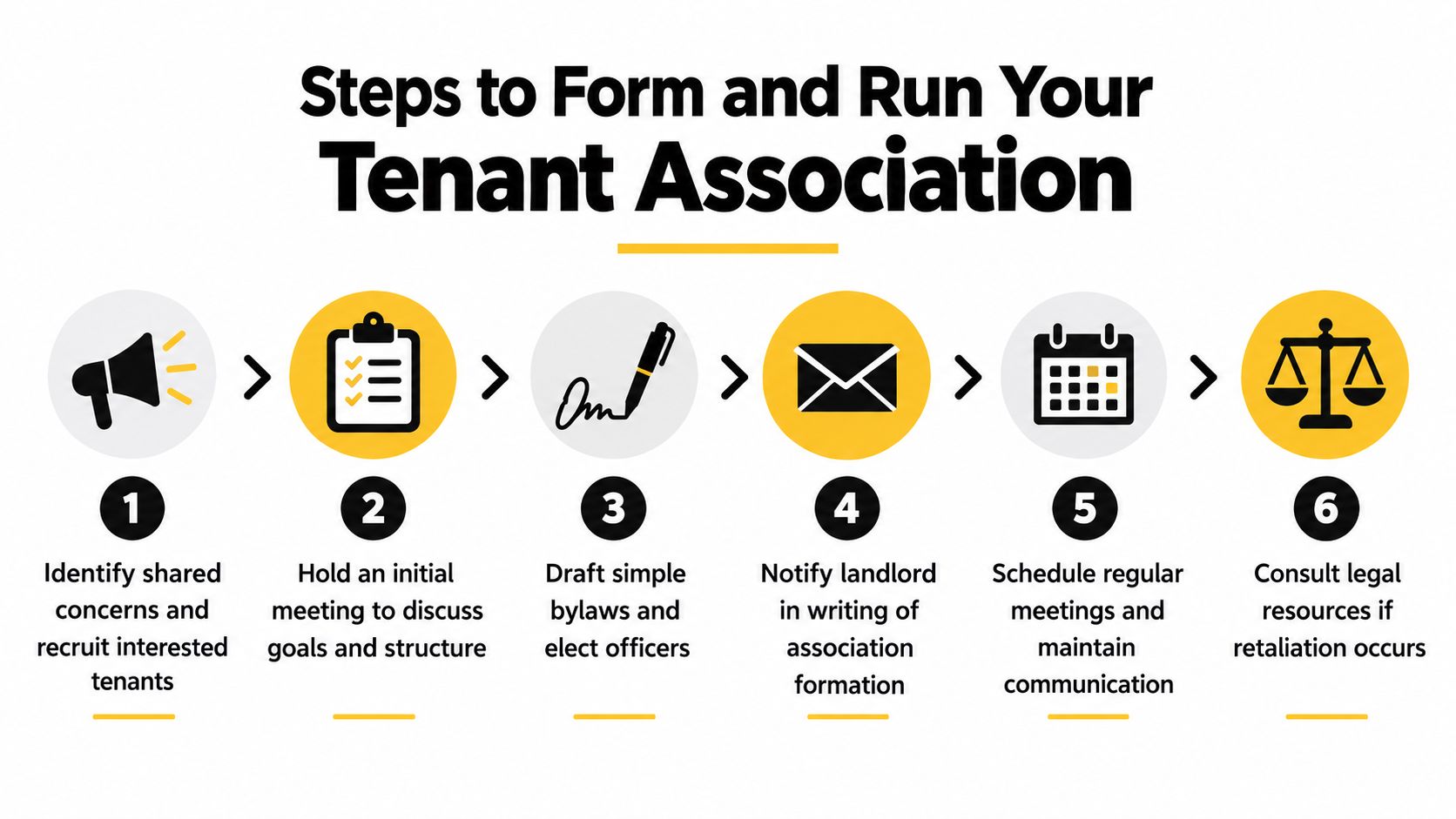
A tenant association works best when it operates like a careful community project rather than an improvised confrontation. The objective is to create a reliable record, identify common concerns, and give the landlord a fair opportunity to respond.
Build the group carefully
Start with shared facts. Speak with interested tenants about the actual conditions they've experienced. Create a membership list with names, unit numbers, contact information, and the concerns each person can document. Don't include rumors or accusations that no one can support.
Coordinate privately and safely. Hold meetings offsite or digitally. Review the lease before using common areas, and avoid blocking entrances, threatening employees, or interfering with other residents. A private meeting location also makes it easier to keep the discussion focused.
Set simple procedures. Agree on the association's purpose, how members will communicate, and who can send notices. Simple written bylaws can help prevent confusion, but you don't need a complicated organization to begin lawful collective activity.
Keep rent records current. Participants should document that they're caught up on rent. Texas tenant guidance emphasizes current rent status because nonpayment can give a landlord a lawful basis for enforcement and can make a retaliation dispute harder to present.
Send important notices in writing. For repair or health-and-safety concerns, identify the condition, the affected areas, the requested response, and the date. Use certified mail or tracked delivery for formal notices so you can prove when the landlord received the communication and what it contained.
Track the response. Texas practice commonly uses a seven-day repair response rule for non-emergency habitability issues, while emergencies can require much faster action, sometimes as little as 24 hours for notice or response expectations. Those benchmarks come from Texas tenant-organizing guidance, but the lease, the condition, and the facts can affect what is reasonable. Don't assume that sending one message ends the process.
Keep a shared timeline. Each entry should identify who acted, what was said, which documents were exchanged, and what happened next. Store original files, not just screenshots, and ask each participant to write a short factual statement while the events are fresh.
After a reasonable opportunity to respond, unresolved health and safety hazards can be reported to the appropriate local inspection authority. That step isn't a substitute for legal advice, but an inspection record can help establish the condition and show that the association used a responsible escalation path.
Don't promise members a particular result. A tenant association can improve communication and add weight to collective demands, but it can't guarantee repairs, rent reductions, renewal, or a court ruling.
Statewide Protections Versus Local City Ordinances
Texas renters need to separate two questions. What does state law protect everywhere, and what additional organizing rules might apply in a particular city or property?
Statewide, Section 92.331 names tenant organizations as protected activity and limits retaliatory actions during the statutory window. That baseline follows the Texas Property Code and is the starting point for tenants in Houston, Dallas, Austin, San Antonio, and other Texas markets. It doesn't automatically create every procedural right a local tenant may have heard about.
The local layer
Austin tenant-rights materials describe a right to organize a tenants' association and provide more detailed guidance about self-organization, meetings, and tenant organizers entering property when invited. Those materials offer a useful operational framework, but richer local guidance isn't the same thing as a statewide rule. Review Austin tenant stabilization and renters' rights guidance before assuming an Austin practice applies in another city.
A practical comparison looks like this:
| Question | Statewide Texas framework | Local framework |
|---|---|---|
| Can tenants organize? | Section 92.331 protects establishing, attempting to establish, or participating in a tenant organization. | A city may provide more detailed guidance or additional procedures. |
| What conduct is restricted? | The state rule focuses on retaliation, including eviction, reduced services, rent increases, lease termination, and bad-faith interference. | Local materials may address meetings, organizer access, or self-organization in greater detail. |
| What should tenants verify? | The lease, Chapter 92, rent status, notices, and the timing of adverse action. | City ordinances, housing programs, property-specific rules, and local enforcement options. |
Don't assume that a city document creates a private claim for damages, and don't assume that a local process replaces the state statute. Conversely, don't overlook local rules that may affect how meetings occur or how organizers access a property.
The strongest approach is to identify the property's city and county, check current municipal guidance, review any subsidized-housing requirements, and ask a Texas landlord tenant lawyer to distinguish enforceable law from best-practice advice. A tenant in Houston may have a different local toolkit than a tenant in Austin, even though both rely on the statewide anti-retaliation protection.
Identifying Retaliation and Enforcing Your Remedies
Retaliation often appears through timing and changed treatment. A tenant helps form an association, sends a documented repair request, or participates in a group meeting. Soon afterward, management issues a notice, raises the rent, reduces services, refuses renewal, or files an eviction case. That sequence deserves careful review, but it doesn't prove retaliation by itself.
The law distinguishes punishment from ordinary lease enforcement. A landlord may pursue an eviction for genuine nonpayment or a serious lease violation, even when the tenant has engaged in protected activity. The tenant's strongest response is evidence showing that the stated reason is inconsistent, pretextual, selectively enforced, or closely tied to the organizing.
Preserve evidence before escalating
Create a retaliation file with:
- The protected-activity record: Meeting dates, membership records, group notices, repair requests, and government complaints.
- The timing record: Rent notices, lease changes, service reductions, nonrenewal notices, and eviction filings.
- The comparison record: Similar violations by other tenants and how management treated them, if you can obtain that information lawfully.
- The payment record: Receipts, portal confirmations, bank records, and communications showing rent status.
- The condition record: Photos, videos, inspection reports, work orders, and witness statements.
Don't alter messages or delete unfavorable material. A complete record is more credible than a selective one.
If retaliation is established, the tenant-remedy provision allows recovery of the civil penalty of one month's rent plus $500, actual damages, court costs, and reasonable attorney's fees. In subsidized housing, the penalty uses fair market rent rather than the tenant's out-of-pocket rent. The statutory remedy is explained in Texas's six-month retaliation presumption under Section 92.331.
Use the right escalation path
Send a focused written response disputing the retaliatory action and preserving your position. If the problem involves an unresolved health or safety hazard, report it to the relevant local inspection authority after giving the landlord an appropriate opportunity to respond. Avoid withholding rent, moving out, or signing a settlement without legal advice, because those steps can change your defenses and available remedies.
A court will care about the lease, notice, dates, payment history, and actual conduct. A calm paper trail gives an eviction attorney or Texas landlord tenant lawyer something concrete to evaluate.
When to Contact a Texas Landlord-Tenant Attorney
You don't need to wait for an eviction citation before seeking advice. Early legal review can help you separate protected organizing from a lease violation, identify whether the landlord's response is lawful, and preserve documents before witnesses forget what happened.
Contact counsel promptly if management threatens to remove you for joining the association, changes your rent or services after a group complaint, refuses to renew soon after protected activity, serves an eviction notice, or ignores a serious health and safety condition. The same applies if you're a landlord who needs to enforce a legitimate lease violation after tenants have organized. A neutral legal review can help prevent an ordinary enforcement action from appearing retaliatory.
What to bring to a consultation
Gather:
- Your lease and addenda
- Rent receipts and account statements
- Every written notice and portal message
- The association's dated meeting and communication records
- Photographs, videos, work orders, and inspection documents
- Any eviction citation, notice to vacate, or nonrenewal notice
Don't rely on memory alone. Dates and original documents often determine whether a claim is viable.
The Law Office of Bryan Fagan, PLLC provides Texas landlord-tenant guidance involving leases, evictions, repairs, retaliation, security deposits, and related property disputes. You can review its Texas rental lawyer services and use a consultation to explain the facts in plain language, understand your options, and develop a practical response.
Organizing can give renters a stronger voice, but it should be done with discipline. Keep rent current when possible, communicate in writing, respect valid lease rules, document every change in treatment, and get advice before a dispute turns into an eviction case.
If you're forming a tenant association, facing landlord retaliation, or responding to an eviction, The Law Office of Bryan Fagan, PLLC can review your lease, timeline, notices, and supporting records. Schedule a free consultation by visiting The Law Office of Bryan Fagan, PLLC to understand your tenant rights and choose a clear next step.