Texas Property Code § 92.008 says your landlord generally can't shut off water, wastewater, gas, or electricity to force you out or pressure you over rent, unless the interruption is for bona fide repairs, construction, or an emergency. If that happens, you can seek immediate court-ordered restoration and may also recover actual damages, one month's rent plus $1,000, reasonable attorney's fees, and court costs.
Dealing with a landlord dispute or eviction can be stressful, especially when the lights go out, the water stops, or your refrigerator starts warming up while you're trying to figure out what happened. For many Texas renters, this doesn't feel like a legal problem at first. It feels like panic.
A common situation looks like this. You paid part of the rent, you and the landlord argued, and then the power suddenly cuts off. Or you come home from work and find there's no water, and the landlord texts that service will come back when you "handle the balance." That kind of pressure can feel overwhelming, but Texas law treats utility shutoffs as a serious issue for a reason.
For help with a utility shutoff by landlord Texas 92.008 tenant remedy, the most important idea is simple. Your first move usually shouldn't be waiting, negotiating in circles, or focusing only on money later. Your first move is protecting your safety, building proof, and using the fast court process that can restore service before a final hearing.
When Your Landlord Cuts Utilities in Texas
Losing utilities in a rental home isn't just inconvenient. It can affect your food, your medication, your kids, your ability to bathe, and whether the home is even livable that night.
Take a simple example. A tenant in Fort Worth gets a message from the landlord saying rent is late and "services will stay off until payment clears." The tenant has a child at home, groceries in the fridge, and no clear idea whether this is even legal. By the time tenants start searching online, they're already behind. They're calling family, buying ice, or trying to find somewhere to sleep.
Practical rule: Treat a sudden utility cutoff as an urgent rights issue, not just a billing dispute.
Texas law has long pushed landlords away from self-help tactics like utility pressure and toward the court system instead. Public legal guidance shows this has been part of Texas policy for decades, with related tenant-remedy provisions effective since at least August 28, 1989 in the broader statutory framework for utility-cutoff liability, as summarized by the Texas State Law Library utility shutoff guide.
Why this feels so urgent
Utility cases move differently from many other rental disputes because the harm happens fast. A broken air conditioner is serious, but a total power or water cutoff can become dangerous within hours. That's why Texas built a faster remedy for this problem than many renters expect.
You may be dealing with:
- Food loss: Refrigerated or frozen food may spoil quickly.
- Medical problems: Some people need electricity for medication storage or medical devices.
- Sanitation issues: No water or wastewater service can make the unit unsafe to stay in.
- Pressure tactics: A landlord may be trying to make you leave without filing through court.
What you need to focus on first
Right now, your job is not to win every legal issue at once. Your job is to stabilize the situation and create a record.
That means:
- making sure everyone in the home is safe,
- documenting what happened,
- giving written notice,
- preparing to ask the justice court for restoration if service isn't restored quickly.
If you're a landlord or property manager reading this, the same urgency applies from the other side. A cutoff that wasn't supported by a real repair, construction need, or emergency can create both court-ordered restoration and money exposure under the Texas Property Code.
What Texas Property Code Section 92.008 Says About Utility Shutoffs
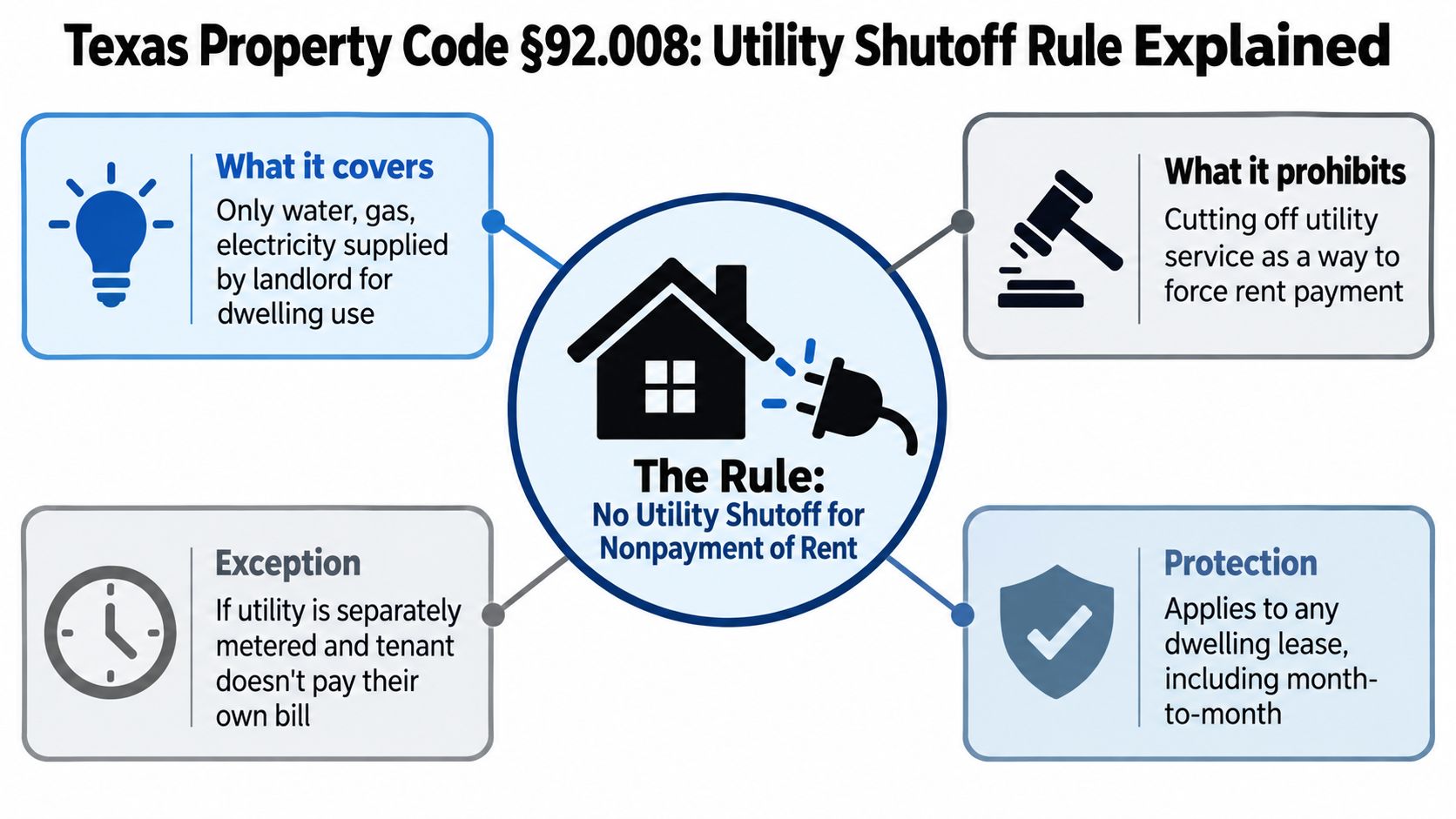
Texas Property Code § 92.008 is the main rule. In plain English, it says a landlord usually may not interrupt or cause the interruption of utility service furnished to the tenant as part of the tenancy. County court guidance confirms the covered services include water, wastewater, gas, and electric service, and the interruption is unlawful unless it results from bona fide repairs, construction, or an emergency, as explained by Tarrant County justice court guidance on interruption of utility service.
What counts as an unlawful interruption
If the landlord provides the utility as part of the rental arrangement, they usually can't cut it off because:
- Rent is late
- You argued with management
- They want you to move
- They want an advantage in a lease dispute
That is why utility shutoffs are often described as a form of self-help. Texas generally requires landlords to use legal process, not utility pressure, when there's a dispute.
A broader view of the rental relationship appears in Texas Landlord-Tenant Law: An Overview, which discusses how Texas Property Code Chapters 91-94 and Chapter 24 govern the rental relationship.
The narrow exceptions
The law isn't saying utilities can never be interrupted. It allows interruption when the reason is legitimate and specific:
| Situation | Likely treatment under § 92.008 |
|---|---|
| Landlord shuts off power because rent is late | Likely unlawful |
| Water must be turned off for real plumbing repair | May be lawful |
| Gas service is interrupted during actual construction work | May be lawful |
| Electrical service is cut during a true emergency | May be lawful |
The key issue is the reason. The landlord needs a real factual basis for claiming repairs, construction, or emergency. Calling something "maintenance" after the fact doesn't automatically make the cutoff legal.
If the utility shutoff was used to make you pay or leave, that is the kind of conduct § 92.008 is designed to stop.
For a plain-language discussion of this issue, see can a landlord shut off utilities in Texas.
A simple comparison
A retaliatory example: a tenant complains about a lease dispute, then the landlord cuts electricity and says service will return after payment. That is the kind of utility pressure Texas law targets.
A lawful example: a pipe bursts, the landlord shuts off water to stop flooding, and repair crews are actively working. That is much closer to the type of emergency or bona fide repair the statute allows.
What to Do Immediately After a Utility Shutoff
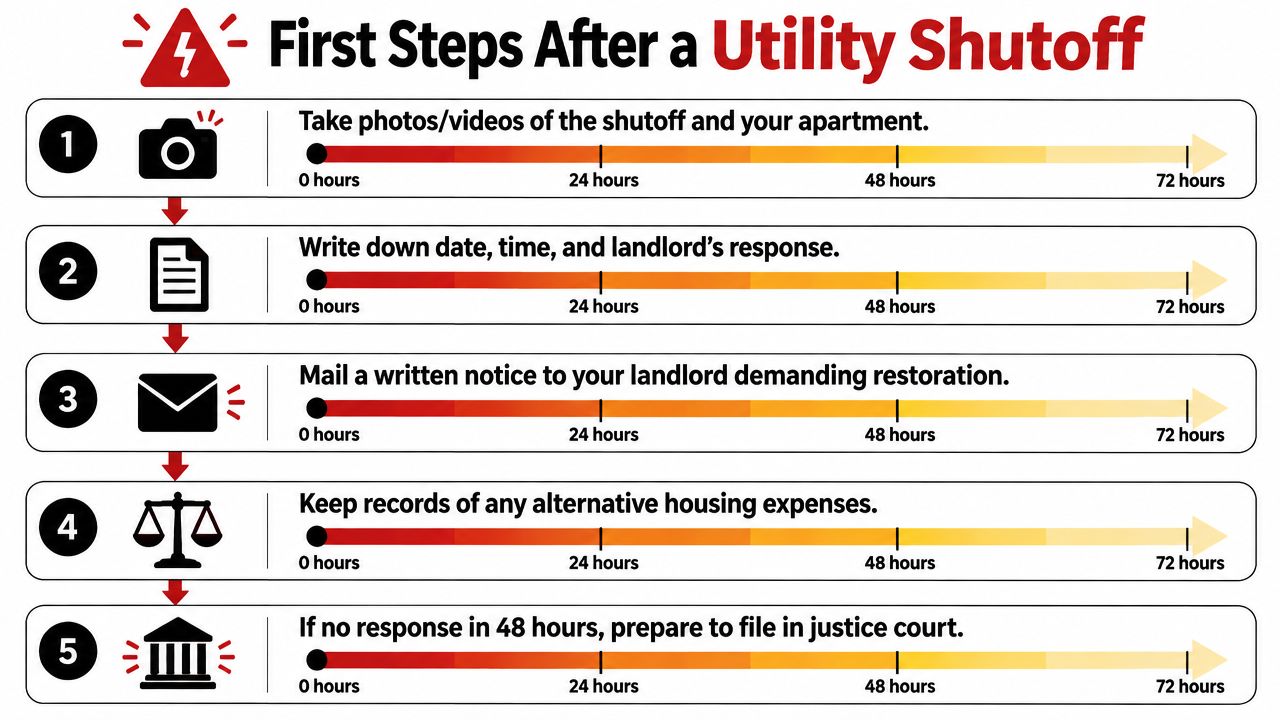
Your first few hours matter. A good paper trail helps with both fast restoration and any money claim later.
Start with safety
If anyone in the home has a medical issue, medication that needs refrigeration, or a health condition made worse by heat, cold, or lack of sanitation, deal with that first. Go somewhere safe if needed. If you incur costs because of the shutoff, keep every receipt.
Then confirm what happened. Sometimes tenants assume the utility company disconnected service, when the issue is inside the property or on the landlord side of the account.
Build proof in real time
Create a record while details are fresh. Don't rely on memory later.
- Take photos and video: Show dark rooms, nonworking fixtures, clocks, thermostats, or warning displays.
- Save messages: Screenshot texts, portal messages, emails, and voicemails from the landlord or manager.
- Write down the basics: Note the date, time, and when you discovered the outage.
- Call the utility provider if appropriate: Ask whether service was disconnected, and by whom if they can say.
- List losses as they happen: Food spoilage, hotel costs, rides, missed work, and similar out-of-pocket costs.
Send written notice right away
Even if you've already called, send a written demand for restoration. Keep it short and factual.
You can use language like this:
Sample notice: "I am a tenant at [address]. Utility service to the property was interrupted on [date] at about [time]. Please restore service immediately. Texas Property Code §§ 92.008 and 92.0091 provide remedies for unlawful interruption of utility service."
Don't add insults, threats, or a long history of every complaint you've ever had. A short notice reads better in court.
Avoid common mistakes
Many tenants hurt their own case by reacting in ways that create new problems.
- Don't stop documenting after the first text: Keep updating your record.
- Don't throw away spoiled food without photos: Photograph it first if possible.
- Don't assume a verbal promise is enough: Get written confirmation.
- Don't mix up remedies: An illegal shutoff claim is different from withholding rent.
- Don't wait too long to act: Delay can make restoration harder and can weaken urgency.
Your shutoff documentation checklist
| Item | Why it matters |
|---|---|
| Photos and videos | Shows the condition of the unit during the outage |
| Written timeline | Helps you testify clearly |
| Landlord messages | May show motive or admissions |
| Utility company notes | Helps separate landlord action from outside outage |
| Receipts | Supports actual damages |
| Copy of your notice | Shows you demanded restoration |
If court action becomes necessary, organized proof matters. Tenants preparing for hearings often benefit from practical guidance on records and exhibits, and landlords need the same discipline when defending a repair or emergency explanation.
Your Tenant Remedies Under Texas Law
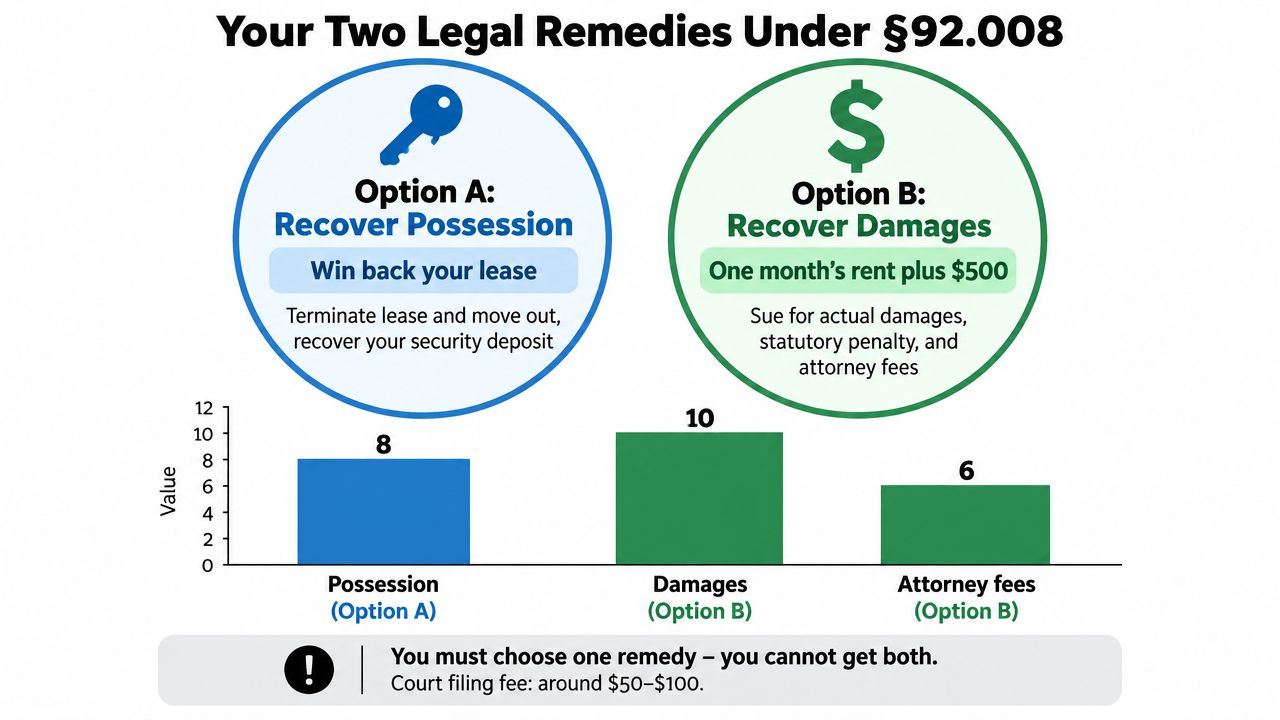
Section 92.008(f) gives tenants a strong set of remedies when a landlord unlawfully interrupts covered utility service. The statute allows the tenant to recover possession of the premises or terminate the lease, and also recover actual damages, one month's rent plus $1,000, reasonable attorney's fees, and court costs, reduced only by delinquent rent or other sums the tenant owes the landlord, as set out in Texas Property Code § 92.008.
The two tracks that matter
Think of the remedy structure in two parts.
First, there is the immediate housing problem. You need the utility back on, or you may need to leave.
Second, there is the financial harm caused by the shutoff.
Those tracks work together. A tenant who focuses only on damages but ignores restoration may stay stuck without service longer than necessary.
Key point: In many utility shutoff cases, the strongest first move is restoration. Money claims matter, but restored service often changes the whole dispute.
What actual damages can include
Texas tenant-rights guidance recognizes that actual damages can grow quickly when the shutoff causes real losses. Depending on the facts, that may include:
- Emergency housing
- Lost food
- Lost wages
- Other out-of-pocket costs tied to the outage
That doesn't mean every claimed expense will be accepted automatically. It means documentation matters. If you spent money because the landlord's conduct left the unit without basic service, save proof.
A practical example
Suppose your landlord cuts electric service after a rent argument. You pay for a hotel, replace spoiled groceries, and miss work the next morning while trying to deal with the situation. Those losses may become part of your actual damages claim, separate from the statute's additional recovery of one month's rent plus $1,000.
Why landlords should pay attention too
For landlords and property managers, this statute creates more than one type of risk. There can be pressure to restore service immediately, plus exposure for money damages and attorney's fees. That is why recordkeeping matters.
Useful records include:
- Utility payment records
- Service notices
- Repair logs
- Emergency documentation
- Construction scheduling records
If you need related guidance on self-help conduct, lockouts, and restoration issues, a Texas landlord tenant lawyer or eviction attorney can also evaluate whether other parts of the Texas Property Code are involved. The Law Office of Bryan Fagan, PLLC handles landlord-tenant disputes involving lease enforcement, eviction procedure, and tenant rights under the Texas Property Code.
How to Get Utilities Restored Fast Through Justice Court
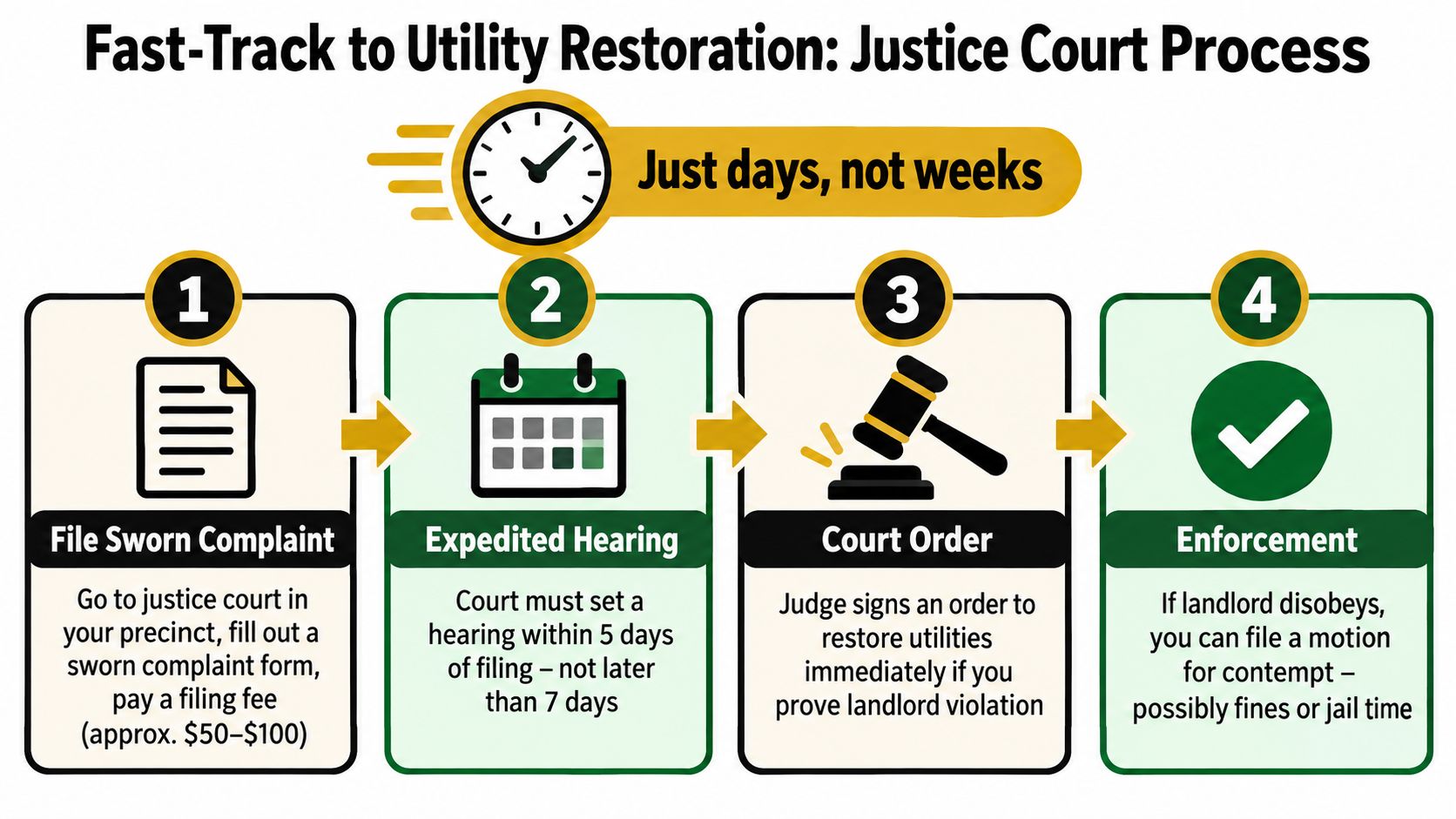
Texas gives tenants a fast court process under § 92.0091. The tenant files a sworn complaint in the justice court for the precinct where the rental property is located and states the facts under oath. If the judge reasonably believes an unlawful disconnection likely occurred, the court may issue an ex parte writ of restoration of utility service for immediate, temporary reconnection before the final hearing, as provided in Texas Property Code § 92.0091.
Where to file and what to say
You file in the justice court precinct where the property is located. The complaint should clearly state:
- your name and rental address,
- what utility was interrupted,
- when it happened,
- why you believe the interruption was unlawful,
- what notice or communication occurred,
- what harm you are experiencing.
Because the complaint is sworn, accuracy matters. Stick to facts you know.
Why the ex parte writ matters
"Ex parte" means the judge can act on the initial presentation without waiting for a full final hearing first, if the judge reasonably believes the unlawful disconnection likely happened. That makes this remedy especially important in shutoff cases, where waiting can make the harm much worse.
The Texas State Law Library's utility shutoff guidance was updated August 26, 2026, and the Texas Attorney General's renter-rights guidance updated October 21, 2025 both continue to treat § 92.008 as active Texas law, as summarized in the public-law discussion of § 92.0091 and restoration procedure.
What to bring to court
A neat file helps. Bring:
| Bring this | Why |
|---|---|
| Lease or proof of tenancy | Shows your right to occupy |
| Your written notice | Shows you demanded restoration |
| Photos and screenshots | Supports your timeline |
| Utility notes | Helps explain the outage |
| Receipts and loss list | Supports damages later |
If you need help organizing your evidence, this guide on tenant documentation for court in Texas eviction defense can help you prepare a cleaner record.
Bring paper copies in an organized stack. Judges move quickly, and a simple timeline can make your testimony much easier to follow.
Protecting Your Rights and Getting Legal Help Now
A utility shutoff case often starts with a basic question. "Can my landlord really do this?" In Texas, the answer is often no, unless the facts fit one of the narrow exceptions in the Texas Property Code.
If you're a tenant, the biggest decision is whether the matter is still fixable with immediate documentation and a court filing, or whether it has already grown into a larger dispute involving retaliation, lease termination, or an unsafe property. If you're a landlord, the key issue is whether your records support a repair, construction, or emergency explanation. If they don't, the risk gets harder to manage.
When legal help makes sense
You should strongly consider speaking with a Texas landlord tenant lawyer or eviction attorney when:
- Service still isn't restored: The housing problem is ongoing.
- The landlord is threatening lockout or removal: The dispute may expand beyond utilities.
- You have significant losses: Receipts, missed work, and temporary housing can change the case.
- You're a landlord with weak records: Early advice can help avoid compounding mistakes.
For readers deciding whether to handle the matter alone or get counsel, when to hire a Texas rental lawyer is a useful starting point.
Some people also use support staff to help organize records, timelines, and communication logs before meeting with counsel. In that context, a virtual legal assistant can be a practical administrative resource, especially when the main challenge is gathering documents fast and keeping them organized.
If you need help with an eviction, lease issue, or rental dispute, contact The Law Office of Bryan Fagan, PLLC for a free consultation today.
If your landlord shut off utilities or you're a landlord facing a claim under Texas Property Code § 92.008, The Law Office of Bryan Fagan, PLLC can help you evaluate the facts, prepare the right court filing, and respond quickly. We offer free consultations for Texas lease disputes, tenant rights issues, and emergency landlord-tenant conflicts involving utility shutoffs, restoration requests, and related eviction concerns.