Skip to content
Dealing with a landlord dispute after move-out can be stressful, especially when your security deposit is still missing and no one is giving you a clear answer. For landlords, the pressure feels different but just as real. You may know repairs were needed, but you're not sure what Texas law required you to send, when to send it, or what happens if the deadline slipped.
Texas law takes these disputes seriously. Under the security deposit bad faith presumption Texas 92.109, a missed deadline can change an ordinary refund dispute into a legal claim with penalties, fee shifting, and a fight over records. That catches many tenants and landlords off guard.
This guide explains the rule in plain English. You'll see what Texas Property Code Section 92.109 means, how courts treat the bad-faith presumption, what proof matters most, and how both sides can protect their rights. If you're looking for a broader explanation of the timing rules, this guide on how long a landlord has to return a deposit in Texas is also helpful background.
When Your Security Deposit Does Not Come Back
You move out, leave the place clean, hand over the keys, and expect your deposit to follow. Then the mailbox stays empty. No check. No letter explaining deductions. After a few weeks, a simple move-out turns into a legal problem.
The same kind of problem can hit landlords from the other side. You inspect the unit and see damage you believe is real. You mean to send the itemized list, but the photos are still on your phone, the receipts are not organized, and the deadline slips. In court, good intentions rarely fix missing paperwork.
That is why these cases often rise or fall on timing and proof, not just on who sounds more reasonable.
Why the missing deposit becomes a bigger issue
Texas law gives landlords a set period to return the deposit or send a written description and itemized list of deductions after the legal trigger happens. If you want the full timing rule in one place, this guide on how long a landlord has to return a deposit in Texas explains the deadline in more detail.
Once a deposit does not come back, the dispute usually becomes a paper trail question. Judges often look for basic, concrete proof:
- the date the tenant surrendered possession
- the tenant's written forwarding address
- any refund check, accounting, or deduction letter
- mailing records, emails, photos, invoices, and receipts
A security-deposit case works a lot like a school assignment turned in with no name on it. You may know what happened. The court still needs something it can verify.
What usually wins or loses early
Tenants often lose strong claims because they cannot show they gave a forwarding address in writing. Landlords often lose defensible deduction claims because they cannot show what was sent, when it was sent, or what evidence supported the charges.
That is the part many people miss. A landlord does not rebut a bad-faith claim by saying, "the unit needed work." A landlord usually needs records that match the deductions. A tenant does not prove bad faith by saying, "I never got my money." A tenant usually needs to show the move-out date, the forwarding address, and the lack of a proper response.
Start with this checklist
If you are a tenant, gather:
- your lease
- proof you moved out and returned possession
- your written forwarding address
- photos or video from move-out
- texts, emails, and letters about the deposit
If you are a landlord, gather:
- the lease and move-in condition records
- move-out photos
- repair invoices or receipts
- a copy of the itemized deduction notice
- proof of mailing or delivery
Those details may sound small. In Texas security-deposit cases, small details often decide who wins.
What Texas Property Code Section 92.109 Says in Plain English
You move out, clean the place, turn in the keys, and wait for your deposit. Weeks pass. Then either nothing arrives, or you get a short note with charges that do not really explain anything. Section 92.109 is the part of Texas law that gives that situation real consequences.
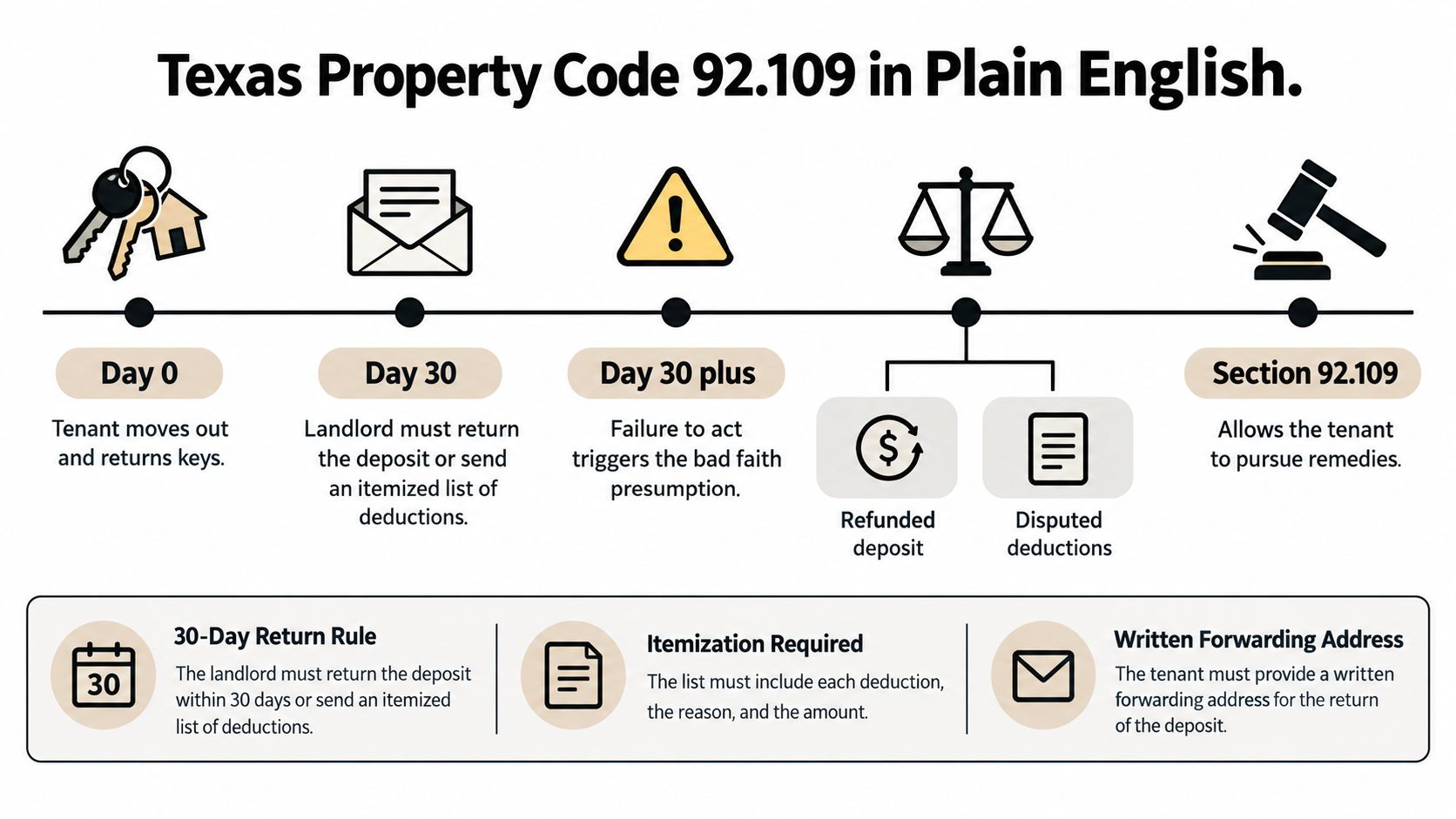
This statute matters because it does more than say, "return the money on time." It sets up a rule that can shift pressure onto the landlord if the deadline is missed. It also helps explain why courts care so much about dated letters, receipts, photos, and mailing proof.
The basic rule, in plain English
Section 92.109 works with the rest of the Texas security-deposit rules in Chapter 92. In everyday terms, the law says a landlord can face legal consequences for keeping a deposit in bad faith.
The timing piece trips up many people. The 30-day clock does not start just because the tenant moved out. It starts after the tenant has surrendered possession and given a written forwarding address. An Austin Tenants' Council security-deposit law guide explains that same timing rule in practical terms.
Once that trigger happens, the landlord generally has two lawful options within 30 days:
- Return the deposit.
- Send a written description and itemized list of deductions, if deductions are claimed.
If that does not happen on time, Texas law may presume the landlord acted in bad faith.
What the bad-faith presumption really means
A presumption is a legal head start, not an automatic win.
A simple way to read this is that the law treats a missed deadline like a warning light on a dashboard. The warning light does not prove every detail of the problem by itself. It does mean the landlord now needs a solid explanation backed by records.
That is why this statute has real force in court. Once the tenant shows the basic trigger facts, the case often turns on whether the landlord can produce documents that line up with the deductions and the mailing date. A judge will usually care much more about copies of notices, envelopes, invoices, and move-out photos than broad statements like, "the unit needed repairs."
Why paperwork matters so much under this section
Section 92.109 is about money, but deposit cases are often decided by paper trails.
For tenants, the winning documents usually show when possession ended, when the forwarding address was given, and what the landlord did or did not send back. For landlords, the strongest rebuttal usually comes from organized records that match the amount withheld to real cleaning, repair, or unpaid-rent claims.
This fits into the larger set of Texas rental rules. If you want a broader overview, this page on Texas Property Code 92 tenant rights gives helpful context.
In many deposit disputes, the key question is not who sounds more believable. The key question is who can prove the timeline with records.
How the Bad Faith Presumption Works and What You Must Prove
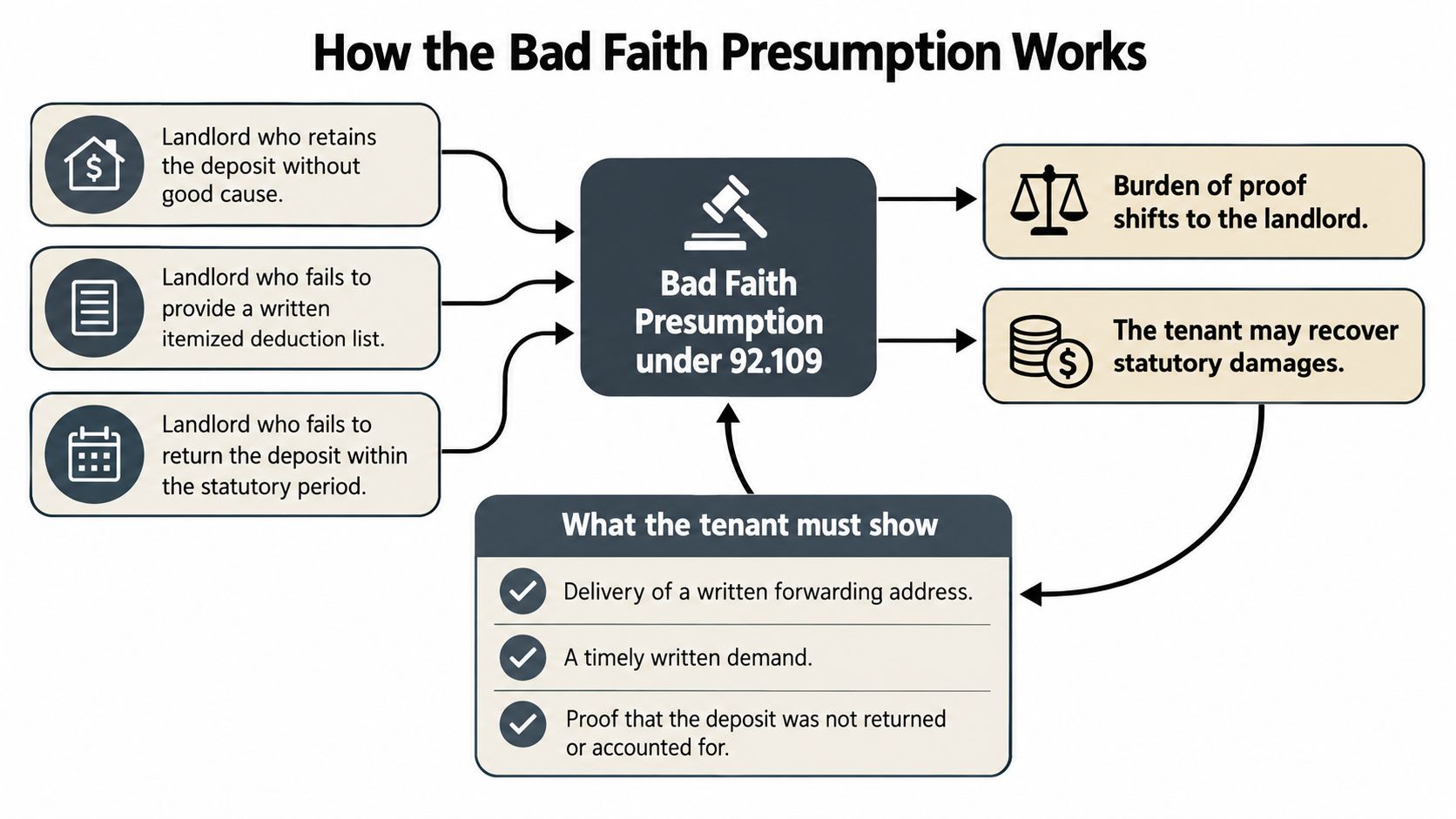
The law becomes practical here. A tenant doesn't win just by saying, “I never got my money.” A court usually looks for a short chain of proof that activates the security deposit bad faith presumption Texas 92.109.
The three facts that usually matter most
In plain English, a tenant usually needs to show these core points:
- The tenant surrendered possession. That means the tenancy ended and the unit was given back.
- The tenant provided a written forwarding address. Without that, the timing issue often becomes harder for the tenant.
- The landlord did not return the deposit or send the written itemization within 30 days. That missed deadline is the key trigger.
Once those facts are shown, Texas appellate materials indicate the tenant can establish a prima facie case, meaning enough evidence to shift the burden to the landlord. Later court materials continue to apply that same structure, with the landlord then expected to come forward with rebutting evidence (Texas Court of Appeals discussion of the presumption framework).
What “prima facie” means without legal jargon
Lawyers use “prima facie” to mean a case that is strong enough to move forward unless the other side answers it with evidence.
A simple example helps. If a tenant has:
- a copy of the written forwarding address,
- proof of move-out or key return,
- and proof that no refund or itemized statement arrived within the deadline,
the tenant may have done enough to trigger the statutory presumption. At that point, the landlord can't rely on general statements like “there was damage” or “we meant to send it.” The landlord needs real evidence.
Why documentation matters more than feelings
Bad faith often sounds like a question about motive. In deposit disputes, it usually becomes a question about records.
If you're preparing for court, bring documents, not just conclusions.
A tenant's strongest documents often include:
- A written forwarding address
- Move-out photos
- A lease copy
- Texts, emails, or letters about the deposit
- Proof of the date possession was surrendered
A landlord's strongest documents often include timely mailing proof, a dated itemized statement, repair invoices, and clear records showing the difference between actual damage and ordinary wear.
That's one reason a Texas landlord tenant lawyer or eviction attorney may focus first on the file, not the story. The Texas Property Code gives both sides rights, but the side with clean records usually stands on firmer ground.
Penalties for Bad Faith and What You Can Recover
You move out, leave a written forwarding address, and expect a deposit refund. Instead, weeks pass. Then the landlord keeps money without a clear, supported explanation. At that point, the dispute is no longer just about getting your deposit back. Texas law can add extra consequences if the withholding was in bad faith.
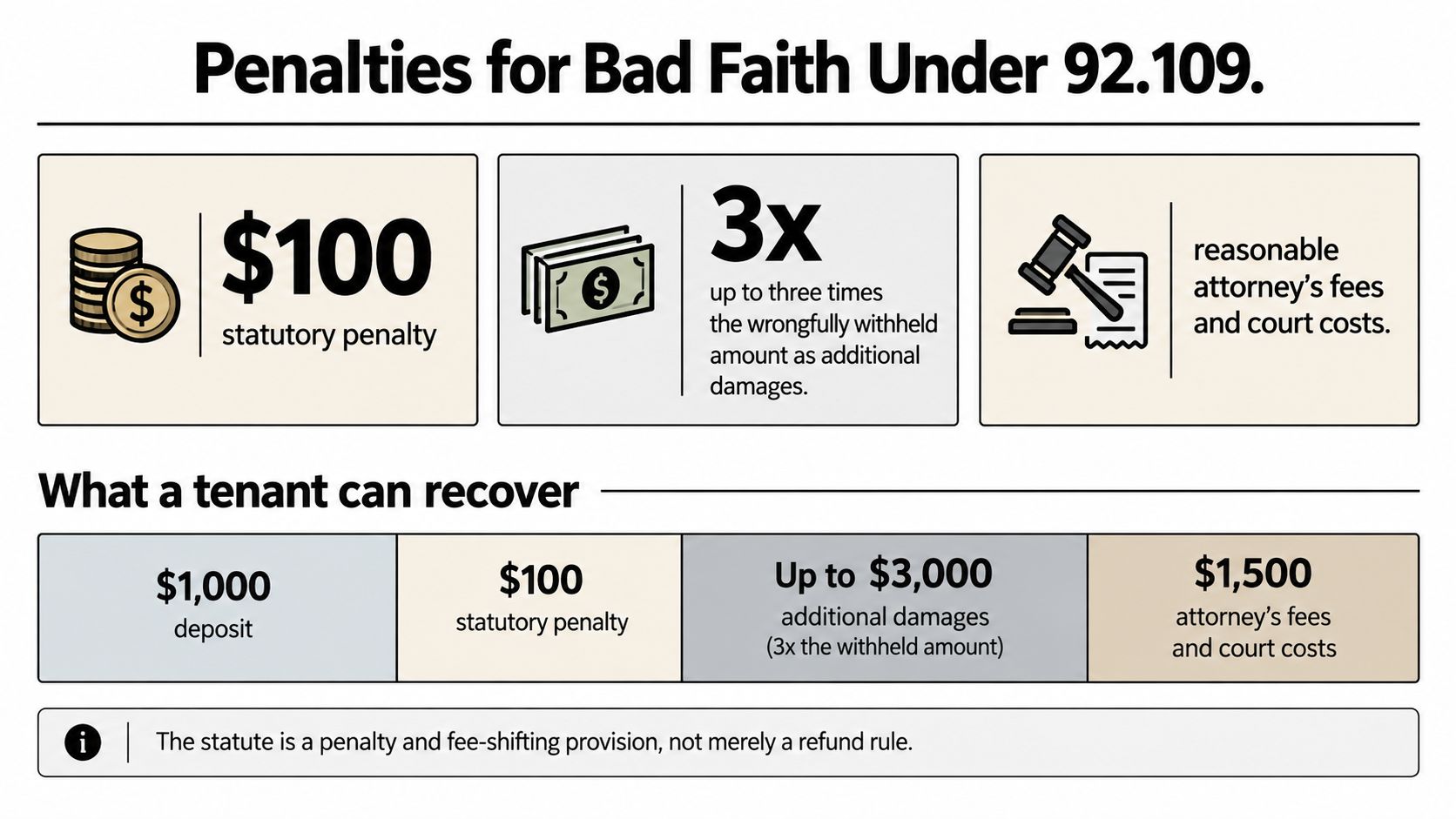
A helpful way to view Section 92.109 is this: the law treats a bad-faith withholding like a wrongful charge plus a penalty. If a tenant proves bad faith, the landlord may owe $100, three times the portion of the deposit wrongfully withheld, and the tenant's reasonable attorney's fees (Denton law discussion of Section 92.109 remedies).
What you may recover
If the court finds bad faith, the usual pieces of recovery are:
- $100
- Three times the amount wrongfully withheld
- Reasonable attorney's fees
The phrase that trips people up is wrongfully withheld. That does not always mean the full deposit.
If a landlord had a valid reason to keep part of the deposit, the penalty usually applies only to the part that should not have been kept. That distinction matters in real cases, because many disputes are mixed. Some deductions may be proper. Others may be vague, inflated, unsupported, or plainly tied to ordinary wear and tear.
A simple way to do the math
Suppose your deposit was $1,000. The landlord had proof for $300 in actual repair costs, but kept another $200 with no receipts, no photos, and no clear explanation.
In that situation, the fight may center on the unsupported $200, not the full $1,000. If that $200 was withheld in bad faith, the potential claim may include:
- $100
- Three times $200
- Reasonable attorney's fees
That is why paperwork changes the value of the case. A weak $200 deduction can create much more than a $200 problem.
Why these penalties matter in practice
For tenants, the penalty changes the conversation. A landlord who assumes a small deposit dispute is not worth pursuing may be wrong once fees and statutory damages are on the table.
For landlords, this is a reminder that good records often matter more than confidence. In court, a detailed statement, dated photos, invoices, and mailing proof usually carry more weight than a general claim that the property was left in bad shape.
Here is the practical point. The money you can recover often depends less on how upset each side is and more on whether the file shows careful, honest handling of the deposit. That is also why judges tend to look closely at partial deductions. They want to see which charges were real, which were documented, and which look made up after the fact.
Common Defenses and How Landlords Rebut the Presumption
This is the part many public guides skip. They explain the penalty, but they don't explain how a landlord can respond once the presumption arises.
The short answer is that a landlord needs evidence, not just an explanation. Courts tend to care about what was sent, when it was sent, and whether the deductions were documented in a way that looks reasonable and specific.
What rebuttal usually looks like
A landlord may try to rebut the presumption by showing facts such as:
- The mailing was timely. A dated mailing record or other proof may defeat the claim that the deadline was missed.
- The forwarding address was not properly provided in writing. If the tenant never triggered the duty, the landlord may have a defense.
- The itemization was sent but not received. Mailing proof matters here.
- The deductions were grounded in real records. Receipts, photos, inspection notes, and lease terms can support the claim that the withholding was reasonable rather than arbitrary.
A landlord does better with a file that includes move-in photos, move-out photos, invoices, line-by-line deductions, and proof of the return mailing. A landlord does worse with round-number charges, vague labels like “damage” or “cleaning,” and no dates.
For disputes about ordinary wear and tear, this guide on whether a landlord can keep a deposit for normal wear and tear in Texas helps explain the difference.
Evidence That Helps Rebut or Support Bad Faith
| Evidence Type | Helps Landlord Rebut Presumption | Helps Tenant Prove Bad Faith |
|---|---|---|
| Written forwarding address | If missing or unclear, it may support the argument that the clock never started | If dated and clear, it helps show the deadline began |
| Proof of surrender | Helps pin down the timeline accurately | Helps show the landlord's deadline passed |
| Dated mailing receipt | Strong evidence that itemization or refund was sent on time | If absent, tenant may argue no timely compliance |
| Itemized deduction statement | Helps show a real accounting was made | If vague or missing, tenant may argue bad faith |
| Repair invoices or receipts | Supports reasonableness of deductions | If inconsistent with deductions, tenant may argue padding |
| Move-in and move-out photos | Helps distinguish damage from wear | Helps challenge inflated or false charges |
| Lease terms on cleaning or damage | Helps connect charges to tenant obligations | Helps tenant if charges go beyond the lease |
| Messages between the parties | May show timely notice or explanation | May show delay, refusal, or lack of documentation |
What tends to lose credibility
Tenants should watch for unsupported deductions. Landlords should avoid making them.
Weak evidence often includes:
- Undated photos
- No written itemization
- Charges that don't match receipts
- General statements without backup
- Confusion about what counts as normal wear
A court may not expect perfection. It usually does expect an honest, timely, organized record.
Practical Steps to Resolve a Texas Security Deposit Dispute
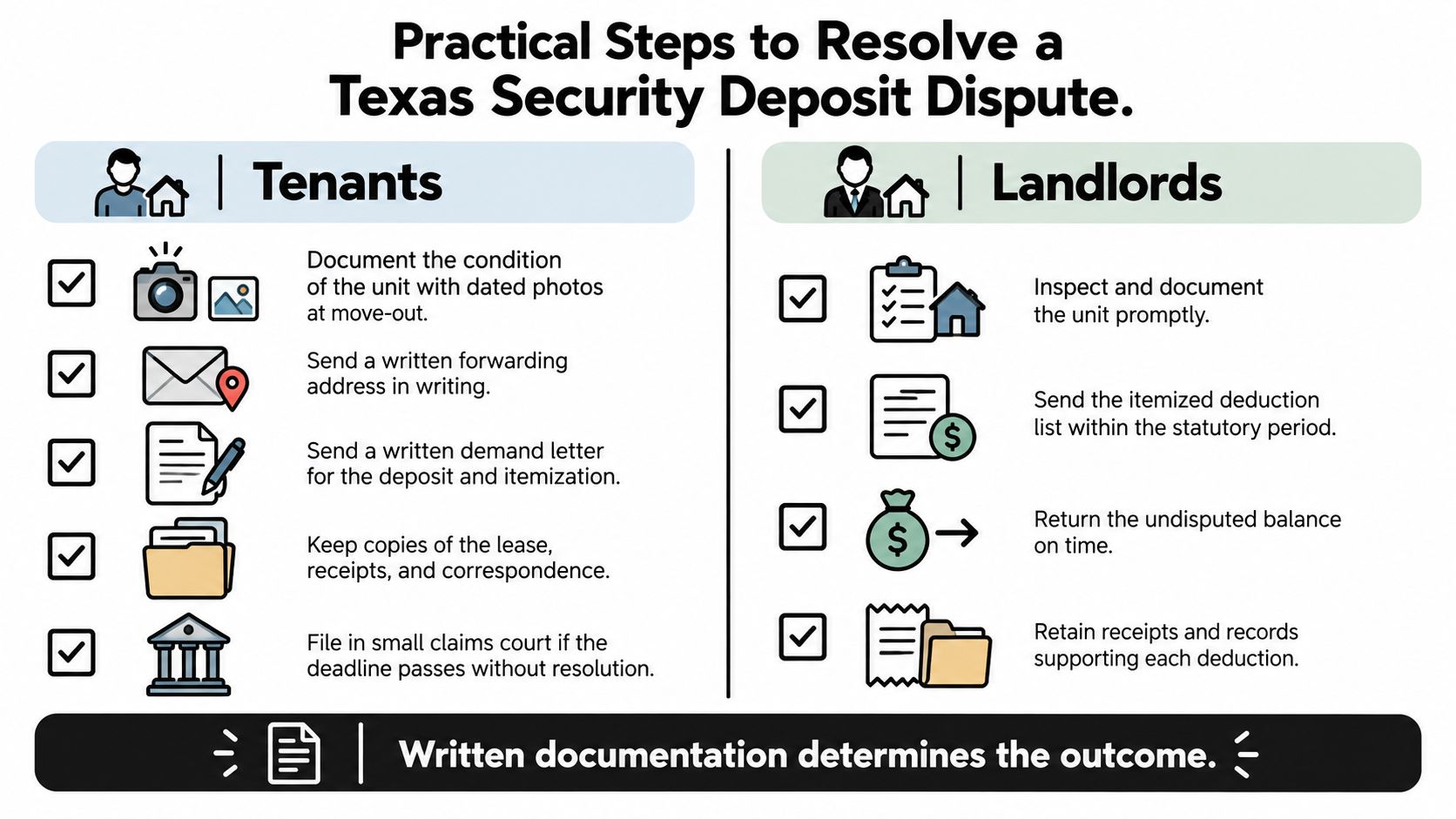
Once a deposit dispute starts, both sides often make the same mistake. They talk past each other instead of building a usable record. Texas law rewards written proof, clear dates, and specific numbers.
Steps tenants should take
If you're a tenant, start with documentation and stay organized.
Confirm surrender clearly
Keep records showing when you moved out, returned the keys, or otherwise gave up possession.Send your forwarding address in writing
Don't assume a text, verbal statement, or old application address will be enough. Send a clear written notice and keep a copy.Save proof of delivery or mailing
If there's a later dispute over dates, this can matter a lot.Wait for the response period, then send a written demand
Keep the message simple. Identify the property, your move-out date, your forwarding address, and state that you have not received the deposit or a proper itemization.Organize your file before filing suit
Gather the lease, photos, your forwarding-address notice, the demand letter, and all communications.
A short demand can say:
I surrendered possession of the property and provided my forwarding address in writing. I have not received my security deposit or a written itemization of deductions. Please send the required refund and accounting immediately.
Steps landlords should take
If you're a landlord or property manager, think like you may need to explain the file to a judge later.
- Inspect promptly and take dated photos.
- Prepare a written itemization with line-by-line deductions.
- Return any undisputed balance on time rather than waiting for every disagreement to be resolved.
- Keep receipts, invoices, and repair records that match each deduction.
- Preserve mailing proof in the tenant's file.
The Law Office of Bryan Fagan, PLLC assists tenants and landlords with Texas rental disputes, including deposit claims, lease enforcement, and related litigation strategy.
When to handle it yourself and when to get legal help
Some disputes can be resolved with a direct written exchange. Others need stronger action.
You should think about speaking with a Texas landlord tenant lawyer or eviction attorney when:
- The deadline issue is disputed
- The deductions are large or heavily contested
- The paperwork is missing or inconsistent
- You may need to file or defend a court claim
- The dispute overlaps with eviction, lease violations, or property damage claims
If the issue is small and the facts are clean, a well-written demand may be enough. If the file is messy, legal advice early can save time and money.
Protect Your Rights and Get Help With Your Deposit Claim
Security-deposit disputes feel personal because they usually happen at the end of a stressful rental relationship. By that point, patience is thin and trust is often gone. The good news is that Texas law gives you a practical framework to work from.
For tenants, the biggest lessons are simple. Give your forwarding address in writing, keep proof, and don't let a missing itemization slide without a written response. For landlords, the lesson is just as clear. Meet the deadline, send a specific written accounting, and back up deductions with records that make sense.
If your dispute is straightforward, you may be able to resolve it with a demand letter and organized documentation. If the timeline is disputed, the deductions are substantial, or the file has holes, legal guidance often becomes worth it quickly. Deposit cases may look small at first, but Section 92.109 can raise the stakes fast once the bad-faith issue enters the case.
Readers dealing with broader lease or rental conflict may also want guidance on related topics such as eviction defense, lease enforcement, or landlord entry rights under Texas law. Those issues often overlap in real life, even when the immediate problem is a deposit.
If you need help with a deposit claim, lease issue, or rental dispute, The Law Office of Bryan Fagan, PLLC offers free consultations for Texas landlords and tenants who need clear guidance under the Texas Property Code. We can help you assess whether the bad-faith presumption may apply, what records matter most, and what next step makes sense in your case.