Under Texas law, a residential landlord has 30 days to return your security deposit or provide a written, itemized list of deductions, but only after you've surrendered the property and provided a written forwarding address. The clock is measured in calendar days, and the forwarding address is the trigger many renters miss.
You may be sitting in a new apartment with moving boxes still stacked against the wall, wondering whether the deposit check is lost or whether your former landlord is allowed to keep it. Texas law gives you a clear framework. Your move-out date matters, but so do the keys, possession of the property, and proof that you gave the landlord a written address for the refund.
The Move-Out Moment That Starts the Clock
You hand over the keys, take photos of the clean kitchen, and drive away from the rental. Because the lease ended that day, you mark the date and begin counting 30 days. That seems logical, but it may be legally incomplete.
Texas ties the deposit obligation to surrender of the premises and the tenant's written forwarding address. Surrender generally means you've moved out, returned possession, and no longer control the property. Returning keys is strong evidence, but it's only one part of the record. A move-out inspection form, a written confirmation from management, and dated photographs can help establish exactly when possession ended.
The hidden problem appears when the landlord later says, “We never received your forwarding address.” If you only mentioned it during a hallway conversation or assumed the address in your lease termination notice was enough, you may have difficulty proving the landlord received the information required to mail the deposit.
Practical rule: Treat your forwarding address as a separate legal notice, not as an informal detail in your move-out conversation.
A tenant who leaves on a Friday but doesn't send a written forwarding address until weeks later may discover that the deposit deadline is measured from the later notice, not just from the day the last box left the unit. The Texas State Law Library explains both the surrender requirement and the written-address condition in its guidance on security deposit refunds in Texas.

Before you leave, review your lease and document the surrender date. A plain-English overview of how Texas landlord-tenant law governs the rental relationship can also help you understand why possession, notice, and lease terms matter together.
The 30-Day Rule Under Texas Property Code
Texas Property Code § 92.103 requires a residential landlord to return the security deposit by the 30th day after the tenant surrenders the premises, subject to the written forwarding-address requirement. The same deadline applies when the landlord sends a written description and itemization of deductions instead of returning the full deposit. The Texas State Law Library identifies this rule within the statutory protections governing security deposits. Read the broader framework in Texas Landlord-Tenant Law: An Overview, which addresses how Texas Property Code Chapters 91 through 94 and Chapter 24 govern the rental relationship.
The deadline uses calendar days, not business days. Weekends and holidays count. You shouldn't assume the landlord gets extra time because the last day falls outside a normal office schedule.
What surrender means in practice
The lease's ending date and the surrender date may be different. If you remain in possession after the lease term, surrender may occur when you leave and return possession. If you leave early, the surrender question depends on what happened with the property, the keys, and the landlord's acceptance of possession. If you abandon the home without clearly documenting the move-out, the parties may later disagree about when possession ended.
Your job is to create a clean timeline:
- Record the date you removed your belongings.
- Return the keys, remotes, and access devices in a traceable way.
- Ask the landlord or property manager to confirm receipt.
- Send the forwarding address in writing.
- Preserve photos, inspection records, and messages.
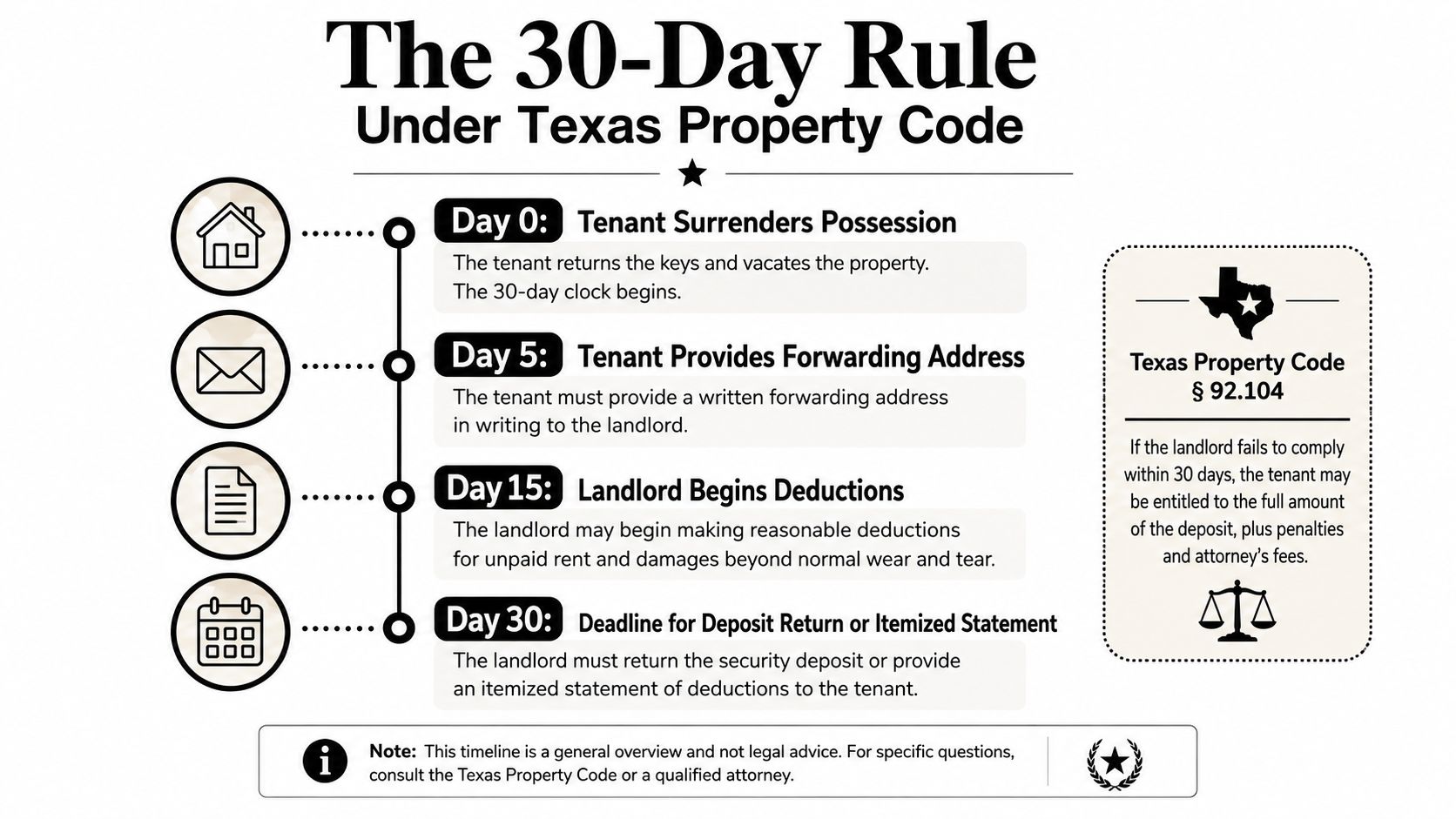
The landlord may need to inspect, clean, or repair the property before deciding whether deductions are justified. That work doesn't erase the statutory deadline. By the deadline, the landlord must send the refund or a written, itemized explanation of deductions.
The key question isn't merely, “How long does landlord have to return deposit Texas?” It's, “When did surrender occur, and when did the landlord receive my written forwarding address?”
Why Your Forwarding Address Is the Hidden Trigger
Texas Property Code § 92.107 gives the landlord a practical defense that many renters never consider. The landlord generally isn't obligated to return the deposit or send the written deduction statement until you provide a written statement of your forwarding address for the purpose of returning the deposit. The Texas State Law Library highlights this condition in its explanation of Texas security deposits and forwarding addresses.
That rule makes sense from the landlord's perspective. A landlord needs a reliable destination for the refund. But it creates a serious documentation issue for tenants. Saying your new address aloud, texting it to a leasing agent, or assuming the landlord copied it from another document may leave room for an argument about whether the legal notice was received.
Use a delivery method that creates proof
Send a short, separate notice. State your name, the former rental address, the date you surrendered possession, and the address where the landlord should send the deposit. Keep a copy of the exact message and every attachment.
Good documentation options include:
- Certified mail: Send the notice with return receipt requested and keep the receipt and delivery record.
- Email: Send it to the property manager and landlord, then preserve the sent message and any delivery or read confirmation.
- Hand delivery: Give it directly to the office and ask for a signed, dated acknowledgment.
- Written move-out form: If management accepts the address on a move-out document, photograph or copy the completed form.
If you're between homes, use a dependable P.O. box or a trusted person's mailing address, but make sure the notice clearly says it's the forwarding address for the security deposit. Don't rely on a verbal update.
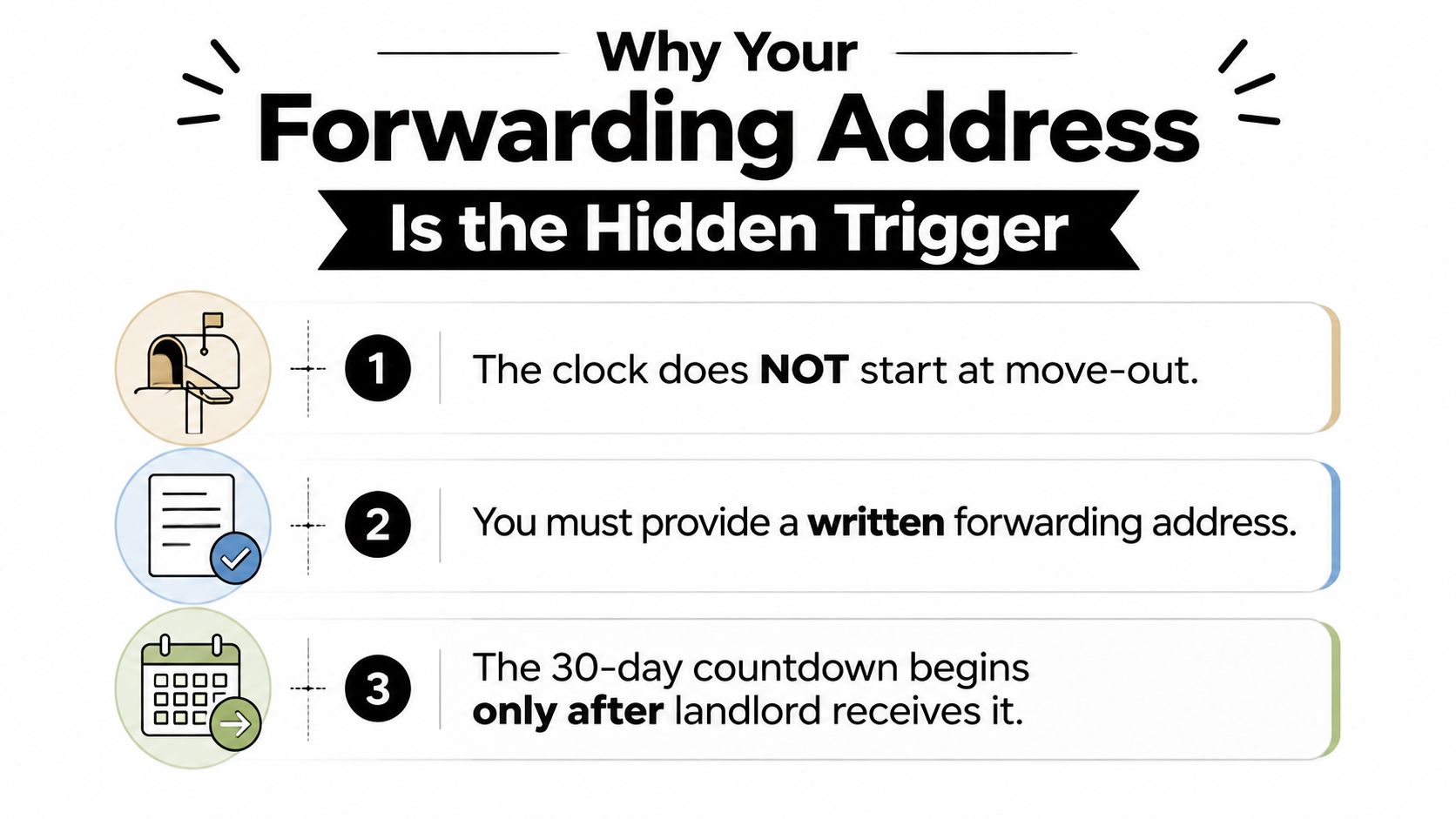
The address doesn't eliminate your right to a refund if you forgot to send it. It does affect when the landlord's statutory obligation begins and whether you can prove the deadline was missed. That's why a dated receipt can matter as much as your move-out photos.
What Landlords Can and Cannot Deduct
A landlord may deduct amounts for damages and charges for which you're legally liable under the lease or because you breached the lease. Texas Property Code § 92.104 also prevents a landlord from charging the deposit for normal wear and tear, which generally means deterioration from ordinary use rather than negligence, carelessness, an accident, or abuse. The Texas State Law Library explains these limits in its security deposit guidance.
A broken window caused by a tenant's conduct is different from faded paint caused by ordinary occupancy. A large hole in drywall is different from minor nail marks. A cleaning charge may be defensible when the lease requires the property to be returned in a particular condition and the tenant leaves it below that standard, but routine turnover work isn't automatically chargeable.
| Lawful Deductions | Illegal Deductions |
|---|---|
| Unpaid rent: Rent the tenant legally owed under the lease. | Ordinary aging: Repainting or replacing materials solely because they show normal age. |
| Excess damage: Repairs for damage beyond normal wear and tear. | Routine cleaning: General turnover cleaning unrelated to the tenant's breach of a lease standard. |
| Lease-related loss: Charges tied to a lease breach that caused financial loss. | Pre-existing conditions: Damage shown in a move-in inspection or earlier photographs. |
| Missing property: Replacement of items the tenant was responsible for returning. | Inflated charges: Amounts unsupported by a reasonable explanation or actual repair evidence. |
The landlord must provide a written description and itemized list of deductions with the remaining deposit, if any. An invoice by itself may not explain what happened, why the tenant is responsible, or how the charge was calculated.
Compare the deduction to the evidence
Ask for photographs, inspection records, invoices, and a clear explanation of each charge. Compare the claimed condition with your move-in and move-out photos. You can also question whether the landlord charged for a full replacement when a limited repair addressed the actual damage.
A written response can point out each disputed item without making personal accusations. For a focused review of the accounting, see the Texas security deposit itemized deduction rules.
Bad-Faith Penalties When Landlords Miss the Deadline
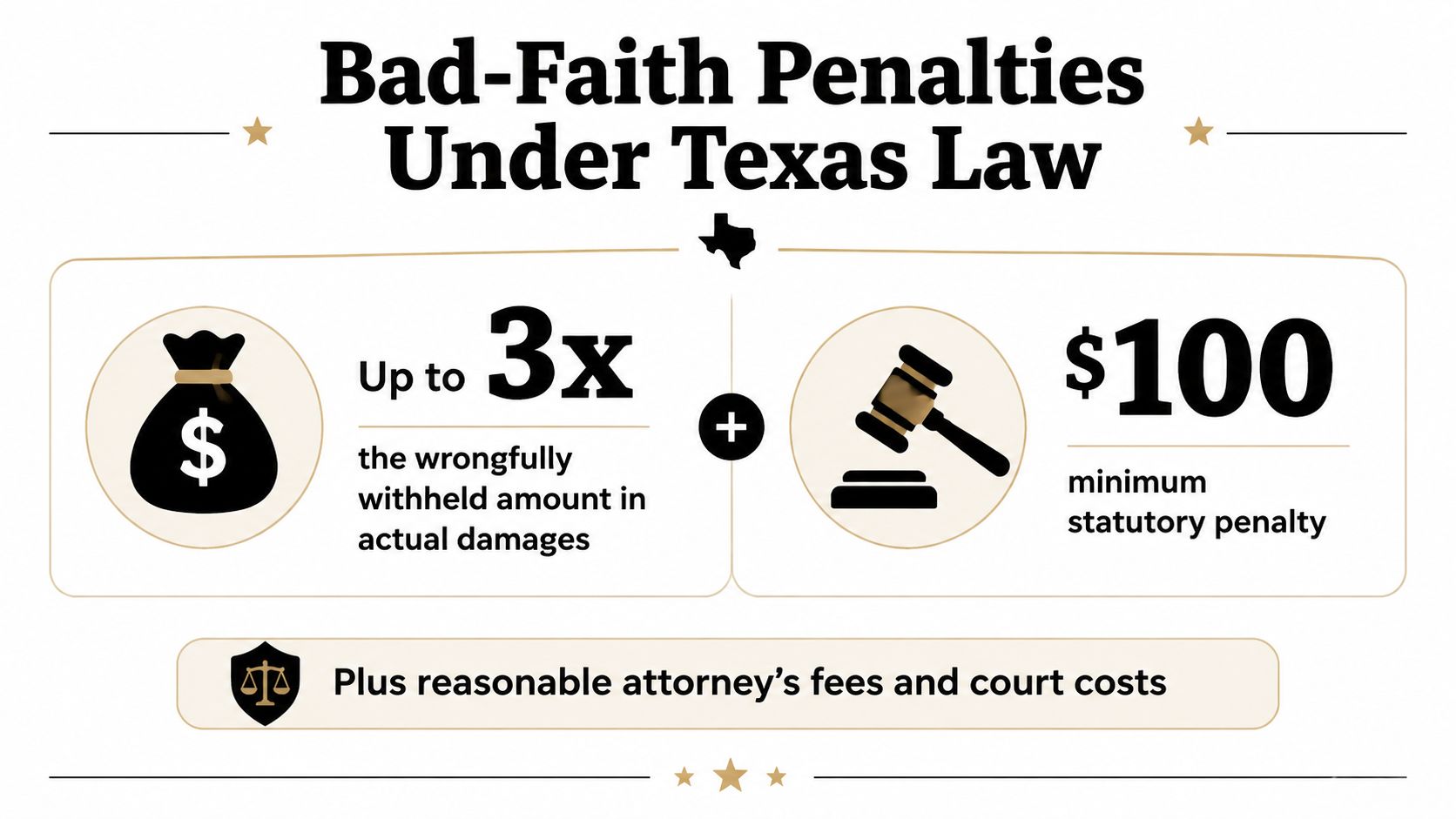
A missed deadline can become much more serious than a delayed check. Under Texas Property Code § 92.109, when a landlord fails to return the deposit or provide the required written itemization within the applicable period, Texas law presumes bad faith and allows monetary penalties. The statute provides for $100 plus three times the portion of the deposit wrongfully withheld, along with the tenant's reasonable attorney's fees. The penalty rule is set out in Texas Property Code § 92.109.
The important distinction is between the landlord's underlying claim and the landlord's handling of the deposit. A landlord may believe the tenant caused damage, but that belief doesn't excuse failing to send the required written accounting on time. The landlord must preserve the procedural protections as well as support the deduction itself.
Why the penalty changes negotiations
The exposure isn't limited to the original deposit balance. A tenant who proves the required trigger occurred, the deadline passed, and the landlord failed to return or itemize the deposit may have a claim for the statutory amount, multiplied damages on the wrongfully withheld portion, and reasonable attorney's fees.
The landlord's failure to understand the law isn't automatically a defense. Good-faith questions usually turn on the facts surrounding the delay, the forwarding address, the surrender date, and the landlord's records. That makes your evidence critical.
Demand more than an apology: Ask for the deposit, a legally sufficient accounting, and the statutory remedies supported by the facts.
Don't threaten penalties without assembling your proof. Gather the lease, payment records, move-out evidence, forwarding-address delivery record, and every communication about the deposit. A calm, documented claim is more persuasive than an angry message.
How to Recover Your Deposit Step by Step
Start with the timeline, not the argument. Confirm when you surrendered possession and when the landlord received your written forwarding address. Then determine whether the landlord sent the deposit or a written, itemized deduction statement within the required 30-day period described by the Texas State Law Library's security deposit refund guidance. Don't skip this step, because the landlord may argue that the address was never provided or that surrender occurred later.
Send a documented demand
Write a formal demand and send it through a delivery method that creates proof. Keep the tone professional and give the landlord a reasonable opportunity to resolve the dispute.
You can adapt this language:
I surrendered possession of the rental at [former address] on [date]. I provided my written forwarding address on [date], and the landlord received it by [delivery method]. The statutory deadline has passed, and I have not received the security deposit or a compliant written, itemized description of deductions. Under Texas Property Code §§ 92.103, 92.107, and 92.109, I demand payment of the deposit and any remedies supported by the wrongful withholding. Please respond in writing within 10 days of receiving this letter. If the matter isn't resolved, I may pursue available legal remedies.
Attach copies, not your only originals. Include the lease, deposit proof, move-out photos, key-return confirmation, address notice, delivery records, and any accounting you received.
File in the proper court if needed
If the landlord doesn't resolve the matter, a tenant may consider Justice of the Peace court when the claim falls within that court's monetary jurisdiction. The Texas State Law Library notes that when less than $20,000 is involved, a tenant can sue through the local justice court. Confirm current filing requirements and fees with the appropriate court because procedures can vary.
Present a simple chronology. Judges need to see possession ended, the written address was delivered, the deadline passed, and the landlord failed to provide the required refund or accounting. Organize your evidence by date instead of bringing an unstructured bundle of messages.
Decide whether counsel adds value
A Texas landlord tenant lawyer can evaluate whether the deduction was lawful, whether the landlord's conduct supports a bad-faith claim, and whether a demand letter or lawsuit is appropriate. Because § 92.109 allows recovery of reasonable attorney's fees in qualifying cases, ask a tenant-rights attorney how fees and representation would work before you proceed.
You can also review resources about recovering a landlord deposit in small claims court before choosing your next step. Don't let the deposit amount alone determine your strategy. A defective accounting, weak damage evidence, or documented bad faith may change the value of the dispute.
Protect Your Rights and Get the Help You Need
The answer to “how long does landlord have to return deposit Texas” is straightforward only when the timeline is complete. For a residential tenancy, the landlord has 30 days to return the deposit or provide the written itemization after surrender, but the tenant must provide a written forwarding address so the statutory obligation can begin. Your strongest protection is a record showing exactly when each event occurred.
The deduction dispute is separate from the timing dispute. A landlord may pursue unpaid rent or damage beyond ordinary wear and tear when the tenant is legally responsible, but the landlord can't use the deposit for normal aging or unsupported charges. Require a clear written explanation and compare every deduction with your lease, inspection records, photographs, and receipts.
Your move-out file is your leverage. Keep the lease, key-return proof, photos, forwarding-address notice, delivery confirmation, and deposit correspondence together.
If the landlord misses the deadline after receiving the required address, Texas Property Code § 92.109 can create substantial exposure, including $100, three times the wrongfully withheld portion, and reasonable attorney's fees. That doesn't mean every delayed deposit automatically produces a judgment. It means you should take the issue seriously, preserve evidence, and avoid accepting an unsupported explanation as the final answer.
The Law Office of Bryan Fagan, PLLC can evaluate the timeline, review deductions, prepare a demand letter, and discuss whether Justice Court or another legal remedy fits your dispute. If you're dealing with a security deposit, lease issue, eviction, or another rental conflict, visit The Law Office of Bryan Fagan, PLLC to schedule a free consultation and get a clear strategy for protecting your rights.