Dealing with a landlord not making repairs in Texas can turn an ordinary rental problem into a serious health, safety, and eviction concern. Rosa, a Houston renter, learned that when a ceiling stain above her child's bed kept spreading and her landlord ignored repeated emails. Her belongings were at risk, her child developed a cough, and the leak reached a nearby light fixture. Rent was due Friday, and Rosa feared that pressing harder would lead to retaliation.
That fear is common, but silence from a landlord doesn't erase your rights. Texas law gives tenants remedies when specific legal conditions are met, but those remedies depend on proper notice, current rent, the nature of the defect, and solid documentation. A phone call alone may not protect you.
You need to take four steps: confirm the repair is legally required, send notice that proves what you reported, select the remedy that fits your situation, and involve a lawyer before a procedural mistake puts your housing at risk. If you're also reviewing related safety duties, this resource on smoke alarm rules for landlords provides useful maintenance context. For a Texas-specific starting point, see what to do if your landlord ignores repair requests.
When Your Landlord Won't Fix What's Broken
Rosa's first email was polite. She described the brown ceiling mark, attached a photograph, and asked the property manager to inspect it. After another week, the stain had widened. She sent a second email and called the office. No one scheduled a visit, and no one explained whether the roof, plumbing, or ceiling would be repaired.
Then the problem became dangerous. Water damaged a box of clothing near the bed. Rosa moved her child to the living room, but the leak continued toward the light fixture. Her child began coughing, and Rosa spent several nights listening for dripping water while worrying about rent, damaged property, and whether the landlord could punish her for complaining.
Many renters get stuck. They know something is wrong, but they don't know whether the issue is legally significant, whether an email counts as formal notice, or whether withholding rent will force action. Withholding rent is usually a dangerous response. Texas law expects the tenant to remain current on rent while pursuing repair remedies through the statutory process.
Practical rule: A repair dispute is won or lost through proof. Save the notice, delivery record, photographs, rent records, and every response.
A ceiling stain may be cosmetic in one apartment and evidence of an active water intrusion in another. A broken fixture may be inconvenient, or it may expose occupants to electrical danger. The facts, severity, duration, and effect on health or safety matter more than the label you give the problem.
Rosa's next move shouldn't be another casual email. She should identify the condition precisely, confirm that rent is current, send a legally effective notice, and preserve evidence before the damage changes. If the landlord still refuses to act, she can evaluate lease termination, repair-and-deduct, a court order, or a damages claim. A Texas landlord tenant lawyer can also identify problems that a tenant may miss, such as an incorrect notice address or a lease-specific notice requirement.
What the Texas Property Code Says About Repairs
Texas Property Code § 92.052 creates the basic repair duty, but it doesn't promise a repair for every inconvenience. The landlord must make a diligent effort when the tenant satisfies the statutory conditions, including proper notice, current rent, and a condition that materially affects the physical health or safety of an ordinary tenant, or hot water below 120 degrees Fahrenheit. See the Texas Property Code.
The three gates under Section 92.052
First, you must specify the condition. Your notice should identify what is wrong and where it is located. “The ceiling in the child's bedroom is leaking near the light fixture” is useful. “The apartment has problems” is not. Check your lease because it may require written notice or identify the person and address that must receive repair requests.
Second, you must be current on rent when you give notice. A tenant who is delinquent may lose access to the statutory repair framework. Do not stop paying rent to pressure the landlord. Keep a rent ledger and proof of payment, because the landlord may argue that rent was already delinquent when notice was sent.
Third, the condition must materially affect health or safety. An active ceiling leak moving toward an electrical fixture is materially different from a paint scuff. Serious water intrusion, sewage problems, gas hazards, unsafe electrical conditions, and dangerous loss of essential services may qualify. A cosmetic defect usually doesn't.
The statute also limits responsibility for conditions caused by the tenant, a household member, guest, or invitee, unless the issue is connected to normal wear and tear. Separate security-device provisions, including § 92.153, can create narrow rules that don't follow the ordinary repair analysis.
| Statutory Trigger | Controlling Statute | What It Means in Practice |
|---|---|---|
| Specific notice | Texas Property Code § 92.052 and related notice provisions | Identify the defect, location, and requested repair through the method required by the lease or law. |
| Rent is current | Texas Property Code § 92.052 | Confirm that rent wasn't delinquent when the notice was delivered. |
| Health or safety impact | Texas Property Code § 92.052 | Show a material effect on an ordinary tenant's physical health or safety, or hot water below 120 degrees Fahrenheit. |
Section § 92.052 is a condition precedent, not a remedy. It determines whether the landlord's repair duty is triggered. Sections § 92.054 and § 92.061 help define the statutory framework and its limits, while the enforcement provisions determine what happens after the landlord fails to act. The broader relationship is governed by Texas Landlord-Tenant Law: An Overview, which covers Texas Property Code Chapters 91 through 94 and Chapter 24. Tenants looking for practical guidance can also review Texas tenant rights regarding repairs.
How to Send a Repair Notice That Holds Up
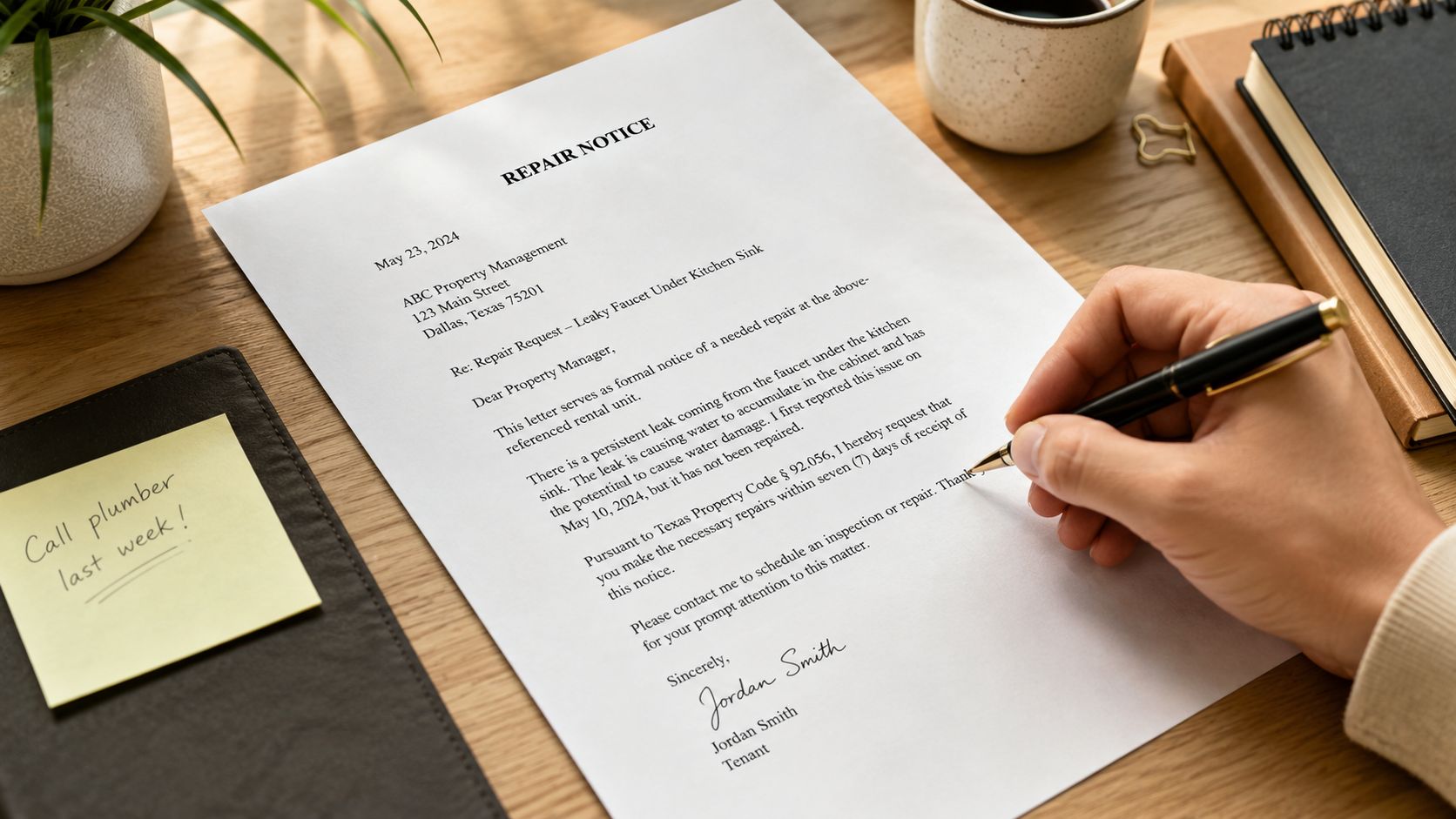
A repair notice should read like evidence, not frustration. Put the date at the top, identify the property and unit, describe the condition with precision, explain the health or safety effect, and request repair under Texas Property Code § 92.052. Sign and keep a complete copy.
Build the notice around four facts
Date and property. Write the date of delivery, the full rental address, and the unit number. A notice that doesn't clearly identify the premises creates avoidable confusion.
Specific condition. State what happened, where it happened, and whether it continues. Mention visible damage, water movement, odors, loss of service, exposed wiring, or other concrete facts. Don't exaggerate, but don't minimize danger.
Legal request and reasonable time. Request a diligent effort to repair under § 92.052 and § 92.056. Texas guidance treats seven days as a presumed reasonable repair window, although that presumption can be rebutted based on the circumstances. An emergency may require faster action.
Signature and delivery proof. Sign the notice and send it using the lease's required method. Certified mail with return receipt requested is the strongest practical choice because it creates delivery evidence. Email with a timestamp and photographs, plus a posted-door photograph when appropriate, can support the file but shouldn't replace the legally required method when the lease demands something else.
A concise paragraph might say:
“I am requesting repair of the active ceiling leak in the bedroom at [full address and unit]. Water is spreading toward the ceiling light fixture and has caused visible damage near my child's bed. This condition materially affects health or safety under Texas Property Code § 92.052. Please make a diligent effort to repair the condition within a reasonable time and provide written confirmation of the repair plan.”
Keep a contemporaneous record
Create one folder for the dispute. Save the original notice, the postal receipt, the signed delivery confirmation, photographs with timestamps or metadata, videos showing active dripping, rent receipts, and every text or email. Record phone calls in a dated log with the caller, recipient, time, and substance of the conversation.
A second-notice mistake can weaken an otherwise legitimate claim. Vague language, a missing property address, an omitted unit number, or a notice sent only to an employee who isn't the designated recipient can create proof problems. The Texas State Law Library's failure-to-repair guidance explains why notice timing, delivery, rent status, and documentation matter.
Your Legal Options When the Repair Never Happens
Once the statutory prerequisites are satisfied and the landlord fails to make a diligent effort, the right remedy depends on whether you need to leave, stay, or force the work while preserving a damages claim. Texas Property Code §§ 92.056 through 92.0563 create an escalation path. They don't give every tenant an automatic win.
| Remedy | Statute | Tenant Stays? | Typical Time | Upfront Cost |
|---|---|---|---|---|
| Terminate the lease | § 92.056 | No | Potentially the fastest practical exit, if the statutory process is satisfied | Moving and replacement-housing costs may arise |
| Repair and deduct | § 92.0561 | Usually yes | After the required notice and repair period | Tenant initially pays the repair cost, subject to the statutory cap |
| Court-ordered repair | § 92.0562 | Yes | Depends on court scheduling and the urgency of the condition | Filing and litigation costs may arise |
| Judicial remedies and damages | § 92.0563 | Often yes | Depends on the dispute and court process | Filing, evidence, and possible attorney costs |
Choose based on the housing decision
Termination fits a tenant who no longer wants the unit. It can end the lease when the statutory requirements are met, but leaving is not a casual decision. Keep the notice file and proof that you surrendered the premises properly. Termination also changes which other remedies remain available, so get advice before treating it as a shortcut.
Repair-and-deduct fits a tenant who wants to stay and can fund the work. Section § 92.0561 limits the deduction to the greater of one month's rent or $500, and the tenant must provide the repair bill and proof of payment. This remedy preserves possession, but a tenant who deducts incorrectly may face a nonpayment claim.
A court order fits a tenant who needs the landlord to perform the repair. It may be appropriate when the repair is urgent, expensive, or too complex for self-help. The court can also address rent reduction and other statutory relief under § 92.0563.
A § 92.0563 case fits documented losses and serious noncompliance. Available relief can include a repair order, a rent reduction from the date of the first repair notice in proportion to reduced rental value, actual damages, court costs, attorney's fees, and a civil penalty of one month's rent plus $500. Those are procedural points, not automatic awards. Your photos, repair log, rent ledger, and delivery records must establish each element.
Don't select a remedy based only on the repair cost. Consider whether you need the unit, whether the condition is dangerous, whether you can pay a contractor, and whether an eviction is pending. The repair-and-deduct process deserves separate attention because the rules changed for some leases after September 2025.
Using Repair and Deduct Without Losing in Court
Repair-and-deduct is not permission to hire someone, subtract an amount, and explain later. Section § 92.0561 requires strict compliance, and the deduction is limited to the greater of one month's rent or $500. The amount must cover the qualifying repair, not upgrades, unrelated damage, replacement belongings, or general inconvenience. See the statutory explanation of the repair-and-deduct limit and proof requirements.
Follow the paper trail in order
Start with the lease and your prior notice. Confirm that the condition meets the health-and-safety standard, rent was current when notice was given, and the landlord received a compliant request. Do not deduct before the applicable repair period has passed.
Next, choose an independent company, contractor, or repairman who can document the work. House Bill 2037, effective September 1, 2025, changed the repair-and-deduct process for leases entered into or renewed on or after that date. The newer rules require repairs to be performed by an independent company, contractor, or repairman and limit tenant-involved repair arrangements. The dollar cap wasn't increased, and older leases remain governed by prior law for this purpose. Review the House Bill 2037 summary before hiring anyone.
Do not treat a handyman's verbal promise as proof. The contractor's identity, work performed, itemized bill, and payment record should all match.
Obtain an itemized invoice and proof of payment. Within the required period after the repair, give the landlord written notice of the deduction, a copy of the paid bill, and proof of payment. The statutory materials also require documentation concerning the contractor relationship. Keep the originals and send copies through a trackable method.
Common errors include using a person who can't document qualifications or independence, deducting before the repair window closes, exceeding the cap, and charging for improvements. Don't destroy or alter the damaged condition before photographing it, unless immediate action is necessary to protect people or property. If the repair affects a fixture or system, preserve the old part or contractor notes when practical.
Repair-and-deduct may serve as a defense to an eviction claim based on alleged nonpayment, but it doesn't make an incorrect deduction safe. If the rent amount, lease date, contractor arrangement, or repair cost is disputed, call an eviction attorney before subtracting anything. A court will focus on the sequence and paperwork, not merely on whether the apartment needed work.
What Happens If the Case Goes to Court
A § 92.0563 lawsuit places the tenant's proof and the landlord's response under judicial scrutiny. The tenant must show a qualifying condition, proper notice, current rent at the relevant time, the landlord's failure to make a diligent effort, and actual loss or other requested relief. The landlord may respond by disputing notice, rent status, causation, severity, access, or the tenant's claimed expenses.
Potential relief for the tenant
The statute allows a court to consider several forms of relief:
- Actual damages: Documented losses connected to the repair failure, such as qualifying repair expenses or reduced use of the premises.
- Rent reduction: A reduction from the date of the first repair notice, measured in proportion to the reduced rental value.
- Civil penalty: One month's rent plus $500, when the statutory requirements support the award.
- Court costs and attorney's fees: These may be available when the tenant prevails and the statute's conditions are met.
- Court-ordered repairs: A judge may require the landlord to complete the work.
The tenant should not assume every claimed loss will be awarded. Keep receipts, photographs, contractor records, medical documentation when relevant, replacement-housing records, and a clear timeline. The court needs a connection between the defect, the notice, the delay, and the loss.
For both sides, a contested case may involve pleadings, service, evidence exchange, a hearing, and possible appeal. The amount in dispute and the court assigned to the case affect the process. Don't rely on online claims about an exact trial schedule, because local court practice and the facts can change the timeline.
Landlords also face risk beyond the repair invoice. A documented failure can support statutory relief, rent reduction, attorney's fees, and court costs. A separate deceptive-trade-practices theory may create additional exposure, but that analysis depends on the specific conduct and evidence. Landlords should preserve maintenance logs, contractor communications, invoices, photographs, and tenant updates from the first complaint.
This tenant documentation guide for Texas eviction defense offers a useful way to organize the file before a hearing. A demand letter supported by a clean notice log can encourage resolution, but never assume settlement is guaranteed. If you receive a citation, eviction notice, or court filing, respond on time and speak with counsel promptly.
Your Next Step and When to Call a Lawyer
You don't need to guess your way through a repair dispute. Use a short decision checklist, then stop self-help when the risk becomes too high.
Work through these questions
Does the condition affect health or safety? Describe the actual danger, not just the inconvenience. A spreading leak near electrical equipment requires a different response from a cosmetic stain.
Is your rent current? Check the payment date and amount at the time you gave notice. Don't withhold future rent because the landlord hasn't acted.
Did you send proper notice? Follow the lease, identify the property and unit, describe the condition, date the notice, sign it, and use certified or otherwise trackable delivery when appropriate.
Can you prove delivery and delay? Keep the return receipt, email records, photographs, videos, texts, call log, and rent ledger together.
Which remedy matches your goal? If you need to leave, examine termination. If you need to stay and the repair is manageable, evaluate repair-and-deduct. If you need the landlord compelled to act, consider court-ordered repairs or a § 92.0563 claim.
A cheap legal consultation is often safer than an expensive procedural mistake.
Call a Texas tenant attorney before acting if the landlord has filed or threatened eviction, or if the condition involves mold, gas, sewage, or structural danger. You should also get advice when the repair cost exceeds one month's rent, more than $1,000 is in dispute, or you missed even one rent payment during the conflict. Those facts can change the available remedy, the defense strategy, or the evidence you need.
Early advice usually beats late advice because photographs disappear, contractors modify the condition, records get deleted, and memories become less precise. A Texas landlord tenant lawyer can review the lease, test your notice, verify rent status, and help you choose a remedy without turning a repair dispute into an avoidable eviction.
The Law Office of Bryan Fagan, PLLC helps Texas tenants and landlords evaluate repair disputes, lease issues, eviction risks, and related property claims. Visit The Law Office of Bryan Fagan, PLLC to schedule a free consultation and discuss your notice records, repair evidence, and next legal step with a Texas attorney.