Dealing with an eviction in Dallas can turn an ordinary week into a legal emergency. A tenant may be staring at a notice after losing work, while a landlord may be watching unpaid rent accumulate and wondering whether one paperwork mistake will delay possession. Texas eviction law moves quickly, and procedure matters as much as the underlying dispute.
A Dallas eviction lawyer can help a tenant protect possession, identify defenses, and respond before a default judgment. For a landlord, a Texas landlord tenant lawyer can verify notice, service, filing, and enforcement steps before a preventable error costs time and money. The Dallas County system also has practical complications that generic eviction articles often miss, including changing e-filing workflows, precinct-specific procedures, service problems, and incomplete historical filing data.
When a Dallas Eviction Becomes Your Reality
A landlord in Lake Highlands may be holding a pay-or-quit notice while unpaid rent grows after a tenant's job loss. Across town in Oak Cliff, a renter may be looking at a posted notice with no clear cure date, trying to understand whether the landlord can file immediately. In another apartment, a tenant may have reported unsafe conditions repeatedly, only to receive an eviction notice after asking for repairs.
Those facts feel personal, but the court first asks procedural questions. Was the notice authorized by the lease and Texas law? Did the landlord wait the required period? Was service completed correctly? Does the petition match the documents? A strong defense can disappear if the tenant misses a deadline, and a landlord's valid rent claim can fail if the notice was defective.
Dallas County's scale makes fast action especially important. Landlords filed 50,117 eviction cases in 2024, the highest filing volume in 25 years of available data, according to Dallas County eviction data and its housing-stability analysis. The same report described roughly 200 filings every business day, with 52% of cases decided for landlords, 48% for tenants, and 17% ending with an executed writ of possession. It also estimated that 10.5% of the county's renter population faced an eviction filing that year.
Why Dallas procedure deserves local attention
Dallas County Justice Courts don't operate as one perfectly uniform courtroom. Filing workflows may use Odyssey and eFileTexas, precinct practices can differ, and court staff manage a high volume of forcible detainer cases. The Dallas Eviction Advocacy Center reports that nearly 40,000 eviction cases are filed in Dallas County Justice Courts each year through its eviction statistics dashboard.
That's why the first hours matter. A Dallas eviction attorney can examine the notice, identify a defective filing, check the correct precinct procedure, and prevent a missed response from becoming a judgment. Readers dealing with a different local standard can also review this practical NYC good cause eviction guide, but Dallas disputes must be analyzed under Texas law and local Justice Court practice.
How the Texas Eviction Process Works in Dallas County
A Dallas eviction can turn on a missed date or a defective service attempt. Chapter 24 of the Texas Property Code supplies the framework, but each case also depends on the documents filed, the Justice Court precinct, and whether the tenant received legally valid notice and citation.
The sequence from notice to possession
Written notice comes first. Under Texas Property Code Section 24.005, a landlord generally must give at least 3 days' written notice to vacate, unless the lease sets a different period. If the notice is mailed, Dallas County guidance requires an additional 2 days before filing in standard cases, creating a practical timing floor of 5 days from mailing. Review the Dallas County Justice Court eviction procedures before relying on that calculation.
The landlord files in Justice Court. The petition identifies the property, parties, basis for possession, and notice facts. The case belongs in the Justice of the Peace court serving the property. Filing workflows may involve eFileTexas or Odyssey, and precinct staff may apply different local procedures, so confirm the filing requirements for that court.
The tenant must receive citation. Filing alone does not create a valid response deadline. Service must follow the applicable Justice Court rules, and the court needs legally sufficient proof before the case can proceed against that tenant.
The tenant answers and appears. Texas Justice Court Rule 510.10 governs the answer setting, but the citation controls the date the tenant must follow. File a written answer to preserve defenses, then appear at the hearing. An answer does not replace attendance.
The judge decides possession. Justice Court determines the right to possession. It may not resolve every claim between the parties, especially damages outside the court's authority. A tenant seeking additional relief may need a separate case or the proper counterclaim procedure.
A writ can enforce the judgment. Property Code Section 24.006 governs the writ of possession. After the judgment becomes enforceable, a constable may post and execute the writ under the required procedures. Appeals and bonds carry their own strict deadlines. Waiting until the constable arrives is too late to protect possession.
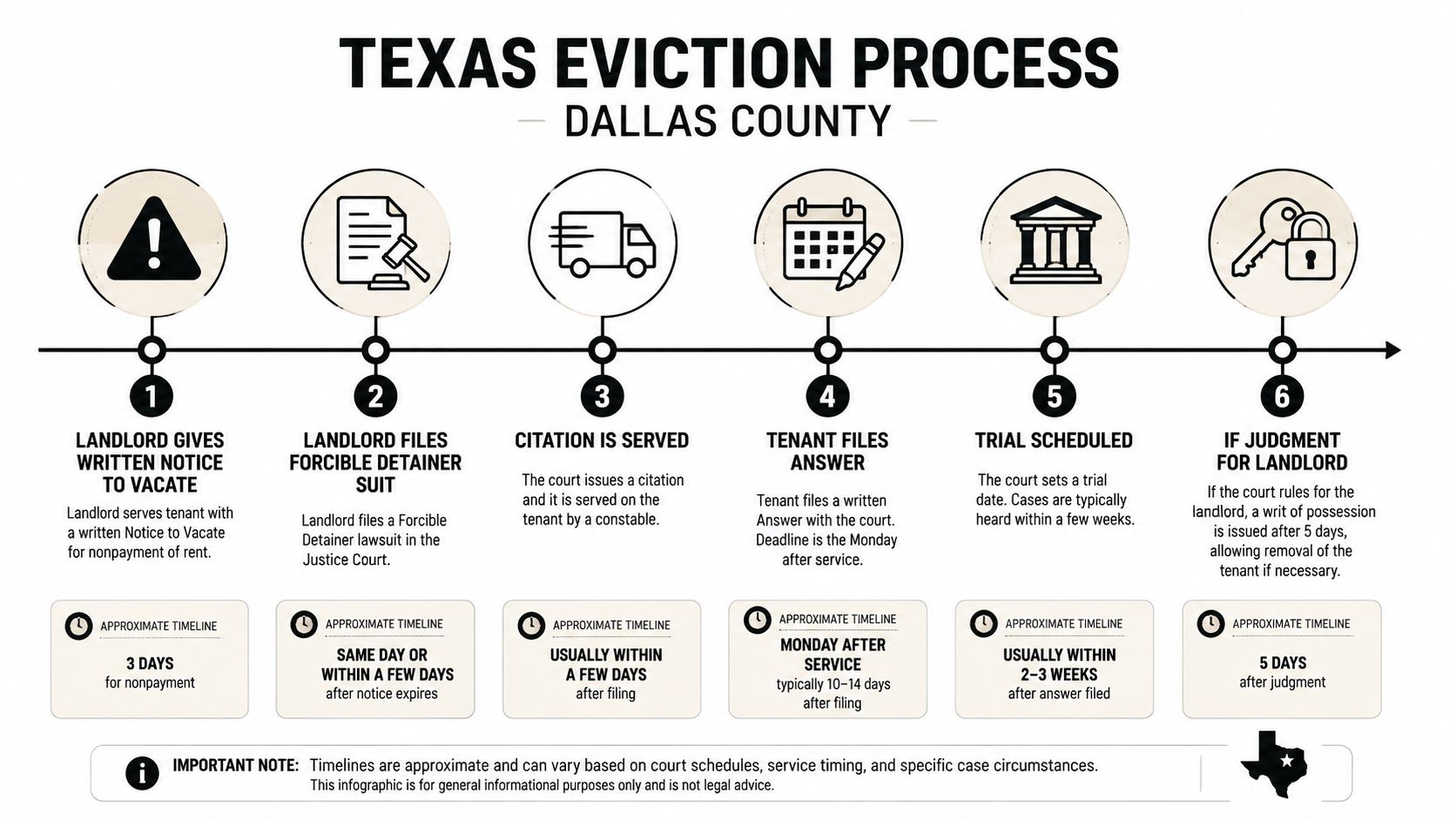
Service problems, continuances, appeals, and court scheduling can change the timeline. For a plain-language explanation of a forcible detainer under Chapter 24, read The Texas Eviction Process Explained. For more detail on how long an eviction takes in Texas, use general timing only as context. Follow the dates printed on the citation and court papers.
Practical rule: Treat every date on the notice, citation, judgment, and writ as a deadline requiring immediate verification.
Notice Types That Decide a Dallas Eviction Case
The notice isn't a formality. It creates the legal foundation for the case, and a defect can undermine an otherwise valid claim for unpaid rent or possession.
| Notice Type | Statute | Tenant Response Window | Key Requirements |
|---|---|---|---|
| Notice to vacate for a lease violation that cannot be cured | Texas Property Code Section 24.005 | At least the period required by the lease or applicable law | Identify the violation, premises, termination demand, and valid delivery method |
| Notice to vacate or cure | Texas Property Code Section 24.005 | The cure period stated by the lease or law | Explain the violation and provide the required opportunity to cure |
| Month-to-month termination notice | Texas Property Code Section 91.001 | The period required for the tenancy and lease terms | Clearly end the periodic tenancy and use an authorized service method |
Read the notice before reacting
For nonpayment, the standard statutory floor is generally 3 days, unless the lease says otherwise. A mailed notice may require the additional waiting period described in Dallas County guidance. A notice that gives the wrong date, demands more than the lease permits, or fails to account for the delivery method can create a procedural defense.
Service must also be documented. Depending on the circumstances and authorization, delivery may involve personal service, certified mail, or posting the notice to the inside of the main entry door. The landlord needs evidence showing what was delivered, when, where, and how. A vague statement that “the tenant knew” isn't a substitute for statutory compliance.
What the court looks for
A Justice Court judge may examine whether the notice identifies the correct premises, names the right tenant, states the basis for termination, provides a valid cure opportunity when required, and expires before filing. The petition must then accurately plead those facts. If the landlord files too early, the tenant may challenge the case even when rent is unpaid.
A late rent payment doesn't automatically repair a defective notice. The court still needs a lawful path to possession.
Landlords should preserve the lease, ledger, notice, delivery proof, photographs, and communications. Tenants should keep every envelope, posted notice, text message, payment record, and repair request. Those documents often answer the first questions the judge asks.
Defenses and Counterclaims That Hold Up in Justice Court
Dallas tenants often arrive in court with a real hardship but no legal defense stated in a way the judge can use. Losing a job, falling behind after a family emergency, or struggling to find another apartment may explain the situation. Those facts may support negotiation, but they don't automatically defeat possession.
Strong procedural defenses
The strongest defenses usually attack the landlord's legal ability to bring the case. Common examples include:
| Defense | Legal Basis | Likelihood of Success in Dallas |
|---|---|---|
| Notice was missing, premature, or defective | Texas Property Code Section 24.005 and lease terms | Strong when documents clearly show the defect |
| Service was not completed as required | Texas Property Code and Justice Court rules | Strong when the landlord lacks reliable proof |
| Wrong property, tenant, or party was named | Petition and jurisdiction requirements | Strong if the error prevents a valid case |
| Rent was paid or accepted under an agreement | Lease, receipts, ledger, and communications | Fact-specific, but persuasive with clear records |
| Retaliation after a protected complaint | Texas Property Code Section 92.055 | Fact-specific and document-dependent |
| Repair or habitability violations | Texas Property Code Sections 92.052 and 92.056 | Stronger when notice, condition, and landlord response are documented |
For repair disputes, the Texas Attorney General explains that 7 days is presumed reasonable for a diligent repair effort after proper notice, although the landlord can rebut that presumption. The guidance recommends sending a dated repair letter by certified or registered mail, keeping a copy, and staying current on rent. Those instructions appear in the Attorney General's renters' rights guidance.
Counterclaims require proof
A tenant may have claims for actual damages, attorney's fees, or other relief under applicable provisions such as Section 92.056. But a counterclaim isn't a substitute for an answer, and it doesn't guarantee that the tenant can remain in possession. A landlord's lease violation may support a defense or separate claim, but the tenant must connect the violation to a statute, lease term, or recognized remedy.
Federal housing protections may matter in particular cases, including issues involving HUD-assisted housing or other federally regulated programs. Those protections must be matched to the property and the tenant's facts.
The weaker arguments are usually equitable rather than legal. “I can't afford to move,” “the market is difficult,” or “I've always paid before” may persuade a landlord to negotiate, but a Justice Court generally needs a recognized statutory or contractual defense. This guide to Texas eviction court defenses can help organize the issues before a consultation.
What to Do in the First 72 Hours of an Eviction Filing
A citation or notice should trigger action, not panic. The first task is to determine exactly what document you received and whether it came from the landlord, the constable, or the court.
Tenant action plan
- Read every page: Find the court, precinct, case number, hearing date, and answer instructions.
- Calendar the deadline: Follow the date on the citation. Don't rely on a general internet estimate because service details control.
- Build the evidence file: Gather the lease, payment receipts, bank records, repair requests, photographs, texts, emails, and notices.
- Write down the timeline: Record when rent was due, when payments were made, when repairs were reported, and when notice was delivered.
- File a response: Submit the written answer through the proper court process before the deadline and attend the hearing.
- Seek help early: Contact a Dallas eviction attorney, legal aid provider, or Dallas Eviction Court Help if you need assistance identifying defenses.
You can review this practical guide on how to respond to an eviction lawsuit in Texas. A tenant shouldn't wait for a judgment before asking whether notice, service, retaliation, payment, or habitability issues matter.
Landlord verification checklist
A landlord should compare the notice against the lease, confirm the notice expired before filing, verify the correct property and occupants, and preserve delivery evidence. The petition and sworn statement should be accurate, consistent, and supported by the ledger. The constable's service affidavit also deserves review because service problems can delay the case or force a new filing.
Dallas filing workflows can change by precinct. E-filing mandates and late-day filing practices may affect whether a submission appears on the expected docket. A landlord should confirm acceptance through the court's system rather than assuming that uploading a document completed filing. Rule 510.9 also provides a bond-to-redeliver mechanism in appropriate circumstances, but the amount and timing require careful review.
How Much an Eviction in Dallas Really Costs
Eviction cost isn't limited to the filing charge. A landlord may face service expenses, attorney fees, lost rent, enforcement costs, and property turnover. A tenant may face relocation costs, bond exposure, loss of possessions after execution of a writ, and the consequences of a judgment.
The available verified information doesn't establish a complete 2025-2026 Dallas fee schedule or reliable ranges for every item. A responsible lawyer should calculate the actual amount from the court's current schedule, the lease, the service method, and the facts of the case rather than promise a national average.
| Cost Item | Who Pays | Typical Dallas Range (2025-2026) |
|---|---|---|
| Justice Court filing fee | Usually landlord at filing | Confirm the current precinct schedule |
| Citation and constable service | Usually landlord initially | Confirm the current service fee |
| Attorney fees | May be landlord or tenant depending on contract and law | Depends on representation and whether the case is defended |
| Writ of possession execution | Generally landlord seeking enforcement | Confirm the current constable schedule |
| Appeal or supersedeas bond | Party appealing or seeking a stay | Set under the applicable rules and court order |
| Relocation and property loss | Usually tenant after a possession judgment | Depends on timing and belongings |
Bond and fee exposure
Texas law makes appeal timing especially important. A county court judgment in an eviction suit generally can't be stayed pending appeal unless the appellant files a supersedeas bond within 10 days after the judgment is signed, and the county court sets the bond amount. The Texas State Law Library explains these Texas eviction appeal requirements.
Attorney fees may be recoverable in some circumstances under the lease or Texas Property Code Section 24.006, but recovery isn't automatic. A landlord should ask what fees are included in the representation and what fees may be requested from the other side. A tenant should ask about bond exposure, appeal deadlines, and whether a defense or counterclaim changes the expected cost.
How to Choose the Right Eviction Lawyer in Dallas TX
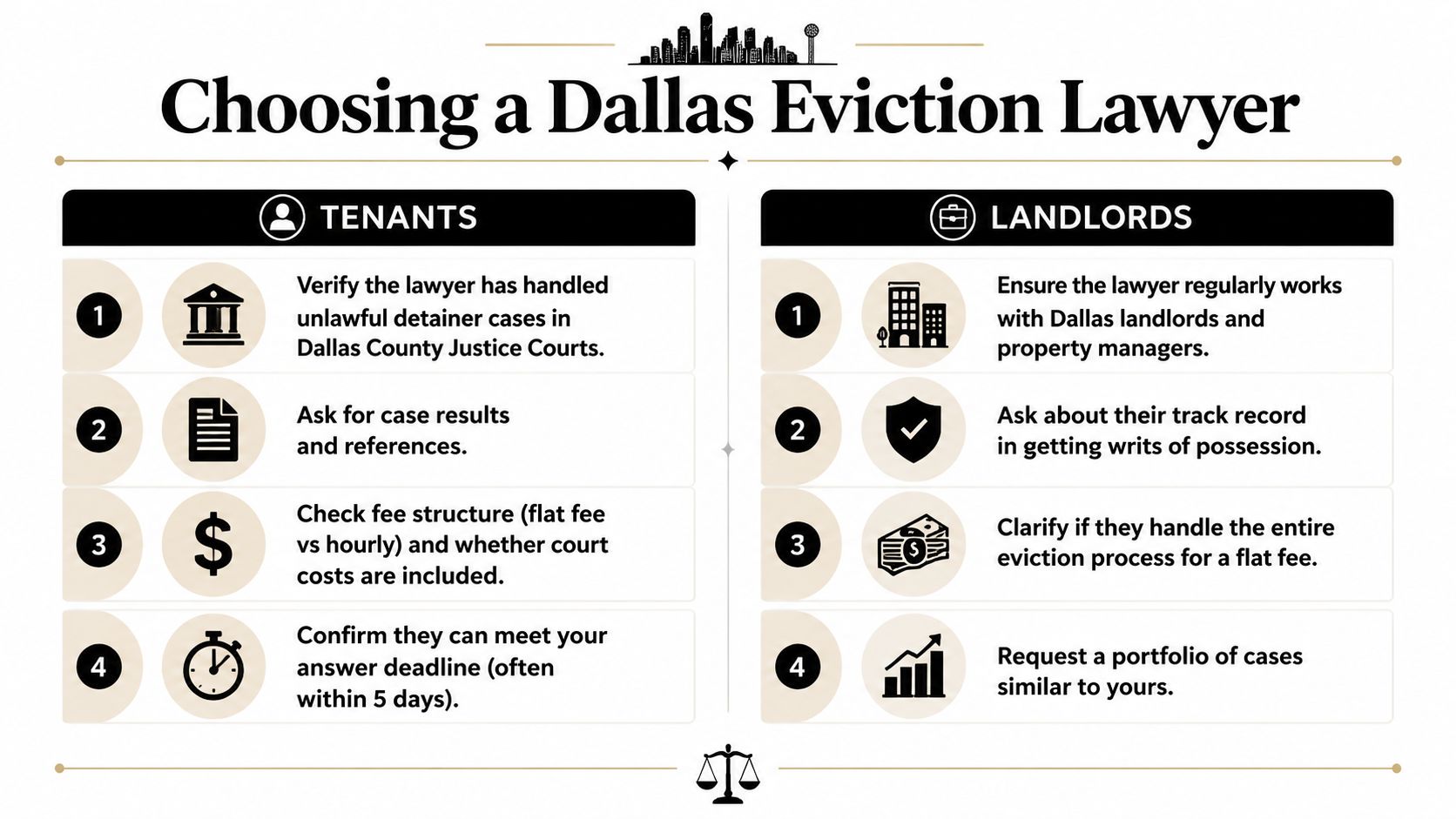
The right eviction attorney understands both the statute and the courtroom mechanics. Look for a lawyer whose practice regularly handles Texas landlord-tenant matters, not someone who treats an eviction as an occasional side issue.
Questions for your consultation
Ask direct questions and expect direct answers:
- Local experience: How often have you handled forcible detainer cases in Dallas County Justice Courts?
- Procedure: How will you verify notice, service, filing, and the correct precinct?
- Deadlines: What date controls my answer, hearing, appeal, or bond?
- Representation: Will you appear at the hearing, negotiate, handle motions, and address enforcement?
- Fees: Is the arrangement flat-fee, hourly, or mixed? Which court and service costs are separate?
- Appeals: Can you advise on a County Court appeal and supersedeas bond if the judgment goes against me?
- Communication: Who will provide updates, and how quickly should I report a new notice or court document?
A landlord may need a lawyer who can handle lease enforcement, nonpayment, property damage, and post-judgment possession. A tenant may need someone who can investigate improper notice, repairs, retaliation, habitability, security deposits, or illegal entry. The same attorney doesn't necessarily fit both situations.
Red flags that should end the conversation
Be cautious if the lawyer won't explain the notice and service requirements, gives a guaranteed result, avoids discussing deadlines, or can't identify who will handle your hearing. Vague promises matter less than a clear plan tied to the documents in front of the lawyer.
Bring the lease, notice, citation, payment history, repair records, photographs, and court information. A lawyer can't evaluate a deadline accurately from a short verbal summary. The Law Office of Bryan Fagan, PLLC describes its work as assisting Texas landlords and tenants with rental, leasing, property, repair, security deposit, and eviction disputes, beginning with a free consultation.
Take the Next Step With a Free Eviction Consultation
Dallas eviction practice now requires more than repeating the standard notice-to-vacate rule. A tenant or landlord must determine how service occurred, whether the correct Justice Court received the filing, whether precinct-specific procedures apply, and whether the documents tell one consistent story. The filing pace makes prompt review practical, not academic. The Dallas County report describes roughly 200 eviction filings per business day, which leaves little room to ignore a citation, defective notice, or electronic filing issue.
A consultation should produce a written action plan. The attorney should review the timeline, inspect the notice-to-vacate, identify defenses or filing weaknesses, discuss negotiation, and explain likely cost categories. For landlords, that review includes the lease, ledger, notice, delivery proof, petition, and service record. For tenants, it includes payment evidence, repair communications, photographs, retaliation facts, and any disability, subsidy, or habitability issues that may affect the case.
Bring documents, not just questions
Bring these items if you have them:
- The lease and addenda: Include renewal terms, notice provisions, and rules about violations.
- Every notice: Keep the original, envelope, photograph, or posted copy.
- Court papers: Bring the citation, petition, hearing information, and any judgment.
- Payment records: Include receipts, bank statements, money orders, and written payment agreements.
- Property evidence: Organize repair requests, photographs, inspection records, and messages.
- A short timeline: Write the key events in date order before the meeting.
Do not wait for a writ of possession or an appeal deadline. Texas appeals can require a supersedeas bond within 10 days after a county court eviction judgment is signed, according to the Texas State Law Library's appeal guidance. Missing that deadline can eliminate options that were available earlier.
The recommendation is direct. Tenants should protect the answer deadline and preserve evidence. Landlords should audit notice, service, filing location, and electronic court records before assuming possession is guaranteed. The Law Office of Bryan Fagan, PLLC offers guidance for Dallas tenants and landlords facing evictions, lease disputes, repair problems, and property conflicts under the Texas Property Code. Visit The Law Office of Bryan Fagan, PLLC to schedule a free consultation, bring your lease and court papers, and get a clear next step before a deadline passes.