
You drive past your vacant San Antonio rental and notice curtains in the windows, a grill on the patio, and a television glowing inside. No lease was signed, no keys were given, and no rent was paid. At that moment, you realize this may not be a normal eviction. Someone may have entered without permission, and choosing the wrong removal process could create more trouble than the unauthorized occupancy itself.
If you're evicting a squatter in Texas, start with facts, not frustration. How did the person enter? How long have they been there? What paperwork proves your ownership and the absence of a rental agreement? Texas now provides two different removal tracks, and the correct choice can depend on details many owners overlook, including whether the occupant claims a color of title or has opened utility accounts.
When a Stranger Moves Into Your Texas Property
The San Antonio owner in this example shouldn't begin by changing the locks or confronting the person alone. The owner should first preserve evidence, confirm who has been living there, and determine whether the occupant ever received permission from the owner, a property manager, a relative, or a prior tenant.
That last question matters. A person who broke into a vacant house with no permission is treated differently from someone who was invited to stay, paid rent informally, or remained after a lease ended. Texas law now creates an expedited law-enforcement option for a true unauthorized occupant, but a former tenant or disputed occupant generally belongs in a forcible-detainer case.
Practical rule: Don't call someone a squatter until you've checked the entire possession history.
Start a file immediately. Save listing records, inspection reports, texts, emails, utility information, prior leases, payment records, and dated photographs. If neighbors saw the person enter, write down what they observed while the details are fresh. This evidence helps establish whether the occupant entered unlawfully and whether any agreement existed.
The three questions that control the path
Ask these questions before taking action:
- How did the person get inside? Forced entry, an open door, a referral from a tenant, and permission from a family member create different legal issues.
- How long has the person possessed the property? The new expedited framework has specific limits and isn't a general substitute for every possession dispute.
- What documents exist? Look for a deed, management authorization, lease, text message, rent receipt, utility account, or any document the occupant may use to claim a right to remain.
Texas adverse possession rules also matter in the background. The baseline rule under Texas Civil Practice and Remedies Code § 16.026 is 10 years of open, continuous, and adverse possession, while shorter statutory paths are commonly described as 5 years with a deed and taxes paid and 3 years with color of title from the state. Those rules don't mean a newly discovered occupant automatically owns your property, but they explain why you should address possession disputes promptly. You can review the broader issue in this guide to squatters' rights in Texas.
Who Qualifies as a Squatter Under Texas Law
Texas Property Code Chapter 24B, effective under the recent law changes, is aimed at a narrow category of person: a true unauthorized occupant in a residential dwelling who never had a tenancy or co-owner relationship and has no lawful basis to remain. The law isn't designed to let an owner bypass court whenever an occupant is inconvenient.
Use four questions to classify the situation.
Apply the four-box test
Was there consent to enter? If you or an authorized person allowed the individual inside, even informally, Chapter 24B may not fit. Consent can be shown through messages, key records, witness statements, or conduct that indicates permission.
Is there any written or oral agreement? A formal lease is obvious, but informal arrangements can matter too. A promise to pay later, an agreement to provide services in exchange for housing, or permission to occupy a room may create a disputed possession issue.
Has the person been there for 30 days or less? The Chapter 24B framework described in current Texas guidance addresses an unauthorized occupant who hasn't possessed the property for more than 30 days as a trespasser. Verify the facts before relying on that route. The occupant's claim about duration may conflict with your records.
Has the person asserted color of title? A deed-like document or other claimed ownership paper doesn't automatically establish title, but it can create a dispute that needs legal review. Don't treat a document as meaningless just because you believe it is invalid.
| Category | Defining Facts | Removal Track |
|---|---|---|
| Squatter | Entered without permission, has no lease or tenancy history, and claims no valid right to possess | Chapter 24B may allow a sworn complaint to the sheriff or constable |
| Tenant | Has a current written or oral lease or another recognized rental arrangement | Chapter 24 forcible detainer |
| Holdover | Previously had permission or a lease but stayed after the right to occupy ended | Chapter 24 forcible detainer |
| Trespasser | Entered without authority and has no colorable possession claim | Chapter 24B may apply if statutory requirements are satisfied |
A mixed situation may require a hybrid strategy. For example, law enforcement may investigate an alleged unlawful entry while you prepare a civil filing in case the occupant presents evidence of permission or tenancy. The key is to avoid swearing to facts you can't support.
For a deeper explanation of the ownership issue, review the elements of adverse possession in Texas. If the occupant was ever a tenant, paid rent, or received permission, treat the case as legally disputed until the records prove otherwise.
The Expedited Removal Path Through Law Enforcement
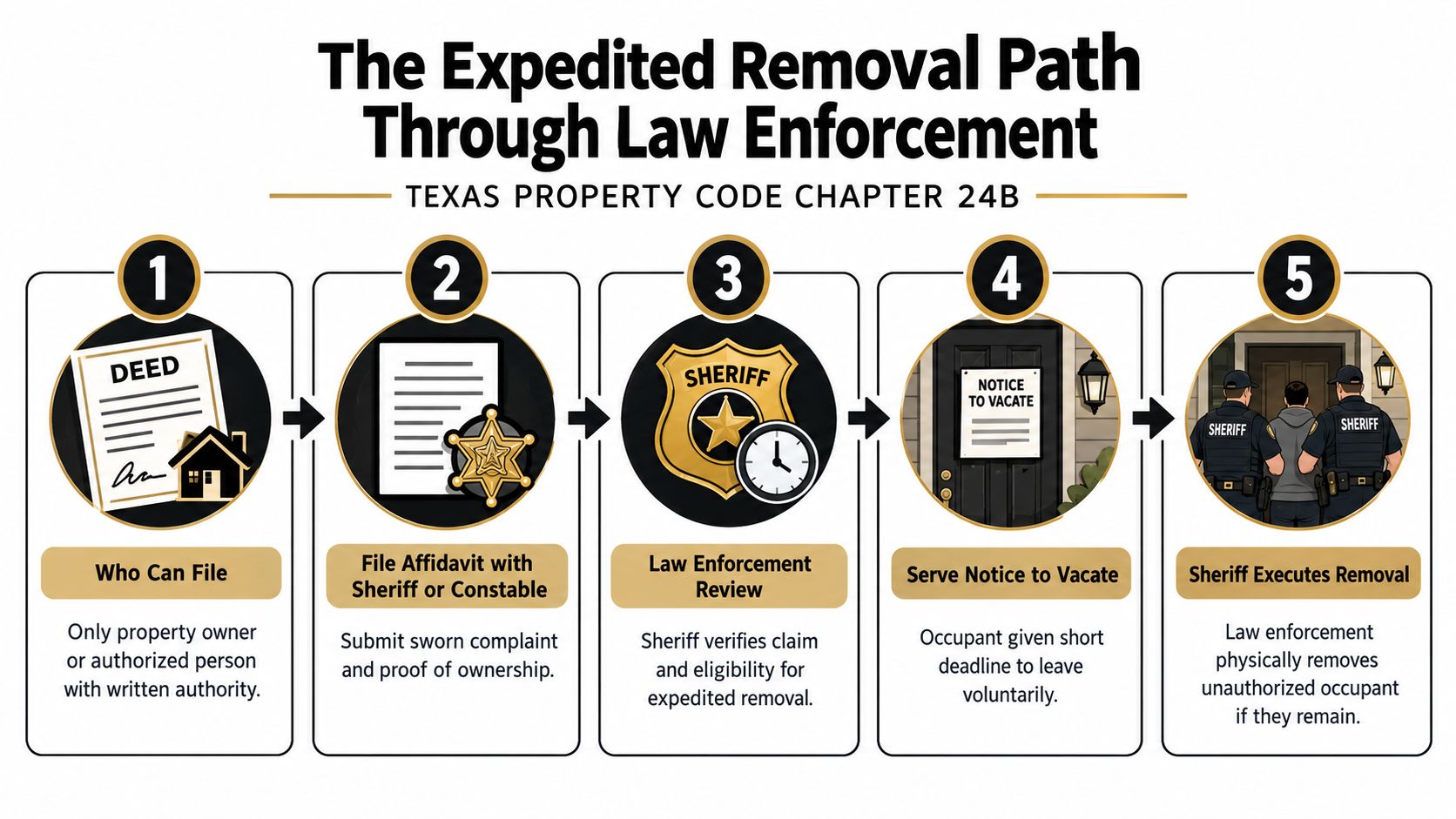
Chapter 24B gives a property owner or an authorized agent with written authority a potential route through the local sheriff or constable. The process is limited. It applies when the occupant entered without permission, has no lease or written agreement, hasn't been in possession for more than 30 days as a trespasser, and isn't a current or former tenant.
The owner must file a sworn complaint. Under the required framework, the complaint must attest under penalty of perjury to facts including that the property wasn't open to the public, the occupant was told to leave and refused, no related litigation is pending, and the occupant isn't and has never been a tenant or co-owner.
Prepare the evidence before filing
Bring organized proof rather than a folder of disconnected papers:
- Proof of ownership: A deed or property record should identify you as the owner. The firm's proof of ownership resource can help you identify the records commonly used to support an ownership claim.
- Authority documents: If a property manager or agent files, include written authorization from the owner.
- Occupancy evidence: Use dated photos, inspection records, neighbor statements, and utility records to show when the unauthorized occupancy was discovered.
- No-tenancy evidence: Gather leases, payment histories, messages, and management notes showing that the occupant never rented the property.
- Demand to leave: Preserve the message, letter, or other record showing that the person was told to leave and refused.
After filing, the sheriff or constable reviews the complaint and supporting information. Law enforcement serves notice, gives the occupant a short opportunity to respond, and evaluates whether the person produces lawful evidence of tenancy or another right to possess. If the statutory conditions are satisfied and no legitimate tenancy evidence appears, the officer may order removal.
The practical timeline and fees vary by county and agency. Don't promise yourself a particular result or deadline. The remedy also has limits. If the occupant contests the facts, claims permission, produces an agreement, identifies a prior tenancy, or raises a colorable ownership issue, the expedited route may stop and the case may need to proceed under Chapter 24.
Owners who need the court-based alternative can review The Texas Eviction Process Explained, which addresses how a forcible-detainer case proceeds under Property Code Chapter 24.
The Traditional Forcible Detainer Eviction Path
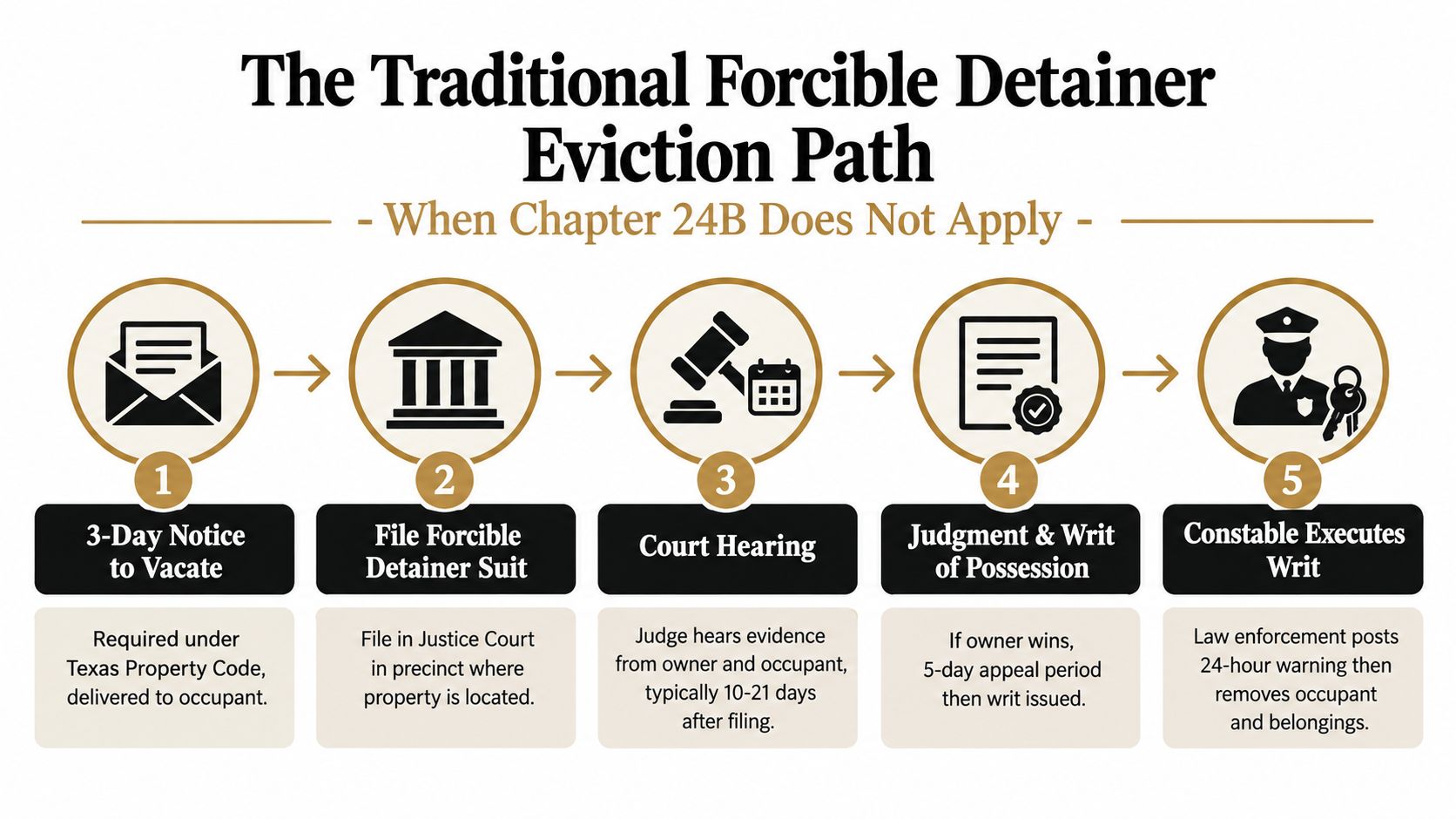
Use the traditional court path when the person was a tenant, former tenant, holdover, invited occupant, or anyone whose right to possess the property is disputed. Texas Property Code § 24.005 generally requires three days' written notice to vacate before filing when a tenant defaults under a written or oral lease, unless the lease provides a different notice period. For a person who entered without legal authority or by force, the statute allows oral or written notice immediately or by a specified deadline, followed by suit after notice.
Don't guess about notice. Check the lease, identify every occupant you know, use a legally permitted delivery method, and keep proof of service. A defective notice can force you to start over.
File in the correct justice court
A forcible-detainer case belongs in the justice court for the precinct where the property is located. The case decides the right to immediate possession, not final ownership. If the occupant raises a title dispute, that issue may require a separate legal strategy, but the justice court still handles the possession procedure within its authority.
Once filed, the justice court must set trial no earlier than the 10th day and no later than the 21st day after filing under the current framework. One county instruction set describes a hearing as typically about 21 days after filing, with judgment often entered the same day. Service of the citation is critical because a missed or defective service can delay the hearing.
At trial, present the lease or possession history, notice, delivery proof, payment records, photographs, and ownership documents. If the occupant doesn't appear, the court may enter a default judgment, but you still need the proper writ process before an officer removes anyone.
Judgment, appeal, and writ
A losing occupant generally has a 5-day appeal window. After that period, or after the court handles the applicable appeal requirements, you can request a writ of possession. A constable or sheriff executes the writ and generally gives the occupant at least 24 hours to remove belongings before physical removal.
The entire process can take weeks, especially when service, continuances, appeals, or disputed facts interfere. Don't rely on a promised calendar. Rely on correctly prepared documents.
Self-Help Mistakes That Put Landlords at Risk
Your goal shouldn't be to remove the person by whatever means seem fastest. Your goal should be to regain possession without creating a separate claim against yourself.
Texas doesn't permit an owner to replace the court or authorized officer with personal force. Changing the locks, shutting off utilities, removing doors or windows, putting belongings on the curb, or physically removing an occupant can expose you to serious legal consequences. Threatening the occupant with arrest is also a poor strategy, particularly when you don't know whether a lease, permission, or ownership dispute exists.
The legally controlled remedy is a notice, a proper filing when required, a judgment, and a writ executed by a constable or sheriff. The officer, not the landlord, performs the forcible removal.
Preserve the property and the record
Before taking any action, photograph the exterior, doors, windows, rooms, personal property, and visible damage. Use dated records. Don't enter occupied space in a way that could create a separate confrontation or privacy dispute.
Keep communications written and professional. Don't make threats, offer confusing side deals, or describe the person as a criminal in messages that may later be reviewed. If the facts are uncertain, route communications through a Texas landlord tenant lawyer.
A shortcut that feels efficient can turn a possession case into a liability case.
If belongings remain after lawful removal, don't haul them away casually. Follow the applicable process and obtain advice about storage, notice, and disposition. The same caution applies to utility accounts and security devices. Protect the property, but don't use property control as a substitute for legal process.
Three Real Scenarios and the Right Path for Each
The building may look identical in all three examples. The legal answer changes because the relationship and evidence change.
Scenario one, the stranger in a vacant house. An owner is preparing a single-family home for sale. A stranger forced entry, never received keys, never paid rent, and has no personal connection to the owner. If the owner can prove the person entered without permission and satisfies the Chapter 24B requirements, this is the cleanest candidate for expedited law-enforcement removal.
Scenario two, the former month-to-month tenant. The tenant stopped paying rent, received a notice to vacate, and stayed after the deadline. That is a holdover and nonpayment dispute, not a Chapter 24B squatter case. The owner should use the traditional forcible-detainer route.
Scenario three, the invited family member. An owner let a sibling, romantic partner, or caregiver stay. The arrangement may have been informal, but permission existed. If the person refuses to leave, the owner should expect a possession dispute and prepare for the court track rather than swearing that the person was a stranger.
| Scenario | Occupant Relationship | Best Removal Path | Key Proof Needed |
|---|---|---|---|
| Stranger broke into vacant home | No personal connection, no lease, no payment | Chapter 24B, if every requirement is met | Ownership records, entry evidence, photos, no-tenancy records |
| Former month-to-month tenant | Prior rental relationship and unpaid rent | Chapter 24 forcible detainer | Lease history, payment records, notice, service proof |
| Family member, partner, or caregiver | Permission to stay, possibly informal terms | Usually Chapter 24 forcible detainer | Messages, witness statements, payment or service records, demand to leave |
When the facts are blended, choose accuracy over speed. A sworn complaint that ignores prior permission can damage your credibility and delay the case you needed to file.
Preventing Squatters Before They Settle In
Vacancy management is legal risk management. Each inspection, lock change, and photograph gives you evidence that the property was actively controlled and helps law enforcement or a court understand when the unauthorized occupancy began.
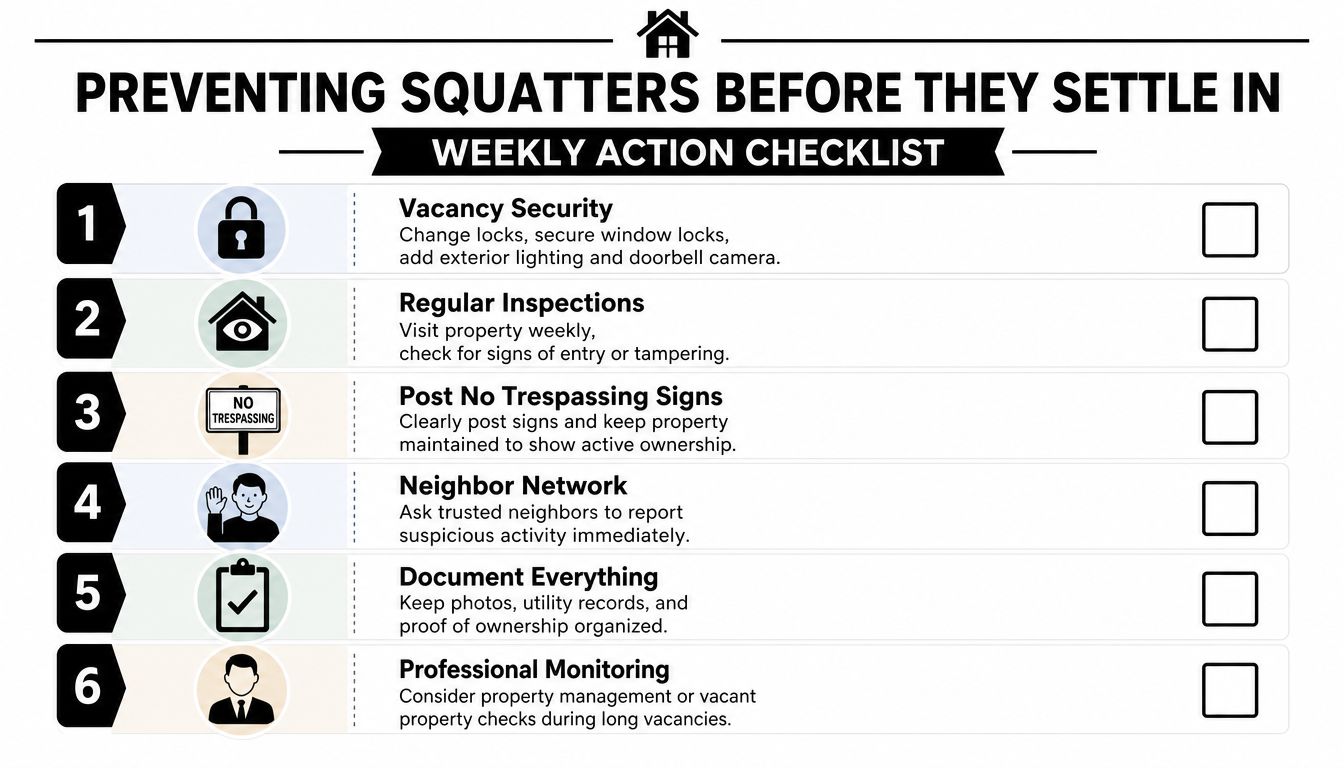
Start with physical security. Change locks after every turnover, secure window locks, install exterior lighting, and use a working doorbell or camera at each entry. Keep access codes private, record who has keys, and disable access for anyone who no longer needs it.
Build a repeatable vacancy checklist
Use a written system instead of relying on memory:
- Inspect regularly: Drive by the property weekly and conduct a walk-through monthly when practical. Look for broken windows, moved curtains, new furniture, trash, or utility activity.
- Create a neighbor network: Give a trusted neighbor a current contact number and ask them to report signs of entry immediately.
- Post clear warnings: Maintain visible no-trespassing signs and keep the property maintained. The condition of the property can help show active ownership and control.
- Track responsible parties: Keep the owner's information, property manager's authority, utility contacts, alarm details, and key inventory together.
- Save dated photographs: Photograph doors, windows, meters, rooms, and exterior conditions during inspections.
- Organize ownership records: Store the deed, tax records, management agreement, insurance documents, and prior inspection logs where you can retrieve them quickly.
Lease drafting also prevents confusion. Use clear no-subleasing language, guest-duration limits, a criminal-trespass acknowledgment, and lawful landlord-entry provisions. Those clauses won't authorize illegal self-help, but they can clarify expectations and make the possession history easier to prove.
Security deposits require separate care when a tenant surrenders the premises. Texas Property Code Chapter 92 generally requires the landlord to refund the deposit within 30 days and provide a written itemized list of deductions if any amount is withheld, while allowing deductions for damage beyond ordinary wear and tear. Keep move-out photos and inspection records separate from a squatter file, because mixing the two can blur whether the person was a tenant.
Know when to involve counsel
A consultation is especially useful when the occupant claims adverse possession, the facts combine squatter and tenant characteristics, you already changed locks or shut off utilities, the case may involve a jury, or the potential liability is greater than the ordinary cost of removal.
The Law Office of Bryan Fagan, PLLC can help evaluate sworn complaints under Chapter 24B, prepare forcible-detainer filings, coordinate with constables, and pursue post-judgment writs. The right consultation should answer one practical question: which removal track fits the documented facts?
If you need help with an eviction, lease issue, or rental dispute, contact The Law Office of Bryan Fagan, PLLC for a free consultation today.
The Law Office of Bryan Fagan, PLLC helps Texas property owners and tenants evaluate squatter claims, Chapter 24B complaints, forcible-detainer cases, notices, and writ procedures. Visit The Law Office of Bryan Fagan, PLLC to schedule a free consultation and get a clear strategy for your property dispute.