Skip to content
If you're in Houston and an estranged partner's threats are getting worse, moving out may feel urgent, but the lease can still stand in your way. Texas law gives some survivors a path to end a residential lease early, but the documentation required for family violence lease termination must be handled carefully. A landlord can challenge an incomplete notice, an unreadable report, or proof that doesn't fit the statute.
This guide explains Texas Property Code § 92.016, the documents that can qualify, how to preserve them safely, and how to deliver your notice so you can create a clear record. If a landlord refuses to cooperate, withholds your deposit, or treats the move as an ordinary lease default, a Texas landlord tenant lawyer can help protect your tenant rights.
Why Documentation Matters When Ending a Lease After Family Violence
A Houston tenant learns that her estranged partner has been escalating threats. She wants to leave immediately and has heard that Texas law may let her terminate the lease because of family violence. The problem is that a phone call to the property manager saying “I'm a victim” usually isn't enough. She needs qualifying proof, written notice, and a documented move-out process.
Texas Property Code § 92.016 treats early termination as a legal right with specific conditions. Under the statute, a tenant must provide the landlord with documentation of family violence and written notice of termination at least 30 days before moving out. The Texas State Law Library's landlord-tenant guidance explains that qualifying documentation can include a protective order, certain emergency court orders, or proof from an appropriate licensed provider or family violence advocate.
The documentation requirement serves two purposes. It gives a genuine survivor a recognized path out of an unsafe home, and it gives the landlord a verifiable basis for ending the lease without treating every unsupported claim as an automatic lease release.
Practical rule: Your statement starts the conversation. A qualifying document, attached to timely written notice, makes the statutory right usable.
Landlords and property managers often ask for proof before processing the termination. Without a strong paper trail, they may characterize the move as an ordinary lease break, retain the security deposit, or report alleged unpaid rent to credit agencies. Those consequences can follow you even after you leave a dangerous home.
Your objective is simple: create a file showing eligibility, notice, delivery, surrender, and forwarding information. Keep copies of everything. If the landlord disputes your rights, that record can help an eviction attorney or tenant-rights lawyer respond quickly.
Qualifying Documents Under Texas Property Code Section 92.016
Texas law recognizes several routes to qualifying proof. You need one qualifying document, not every document listed below. The document must still be legible, complete, and connected to your situation.
Court orders and emergency protection
A protective order issued under Texas Code of Criminal Procedure Chapter 7A can qualify. A magistrate's order for emergency protection under Article 17.292 can also qualify. Obtain a complete copy, including the pages identifying the protected person, the adverse party, the issuing court, and the order's date.
A plain copy of the order is generally what you provide to the landlord. Notarization isn't required for the protective-order copy itself, but don't alter, crop, or selectively submit pages.
Professional affidavits
A signed and dated affidavit from a licensed physician, psychologist, counselor, or social worker may qualify when that professional treated or evaluated the victim for injuries or trauma resulting from family violence. The affidavit should identify the professional's qualifications and license information, identify the victim, and describe the relevant treatment or evaluation.
The most common problem is a generic letter that says the patient discussed a difficult relationship but doesn't use the required statutory framework. Ask the provider to prepare a formal affidavit rather than handing over raw chart notes.
Law-enforcement reports
A written, signed report from a law-enforcement officer or peace officer describing the family violence incident may qualify. Request the complete report, not just an incident number or dispatch summary. Check that the report identifies you, describes the incident, and is signed or otherwise issued by the appropriate officer or agency.
School or daycare records
A school or daycare record documenting the violence may also qualify. This route can matter when the incident affected a child's safety or resulted in a report made through the school or childcare provider. Ask for an official record on institutional letterhead or through the provider's records process.
| Document Type | Source | Must Contain |
|---|---|---|
| Protective order | Issuing court or clerk | Identifying parties, court information, order date, and complete order terms |
| Magistrate's emergency protection order | Magistrate or court clerk | Identifying information, issuing authority, date, and order terms |
| Professional affidavit | Licensed physician, psychologist, counselor, or social worker | Professional qualifications, license information, victim's identity, treatment or evaluation, and family-violence connection |
| Law-enforcement report | Police department, sheriff, or peace officer | Written report describing the incident and identifying the victim |
| School or daycare record | School or childcare provider | Official documentation connecting the record to the violence |
Landlords commonly push back over missing signatures, incorrect affidavit language, absent license details, incomplete pages, or illegible scans. Before serving notice, review the material as if you were a property manager who had never met you. The Texas Property Code overview can help you locate related Chapter 92 provisions, but a lawyer should review uncertain documents before you rely on them.
How to Obtain and Preserve Each Type of Proof
Start with the safest source of the document, then preserve the original before sending anything. If a protective order was issued, contact the clerk of the court that handled the application, usually in the county where it was filed. Bring government photo identification and request at least two certified copies, along with a regular photocopy for your records.
Police reports usually come from the department or sheriff's office that investigated the incident. You can request a copy through the Texas Public Information Act. Agencies often respond within 10 business days, although the actual timing can vary by agency and the status of the investigation. If the report is incomplete, ask the records division what additional report, supplement, or signed officer statement exists.
Request professional records carefully
Hospitals, clinics, and therapists generally use HIPAA release forms for medical or counseling records. Ask the provider's records department for the process, and limit the request to what you need. Raw chart notes can reveal more private information than necessary and may not satisfy the statute as clearly as a properly prepared affidavit.
Tell the provider that you need a signed and dated statutory affidavit, not merely a treatment summary. The affidavit should state the provider's qualifications, your identity, the treatment or evaluation, and the connection to trauma or injuries resulting from family violence.
For an affidavit, review the formal requirements under Texas Civil Practice and Remedies Code § 132.001. The document should include a jurat, the notary's commission expiration date, and the affiant's printed name and signature. Ask the notary to check every page before you leave.
Keep a written log of requests, names, dates, and responses. Organize that log with your copies of the documents. Guidance on tenant documentation for court in Texas eviction defense is also useful when you need to preserve records for a later dispute.
If the property has separate health or safety problems, the overview of Habitability and Health-and-Safety Conditions in Texas explains what conditions a Texas landlord must remedy and how those disputes are resolved.
Store originals in a fireproof container outside the home, such as with a trusted person or attorney. Keep encrypted digital copies in an account the abuser can't access. Don't leave documents in a shared vehicle, shared email inbox, or drawer that can be opened without a lock.
Delivering the 30-Day Notice and Completing the Termination
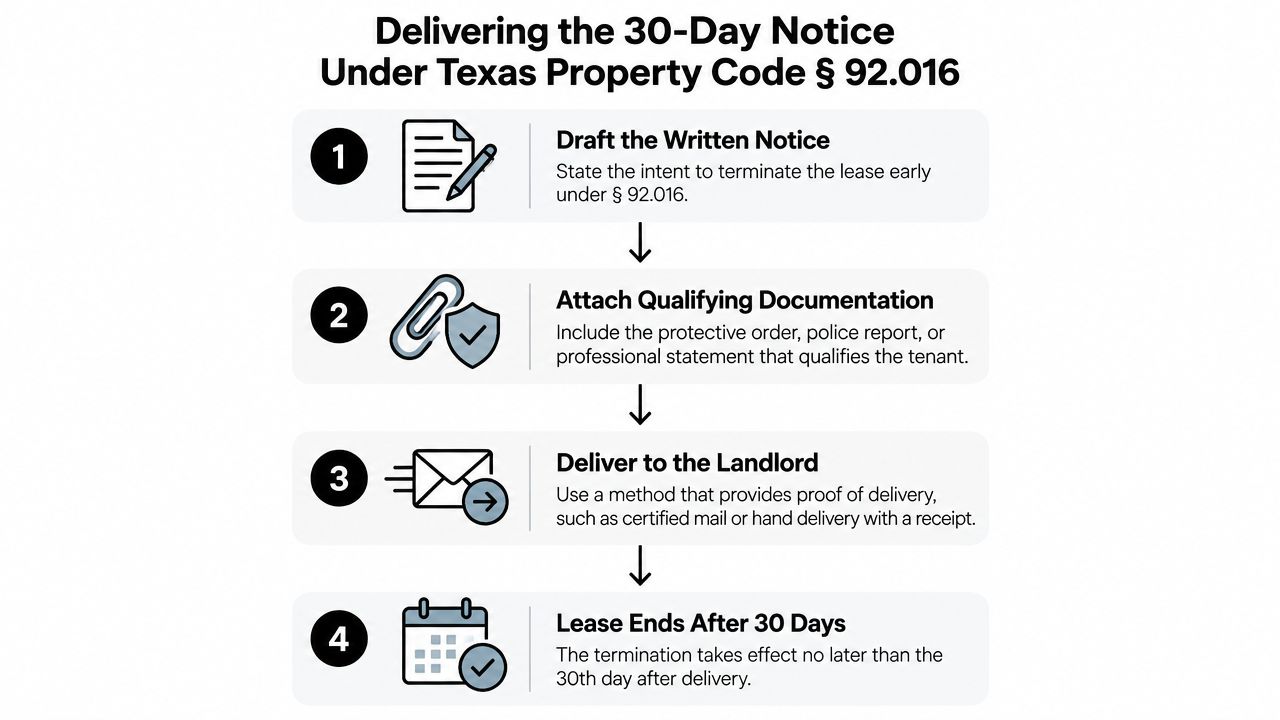
The safest sequence is straightforward:
- Draft the written notice. State your name, the leased address, your intent to terminate under Texas Property Code § 92.016, the qualifying document attached, and the date you'll surrender possession.
- Attach one qualifying document. Send a complete, readable copy. Keep the original and a duplicate.
- Deliver the notice in a verifiable way. Certified mail with a return receipt, personal delivery witnessed and acknowledged in writing, or hand delivery to the landlord's office can create useful proof.
- Complete the move-out. Vacate, return keys, photograph the condition, and provide forwarding information.
The 30-day period is a legal timing requirement. Texas guidance emphasizes written notice and documentation before the tenant moves out. The incident date doesn't substitute for notice. Document the delivery date and calculate the surrender date conservatively.
If the landlord refuses delivery, don't argue at the door. Record the attempted delivery, use certified mail or another method permitted by the lease and law, and preserve returned envelopes, tracking information, photographs, and witness statements. A refusal doesn't erase your notice, but it can make proof of service more important.
A PDF workflow can help you combine the notice and attachment into a clean file, add page labels, and retain a delivery copy. The PDF tools for real estate guide is a practical reference for organizing lease-related documents.
Watch the lease-end date, surrender of possession, keys, utilities, and forwarding address as one process. The Texas notice periods by lease type resource can help you distinguish this protected termination from ordinary notice rules.
The security deposit is a separate issue. Security Deposit Rules in Texas covers the 30-day return rule and what both parties should know under Chapter 92. Photograph the unit after removing your belongings, request a written move-out inspection if available, and keep proof that you surrendered possession.
Here's a short video that may help you think through the notice process:
Confidentiality and Safety Tips During the Process
Legal compliance shouldn't expose you to more danger. Give the landlord the proof needed to evaluate the termination, but don't send unnecessary personal information. Redact unrelated medical details, account numbers, children's identifying information, and other material that doesn't establish eligibility.
Keep originals off-site. Use a separate email address or post office box for lease correspondence if the abuser monitors your normal accounts or mail. You can arrange delivery through USPS General Delivery, a trusted intermediary, or an attorney acting as your agent. Don't send your new residential address unless the landlord legally needs it.
Safety rule: Send copies, not irreplaceable originals. The landlord needs evidence of qualification, not your only court order or medical record.
Digital hygiene matters as much as paper storage. Change passwords from a safe device, sign out of shared accounts, review cloud access, and remove automatic photo backups that the abuser can still open. Before submitting photographs or scans, scrub metadata that could reveal location information.
Use a neutral filename for sensitive records. Don't label a file with the abuser's name, the word “violence,” or your destination address if someone else may see your device or inbox.
The National Domestic Violence Hotline can be reached at 1-800-799-SAFE, and Texas Council on Family Violence advocates can help survivors plan safer document handling and explore confidential address programs. If you're in immediate danger, prioritize emergency safety over paperwork and contact emergency services.
How Texas Compares to Other States on Documentation
Texas gives survivors several proof options, but it still demands disciplined notice handling. Under the Texas framework, one qualifying document plus timely written notice can support early termination. The Texas State Law Library describes a process requiring documentation and at least 30 days' written notice before moving out.
New York separates its deadlines differently. The tenant must give at least 30 days' notice and provide documentation within 25 days after sending that notice, according to the New York residential tenants' rights guide. New York accepts several forms of evidence, including an order of protection, law-enforcement report, health-care record, or written verification from a qualified third party.
California can impose a more technical evidence requirement. A California court handout describes a situation where a police report or restraining order must have been issued within the last 60 days, making the age and format of the document critical. The California court handout on domestic violence victims and residential leases illustrates why survivors should check both the document category and its timing.
| Document Category | Texas, § 92.016 | New York, RPL § 227-c | California, CC § 1946.2 |
|---|---|---|---|
| Court protection | Protective or emergency protection orders can qualify | Order of protection can qualify | Restraining-order documentation may qualify |
| Law-enforcement proof | Written, signed officer report can qualify | Law-enforcement report can qualify | Police documentation may be subject to timing requirements |
| Professional proof | Certain licensed professionals can provide affidavits | Health-care records and qualified third-party verification may qualify | Requirements depend on the statutory route |
| Timing | Written notice and documentation must be handled within the Texas process | Notice first, documentation within 25 days | Some proof may need to be recent, including the 60-day example described above |
The practical Texas takeaway is that the state offers meaningful flexibility in document type, but flexibility doesn't excuse sloppy service. Submit the right proof, in a readable form, with a notice that clearly states when possession will be surrendered.
Sample Notice Language and When to Talk to an Attorney
Use sample language as a drafting aid, not as a substitute for legal review. Your notice should identify the tenant, property, statute, document, and move-out date:
I, [tenant's full name], am the tenant at [complete leased address]. Under Texas Property Code § 92.016, I am providing written notice that I am terminating my residential lease because I am a victim of family violence. I have attached a copy of [identify the qualifying document]. I will surrender possession, return all keys, and vacate the premises on [date], which is at least 30 days after delivery of this notice.
A supporting affidavit should be written by the qualified professional, not improvised by the tenant:
I, [affiant's full name], am a licensed [profession] with license number [number]. I personally treated or evaluated [tenant's full name] for injuries or trauma resulting from family violence. Based on my professional knowledge and records, I provide this statement for purposes of Texas Property Code § 92.016. Attached are the supporting documents, if any. Signed and sworn before me on [date]. [Affiant signature, printed name, and notary acknowledgment.]
Before sending anything, check the document, date, address, delivery method, and surrender plan. Get legal help quickly if:
- The landlord refuses receipt: Preserve the refusal and get advice before assuming delivery was effective.
- The landlord demands a buyout: A lease clause doesn't automatically override a statutory protection.
- The lease is joint: Determine whether another tenant's rights or obligations affect the termination.
- Criminal proceedings are active: Coordinate the housing process with counsel and safety advocates.
- Immigration concerns exist: Share sensitive information only with a qualified attorney or advocate.
- Your document is questionable: An attorney can assess whether the proof fits the statutory category.
If you're dealing with a separate demand for money or property damage, a resource explaining a Stowers demand letter in Texas may help you understand demand-letter terminology, although it isn't a substitute for advice about § 92.016.
Commercial tenants should also avoid assuming residential rules apply to business premises. Commercial Lease Disputes in Texas addresses how Texas treats commercial tenancies differently under Chapter 93.
Before serving notice, consult a Texas tenant-rights attorney, an eviction attorney, or the Texas Legal Services Center if you're unsure whether your document qualifies or how the 30-day period applies.
The Law Office of Bryan Fagan, PLLC helps Texas tenants and landlords evaluate lease-termination notices, documentation, deposits, and related eviction disputes. Schedule a free consultation through The Law Office of Bryan Fagan, PLLC to discuss your documents, delivery record, and next steps.