Dealing with a landlord dispute or eviction can be stressful, especially when a notice arrives with a deadline you don't understand. A landlord may tape a paper to the door believing the tenant must leave immediately. A tenant may receive a letter and assume it gives a full month to move out. In Texas, either assumption can create serious problems.
The answer depends on the lease type, the reason for the notice, and the language of the lease itself. Texas notice periods by lease type aren't controlled by one universal rule. Lease-end termination, default-based eviction, and cure periods are separate concepts, and confusing them can delay an eviction, weaken a defense, or cause a tenant to give up rights too quickly.
Why Notice Periods Cause So Much Confusion in Texas
A landlord manages a rental property after repeated missed payments. The landlord serves a written notice and files an eviction case almost immediately. The tenant, meanwhile, believes the notice period should have been longer because the tenancy is month to month. Both people may be using the word “notice,” but they may be talking about different legal events.
Texas law distinguishes between ending an ongoing tenancy, responding to a lease violation, and giving someone an opportunity to correct a breach. The controlling rules may come from different parts of the Texas Property Code, while the written lease may change a default timeline.
The mistake behind many notice disputes
A month-to-month tenant generally needs notice under Texas Property Code § 91.001 when either party wants to end the tenancy without relying on a breach. That is not the same as the notice to vacate used before a landlord files a forcible detainer case after nonpayment, a lease violation, or a holdover.
For a default-based eviction, Texas Property Code § 24.005 generally requires at least three days' written notice to vacate, unless the lease provides a different period. A landlord who treats that three-day notice as a substitute for month-to-month termination notice may serve the wrong document for the situation.
Practical rule: Before counting days, identify what the notice is supposed to accomplish.
The lease can create another layer. A commercial agreement may require a cure notice before the landlord can declare a default, while the statute may separately govern the notice to vacate before suit. Residential leases also contain renewal, nonrenewal, and early-termination language that can change the practical result.
The good news is that the confusion becomes manageable once you separate the three notice categories. The right question isn't just, “How much notice is required?” It's, “Notice for what purpose, under which lease, and based on what event?”
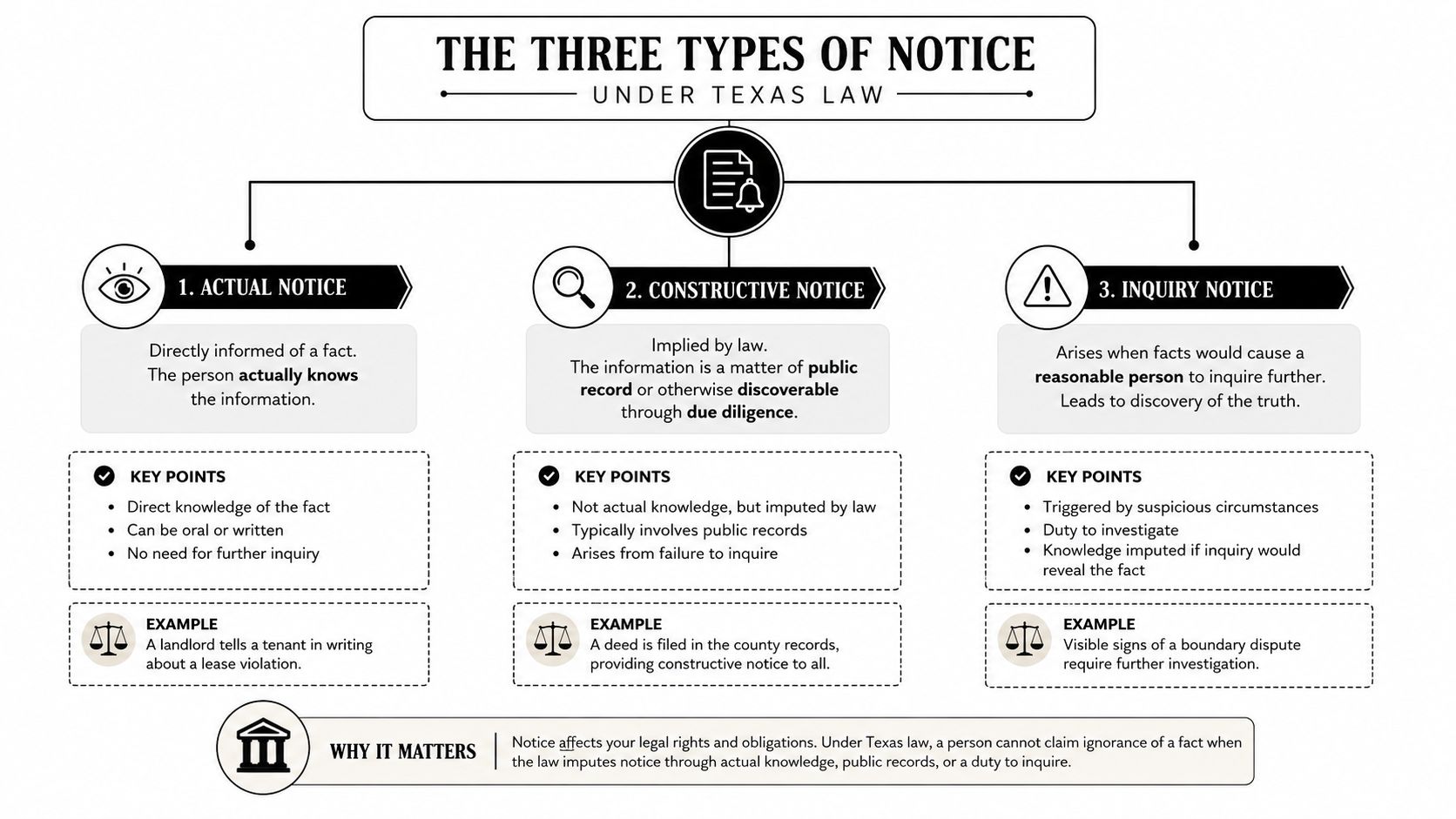
The Three Types of Notice Under Texas Law
Texas notice disputes usually fall into three categories. Termination notice ends a tenancy under its ordinary terms. Notice to vacate tells an occupant to leave after a default or holdover and is generally a step before an eviction lawsuit. Cure notice gives a party a chance to correct a breach before the other side takes additional action.
Termination notice
Termination notice applies when a tenancy is ending without necessarily claiming that the other party breached the lease. For a residential tenancy where rent is paid monthly, § 91.001 generally makes termination effective on the later of the date stated in the notice or one month after notice is given. A weekly tenancy follows the shorter rental-period rule described in that statute.
A fixed-term lease presents a different question. The Texas State Law Library explains that Texas law doesn't establish a required notice period for ending a fixed-term lease before expiration. The lease's own terms control, and the stated expiration date may be decisive.
Notice to vacate
A notice to vacate is tied to possession and eviction. Under § 24.005, a landlord generally must provide at least three days' written notice before filing a forcible detainer suit when the tenant defaults or remains after the rental term or renewal period, unless the written lease changes the period. The notice isn't itself a court order, and the landlord can't use it as permission for a lockout.
A practical resource describing what a valid document must contain before an eviction can be filed is The Notice to Vacate: Requirements and Timing.
Cure notice
A cure notice focuses on correction. It tells the recipient what went wrong and provides the time required by the lease or applicable law to fix it. Commercial leases often make cure periods highly specific. A residential lease may also include a contractual opportunity to cure, but the actual wording must be reviewed carefully.
These categories overlap in real disputes, but they aren't interchangeable. A termination notice may end a month-to-month relationship. A notice to vacate may precede an eviction after nonpayment. A cure notice may be required before a landlord can treat a violation as grounds for termination.
Residential Lease Termination Notice Requirements
Residential termination rules depend heavily on whether the tenancy has a fixed end date or renews from period to period. Start by locating the lease term, rent-payment schedule, renewal language, and any notice clause. Don't assume that a familiar phrase such as “30 days' notice” controls unless the agreement and statute support that result.
Month-to-month tenancies
Under Texas Property Code § 91.001, a month-to-month tenancy may be ended by either party with written notice lasting until the later of the date stated in the notice or one month after notice is given. If the rent-paying period is shorter than a month, the termination period follows that shorter period. The statute also addresses weekly tenancies, where the relevant period is tied to one week after notice is given.
Suppose a tenant gives notice on the 15th of a month and says the tenancy will end on the last day of that same month. That date may arrive before one month has passed. Unless the lease provides a different lawful rule, the later date controls, so the tenant may remain responsible beyond the proposed month-end date.
The same timing matters when a landlord wants to end a month-to-month tenancy without alleging a default. Serving a notice that assumes the next rent due date is automatically enough can produce a defective termination if the notice was delivered mid-cycle.
Fixed-term leases
Texas law doesn't establish a general statutory notice period for ending a fixed-term residential lease before it expires. The written agreement controls that situation. Some leases explain how a tenant must give nonrenewal notice, while others address automatic renewal or conversion after the stated term.
| Lease Type | Required Notice Period | Governing Statute |
|---|---|---|
| Monthly residential tenancy | Later of the stated date or one month after notice, unless the lease changes the rule | Texas Property Code § 91.001 |
| Weekly tenancy | One week after notice, subject to the statutory rule and lease terms | Texas Property Code § 91.001 |
| Fixed-term residential lease | The lease controls before expiration; the term may end on its stated expiration date | Texas State Law Library guidance |
A tenant planning to move should provide notice in the way the lease requires and keep proof of delivery. A landlord should identify whether the tenant is still in a fixed term or has moved into a month-to-month arrangement before sending a termination letter. Guidance on Texas lease renewal notice requirements can help readers focus on the renewal language instead of relying on an assumed day count.
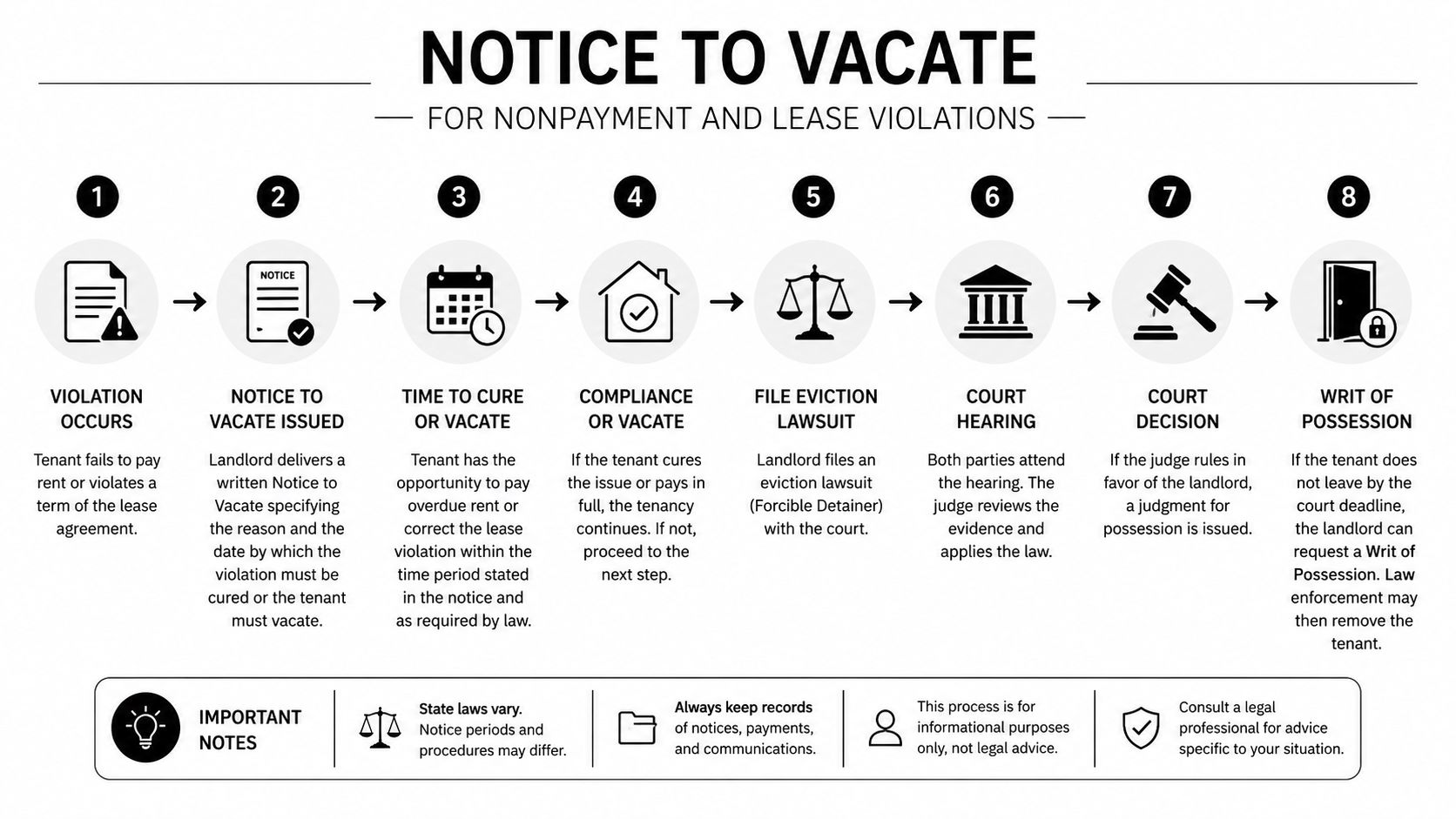
Notice to Vacate for Nonpayment and Lease Violations
A landlord generally can't file a forcible detainer case the moment rent is missed or a violation is discovered. Texas Property Code § 24.005 generally requires at least three days' written notice to vacate before filing, unless the lease says the notice period is shorter or longer. This is a default for the eviction stage, not a replacement for ordinary lease termination notice.
What the landlord should verify
The notice should identify the property, tell the tenant to vacate, and provide a clear deadline consistent with the lease and law. Delivery must also comply with the governing requirements and the lease's notice provisions. A verbal demand in a hallway or a text message may not satisfy the written-notice requirement for the case.
Before serving the document, a landlord should:
- Read the lease: Check notice, default, cure, and delivery clauses.
- Identify the breach: Confirm whether the issue is nonpayment, another violation, or holdover possession.
- Calculate the deadline: Use the applicable statutory or contractual period.
- Document delivery: Keep the notice, date, method, and proof of service.
- Wait before filing: Don't file until the notice period has expired.
If a lease changes the default, that contractual period may control. A landlord who files after only three days when the lease requires longer notice risks an avoidable procedural challenge. A tenant who receives a notice should use the period to review the amount claimed, correct a curable problem when possible, and seek legal advice rather than assuming the case is already lost.
A tenant or landlord comparing notice procedures across states may also find 2026 notice to vacate California useful as a separate state-law resource. It shouldn't be used to calculate a Texas deadline.
The notice period doesn't decide every eviction issue. A tenant may have defenses involving payment, waiver, lease interpretation, retaliation, repairs, or improper service. A landlord should be prepared to prove the right to possession, the lease violation or holdover, proper notice, and proper filing.
Commercial Lease Notice Rules and Negotiated Cure Periods
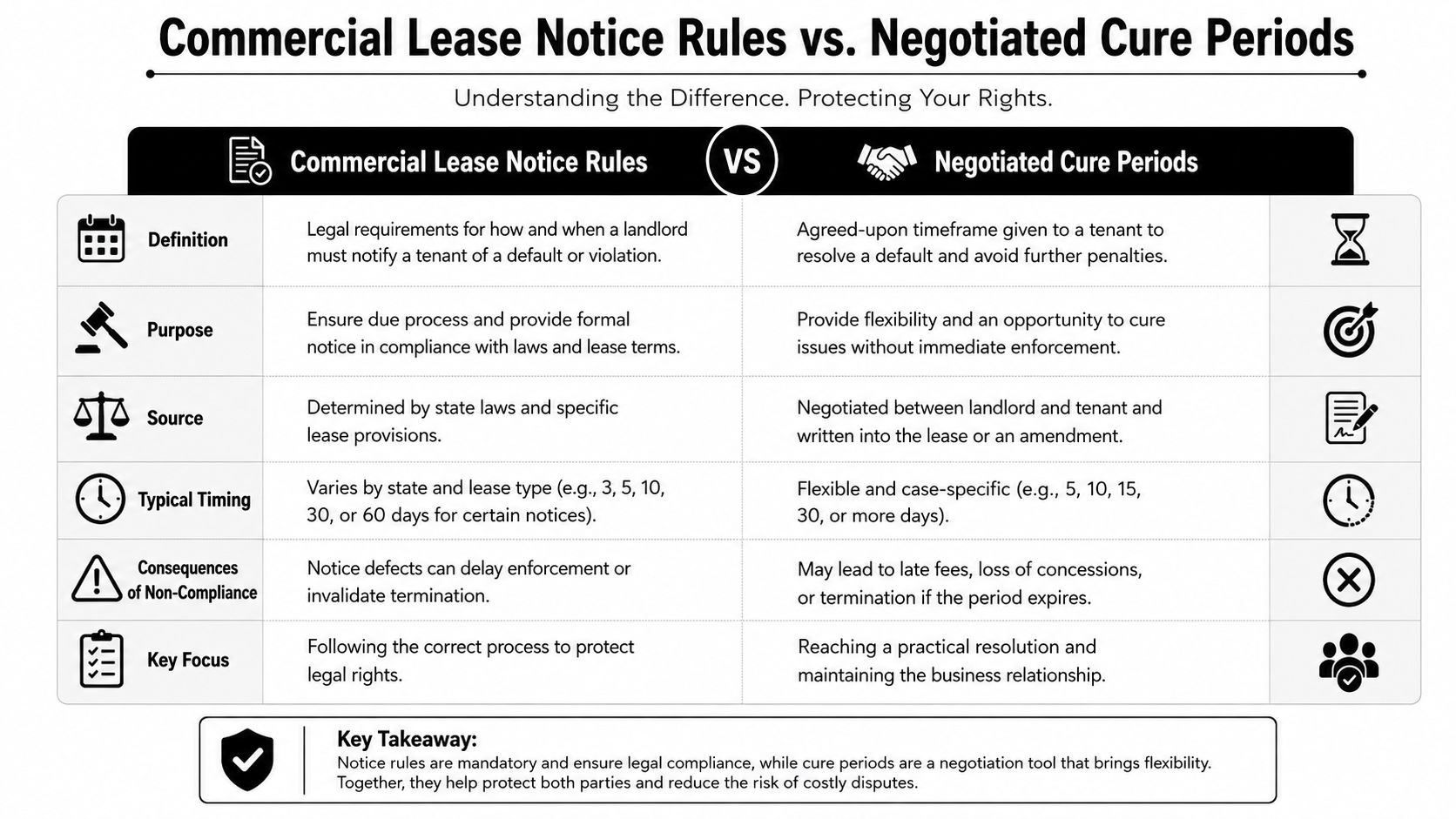
Commercial lease disputes are usually driven more directly by contract language than residential disputes. The statewide starting point for a commercial forcible detainer is often the three-day written notice to vacate under § 24.005, unless the lease changes it. But the lease may separately require notice of default and an opportunity to cure before the landlord can exercise remedies.
The contract may control the timetable
Commercial agreements commonly negotiate cure windows of 3–10 days for monetary defaults and 10–30 days for non-monetary defaults, according to the commercial leasing discussion published by Bell Nunnally. These ranges aren't a universal Texas statutory rule. They're contractual benchmarks that show how commercial parties allocate enforcement risk.
A missed rent payment may trigger a written default notice, a monetary cure period, and then a notice to vacate. A non-monetary violation, such as unauthorized use of the premises, may require a longer period because the tenant needs time to change operations or obtain approval.
Why commercial parties negotiate
A landlord may want a short cure period to limit operational and financial exposure. A tenant may need enough time to investigate an accounting dispute, obtain lender funding, or correct a building-use issue. The strongest lease language states whether a cure applies once or repeatedly, when the clock starts, how notice must be delivered, and whether the landlord can terminate while the tenant is attempting to cure.
A commercial tenant should review more than the rent paragraph. Focus on default definitions, notice addresses, delivery methods, late charges, acceleration, self-help restrictions, and remedies. A landlord should avoid assuming that the statutory baseline fills gaps that the lease already addresses.
Contract interpretation often determines the outcome. Parties comparing their documents with a practical guide may review how to read a commercial lease agreement, then obtain advice before sending a default notice that could waive or trigger contractual remedies.
Specialty Situations and Statutory Exceptions
Some Texas occupancies don't fit neatly into the standard fixed-term or month-to-month model. Holdovers, manufactured-home tenancies, and repair-based termination rights each require a different analysis. The label written on a notice doesn't control if the underlying tenancy has another legal character.
Holdover possession
A tenant who remains after a fixed term ends may be in a holdover situation. The lease may address renewal, conversion, or continued possession. If the tenant holds over beyond the rental term or renewal period, § 24.005 generally makes the three-day notice to vacate the starting point before a forcible detainer suit, unless the lease provides another period.
For example, a tenant's lease expires and the tenant remains without a new agreement. The landlord shouldn't assume the tenant is a month-to-month tenant or a trespasser without reviewing the lease and the parties' conduct. The landlord also shouldn't use self-help. The proper classification affects the notice and the available defenses.
Manufactured-home tenancies
Manufactured-home communities have a distinct statutory rule. Under Texas Property Code § 94.055, the renewal or termination notice period is 60 days. That longer period can materially change move-out planning and should be checked before a landlord serves a short residential notice or a tenant agrees to an immediate termination.
A community operator who serves a notice based only on the ordinary month-to-month rule may overlook the specialty statute. A resident should preserve the lease, community rules, and every notice received so the correct classification can be evaluated.
Repairs and habitability
Repair disputes follow a separate path. Under Texas Property Code § 92.0561, a qualifying tenant may be able to terminate the lease if the landlord fails to remedy a condition after proper notice and an opportunity to cure. The tenant should not skip directly from a maintenance complaint to moving out.
A careful process looks like this:
- Report the condition: Describe the problem and its effect on the property.
- Give written notice: Use the method and address required by the lease and statute.
- Allow an opportunity to repair: Keep records of access, communications, and completed work.
- Evaluate the response: If the condition remains, obtain advice before withholding rent or terminating.
- Preserve evidence: Keep photographs, invoices, inspection reports, and messages.
An unresolved air-conditioning or plumbing problem may create statutory power in a qualifying case, but the tenant still must follow the notice-and-cure steps. Tenants facing violence or safety concerns should also review lease termination for domestic violence under Texas law because that issue follows its own requirements.
Common Notice Period Mistakes and How to Avoid Them
Notice disputes often turn on ordinary details. The parties may understand the underlying disagreement, yet still lose time because the notice was verbal, the deadline was miscounted, or the wrong lease classification was used.

Errors landlords should avoid
A landlord should not file before the applicable notice period ends. Filing too early can create a procedural defense and may require starting over. The landlord should also avoid relying on a verbal demand, using an outdated address, or ignoring a lease clause that requires a longer cure period.
The month-to-month calculation creates another trap. A notice served in the middle of the rental cycle may not end the tenancy on the next rent due date because § 91.001 generally measures the period through the later applicable date.
Errors tenants should avoid
Tenants often make the opposite mistakes. They may assume a conversation with the property manager changed the lease, leave without giving written notice, or treat a repair request as proof that they can immediately terminate. A tenant who wants to preserve rights should communicate in writing and keep delivery evidence.
Use this short verification checklist before acting:
- Confirm the lease type: Fixed term, month to month, manufactured housing, or holdover.
- Identify the purpose: Lease-end termination, default notice, or cure notice.
- Read the controlling clause: Look for renewal, notice, delivery, and cure language.
- Build a date record: Write down when notice was sent, received, and when the period ends.
- Save proof: Keep copies, photographs, emails, tracking information, and payment records.
- Get advice early: Contact a Texas landlord tenant lawyer before filing, surrendering possession, or signing a settlement.
A notice is only as strong as the lease classification, deadline calculation, and proof of delivery behind it.
Protect Your Rights with Experienced Legal Guidance
Texas notice periods by lease type depend on more than the number of days printed on a form. The lease type, the reason for the notice, and the contract language determine whether you're dealing with termination notice, notice to vacate, or a cure period.
Landlords need a defensible process before filing an eviction. Tenants need to know whether a notice is premature, whether a repair-based remedy may apply, and whether the lease changes the statutory baseline. The Texas Property Code provides important rules, but applying them requires matching the right statute to the right event.
The Law Office of Bryan Fagan, PLLC helps landlords and tenants evaluate lease terms, notice documents, repairs, renewals, defaults, and eviction disputes. The firm serves clients across Houston, Dallas–Fort Worth, Austin, San Antonio, and surrounding counties, beginning with a free 30-minute consultation and clear, plain-English guidance.
The Law Office of Bryan Fagan, PLLC can review your lease and notice, identify the controlling deadline, and help you plan the next step in an eviction or rental dispute. Visit The Law Office of Bryan Fagan, PLLC to schedule a free consultation and get practical legal guidance for your Texas property issue.