Skip to content
You may be looking at the same apartment where you sleep, eat, and keep your belongings, yet feel unable to stay another night. After a sexual assault, a lease can become more than a contract. It can tie you to a place connected to fear, the assailant, or an unsafe living situation. Texas Property Code Section 92.0162 gives qualifying survivors a statutory path to end a residential lease early, but the right depends on careful timing, written notice, and acceptable documentation.
This guide focuses on the details that often create problems in lease termination after sexual assault in Texas under Section 92.0162. The law can protect a survivor from continuing a lease without treating early move-out as an ordinary breach, but it isn't a general hardship exception and it isn't a favor from the landlord. If the requirements are met, the right comes from the statute.
When Texas Law Lets You End a Lease After Sexual Assault
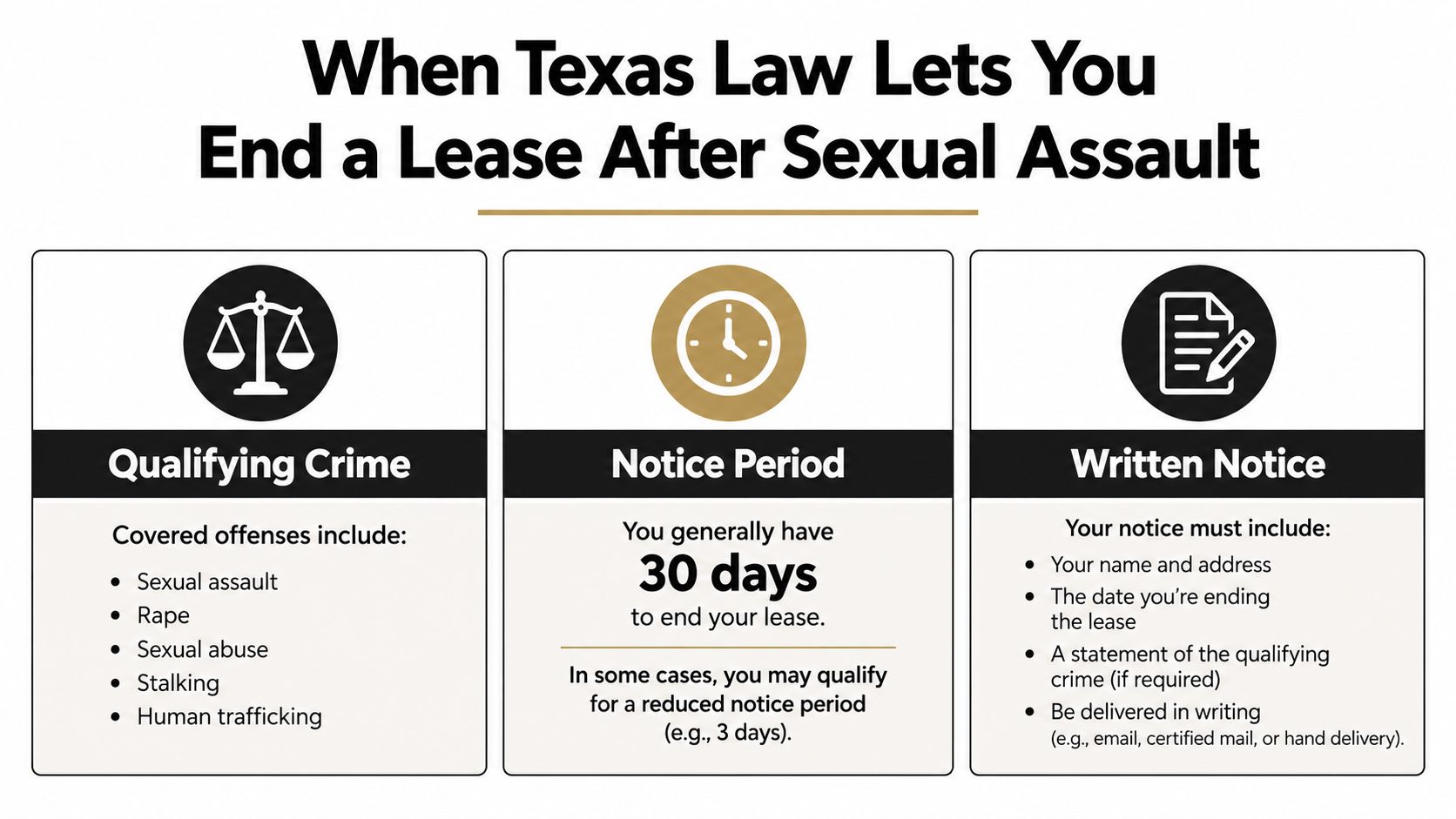
A lease that no longer feels survivable can make every legal deadline feel overwhelming. Start with three anchors: the assault must have occurred within the preceding six months, you generally must give the landlord at least 30 days' written notice, and you must provide qualifying documentation. The Texas Law Library's guide to ending a residential lease confirms that a tenant, parent, or guardian may use the statutory process with documentation and written notice.
Those requirements work together. The six-month period is measured from the date of the offense, not from the date you decide to move, contact an advocate, or send a report. The notice period begins when the landlord receives your written notice, so proof of delivery matters. Documentation connects your request to an offense covered by the statute.
Treat the right as a process
This isn't a negotiation over whether your landlord feels sympathetic. Section 92.0162 creates a statutory right when its conditions are satisfied. A landlord may still need to review the notice and documentation, but the landlord shouldn't convert the process into an investigation of your trauma or demand details beyond what the law requires.
Write down the incident date, the lease address, the date notice is delivered, and the intended termination date. Keep copies of the notice and every attachment in a safe place. A practical break a lease step by step guide can help organize ordinary lease-exit tasks, but a sexual-assault termination requires close attention to the specific Texas statute.
Practical rule: Don't wait for a perfect paper trail if you already have qualifying documentation and the deadline is approaching. Send a legally sufficient notice safely and preserve the evidence of delivery.
What Texas Property Code 92.0162 Covers
A tenant who is assaulted in a rented home or elsewhere on the same property may have a statutory path to end the lease. Section 92.0162 applies to a residential tenant who is the victim of a listed sexual offense. It also protects a parent or guardian acting for a victim. The covered offenses include sexual assault, aggravated sexual assault, indecency with a child, sexual performance by a child, continuous sexual abuse of a young child or disabled individual, and an attempt to commit one of those offenses. The public text of Texas Property Code Section 92.0161 lists the sexual offenses used in this statutory framework.
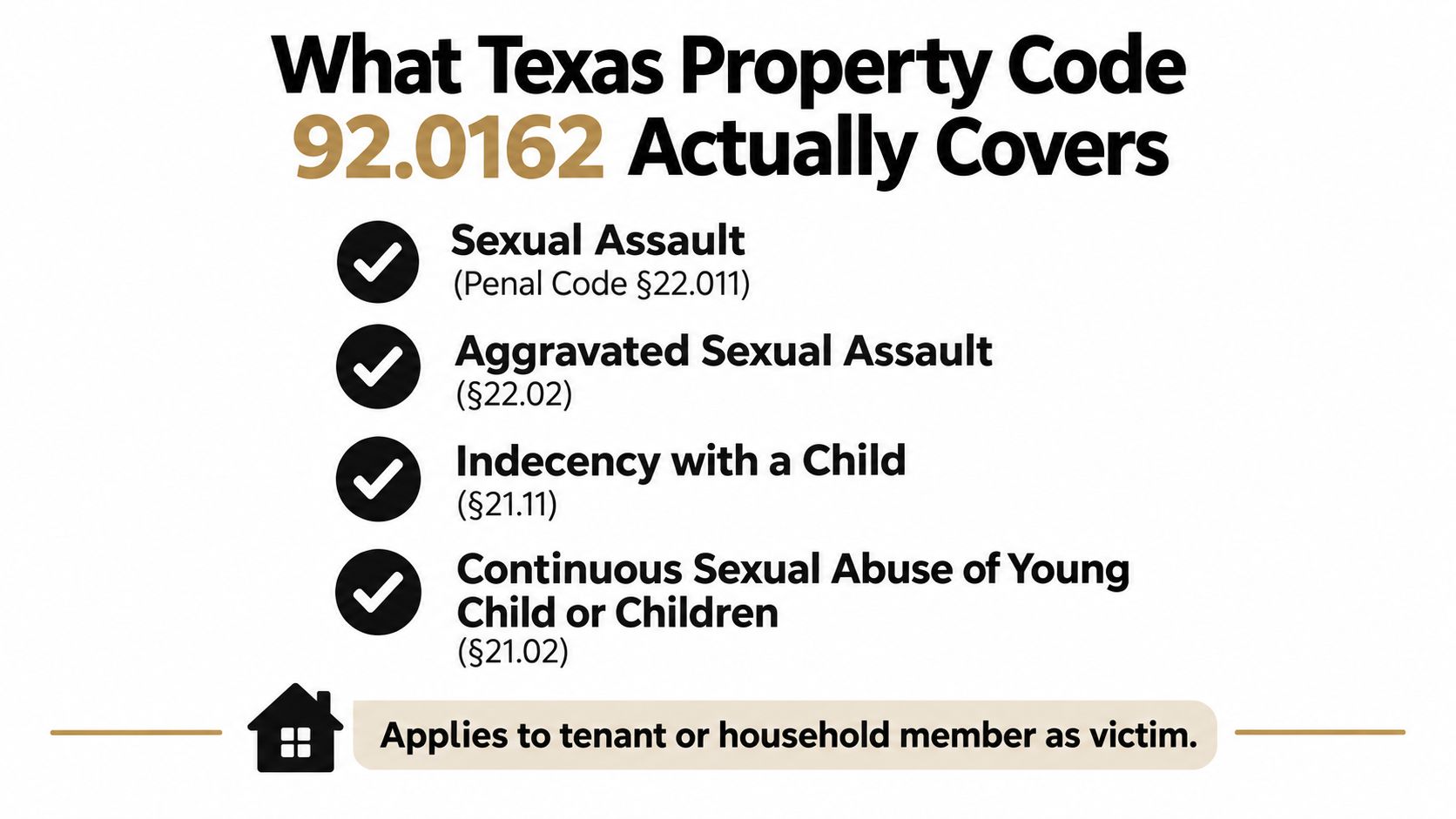
The parent or guardian route matters when the victim is a child or an adult tenant who is legally incapacitated. The victim does not have to sign and deliver every document alone. A parent or legal guardian may act for the victim household member, and the paperwork should clearly establish that relationship.
What “on the premises” means
The offense must occur on the leased premises or at another dwelling on the premises. The rule is not limited to the inside of the rented unit. An assault in an apartment complex laundry room qualifies, because the statute covers offenses at another dwelling on the premises, provided the other legal conditions are met. Shared spaces and another residence within the same property can therefore be relevant.
The main timing trap is the six-month deadline. The six-month clock runs from the date of the offense, not the date of the police report. A later report does not reset that deadline. If the assault occurred near the end of the six-month period, seek legal or advocacy assistance promptly, confirm the incident date, and do not rely on an informal promise from the landlord to preserve the statutory right.
For visual context, this short explainer may help readers understand the subject:
Documentation You Can Use to Prove the Assault
Documentation should be strong enough to show that the statutory conditions apply, but you don't need to describe the assault in unnecessary detail. Depending on what you can safely obtain, the relevant paper trail may include a law-enforcement report or incident information, a protective order issued by a Texas court, or documentation from a qualified professional or sexual-assault crisis provider. The Texas tenant documentation requirements for lease termination provide a useful related reference for organizing proof.
A police report may be the most direct record of the reported event, while a protective order can show court involvement and safety concerns. A letter from a licensed physician, counselor, sexual assault nurse examiner, licensed mental health professional, or sexual assault crisis professional may be more practical when obtaining a court order is unsafe or not realistic. Each option has a different level of detail and may involve different privacy concerns.
Compare the available proof
| Documentation Options Under Texas Property Code 92.0162 | What It Establishes | Trade-Offs |
|---|---|---|
| Police report or incident information | Shows that the incident was reported to law enforcement | It may take time to obtain, and the survivor may prefer not to disclose more than the identifying information needed |
| Texas protective order | Shows that a court issued protective relief connected to the offense | Seeking an order can require a court process and may not be safe or appropriate for every survivor |
| Qualified provider documentation | Connects the survivor to a licensed provider or sexual assault crisis professional who can document the qualifying circumstances | The provider may need enough information to confirm the legal basis, but the letter should avoid unnecessary clinical detail |
Use the strongest documentation you can safely obtain now. Waiting for an ideal document can cause the six-month deadline or notice timeline to become harder to manage. Give the landlord the relevant proof, not a complete personal history.
Residential leases fall within Chapter 92, while Commercial Lease Disputes in Texas involve a different statutory framework under Chapter 93. That distinction matters if the property is being used for business rather than as a residence.
The Co-Tenant and Roommate Problem
Shared housing creates a second legal problem. Suppose you and a roommate are both named on the lease, and the roommate is the alleged assailant. You may want to leave immediately, while the landlord may worry about possession, rent, locks, and the remaining tenancy.
Section 92.0162 includes a co-tenant exception that can change the notice analysis when the alleged perpetrator is a co-tenant or occupant. The statute may permit a survivor to use a reduced notice period, rather than the ordinary 30-day process, when the required conditions and documentation apply. Because the exact exception depends on the statutory facts and paperwork, don't assume that merely sharing an address automatically qualifies.
Separate possession from rent
A landlord may be able to remove or sever the alleged perpetrator's tenancy interest without treating the survivor as having abandoned the lease. But rent responsibility can remain complicated. If the lease makes co-tenants jointly responsible, the departing survivor could still face a claim involving unpaid rent unless the lease, statute, or a separate written agreement changes that result. Review the lease carefully, including any provision about joint and several liability among Texas roommates.
Ask for practical protections in writing. Those may include rekeying the unit, changing access codes, confirming who remains authorized to enter, and identifying how the final rent and deposit will be handled. A landlord shouldn't use changed locks, removal of belongings, or an informal lockout to bypass the statutory process.
A survivor's departure and a roommate's continuing right to possess the home are separate questions. Put both questions in writing before anyone moves out.
How to Give the 30-Day Notice the Right Way
Your notice should be brief, factual, and complete. It should identify the leased premises, state that you or a household member was the victim of a qualifying sexual offense, identify the incident date, attach qualifying documentation, and state the intended move-out and termination date.
The termination date should be at least 30 days after the landlord receives the notice and should be evaluated against the six-month statutory deadline. The landlord's actual receipt date matters more than the date you typed the letter, so retain tracking information, a signed receipt, an email acknowledgment, or another reliable record.
A practical delivery checklist
- Read the lease notice clause. Check whether it requires certified mail, delivery to a management office, a specific email address, or another method.
- Prepare the attachments. Include only the qualifying documentation needed to establish the statutory right.
- State the dates clearly. List the incident date, delivery date if known, and intended termination date.
- Use a provable method. Certified mail or hand delivery with a receipt can create stronger evidence than an unacknowledged text.
- Preserve everything. Save the final notice, attachments, tracking record, photographs of delivered materials, and all landlord responses.
A simple notice might say:
I am a tenant at [leased premises]. I am exercising my right under Texas Property Code Section 92.0162 to terminate the residential lease because I or a household member was the victim of a qualifying sexual offense connected to the premises. The offense occurred on [date]. Attached is qualifying documentation. The lease will terminate on [date], and I will surrender possession by that date.
If the alleged assailant is a co-tenant or occupant, ask a Texas landlord tenant lawyer to confirm whether the reduced-notice rule applies before choosing an earlier move-out date. Landlords and property managers can also review independent notice period advice for landlords while checking the lease's delivery terms. For drafting help, see this guide on how to write a lease termination letter.
What the Landlord Must Do After Notice
Once a qualifying notice and documentation arrive, the landlord should treat the request as a legal compliance matter, not as an ordinary lease-break negotiation. The landlord should confirm receipt, calculate the effective termination date, and identify the rent owed through that date. The survivor should owe rent for the period covered by the tenancy up to termination, not rent for time after the statutory lease ending.
The security deposit remains governed by the ordinary Chapter 92 process. The landlord may make lawful deductions, but the assault itself isn't a reason to charge the survivor for damage or impose an early-termination penalty. The tenant should provide a forwarding address and keep photographs or records showing the property's condition at move-out.
Conduct that creates additional risk
A landlord must not retaliate because a tenant used a statutory right. Retaliation can include raising rent, reducing services, refusing to honor a survivor's continuing tenancy, or trying to terminate the tenancy because the tenant sought protection. Landlords also shouldn't demand graphic details, contact the alleged assailant for an informal confrontation, or distribute sensitive documentation beyond those who need it for lawful administration.
The statute doesn't generally require the landlord to relocate the survivor, pay moving expenses, or erase amounts separately owed by the alleged abuser. Those issues should be separated from the survivor's statutory termination right.
| Landlord Compliance Checklist Under Section 92.0162 | Landlord Must Do | Landlord Must Not Do | Outside Statute |
|---|---|---|---|
| Notice review | Confirm receipt, review qualifying documentation, and calculate the effective date | Ignore the notice or insist on an ordinary lease-break fee when the statute applies | Relocate the survivor or pay moving costs |
| Rent accounting | Calculate rent through the lawful termination date and provide a clear account | Demand rent for periods after termination | Automatically waive the alleged abuser's separate obligations |
| Deposit handling | Follow Chapter 92 security-deposit procedures and account for lawful deductions | Treat the assault as tenant-caused damage or keep the deposit without a lawful basis | Guarantee a particular refund amount |
| Safety and possession | Address access and possession questions lawfully, especially with co-tenants | Change locks or remove property as a self-help eviction | Decide criminal responsibility or conduct a criminal investigation |
| Confidentiality | Limit sensitive records to people with a legitimate need to handle the tenancy | Spread the survivor's information through the property community | Promise absolute confidentiality beyond legal and operational duties |
If the landlord refuses to recognize the termination, continues billing future rent, threatens eviction, or changes the locks, preserve every message. A Texas eviction attorney can review the notice, lease, documentation, and payment history together instead of treating each dispute separately.
Safety Resources and Your Next Step
Lease paperwork matters, but immediate safety comes first. Survivors can contact the statewide sexual assault hotline at 1-800-656-HOPE through RAINN, local rape crisis centers, and advocacy programs supported through the Texas Office of the Attorney General. The Texas Council on Family Violence can also help when the assailant is an intimate partner or when sexual assault overlaps with family violence.
Advocates may help with safety planning, forensic examination logistics, documentation, and relocation planning even when you're unsure about reporting. Confidential victim compensation resources may also help with relocation-related costs. Ask the advocate what confidentiality rules apply before sharing details, particularly if the assailant has access to your phone, email, transportation, or home.
Veterans, Indigenous survivors, and non-citizens may face additional barriers or may qualify for specialized support. An advocate can help identify a service provider that understands those concerns. You don't need to solve the safety plan and the lease problem in the same conversation, but you should avoid delaying the legal timeline while seeking support.
The practical legal next step is a free 30-minute consultation with The Law Office of Bryan Fagan, PLLC. An attorney can review your lease and documentation, assess whether Section 92.0162 applies, plan a safe notice-delivery method, address co-tenant issues, and coordinate the move-out timeline so a statutory deadline isn't missed.
The Law Office of Bryan Fagan, PLLC can help tenants and landlords review Section 92.0162 notices, documentation, co-tenant concerns, rent accounting, and related eviction or lease disputes. Schedule a free 30-minute consultation by visiting The Law Office of Bryan Fagan, PLLC and bring your lease, proposed notice, documentation, and delivery records for review.