Skip to content
You've just lost an eviction case in justice court. The judge has signed a judgment for possession, your money is already gone, and the landlord is talking about a writ of possession. You may still have a path to county court, but the deadline is short and the paperwork matters.
A Statement of Inability to Afford Payment of Court Costs, sometimes called a pauper's affidavit, can let you perfect a Texas eviction appeal without paying the county court filing fee up front. It isn't a magic shield against removal. You still have to meet the appeal requirements, protect your right to remain in the property, and keep paying rent when Texas law requires it.
When the Statement of Inability Comes Into Play
You lost your eviction case in justice court this morning. The judgment is signed, and the landlord may already be preparing the next enforcement step. Your immediate task is to protect the appeal, not wait for a bill or assume the court will give you extra time.
In a Texas eviction case, you generally must file the appeal within five days after the judgment date. Treat that deadline as firm. Missing it can end your right to take the case to county court. The Texas Property Code appeal provision identifies a sworn financial statement as one approved method for perfecting an appeal.
Your appeal plan has two separate tracks. The Statement of Inability addresses the cost of filing the appeal. You must also comply with the rules that protect possession during the appeal, including any continuing rent obligation that applies to your case.
What the filing does
Texas law gives an appealing tenant three routes:
- File an appeal bond.
- Make the required cash deposit.
- File a timely Statement of Inability to Afford Payment of Court Costs.
If you cannot afford the bond or cash deposit, the statement may be the practical route for keeping the appeal alive. Once the appeal is properly perfected with a timely statement, you do not have to pay the county court filing fee up front. Texas law also does not require a second inability statement in county court to waive appellate costs. The Tarrant County eviction appeal guidance describes this option for people who cannot pay the required amount at the start.
What the filing does not do
Filing the statement does not extend the five-day appeal deadline. It also does not replace the bond or cash deposit unless the court accepts the statement as your method of perfecting the appeal.
Do not confuse an accepted inability statement with permission to ignore the separate requirements for remaining in the home. In a nonpayment case, rent may still have to be paid as it becomes due during the appeal. Missed payments can threaten possession even when the appeal itself was properly filed.
Practical rule: Complete the statement, file it in the justice court before the five-day deadline expires, and immediately confirm the rent and possession requirements with the clerk or an eviction attorney. Keep proof of every filing and payment.
What the Texas Property Code Requires on the Form
If your eviction appeal depends on a Statement of Inability, complete it as a sworn financial record. Texas Property Code Section 24.0052 requires enough detail for the court to evaluate whether you can pay the required appeal costs. The form covers employment income, available spouse income, government benefits, other income, bank funds, property, debts, expenses, and dependents. You can review the statutory requirements in Texas Property Code Section 24.0052.
Enter your legal name, current address, case or docket information, and the justice court handling the case. Report household finances fully. Include known spouse income, benefits, and other income in separate entries so the court can see where the money comes from.
Financial categories the judge will examine
| Disclosure category | What to list | Advisor tip |
|---|---|---|
| Identity and case information | Your name, address, and case details | Copy the docket number from the eviction judgment and use your current address |
| Employment and household income | Wages, known spouse income, benefits, and other income | Attach a recent pay stub or benefits notice and explain any recent change |
| Cash and bank funds | Cash on hand and checking or savings balances | Attach the most recent 30-day statement, not a screenshot of a balance |
| Property and vehicles | Real estate and personal property, including vehicles | List the asset even if you still owe money on it, then identify the debt |
| Dependents | Number of dependents, ages, and residences | State who lives with you and whom you financially support |
| Debts and expenses | Housing, utilities, food, transportation, medical costs, child care, court-ordered payments, and other debts | Use actual bills or statements instead of unsupported round figures |
| Special circumstances | Job loss, disability, domestic violence, unusual medical costs, or another factor affecting payment ability | Give the date or circumstances you know and attach available proof |
The verification section matters. Read every answer, sign the statement as required, and complete any notary or clerk verification called for by the form or court. Check your bank records, benefits notice, pay stubs, lease, and bills before signing. A rushed estimate can create avoidable problems.
The court needs a clear explanation of why the required payment is beyond your means. If income recently stopped, identify that change. If an asset is difficult to value, describe it accurately and state what you know. Disclose uncertainty instead of omitting the asset.
A false or incomplete sworn statement can damage your credibility and expose you to legal consequences. Accuracy is more persuasive than a bare claim that you have no money.
The statement supports the financial part of your appeal strategy. It does not decide possession, replace other appeal requirements, or determine whether rent must continue to be paid during the case. Keep those issues separate as you complete the form.
For a broader explanation of challenging a justice court eviction ruling, see Appealing a Texas Eviction Judgment. That resource covers the appeal process, while this form documents why you cannot pay the usual costs.
Filing the Statement in Justice Court
File the statement with the justice court clerk that entered the eviction judgment. Don't send it only to the landlord, county clerk, or a different court. The justice court is where the appeal is perfected.
Use the Statement of Inability to Afford Payment of Court Costs form prescribed by the Office of Court Administration, or a substantially similar form accepted by the local court. You can ask the justice court clerk where to obtain the current version. A county law library or the Texas Judicial Branch may also have the form.
Build a clean filing packet
Prepare the packet before you go to the clerk:
- Completed statement: Fill in every requested financial category and sign it correctly.
- Supporting records: Include recent bank statements, pay information, a termination notice if you recently lost work, benefits documentation, and an organized income-and-expense summary.
- Copies: Bring the original and a copy. Ask the clerk whether the court needs additional copies for the landlord or county record.
- Fee request: If the clerk identifies a justice court filing fee, ask whether your inability statement covers it or whether a separate waiver request is required.
- Proof of filing: Request a file-stamped copy and keep it in a safe place.
Supporting documents aren't a substitute for the sworn statement. They make the numbers easier to verify and help the judge understand your circumstances quickly. If you need legible copies of bank records, pay stubs, or court papers, a local provider offering secure legal document printing can help you assemble a readable packet.
Ask the clerk to mark-stamp your copy. That stamp proves when you filed, which matters because the appeal deadline is measured from the judgment date. Keep the stamped copy with every receipt, email, order, and rent-registry record.
You can also review this Texas tenant appeal information before filing so you understand how the appeal affects your case. If the landlord contests your inability claim, ask the clerk how the court will notify you of the hearing and what documents the judge expects.
Bond, Cash Deposit, or Statement of Inability Compared
After a justice court eviction judgment, the tenant must choose an approved way to perfect the appeal. The three basic options are an appeal bond, a cash deposit, or a sworn Statement of Inability to Afford Payment of Court Costs.
The cash-deposit rules are especially important in a residential nonpayment case. Texas materials explain that a tenant using the inability route may still have to deposit one month's rent within five days if the statement is granted. The Texas landlord-tenant law guide on appealing an eviction highlights the practical confusion this creates. A fee waiver doesn't necessarily eliminate the rent obligation tied to remaining in the property.
| Appeal Option | Typical Cost | Stays Eviction? | Best When |
|---|---|---|---|
| Appeal bond | Amount set under the applicable eviction rules and court order | May provide possession protection when properly posted | You can pay the required bond and need time to remain while appealing |
| Cash deposit | One month's rent in the circumstances covered by Texas residential nonpayment rules | Can support the possession requirements when properly made | You have access to the deposit but can't post a bond |
| Statement of inability | No county court filing fee when properly accepted for inability to pay | Doesn't automatically stop removal or replace every rent obligation | You can't afford the bond or deposit and have a genuine defense |
The statement is often the right starting point when funds are scarce. It can preserve a trial in county court without requiring the county filing fee, but you still need a plan for possession and ongoing rent.
Don't assume the cheapest filing provides the most protection. A tenant who needs to remain in the home should ask specifically what must be paid into the registry and whether a separate stay request is needed. The Texas eviction appeal bond and pauper affidavit guidance can help you compare those choices before the deadline.
Why a Granted Inability Statement Does Not Stop Eviction
Consider a hypothetical Waco tenant who loses a nonpayment case in justice court. The tenant files a sworn inability statement, and the clerk accepts the filing. The appeal may continue, but the landlord can still pursue possession if the tenant hasn't satisfied the separate bond, deposit, or rent requirements that control whether the eviction is stayed.
The key distinction is simple. The inability statement addresses court costs. It doesn't automatically satisfy the possession requirement. A tenant can have a properly filed appeal and still face removal if the tenant doesn't pay rent into the registry as required or obtain an order that protects possession.
The paperwork does different jobs
| Event | What it accomplishes |
|---|---|
| Justice court signs the judgment | Starts the short eviction appeal deadline |
| Tenant files the inability statement | May perfect the appeal and waive the county court filing fee |
| Tenant pays required rent into the registry | Helps satisfy the continuing rent obligation in a nonpayment appeal |
| Court grants a stay or the tenant posts the required security | Can protect possession while the appeal proceeds |
| Tenant misses required rent payments | Can put possession at risk despite the pending appeal |
Texas Property Code Section 24.0053 requires rent to be paid as it becomes due into the justice court or county court registry during the appeal in a residential nonpayment case. The statutory text on rent during an eviction appeal is the authority you should review with the clerk or your lawyer.
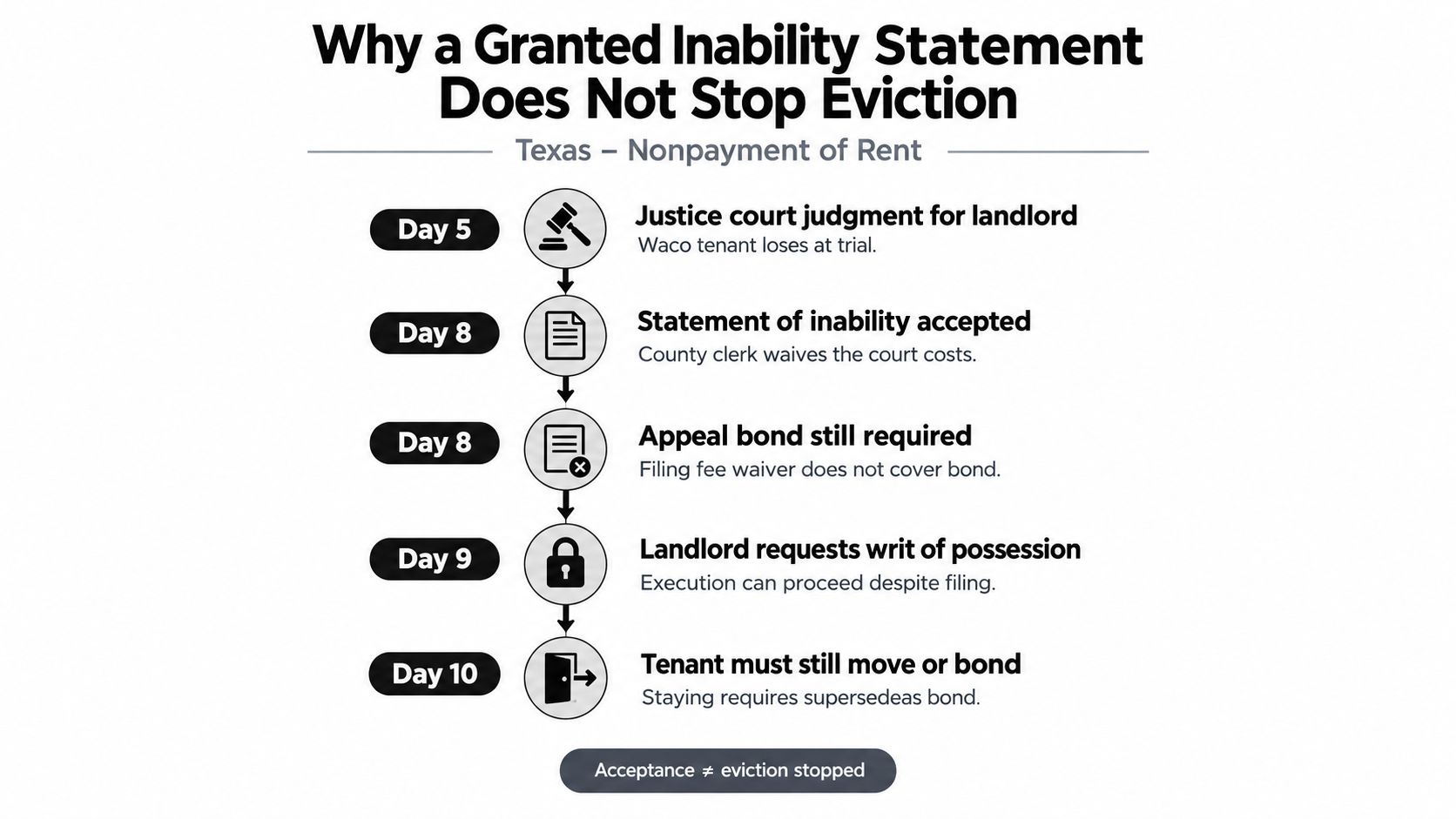
If the landlord is moving toward a writ, act immediately. Ask whether you need to post a bond, make the required rent deposit, request a stay, or seek another court order. Don't wait for the county court appeal to protect you automatically.
Even a perfect statement can fail to preserve the tenancy if the tenant doesn't comply with the continuing rent rule. The appeal and the right to remain are related, but they aren't the same legal issue.
How the Court Decides Your Inability Claim
A landlord can challenge the statement and ask the court to examine whether you really can't afford the required costs. Texas law gives the landlord a way to contest the claim through a hearing. The judge then weighs competent evidence, not just a conclusory statement.
Bring the records that support every major entry. Organize them in the same order as the form. Put recent pay information, bank records, benefits letters, proof of rent and utilities, medical or child-care expenses, and documents showing job loss or disability in a labeled folder.
What the judge is looking for
The judge may focus on:
- Gross monthly income from every source.
- Available funds in checking and savings accounts.
- Public benefits and other regular support.
- Rent, utilities, food, transportation, and medical expenses.
- Dependents and household responsibilities.
- Debts, court-ordered payments, and unusual financial pressure.
- Whether the information on the form matches the documents.
The landlord may attend and present contrary information. You should answer directly, correct mistakes promptly, and explain unusual entries instead of becoming defensive. If a bank balance is temporarily high because money was earmarked for medical care or another necessary expense, bring proof.
Possible outcomes include approval of the statement, a request for more evidence, an order addressing some costs separately, or rejection of the claim. The court may also require you to correct incomplete information. A rejected statement can affect whether the appeal is properly funded, so don't ignore a hearing notice.
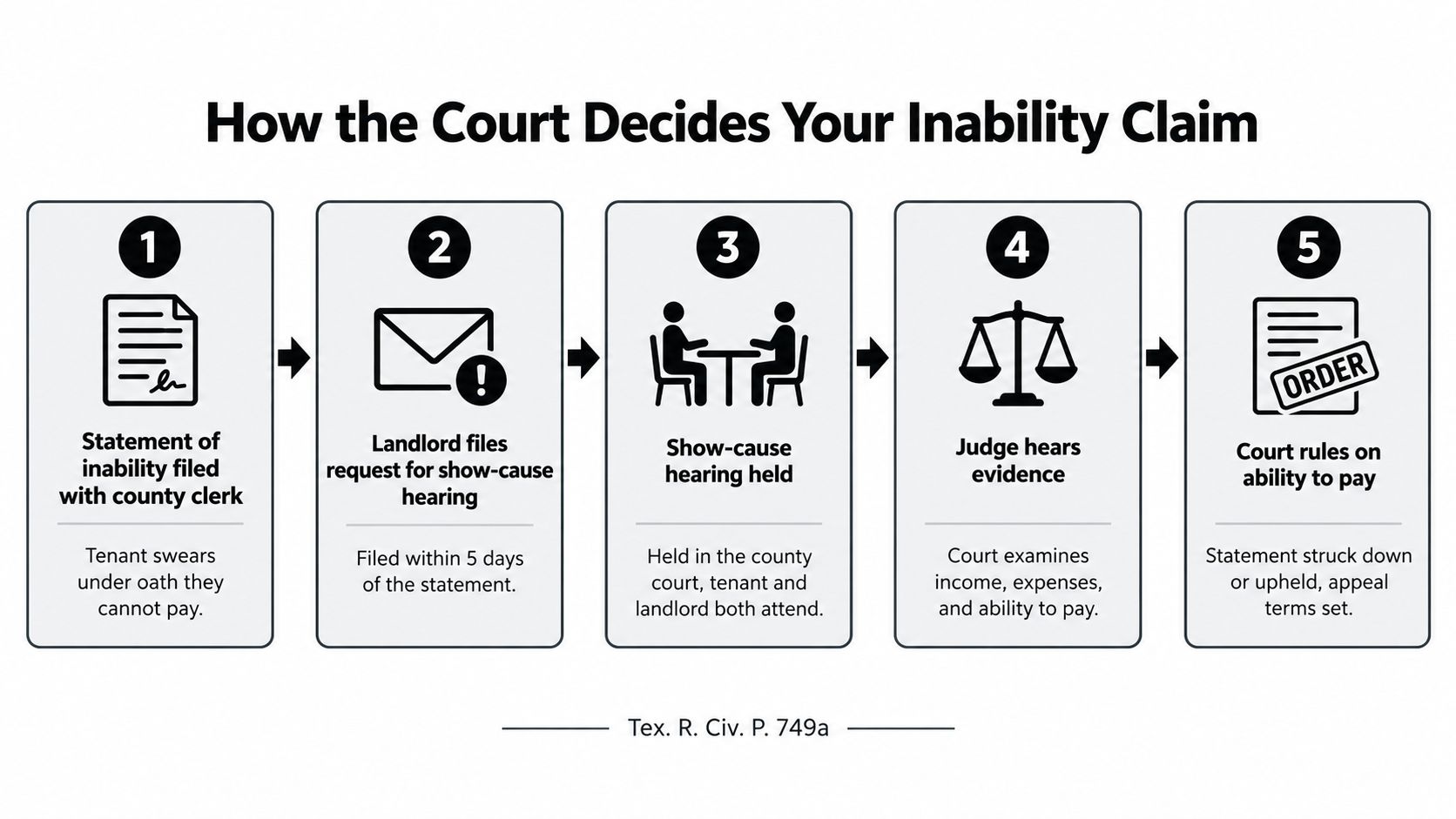
A hearing about costs doesn't automatically resolve the possession issue. Continue tracking rent payments and ask for written orders. Keep proof of every registry deposit, including the date, amount, court, and case number.
For help preparing a court record, use this tenant documentation guide for a Texas eviction defense. A well-organized file lets the judge reach a decision without searching through loose papers or unclear screenshots.
Final Checklist and Next Steps
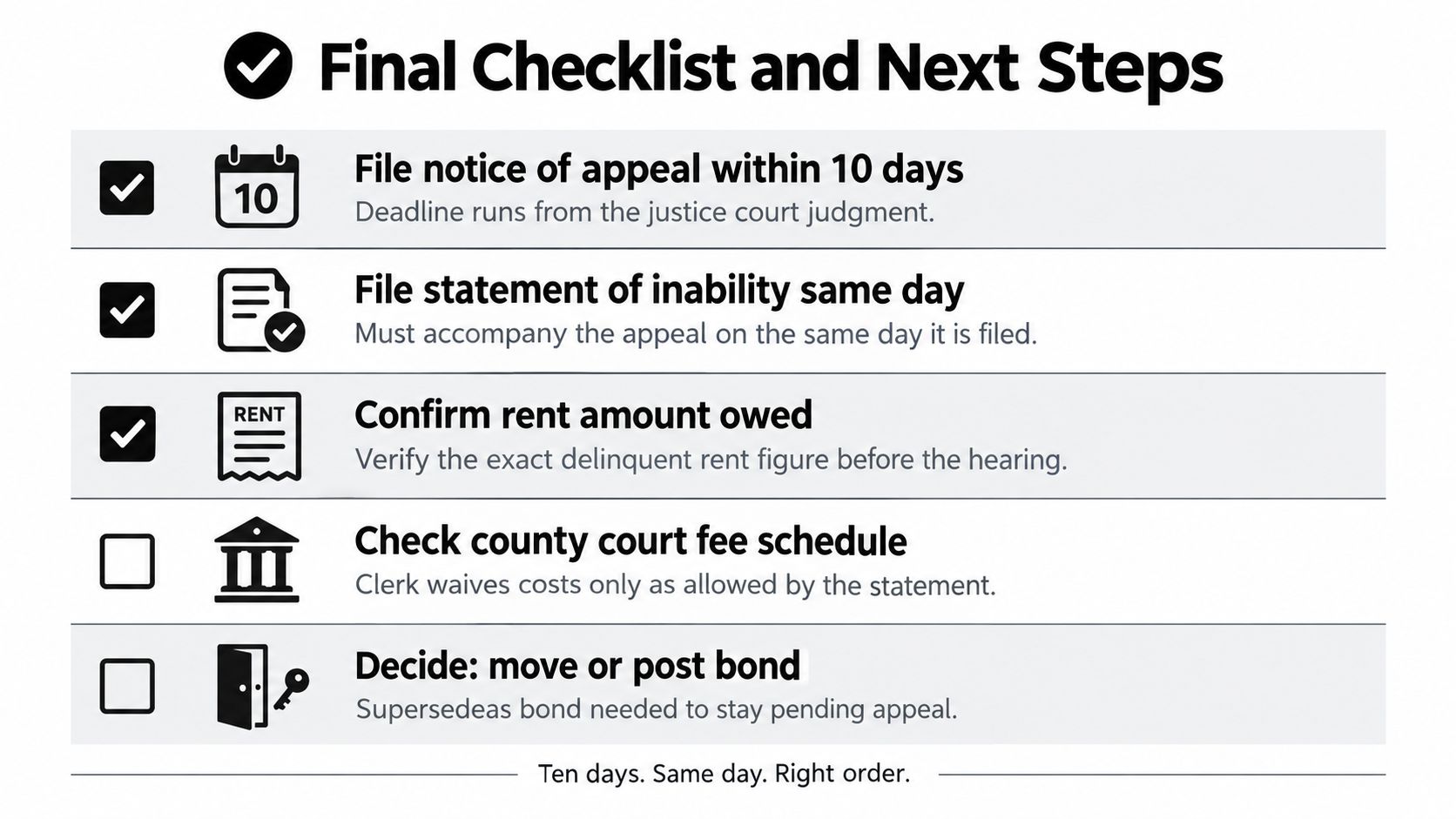
A Texas eviction appeal is won or lost through details. Start with the signed judgment, calculate the five-day appeal deadline, and file the bond, cash deposit, or Statement of Inability to Afford Payment of Court Costs with the justice court before that deadline. Don't substitute a general letter for the prescribed form, and don't assume that speaking with the clerk counts as filing.
Use this working checklist:
- Confirm the judgment date: The eviction appeal deadline runs from the date the justice court judgment is signed.
- File the appeal on time: Submit the approved financial statement, bond, or cash deposit within five days.
- Request every applicable waiver: Ask the clerk whether a separate justice court fee waiver is needed.
- Address the rent deposit: In a residential nonpayment case, confirm whether one month's rent must be deposited and when.
- Keep paying rent: Pay rent into the proper court registry as it becomes due during the appeal when the law requires it.
- Protect possession separately: Ask about a stay, bond, cash deposit, or other order. The inability statement alone may not stop a writ.
- Save proof: Keep file-stamped copies, receipts, registry confirmations, hearing notices, and all communication with the court.
- Prepare for a challenge: Bring complete income, asset, debt, expense, benefits, and dependent information if the landlord contests the statement.
The county clerk or justice court clerk can tell you the current filing-fee schedule and local filing procedures. Clerks can't give legal advice, decide whether your defense is strong, or create extra time after the deadline.
Call a Texas tenant-rights attorney quickly if the landlord challenges your affidavit, you face an illegal lockout, your case involves repairs or habitability, or you have defenses involving retaliation, discrimination, notice, or improper service. A Texas landlord tenant lawyer or eviction attorney can also help separate the appeal paperwork from the possession strategy, which is where many tenants get hurt.
Gather your pay records, benefit letters, bank information, lease, judgment, and rent receipts now. Use a written worksheet to match each number to a supporting document, then file the appeal paperwork the same day you decide to proceed. Low-income tenants should also contact local legal-aid organizations or tenant-rights hotlines promptly, because free assistance may depend on eligibility and availability.
The Law Office of Bryan Fagan, PLLC helps Texas tenants and landlords evaluate eviction appeals, prepare for contested inability claims, and address the rent and possession issues that continue after filing. Visit The Law Office of Bryan Fagan, PLLC to request a free consultation and discuss your deadline, paperwork, and next legal step.