You come home to a notice taped to your door. Your landlord hasn't mentioned a foreclosure, but a neighbor says the property was sold, or an unfamiliar company tells you to move. Your first fear is understandable: can someone force you out immediately because your landlord lost the property?
Usually, the answer is no. Tenant rights foreclosure Texas disputes are governed by overlapping federal and state rules, and those rules can give you time to remain in the home, protect a fixed-term lease, and challenge an improper eviction notice. The most important step is identifying which foreclosure occurred, what kind of tenancy you have, and whether the notice matches the protection that applies.
Your Lease Does Not Disappear When Foreclosure Hits
Maria has a written lease, pays rent on time, and cares for the rental home. Then she learns the property was foreclosed and receives a letter from a company claiming to be the new owner. The letter gives her almost no time to leave.
She should not move out based only on that demand. Foreclosure changes ownership, but it does not automatically erase a tenant's protections. Under the federal Protecting Tenants at Foreclosure Act, a bona fide tenant with a fixed-term lease can generally remain until the lease ends. A month-to-month tenant generally must receive at least 90 days' notice before being required to leave. The Texas State Law Library's guidance on tenant rights after foreclosure explains the Texas tenant-notice issues that can arise after a foreclosure.
Texas law may create a different timeline. In some situations, state law calls for 30 days' notice, while the federal rule provides 90 days. Do not assume the shorter period controls. The applicable deadline depends on the foreclosure, the mortgage, the lease, and the tenant's status. If both protections could apply, use the longer notice period unless a qualified Texas attorney confirms otherwise.
The foreclosure itself is a dispute between the former landlord and the lender or lienholder. You still must pay rent when properly directed and follow the lease. The new owner cannot use the sale as a shortcut around required notice and lawful eviction procedures.
Practical rule: Treat every foreclosure letter as serious, but do not treat every move-out demand as legally effective.
What you should preserve immediately
Keep your lease, renewal agreements, rent receipts, bank records, payment-app confirmations, emails, text messages, and photographs of the property. These records help prove that you are a legitimate renter, show whether rent was current, and document compliance with the agreement.
Record who contacted you, what that person claimed, the communication date, and the proposed move-out deadline. Do not surrender keys, sign a replacement agreement, or acknowledge that your lease ended until you understand the legal effect.
The notice date matters. Compare it with the federal 90-day rule and any Texas 30-day requirement, then respond in writing and keep proof of delivery. That difference can give you time to remain in the home, correct an inaccurate demand, and arrange your next step without surrendering rights.
How Foreclosure Changes Your Rental Situation
Foreclosure is a process used to sell property after a borrower fails to satisfy a lien obligation. For a tenant, the practical issue isn't the landlord's entire financial dispute. It's what happens to possession after the property changes hands.
Texas commonly uses nonjudicial foreclosure, meaning the sale can occur without the lender first obtaining a court judgment. The Texas State Law Library explains the tenant-notice problem in nonjudicial foreclosure: tenants often aren't told about the ownership change until after the sale. That delay makes the post-sale notice especially important.
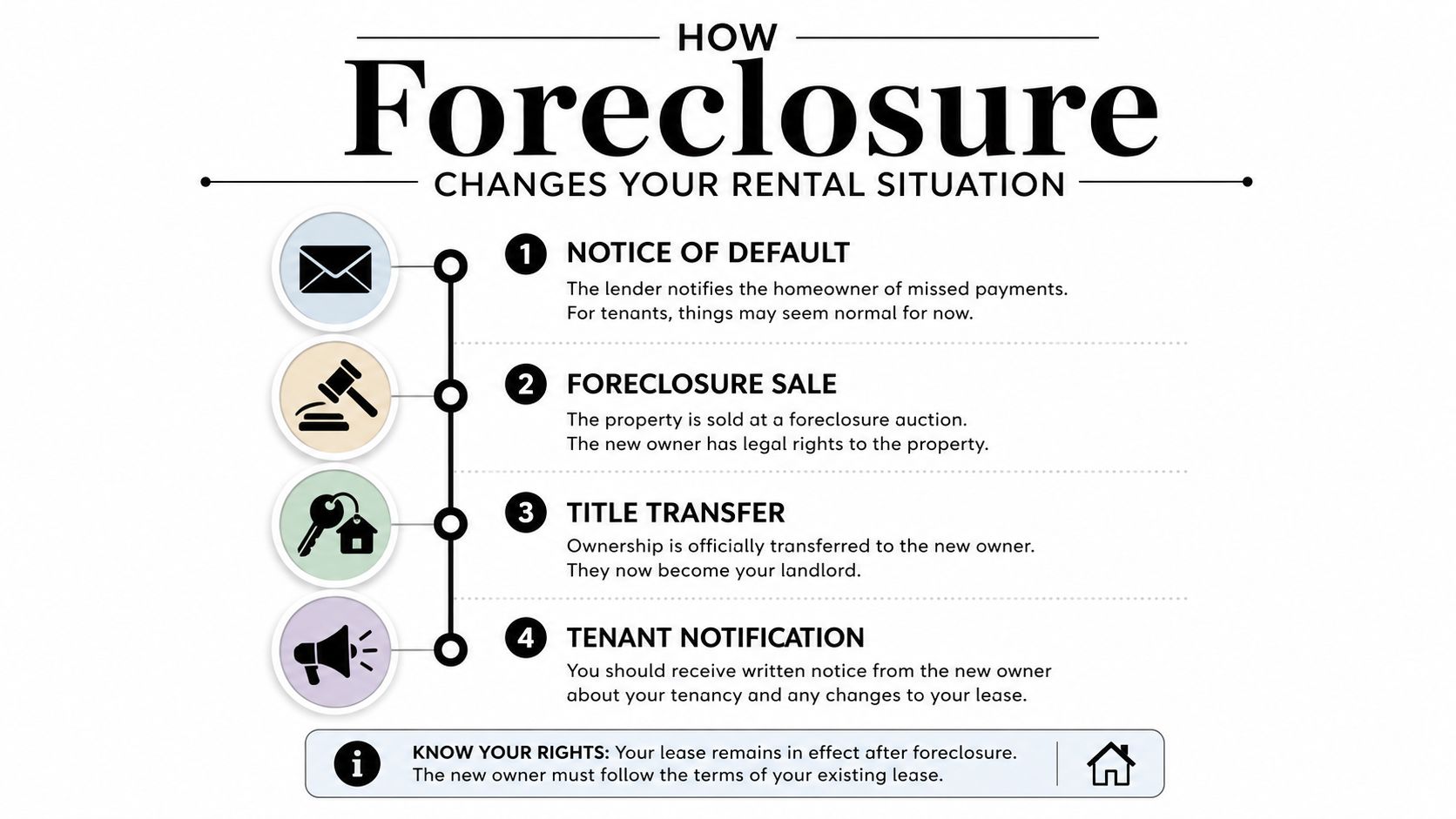
Think of the process as a timeline
Before the sale, the borrower may receive foreclosure-related notices, but the tenant might receive little or no direct information. A notice addressed to the owner doesn't necessarily tell you what your own occupancy rights will be.
At the foreclosure sale, the property is sold to a purchaser. The purchaser becomes the person seeking possession, but title transfer alone doesn't authorize an immediate lockout. The purchaser must still address the tenant's legal status and provide the required notice before filing a possession case.
After the sale, the new owner decides whether to continue the tenancy or seek possession. That decision may depend on the lease, the kind of foreclosure, whether federal protections apply, and whether the tenant qualifies as bona fide.
A judicial foreclosure follows a different path because the lienholder files a lawsuit and seeks a court order before the sale. The practical result for you still depends on the documents and notices, so don't rely on a neighbor's description of the process.
What stays stable during the transition
Your written lease, payment records, and communications remain evidence. The identity of the person entitled to receive rent may change, but you shouldn't guess where to send payment. Ask for written confirmation from the new owner or property manager, and keep proof of every payment or attempted payment.
If an unfamiliar person demands immediate possession, respond in writing. Ask for the foreclosure-sale information, proof of ownership, the proposed move-out date, and instructions for rent. A calm written record protects you far better than an argument at the door.
Federal and Texas Notice Requirements Explained
The deadline depends on which rule covers your situation: the federal 90-day notice protection or Texas's 30-day notice rule. Identify the foreclosure type, your lease, and your tenant status before accepting the date in a notice.
The federal Protecting Tenants at Foreclosure Act generally protects a bona fide tenant in a federally related mortgage foreclosure. A Texas A&M Real Estate Center summary of the federal foreclosure protections explains that the tenant must receive at least 90 days' notice to vacate. A tenant with a written fixed-term lease may generally remain through the end of the lease term.
Texas provides a separate protection under Property Code Section 24.005. If a building is purchased at a tax foreclosure sale or a trustee's foreclosure sale under a lien superior to the tenant's lease, a residential tenant who timely pays rent and follows the lease must receive at least 30 days' written notice when the purchaser will not continue the lease. The Texas statute's text on Justia also distinguishes this foreclosure rule from ordinary eviction cases, where Texas generally requires at least three days' written notice unless the lease provides another period.
Federal versus Texas notice requirements after foreclosure
| Protection Type | Federal Law, PTFA | Texas Law, Section 24.005 |
|---|---|---|
| Who may qualify | Most bona fide tenants in a federally related mortgage foreclosure | Residential tenants meeting the statutory rent-payment and compliance conditions |
| Notice period | At least 90 days' notice to vacate | At least 30 days' written notice to vacate in the specified foreclosure sales |
| Fixed-term lease | Tenant may generally remain through the end of the lease term | Purchaser may choose not to continue the lease, subject to the statute |
| Month-to-month tenancy | Generally at least 90 days' notice | The statute supplies the specified 30-day protection when its conditions apply |
| Main practical issue | Whether the tenant and foreclosure qualify for federal protection | Whether the sale, superior lien, rent timing, and compliance satisfy Section 24.005 |
Notice timelines also vary by lease type. Review our guide to Texas notice periods by lease type for the month-to-month and fixed-term distinctions.
How to identify the stronger timeline
Start with the mortgage and foreclosure records, not only the wording of the notice. If the foreclosure involved a federally related mortgage and you qualify as a bona fide tenant, the 90-day federal floor usually gives you more time than the Texas rule. That difference can give you time to verify the sale, gather records, negotiate a move-out date, or prepare a defense.
If federal protection does not apply, Section 24.005 may still provide the 30-day state notice when its specific requirements are met.
Rent timing can decide whether the state protection applies. The Texas statutory analysis available through FindLaw explains that Section 24.005 addresses timely rent payment around the sale month and the post-notice deadline. Keep payment records, and do not ignore a demand because you believe the deadline is too short.
If the notice is unclear, When to Consult a Texas Landlord-Tenant Attorney can help evaluate the lease, foreclosure facts, notice, and available defenses. Get that review before the stated deadline expires.
The Post-Foreclosure Eviction Process in Texas
A new owner cannot decide that the tenant is gone. In a Texas post-foreclosure case, the purchaser must first provide a written notice to vacate, then file a forcible detainer suit in justice court if the occupant remains after the applicable period. Court summaries describe that notice as a required gateway before a court can order removal, as explained in this Texas post-foreclosure eviction notice overview.
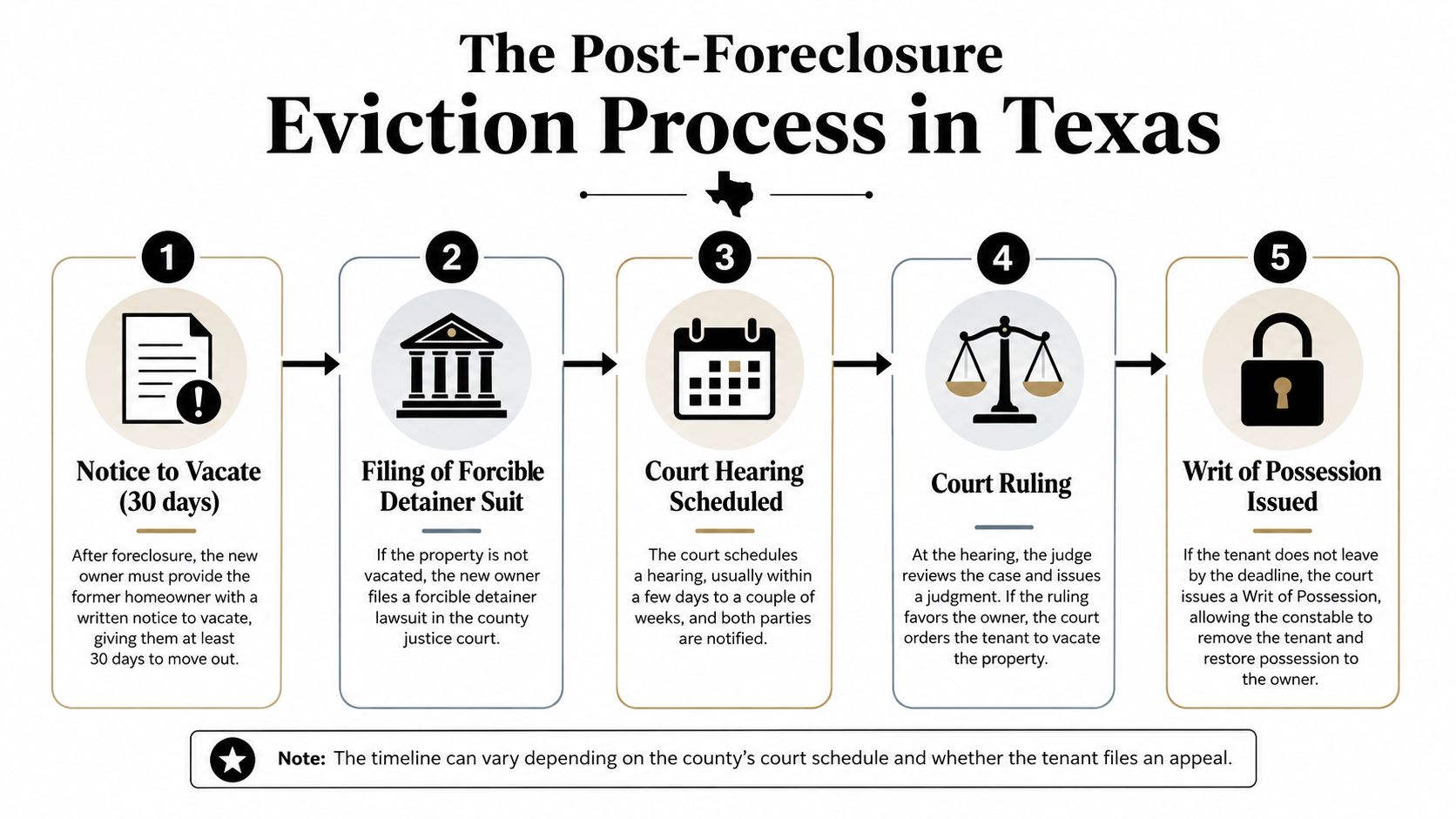
Follow the case in order
Notice to vacate. Read the notice carefully. Check the property address, sender, stated ownership, deadline, delivery method, and the legal basis for the demand. Compare the deadline with the federal or Texas protection that applies to you.
Forcible detainer filing. If you don't leave after a valid notice period, the purchaser may file an eviction case in justice court. The new owner must prove a present right to possession, and you can raise defenses related to the lease, notice, payment history, and applicable foreclosure protections.
Court hearing. Don't ignore court papers. Bring your lease, payment evidence, photographs, messages, notices, and any proof showing when and how the owner contacted you.
Court ruling. The judge decides possession based on the evidence and legal requirements. An eviction case isn't the place to assume the foreclosure automatically settles every lease issue.
Writ of possession. If the purchaser wins and the judgment is not resolved through the available court process, the court may issue a writ authorizing the proper removal process. A landlord or purchaser shouldn't replace that process with personal force.
The Texas eviction laws guide can help you understand the broader Chapter 24 process, but foreclosure cases often require a closer review of federal protections.
Recognize unlawful self-help
A new owner generally can't lawfully bypass the court process by changing the locks, shutting off utilities, removing your belongings, or using threats to force you out. If someone attempts this, document the condition immediately, preserve messages and witness information, and seek legal help.
You should also avoid withholding rent because ownership changed. Ask in writing where rent should go, and keep the money available while the payment dispute is clarified. A tenant who stays but stops communicating can make a defensible case harder to present.
The embedded video offers a visual explanation of the process:
Does Your Lease Survive the Foreclosure Sale
A foreclosure sale doesn't produce one automatic result for every renter. The decisive facts include whether the tenancy is bona fide, whether the lease is fixed-term or month-to-month, the type of foreclosure, and the applicable mortgage and notice rules.
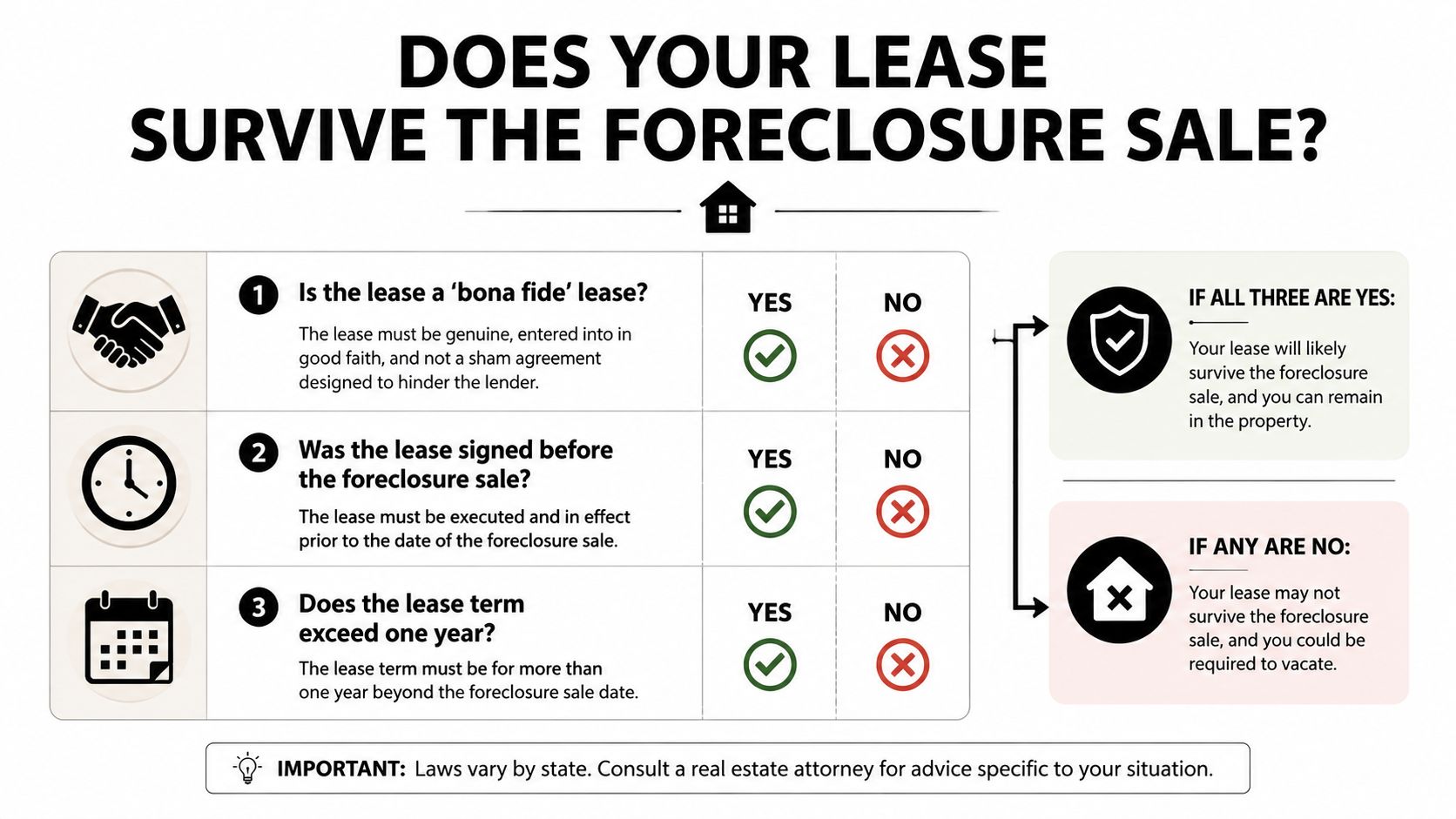
Start with bona fide status
A bona fide tenancy is a genuine rental arrangement, not a sham created to interfere with foreclosure. Review how the lease was formed, who signed it, what rent was required, and whether payments occurred.
A family arrangement deserves special attention. For example, a person renting from the foreclosed owner's close family member may face questions about whether the arrangement qualifies for federal protection. A very low rent, unusual lease terms, or a recently created agreement can also lead the purchaser to challenge the tenancy.
That doesn't mean those facts automatically decide the case. It means you should collect the documents that explain the arrangement, including payment history, communications, and evidence of the home's ordinary rental use.
Compare the common tenancy types
Fixed-term lease. If you signed a genuine fixed-term lease and federal protections apply, you may generally remain through the end of the lease term. The new owner may need to honor that term unless a recognized exception applies, so don't accept a demand for immediate surrender without reviewing the agreement.
Month-to-month tenancy. A month-to-month renter doesn't have a future lease end date to enforce in the same way. Federal protection generally supplies at least 90 days' notice in a qualifying foreclosure, while the Texas rule may supply at least 30 days when Section 24.005 applies.
Verbal tenancy. A verbal agreement can still create a real rental relationship, but proving its terms is more difficult. Use rent records, messages, mail, utility records, and witness information to establish possession and payment.
A one-year lease signed before the foreclosure sale is different from a below-market family arrangement created to delay the sale. The Texas guidance on what happens when a landlord sells a rental property can help frame the ownership-change issues, but the foreclosure documents still control the legal analysis.
Practical Steps to Protect Your Tenancy and Deposit
Act quickly, but don't act emotionally. Your strongest position comes from a complete paper trail showing your lease, your payments, and your response to the ownership change.
Build your file
Save digital copies and keep paper copies of:
- Your lease: Include every addendum, renewal, and written notice.
- Rent records: Preserve bank statements, receipts, payment-app confirmations, and money-order information.
- Occupancy evidence: Keep photographs, utility records, mail, and communications showing that you live there lawfully.
- Foreclosure communications: Record the sender, date, deadline, and exact demand in every letter, email, text, or visit.
Don't alter or discard documents that seem unimportant. A casual message about rent or repairs may help establish who acted as landlord and when.
Confirm the new owner and payment instructions
Ask the new owner or property manager for written confirmation of ownership and rent instructions. Until you receive reliable instructions, don't send money to an unknown person merely because they claim to have purchased the property.
If payment is due during the transition, communicate in writing that you're ready to pay the proper recipient. Keep the funds available, and don't treat a dispute over payment instructions as permission to stop paying altogether. Your records should show cooperation and good faith.
Protect the deposit
Ask the former landlord and the new owner, in writing, who holds the security deposit and how it will be handled. Keep the move-in inspection, photographs, repair requests, and any move-out documentation. If you leave, request a written acknowledgment of key delivery and the property's condition.
A tenant who pays the wrong entity, loses proof of payment, or leaves without documenting the condition may face avoidable disputes. If the former landlord refuses to account for the deposit, preserve the demand and consult a Texas landlord tenant lawyer about the responsible party and available remedies.
When to Contact a Texas Landlord-Tenant Attorney
You should speak with a Texas landlord tenant lawyer promptly if the notice gives you less time than the applicable federal or Texas rule, the purchaser disputes that you're a bona fide tenant, or the new owner refuses to recognize a fixed-term lease. Those facts can affect whether the purchaser can proceed and what defenses you can present.
Legal help is especially important if:
- You're locked out or threatened without a court order.
- You receive justice court papers and need to prepare for the hearing.
- The purchaser claims your lease is invalid because of its timing, rent amount, or relationship with the former owner.
- Your former landlord or the new owner disputes your security deposit.
- You face pressure to sign a surrender agreement before understanding your rights.
An eviction attorney can review the lease, foreclosure sale, notice, rent records, and court papers. The Law Office of Bryan Fagan, PLLC helps Texas landlords and tenants evaluate rental and foreclosure-related disputes, including possession issues, lease enforcement, and eviction procedure.
If you're facing a foreclosure notice, threatened lockout, or post-foreclosure eviction, The Law Office of Bryan Fagan, PLLC can review your documents, explain the timeline that may apply, and help you plan your next step. Visit the firm to request a free consultation about protecting your tenancy and responding to the new owner.