Skip to content

Three days is the default notice period before many Texas eviction lawsuits, but no written lease does not mean no tenancy. Rent payments, permission to occupy, and the parties' conduct can create a month-to-month tenancy, so landlords generally must follow notice and court procedures before removing an occupant.
Dealing with a landlord dispute or eviction can be stressful, especially when the arrangement was made through a handshake, text messages, or a family conversation instead of a signed document. A renter in Houston might pay rent each month, receive a text demanding that they leave within 24 hours, and wonder whether the lack of paperwork means they have no rights.
Usually, “no lease” means no written lease, not no rental relationship. Texas recognizes written, oral, and implied arrangements. The legal question is whether the owner gave permission to occupy the property and whether the parties' conduct created a landlord-tenant relationship. The answer affects the notice required, the evidence each side should preserve, and whether the dispute must proceed through a formal eviction.
When There Is No Written Lease in Texas
Suppose a tenant has paid monthly rent for several months. The landlord accepted electronic transfers, allowed the tenant to move in, and communicated about repairs by text. Nothing was signed. When the relationship breaks down, the landlord sends a message saying, “Leave tomorrow or I'll change the locks.”
That message may not end the tenancy or authorize immediate removal. Under guidance from the Texas State Law Library's explanation of the eviction process, a lease can be oral, and a spoken agreement allowing someone to live in a property may establish a tenant relationship. The absence of a document changes how the parties prove their arrangement. It doesn't automatically erase tenant rights.
Three situations commonly become confused:
- An oral or implied month-to-month tenancy: The occupant pays rent monthly, or the parties otherwise act as though rent is owed on a recurring basis.
- A holdover arrangement: A written lease ends, but the owner permits the occupant to remain and continues accepting rent or communicating with the person as a resident.
- An at-will or informal arrangement: The owner allows someone to live there without a clearly fixed end date, sometimes involving family, roommates, or friends.
A true trespasser is different. That generally means the person never had permission to enter or live in the property. But calling someone a “guest” or “squatter” doesn't decide the issue by itself. Courts may examine how the person entered, how long they stayed, whether they paid money or services, and what the owner said or did.
Practical rule: The lack of a signed lease usually creates an evidence problem, not an automatic right to bypass eviction law.
Texas Property Code Chapter 24 governs forcible-detainer actions, the court process commonly used to recover possession. If the occupant claims the property as their residence, the landlord may need to provide proper written notice, file in justice court, serve the citation, obtain a judgment, and secure a writ of possession before physical removal. A landlord who treats a tenant as an unauthorized trespasser may choose the wrong process.
Clear written agreements can prevent many disputes. Property owners and managers who are developing a broader real estate lawyer marketing strategy should also recognize that public legal education works best when it explains these distinctions instead of reducing every case to a single three-day rule.
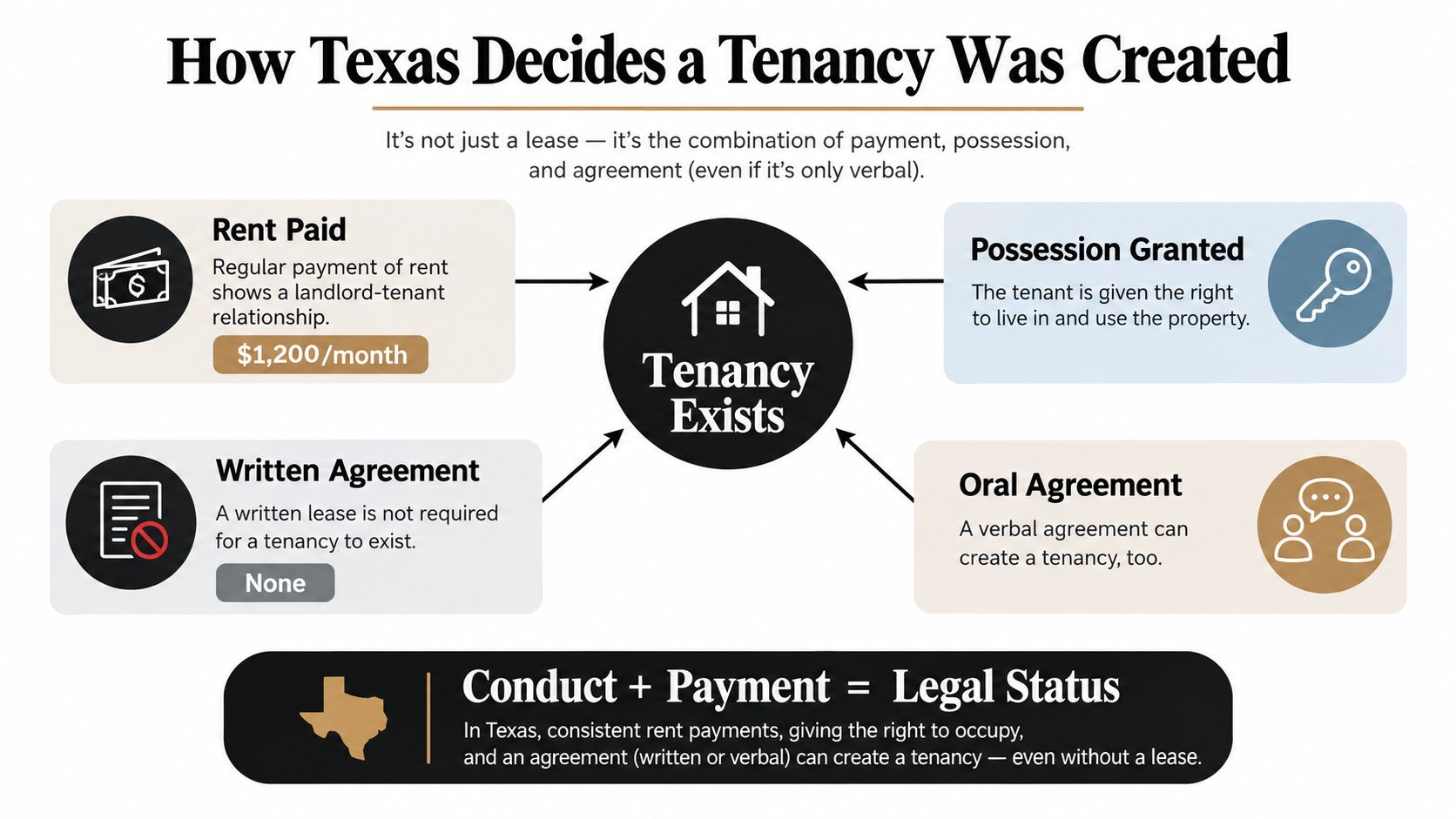
How Texas Decides a Tenancy Was Created
Texas courts generally look at conduct rather than a signature alone. The important questions are practical:
- Did the owner give the person permission to live there?
- Did the person pay rent, transfer money, or provide an agreed service?
- Did the owner accept those payments or benefits?
- Did the parties communicate as though the person had a right to occupy the property?
- Did the occupant receive mail, keep belongings there, or make repair requests?
The Texas guidance on guests, tenants, and informal occupancy explains that a rental agreement may be written, oral, or implied. An implied arrangement can arise from conduct, such as monthly payments and the owner's acceptance of them.
Examples that change the analysis
A friend who stays for a short visit and never receives permission to establish a residence may remain a guest. The analysis becomes different if the owner gives the friend a key, agrees that the friend may live there indefinitely, accepts regular payments, or tells neighbors that the friend resides at the property.
A sibling who contributes to utilities isn't automatically a tenant. But utility payments may become evidence of an implied arrangement when combined with permission to occupy, shared communications, or an understanding that the payments replace rent. Courts examine the full pattern rather than one isolated payment.
A tenant whose written lease expires may become a month-to-month occupant if the landlord permits continued possession and accepts recurring rent. That conduct can matter even if the original lease says nothing about renewal.
The distinction matters because the wrong label can produce the wrong legal response. A person who entered lawfully and became a resident ordinarily can't be removed only because the owner later calls them a guest. A person who never had permission may present a different trespass issue, but uncertainty should be handled carefully.
For residential matters, practical guidance about verbal rental agreements in Texas can help parties identify what evidence may establish an oral tenancy. Commercial occupants require separate analysis. Commercial Lease Disputes in Texas may involve different treatment of commercial tenancies under Chapter 93.
Once permission, possession, and payment point toward a tenancy, a landlord should use the formal process instead of changing locks or removing property.
Notice Rules When No Written Lease Exists
The most common mistake in an eviction without a lease is treating the three-day notice as an automatic answer to every situation. The correct question is not only, “How many days' notice?” It's also, “What kind of notice is required, when does the clock start, and how can delivery be proven?”
The two-track notice analysis
If rent is paid monthly and the arrangement has no fixed end date, the tenancy may be periodic, commonly month-to-month. In that situation, the landlord may first need to terminate the periodic tenancy by giving notice for at least one rental period. The Texas State Law Library's eviction-process guidance explains that, absent a different agreement, landlords generally must provide at least three days' notice to vacate before filing, while the termination of a periodic arrangement can require a separate analysis.
A practical decision tree looks like this:
- Periodic tenancy: Determine the rental period, give the required termination notice, and wait for the tenancy to end.
- Nonpayment or lease violation: Review the agreement and applicable law to determine whether a demand for payment, possession, or compliance is required.
- Holdover: Confirm that a fixed term ended and that the occupant remained without the landlord's consent.
- True trespass: Confirm that the person never had permission to occupy the property. Do not rely on this label merely because there's no written lease.
After a tenancy is properly terminated, a separate notice to vacate may still be necessary before filing a forcible-detainer case. The default period is three days, unless the parties agreed to a different period in a written lease or another applicable rule changes the requirement.
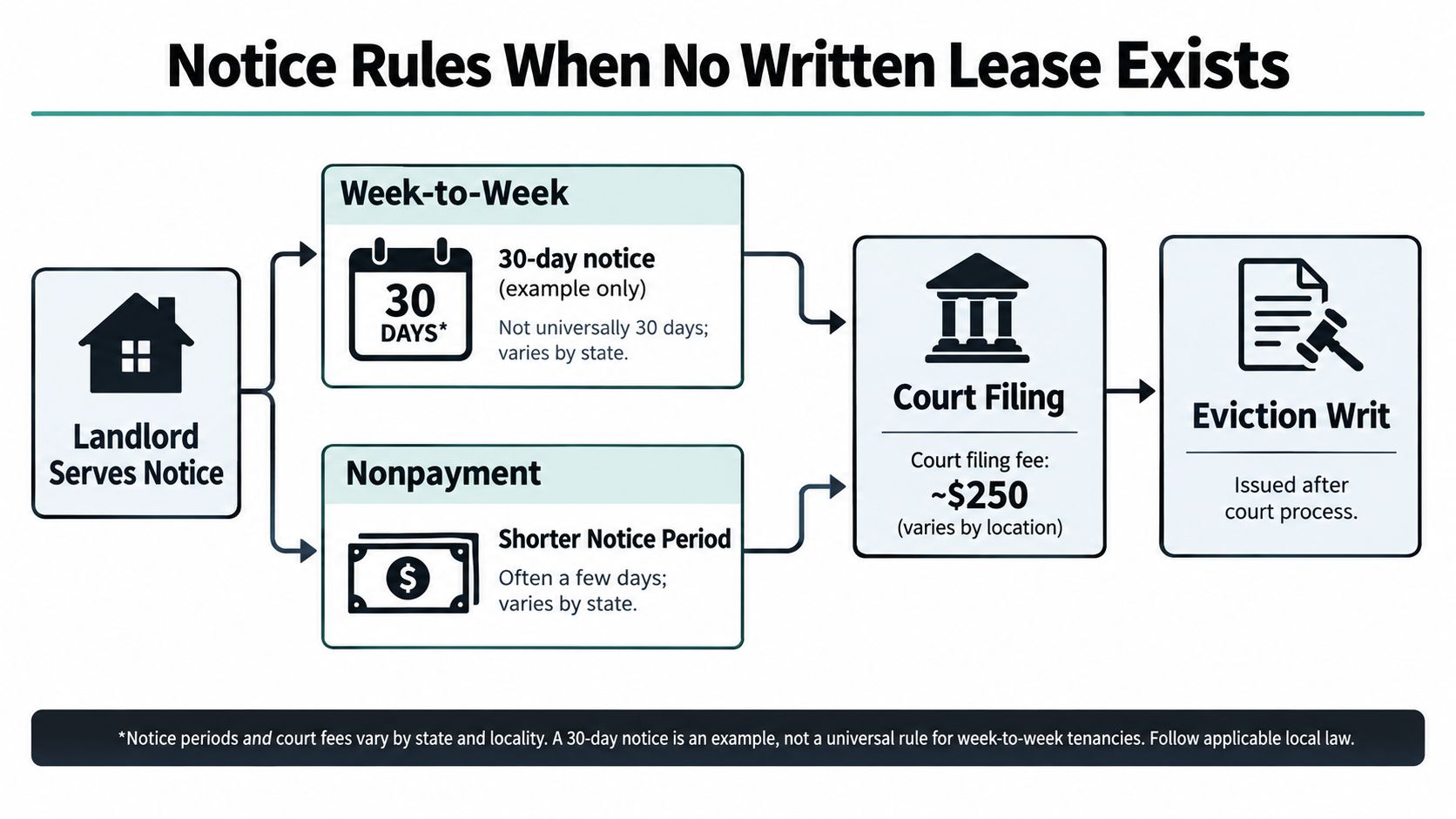
A notice should identify the premises, clearly demand that the occupant leave, and state the deadline. Texas guidance recognizes delivery methods such as personal delivery, posting inside the premises, and mail. Electronic delivery generally depends on a written lease authorizing that method, so a text message may not be enough.
The Texas Supreme Court has emphasized that a notice to vacate isn't itself an eviction. It's a prerequisite to the court's possession decision, and an unclear or defective notice can prevent the court from ordering removal.
For a closer review of the required contents and delivery issues, see notice to vacate requirements in Texas.
A filing also isn't proof that the tenant was evicted. The case still requires service, a hearing, and a court decision.
How a Texas Eviction Case Actually Proceeds
A Texas residential eviction is generally a forcible-detainer action under Texas Property Code Chapter 24. The process is designed to decide possession. It isn't a shortcut for deciding every title dispute, ownership question, or unrelated claim between the parties.
The sequence in justice court
The landlord typically starts by filing a petition in the proper justice court after the required notice period has ended. The court issues a citation, and the tenant must receive formal service. A text message, informal warning, or knowledge of the lawsuit doesn't replace proper service.
The case then proceeds to a hearing. Both sides can present documents, testimony, payment records, communications, photographs, and other evidence. A tenant who fails to appear or respond may face a default judgment, even when the underlying arrangement was oral or disputed.
The main stages are:
| Stage | What Happens | Who Acts |
|---|---|---|
| Notice | The landlord serves the required termination or notice to vacate | Landlord |
| Filing | A forcible-detainer petition is filed in justice court | Landlord |
| Citation | The court issues process and arranges formal service | Court and authorized server |
| Hearing | The parties present evidence about possession and notice | Judge, landlord, and tenant |
| Judgment | The court decides who has the right to immediate possession | Judge |
| Appeal | An eligible party may challenge the justice-court result | Appealing party |
| Writ of possession | If the landlord prevails and the case is ready for enforcement, the writ authorizes physical removal | Court and constable |
Only the writ of possession authorizes the constable to physically remove an occupant. A landlord's notice doesn't do that. Neither does a judgment by itself permit the landlord to take matters into their own hands.
Deadlines matter at every stage. A tenant should read the citation carefully, calendar the hearing, and obtain legal help promptly if the notice, service, or occupancy history is disputed. Landlords should verify that the notice expired before filing and that the petition is filed in the correct precinct. A practical guide to court deadline tracking can help organize dates, but it can't replace legal analysis.
A title dispute may require a different court or action. A forcible-detainer case focuses on the immediate right to possession, not necessarily the final ownership of the property.
Why Self-Help Lockouts Create Real Liability
A landlord who stops receiving rent may demand that an occupant leave. If the landlord then changes the locks, puts belongings outside, or calls the police to report trespassing, the possession dispute can become a separate legal claim.
Texas generally requires a landlord to use the eviction process when the occupant has a recognized claim to live there. Police involvement and a lock change do not replace the justice-court case, judgment, and writ of possession. Only the proper enforcement process authorizes physical removal.

What counts as a dangerous shortcut
A lockout can take several forms. A landlord may create liability by:
- Shutting off utilities to pressure the occupant to leave.
- Removing, discarding, or withholding personal belongings.
- Changing the lock and refusing to provide a key.
- Asking law enforcement to remove the occupant without a final eviction order.
- Blocking access while the right to possession remains disputed.
The Texas legal-aid explanation of renter rights after a disaster describes the formal route and explains that a tenant locked out without a writ may contact the local justice of the peace and seek a writ of reentry, as explained in this overview of the illegal-lockout remedy under Texas Property Code Section 92.0081. That remedy can order the landlord to restore access.
A tenant should photograph the door, preserve messages, save rent records, identify witnesses, and collect evidence showing residence. Prompt action through the justice court or advice from an eviction attorney may matter. A landlord should serve the applicable notice and let the court and constable handle possession.
A missing signature does not make a lockout safe. Evidence of permission to occupy and a landlord-tenant relationship may turn an attempted shortcut into an illegal-lockout or wrongful-eviction claim. Put any move-out agreement, payment arrangement, or surrender date in writing.
Defenses Tenants Raise and Counter-Arguments Landlords Make
A justice court usually needs concrete proof, not just competing labels. Tenants and landlords should organize the dispute around notice, payment, possession, service, and the conduct that created the arrangement.
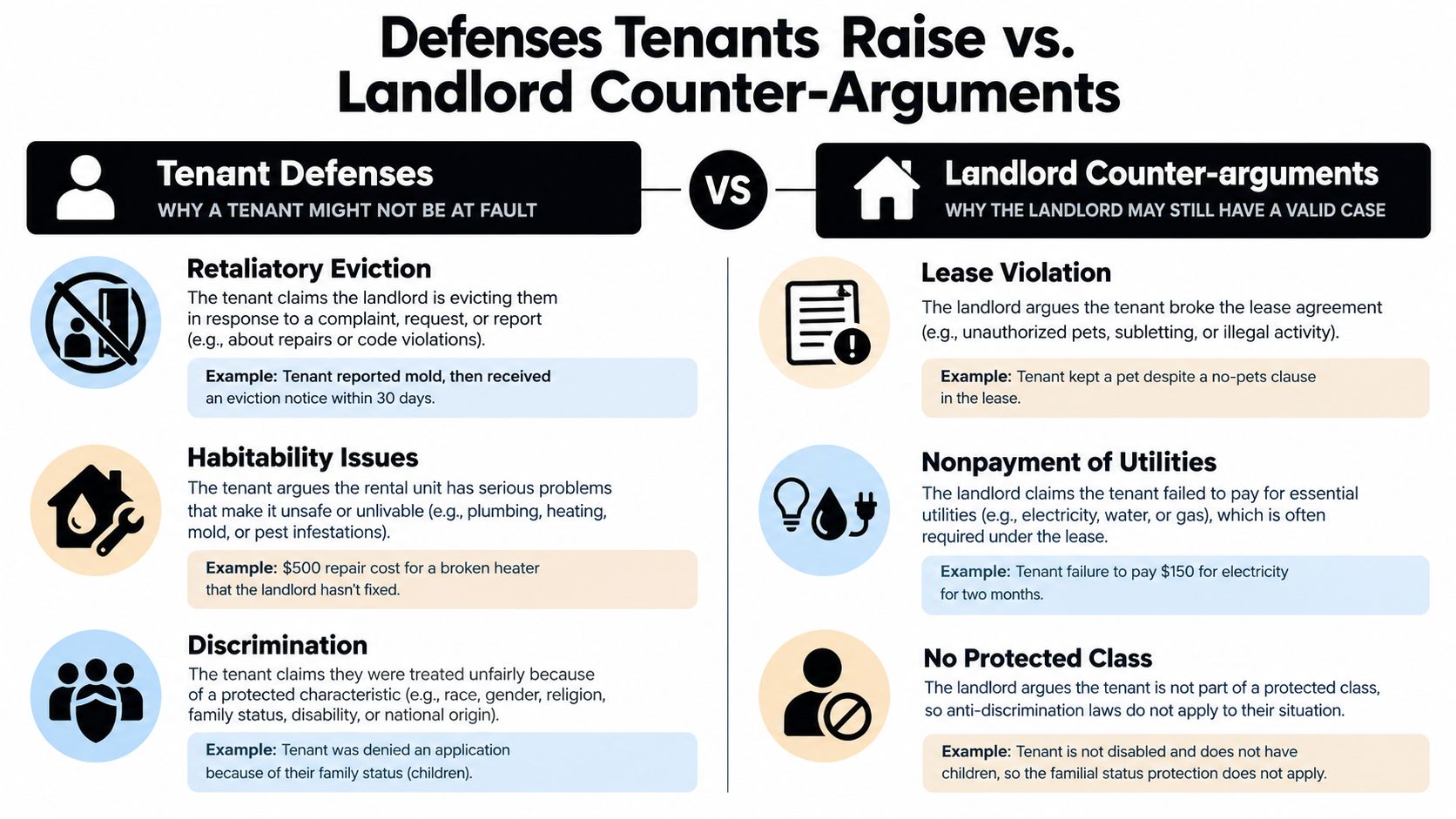
Common arguments often appear in pairs:
- Improper notice: The tenant may argue that the landlord gave only an oral demand, used the wrong notice period, failed to state a clear deadline, or served the notice incorrectly. The landlord may respond that the tenancy was already terminated, the occupant was a true trespasser, or the notice complied with the applicable agreement.
- Payment dispute: The tenant may show bank records, receipts, or electronic transfers. The landlord may argue that the payment was incomplete, applied to another obligation, or accepted after a termination date under circumstances that didn't reinstate the tenancy.
- Service or filing defect: The tenant may challenge service of the citation, the precinct, or the landlord's failure to wait until the notice expired. The landlord may contend that the case was filed correctly and that the tenant had actual knowledge.
- Habitability or repair concerns: A tenant may present repair requests, photographs, and communications showing serious conditions. The landlord may argue that the tenant failed to provide access, caused the condition, or didn't follow the required notice process for a repair-related claim.
- Retaliation or discrimination: A tenant may assert that the eviction followed a protected complaint or reflects unlawful discrimination. The landlord may deny that motive and present a documented, non-discriminatory reason, such as nonpayment or a lease violation.
In an oral-arrangement case, evidence often carries more weight than a person's preferred description of the relationship. Useful records may include:
- Payment proof: Bank statements, payment-app records, receipts, and canceled checks.
- Permission evidence: Move-in messages, emails, witness statements, and key-transfer discussions.
- Residence evidence: Mail, repair requests, photographs, and communications identifying the property as the person's home.
- Notice evidence: Copies of notices, delivery records, photographs of posting, and messages about deadlines.
- Court evidence: The petition, citation, hearing notice, judgment, and any writ.
Neither side should assume that one favorable document decides the case. A tenant without a written lease may still prove a tenancy through conduct. A landlord may still prevail if the evidence shows a lawful termination, nonpayment, or another valid possession ground and the required procedure was followed.
Practical Steps for Tenants and Landlords
The safest response to an eviction without a lease is to preserve evidence before memories fade or messages disappear. Both sides should create a simple timeline showing when permission began, when payments were made, when conflicts arose, and when notices were delivered.
Tenants should act promptly
Save rent records, text messages, emails, move-in communications, repair requests, mail, photographs, and witness names. If there's a lockout, photograph the door and preserve evidence of any property left outside. Keep every court paper, including the citation and hearing information.
After receiving a notice:
- Read the stated deadline and identify whether it demands payment, possession, or both.
- Compare the notice with the actual rental arrangement and payment history.
- Preserve proof of delivery and the original document.
- Respond to any citation and attend the hearing.
- Ask a Texas landlord tenant lawyer to review the situation when notice, service, retaliation, discrimination, repairs, or the tenancy itself is disputed.
Don't delete messages, rely only on a verbal conversation, or miss the hearing because the arrangement was informal. Moving out may affect possession, property access, or related claims, so get advice before signing a surrender agreement when the dispute is serious.
Landlords should build a clean record
Keep records showing permission to occupy, rent demands, payments received, repairs, communications, and the basis for termination. Identify whether the occupant is a periodic tenant, a holdover, an at-will resident, or someone who never had permission to occupy.
Before filing:
- Confirm the legal status: Don't assume “guest” or “squatter” is accurate.
- Choose the correct notice: Separate termination of a periodic tenancy from the later notice to vacate.
- Prove delivery: Use a permitted method and retain evidence.
- Verify filing details: File in the correct justice-court precinct after the notice period expires.
- Avoid self-help: Don't change locks, shut off utilities, remove property, or use police to bypass the court.
A careful record can resolve confusion early. It also gives the court a clearer basis for deciding possession if the matter proceeds to hearing.
Next Steps and How a Texas Eviction Lawyer Can Help
No written lease doesn't mean no tenancy. A landlord may still need to terminate a periodic arrangement, provide a valid notice to vacate, and obtain a court order before removal. Self-help lockouts create risk, while payment records, messages, witness testimony, and proof of permission can decide how the court characterizes the occupancy.
If you've received a notice, been served with an eviction case, experienced a lockout, or are deciding whether to file, gather your records and get advice before taking the next step. The Law Office of Bryan Fagan, PLLC can help tenants and landlords evaluate the Texas eviction process, lease issues, possession disputes, and eviction appeals. For firms and legal professionals reviewing educational content strategy, CitationOS legal SEO insights also offers context on communicating legal information clearly online.
If you need help with an eviction without a lease, lease issue, or rental dispute, schedule a free 30-minute consultation with The Law Office of Bryan Fagan, PLLC. The firm can review your notices, payment records, communications, and court papers, then explain practical options for protecting your rights under the Texas Property Code.