Receiving a Section 8 termination notice can make your housing feel unstable overnight. You may be worried about losing your home, your voucher, or both. But a landlord's notice is not automatically a court order, and a notice from a public housing agency is not the same thing as a private eviction case.
The phrase section 8 good cause termination tenant defense Texas describes two connected but separate legal problems. You may need to challenge the landlord's reason for ending your lease while also responding to a public housing agency, or PHA, that threatens to end your rental assistance. Acting quickly, preserving your records, and separating these legal tracks can make a major difference.
Understanding Your Rights After an Eviction Notice
A landlord's notice and a PHA termination letter can arrive close together, yet they may concern different legal questions. For example, a landlord may post a notice alleging a lease violation while your Housing Choice Voucher remains active with the public housing agency. The landlord may be seeking possession of the unit. The PHA may be deciding whether you remain eligible for rental assistance. Treating those documents as one case can cause you to miss a deadline or use the wrong defense.
A notice requires prompt action, but it does not establish that the landlord has a lawful basis to end your tenancy. Many Section 8 tenants have a substantive defense when an owner tries to end the tenancy without good cause. Review the lease, HUD requirements, and Texas eviction procedure separately. The same facts may matter in both proceedings, but the decision-makers, deadlines, and requested remedies can differ.
Practical rule: Treat every notice as urgent, but do not treat every allegation as established fact.
Make a complete copy of each document, including the envelope, posting, or other delivery information. Record the date, time, and method of receipt. Keep your lease, HUD tenancy addendum, rent records, inspection paperwork, repair requests, emails, text messages, and communications with the PHA together. Preserve the original files where possible, rather than relying only on screenshots or memory.
What to do before responding
Start with four questions:
- Who sent the notice? Identify the private landlord, property manager, PHA, or any combination of them. A landlord's notice generally addresses the tenancy. A PHA letter may address the voucher or your participation in the housing program.
- What reason is stated? Look for nonpayment, a lease violation, criminal or nuisance conduct, failure to provide information, or the end of a lease term.
- When does it take effect? Compare the stated date with the lease term, the date of delivery, and any opportunity to cure the alleged problem.
- What action comes next? Check for a PHA hearing deadline, a justice court case number, filing instructions, or a demand to answer a lawsuit.
Do not leave solely because a landlord says you must go. Moving may affect your tenancy, voucher search, defenses, and ability to challenge the case. A landlord may still need to file a forcible-detainer case and prove the right to possession. Ignoring the notice creates a different risk because Texas eviction cases can proceed quickly after filing.
Review whether the stated reason could be a pretext. A vague complaint appearing soon after you reported unsafe repairs, requested an accommodation, or asserted a legal right may raise retaliation or discrimination concerns. Timing alone may not resolve the case, so preserve dated records showing what you reported, when you reported it, and how the landlord responded.
Why the voucher matters, but is not a complete shield
A Housing Choice Voucher does not prevent every eviction. A serious lease violation, material violation of law, or another recognized ground may support termination if the landlord proves the required facts and follows the required procedure.
The voucher still affects the analysis. Federal housing rules limit how a participating owner may terminate the tenancy, and those protections may be stronger during the initial lease term. They may also impose notice and documentation requirements that give you grounds to challenge the landlord's action.
A Texas landlord tenant lawyer or eviction attorney can compare the allegations with the lease, HUD tenancy addendum, PHA records, and Texas Property Code. The useful question is not merely whether "Section 8 protects me." Identify the specific reason, governing rule, relevant date, and missing procedural step. Then address the landlord's possession case and the PHA's voucher action on their own tracks.
What the Texas Property Code and HUD Say About Good Cause
A notice stating that the owner wants to sell the property does not answer the legal question by itself. The tenant must identify whether the notice was served during the initial lease term, what reason the landlord gives, and whether that reason qualifies under federal rules. Those details can determine whether the landlord has a valid basis to end the tenancy or is relying on a reason unavailable at that stage.
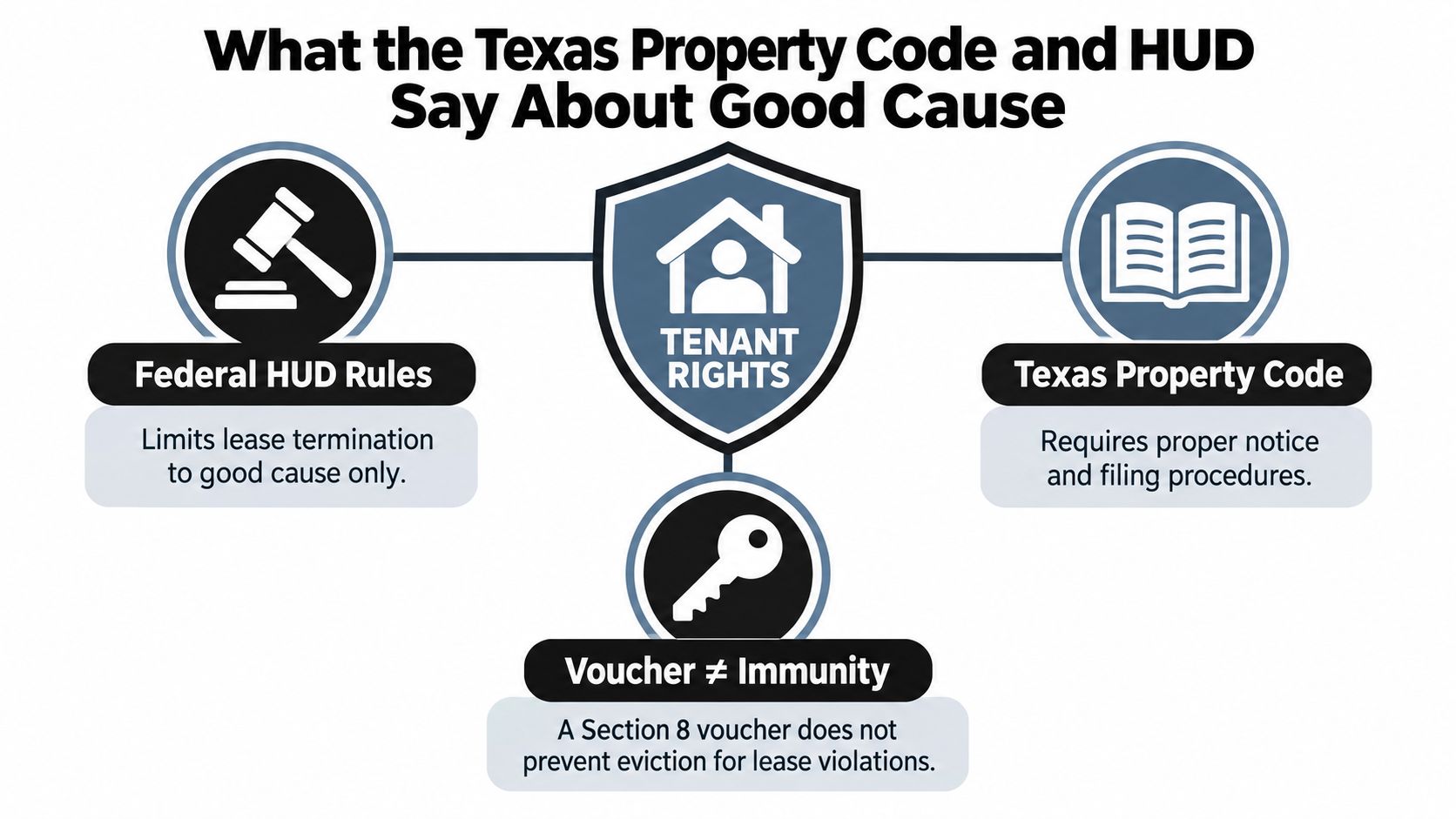
Under 42 U.S.C. § 1437f(o)(7)(C), an owner generally may not terminate a Section 8 tenancy during the lease term without good cause. Recognized grounds include a serious or repeated lease violation, a violation of applicable federal, state, or local law, or another qualifying reason. This federal court discussion of Section 8 termination protections explains the federal protection.
During the initial lease term, “other good cause” generally must arise from something the tenant or household did or failed to do. A landlord usually cannot end a new tenancy just because the owner prefers another renter, wants a different business arrangement, or dislikes the tenant.
Which reasons may support termination?
HUD regulations identify several possible categories:
- Serious or repeated lease violations, including conduct that materially breaches the rental agreement.
- Violations of applicable law connected to the tenant's occupancy or use of the unit.
- Criminal activity or alcohol abuse covered by the applicable federal rules.
- Other good cause, subject to the lease's timing and any stronger state or local tenant protections.
The analysis can change after the initial lease term. HUD rules may recognize a tenant's refusal to accept a new lease or lease revision as a possible reason. They may also recognize business or economic reasons, such as selling or renovating the property or seeking higher rent, as possible “other good cause” after the initial term. State and local law may limit those grounds. Federal rules do not remove more protective tenant rights.
Consider a midterm notice stating that the owner plans to sell. The tenant should check whether the initial lease term remains active and whether the notice identifies a reason permitted at that point. If the lease has ended, the legal analysis changes, though the landlord still must follow the lease, HUD requirements, and Texas eviction procedure.
Federal protection and Texas procedure work together
The Texas Property Code controls important parts of the eviction process, including notice and court filing requirements. It does not replace federal good-cause protections, while HUD rules do not eliminate every Texas procedural requirement. Review the notice with the lease, HUD tenancy addendum, and these Texas Property Code provisions affecting tenant rights.
The written notice should identify the claimed grounds with enough detail for the tenant to understand the allegation and prepare a defense. HUD materials also indicate that conduct may qualify as “other good cause” only when the owner previously gave written notice that the conduct could later support termination. A landlord generally cannot rely on conduct that was never identified as a possible termination basis in the required manner.
Access disputes require the same careful review. The discussion of A Landlord's Right to Enter in Texas addresses landlord access and a tenant's quiet enjoyment. An entry dispute may not independently defeat an eviction, but related messages can support a defense when they reveal inadequate notice, harassment, retaliation, or the landlord's actual reason for acting. Keep the federal good-cause question and the Texas procedure question in the same file, then test each part of the notice against the rule that governs it.
Separating PHA Voucher Termination From Landlord Eviction
A tenant can receive a PHA notice threatening the Housing Choice Voucher while also facing a landlord's lease-termination notice or eviction lawsuit. Treat those as two separate legal tracks. The PHA controls the subsidy decision. The private landlord controls the lease decision. Different rules, deadlines, evidence, and hearing forums apply, as explained in this overview of the Section 8 Housing Choice Voucher process.
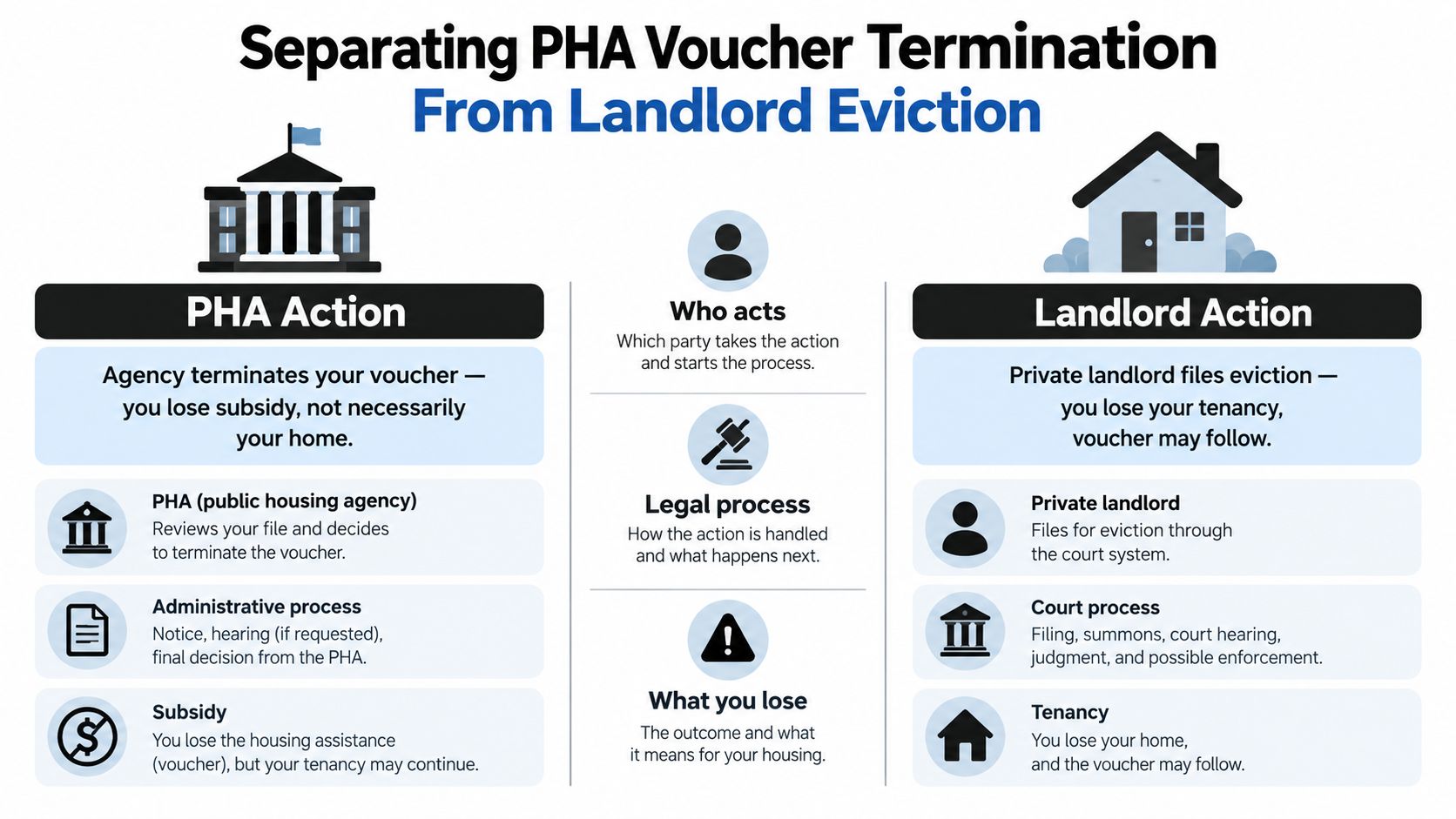
Start by identifying which decision-maker sent each notice. The PHA might cite alleged misconduct, a reporting problem, an income calculation, or another program concern. The landlord might allege nonpayment, a lease violation, or the end of the tenancy. A problem in one proceeding does not automatically decide the other.
If the PHA is threatening your voucher
Preserve the PHA's written notice, envelope, email, and delivery record. Follow the hearing or review instructions printed on the notice. HUD materials commonly allow roughly 10 to 14 days to request an informal hearing or review, but the deadline stated in your notice and the local PHA's policy control.
Build the hearing file around the allegation. Include the notice, the evidence the PHA relied on, and documents that correct inaccurate rent or income calculations. Add records explaining disputed household members or conduct, along with mitigation or disability-related information when relevant. Request the evidence before the hearing, then compare the alleged conduct with 24 C.F.R. §§ 982.552–.553 and the PHA's administrative plan.
The hearing officer should determine whether the PHA followed federal regulations, applicable law, and its own policy, then issue a written decision. Preserve your written response and every document you submit.
If the landlord is pursuing eviction
A landlord-filed eviction proceeds separately in justice court. You must answer that lawsuit, present supported defenses, and attend the hearing. Requesting a PHA hearing challenges the assistance decision. It does not automatically pause a landlord's forcible-detainer case.
The reverse is also true. If the PHA continues your voucher after its review, that result does not dismiss a pending eviction alleging a lease violation. You still must defend the court case. If the PHA ends assistance, that decision alone does not prove the landlord lawfully terminated the lease or may remove you.
Property managers handling different rental models face separate duties as well, including property management for Airbnb hosts. That resource addresses a different housing context, but the distinction remains useful: the person managing a property may not be the legal decision-maker controlling a subsidy.
Use two folders, not one. Place PHA notices, hearing requests, evidence, and decisions in one folder. Keep the lease, landlord notices, court papers, and filed answer in the other. Mark every deadline, submit the PHA request before its stated cutoff, and respond to the justice court case on time. A strong defense on one track cannot repair a missed deadline on the other.
Auditing Your Eviction Notice for Procedural Defects
A notice arrives accusing you of nonpayment or another lease violation, while your voucher paperwork points to a separate PHA decision. Treat those documents as different problems. Start a notice-and-causation audit of the landlord's case. Confirm the alleged reason, the information provided, the delivery method, and the time allowed before the landlord filed in justice court. A Section 8 voucher does not replace these checks, and a defective landlord notice does not automatically reverse a PHA termination.
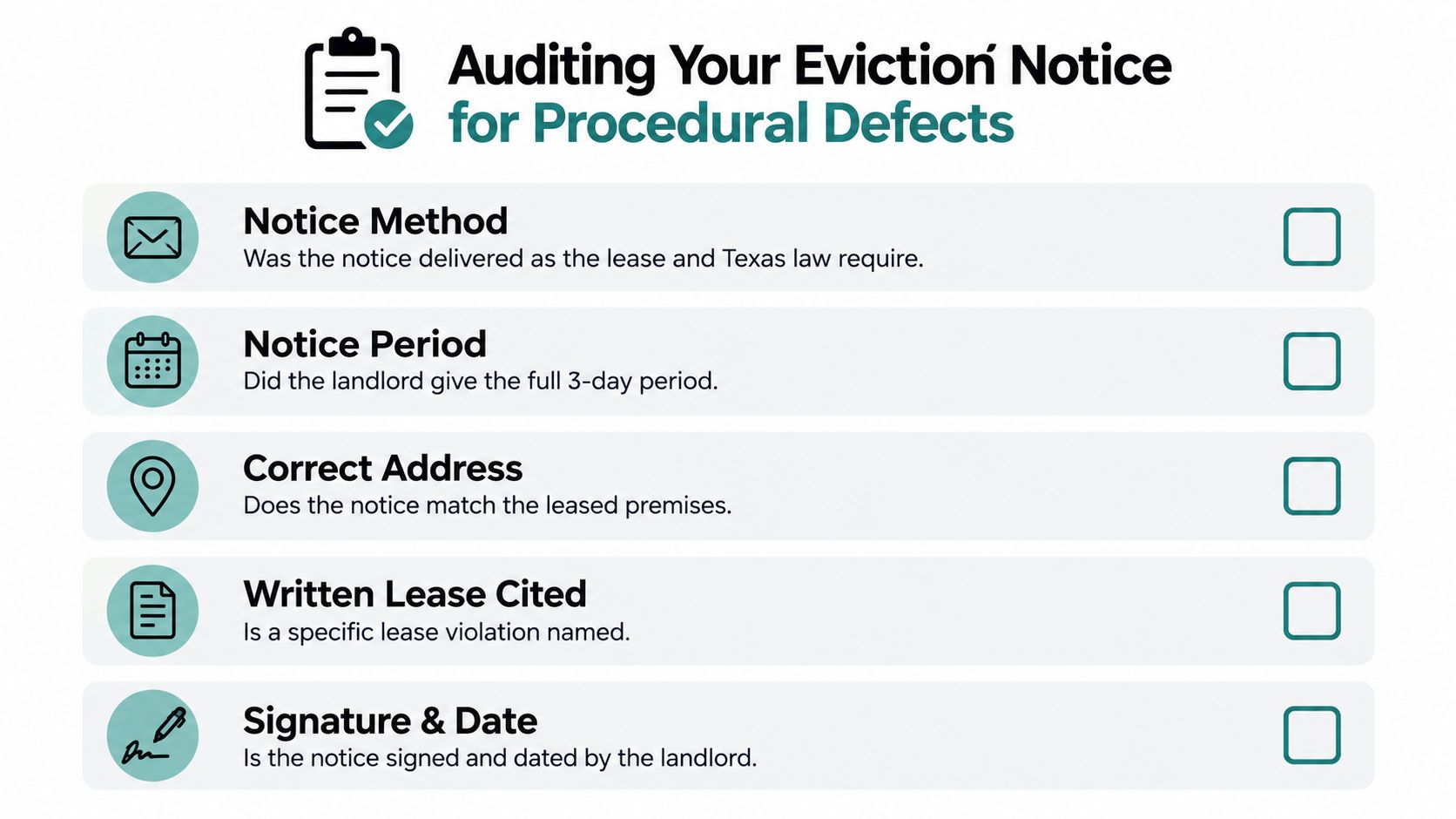
Texas Property Code § 24.005 generally requires at least three days' written notice to vacate before a landlord files a forcible-detainer lawsuit for default or remaining after the rental term ends, under the Texas statutory notice provision. The written lease may require a shorter or longer period. Compare the notice with the lease, HUD tenancy addendum, and any housing-assistance documents. Those papers may impose different duties on the landlord and the PHA.
Run the audit in order
Identify the alleged cause first. Determine whether the landlord claims nonpayment, a lease violation, criminal or nuisance conduct, or expiration of the rental term. A notice that says only “violation” may leave you unable to identify the conduct, lease clause, or facts you must defend.
Compare the dates. Record when the notice was delivered and when the landlord filed the lawsuit. If the lease requires more time than the statutory default, the filing may have been premature. That issue can support a procedural defense or delay the case, although it does not erase an unpaid balance or resolve the alleged violation.
Check delivery carefully. Compare the delivery method with the lease and Texas law. Keep the envelope, photograph any posting, and record the date and location of delivery. Delivery disputes often depend on small factual details, so make those records while the events are fresh.
Read the lease and HUD addendum together. Look for a cure opportunity, a specific notice period, or a required description of the breach. HUD materials state that a termination notice for other good cause ordinarily requires at least 30 days' notice under the cited HUD rules. Project-based HUD-assisted housing generally also requires written grounds detailed enough for the tenant to prepare a defense. Compare those federal requirements with the Texas notice-to-vacate requirements under Section 24.005.
Look for missing information
Check whether the notice identifies the specific lease provision, correct unit address, termination date, and factual basis for the claimed breach. A landlord may have difficulty relying on conduct that was never identified as a terminating violation. For Section 8 housing, determine whether the landlord provided the notice to the PHA when required and whether the notice satisfies both the lease and HUD tenancy addendum.
Federal voucher guidance generally requires a midterm eviction notice to specify the grounds at or before the eviction proceeding. That requirement concerns the landlord's eviction track. It does not decide whether the PHA properly terminated assistance, so preserve defects in both records.
A defect does not guarantee dismissal. The court may allow the landlord to correct the notice and start again. Raising the issue can still prevent an immediate judgment, create time to address payment or accommodation issues, and expose a weak causation theory. Bring the notice, lease, addendum, delivery evidence, and PHA correspondence to court.
Building Your Courtroom Defense Strategy
The landlord says you violated the lease, while the PHA says your assistance is ending. Those papers may arrive close together, but they are not the same case. A courtroom defense must address the landlord's eviction theory and the PHA's assistance decision on separate tracks, using the timeline and documents for each.
Start with the landlord's stated cause. A nonpayment claim calls for payment records, subsidy notices, rent ledgers, and messages about disputed amounts. A lease-violation claim requires closer examination of the clause involved, whether the conduct was material, and whether the lease or HUD rules required notice or an opportunity to cure. Do not assume that a PHA termination proves the landlord's claim. The landlord still must establish the basis for eviction under the lease and applicable rules.
Keep a second file for the PHA. Preserve the PHA termination notice, hearing instructions, correspondence, submitted materials, and any records showing how the agency calculated or reviewed assistance. Compare the dates and stated reasons with the landlord's notice. If the explanations differ, identify the difference in writing. A defect in one track does not automatically resolve the other, so raise each issue in the proceeding where it belongs.
Build a record a judge can follow
Organize documents by date, with the most important pages marked. A judge should be able to understand the sequence without sorting through an unmarked phone full of screenshots.
- Lease documents: Bring the signed lease, HUD tenancy addendum, renewal paperwork, and written revisions.
- Payment evidence: Include receipts, bank records, ledgers, PHA calculations, and messages about rent or subsidy amounts.
- Condition records: Preserve repair requests, inspection reports, photographs, code complaints, and work-order responses.
- Notice records: Bring every notice, envelope, posting photograph, email, and delivery message from the landlord or PHA.
- Communication history: Preserve messages showing what each decision-maker knew, when they knew it, and how you responded.
Use a tenant documentation checklist for a Texas eviction defense to identify missing records. Bring a focused packet, not a disorganized archive.
Match each defense to the evidence
Texas Property Code § 92.331 creates a retaliation defense when a tenant reports repairs, housing-code violations, utility problems, or other legal concerns and then receives termination papers. The statute covers specified good-faith actions, including giving repair notice, seeking a legal remedy, complaining to a governmental code-enforcement body or qualifying organization, and participating in a tenant organization. Review the Texas retaliation provision in Section 92.331 with counsel.
Timing supports the argument, but the documents must connect the protected complaint to the later action. Show the repair complaint, inspection response, photographs, and notice. Address legitimate grounds directly, including rent delinquency, intentional damage, threats, or material lease breaches.
Reasonable accommodation evidence becomes central when an alleged violation relates to a disability, disability-related conduct, or a need for a modified process. Preserve documentation you are legally able to share, accommodation requests, and responses. Limit sensitive disclosures to the appropriate legal or agency process.
Finally, separate your conduct from that of household members or guests. Identify who allegedly acted, what evidence supports the accusation, whether it relates to the tenancy, and whether the landlord followed the HUD addendum.
When to Seek Legal Counsel and Protect Your Housing
A landlord may pursue eviction while the PHA separately considers ending your voucher assistance. Those proceedings involve different decision-makers, documents, deadlines, and defenses. Your response should account for both. The result may depend on whether the initial lease term has ended, which party acted first, what each notice says, and whether the alleged conduct is supported by reliable evidence.
Seek legal help promptly if a notice is vague, the landlord threatens to lock you out, the PHA sets a hearing deadline, or a justice court case has been filed. Get immediate guidance if the landlord alleges criminal activity, serious property damage, repeated disturbances, or conduct involving a household member or guest.
Warning signs that call for quick action
Legal review is especially important when:
- Two notices arrive: The PHA sends one notice and the landlord sends another.
- The dates conflict: The landlord's termination date falls during the initial lease term or before the required notice period ends.
- The reason changed: The landlord gives one explanation informally and a different explanation in writing.
- You recently complained: Repair requests, code complaints, utility disputes, or accommodation requests came before the termination.
- The allegation is unsupported: The notice relies on rumors, a vague accusation, or an incident you believe involved someone else.
- A court case is pending: You received a citation, petition, or hearing notice from a justice court.
An attorney can compare the lease, HUD addendum, landlord notice, and PHA correspondence. Counsel can organize PHA records, examine notice and service, prepare a court answer, and match each defense to supporting evidence. A lawyer may also communicate with the landlord or property manager if negotiation could resolve the dispute without surrendering important rights.
If the PHA proposes to end assistance, request the hearing before the deadline printed on the notice. If the landlord files an eviction, handle that case separately. File the written answer, appear as required, and tell the court about the PHA proceeding. Do not assume that a PHA hearing automatically pauses the landlord's case, or that an eviction court can decide every voucher issue.
Keep copies of every notice, complaint, response, filing, payment record, and document you submit. Request written decisions. If you reach an agreement, confirm what happens to the tenancy, voucher, rent balance, notices, and court case. A verbal promise may leave you unprotected if the parties later disagree.
The Law Office of Bryan Fagan, PLLC offers guidance on Texas evictions, lease disputes, retaliation claims, and Section 8 matters, including notice review and preparation for landlord or PHA proceedings. If you need help protecting your tenant rights, contact The Law Office of Bryan Fagan, PLLC to schedule a free consultation and discuss your situation with a Texas landlord tenant lawyer.