Dealing with a landlord dispute or eviction can be stressful, especially when a short notice on your door appears to leave you only a few days to respond. A renter in Houston, Dallas, San Antonio, or anywhere else in Texas may receive a three-day notice and assume the landlord can file immediately. That assumption can be wrong when the home sits on a federally connected property.
The CARES Act thirty-day notice for a covered property in Texas adds a federal layer to the ordinary Texas eviction process. The original federal filing moratorium ended in 2020, but whether the separate thirty-day notice requirement continues to apply remains disputed. This guide explains the issue in plain English for tenants, landlords, and property managers, including how federal coverage interacts with the Texas Property Code and Chapter 24 eviction procedures.
When a Federal Notice Overrides a Texas Eviction Timeline
In October 2020, a Houston tenant found a three-day notice taped to her apartment door. She believed the landlord could file an eviction case as soon as those three days passed and that she might be locked out by the weekend. The property manager, however, later discovered that the apartment building had a federally backed mortgage. That fact changed the notice analysis.
Texas generally allows a landlord to give at least three days' written notice before filing a forcible-detainer case when a tenant defaults or holds over, unless the lease provides a different period. But Section 4024 of the CARES Act may require a landlord to provide at least thirty days' notice for a qualifying covered property. The federal rule can therefore displace the faster state timeline when the property falls within the federal definition. The Texas eviction process for landlords still matters, but it has to be read alongside the federal protection.
What preemption means in everyday language
“Preemption” sounds technical. In practice, it means a federal rule can set a longer minimum period than Texas law would otherwise require. A landlord can't use the shorter Texas period if federal law protects the rental unit and requires more time.
The clock also shouldn't be confused with a rent grace period. A lease may give a tenant time to pay before a default occurs, while a notice to vacate gives the tenant time to surrender possession after the landlord has decided to terminate the tenancy. Those are separate questions. A landlord must identify the correct lease and statutory requirements before calculating the deadline.
The original federal moratorium applied from March 27 through July 24, 2020, a period of 120 days. After that moratorium ended, Section 4024(c) included a separate notice provision. The Texas State Law Library says the continuing application of that notice requirement remains legally disputed, while Texas legal guidance identifies it as an important issue for qualifying properties. That uncertainty is why a tenant shouldn't assume a three-day notice is valid, and a landlord shouldn't assume the federal question disappeared when the moratorium ended.
Practical rule: Before filing, identify both the ordinary Texas notice period and the property's possible federal coverage. The longer applicable protection is the safer starting point.
What Counts as a Covered Property Under Federal Law
A covered property isn't limited to a traditional public-housing project. Under 15 U.S.C. § 9058, the analysis can reach rental housing connected to federal programs, qualifying assistance, or federally backed mortgage financing. A privately owned Texas apartment building may still qualify even when the lease never mentions the CARES Act. The federal statute is available through the United States Code text of 15 U.S.C. § 9058.
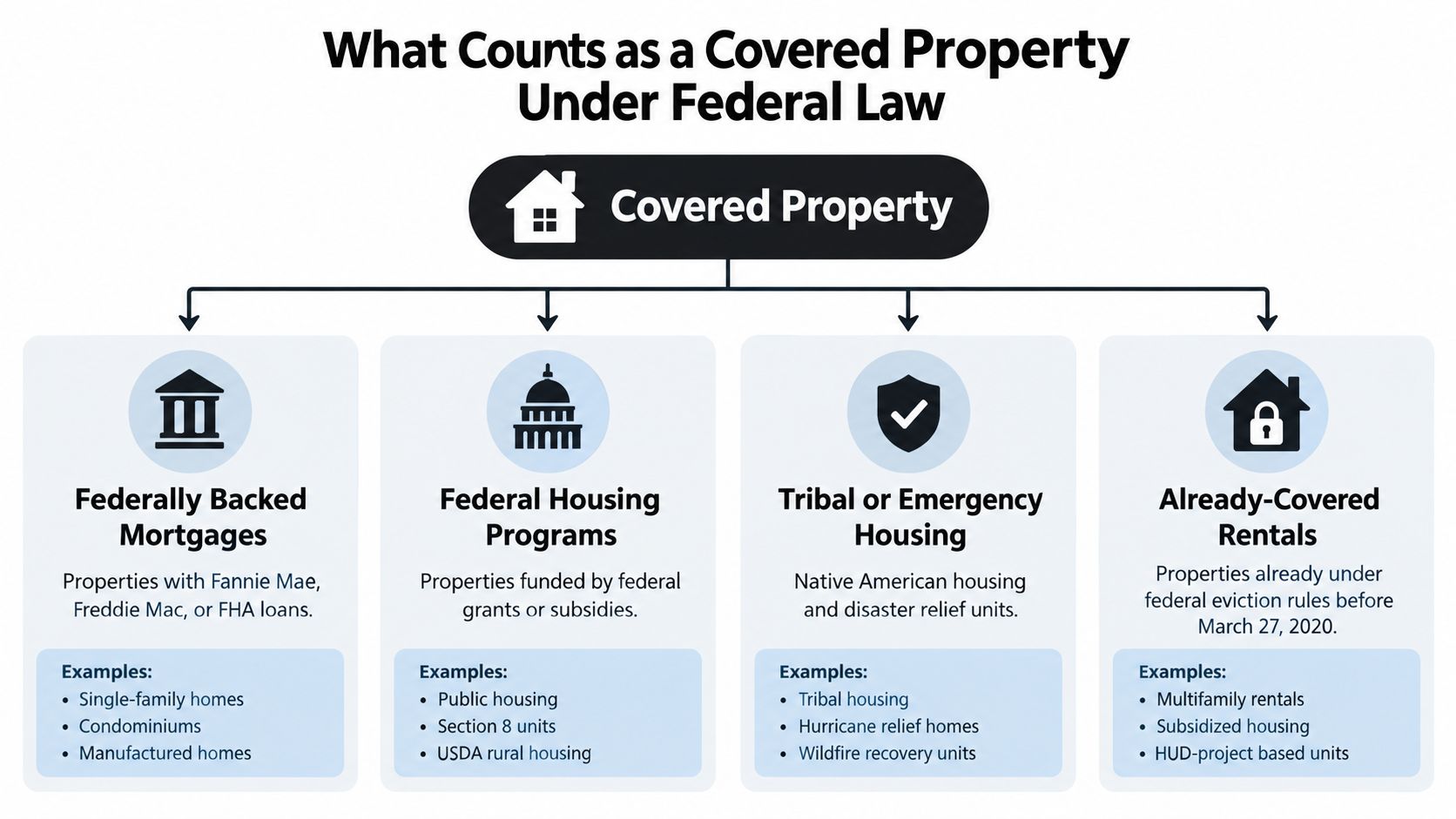
Four common coverage groups
Federally connected mortgages can be the hardest category to recognize. Texas legal guidance identifies qualifying federally backed mortgage categories associated with HUD, the Department of Veterans Affairs, the Department of Agriculture, Fannie Mae, and Freddie Mac. A landlord may need to review loan documents, servicing records, or lender certifications instead of relying only on the lease.
Federal housing assistance is another major group. This can include Section 8 or Housing Choice Voucher properties, project-based federal assistance, and related federally supported rental programs. The subsidy arrangement may involve the property, the tenant, or both, so the landlord should review the program documents.
Low-Income Housing Tax Credit developments may also fall within the covered-property analysis. LIHTC housing isn't always operated like public housing, but its federal connection can affect the notice question.
Public housing operated by a housing authority is the most familiar example. Program rules may create additional termination and notice requirements beyond the CARES Act issue.
For Texas property managers, rural housing connected to USDA programs and multifamily buildings with qualifying federal financing deserve particular attention. Check the loan file, subsidy agreements, voucher records, and property participation documents before serving a short notice. Keep those records with the lease and rent ledger.
A holdover or abandonment dispute raises a separate possession question. Abandoned Property and Holdover Tenancies in Texas addresses how Texas handles tenant property left behind and holdover situations, but it doesn't eliminate the need to analyze federal coverage before pursuing possession.
The Two-Stage CARES Act Protection Explained
The CARES Act protection had two distinct stages, and confusing them causes many notice disputes.
The first stage was a temporary filing moratorium. For covered dwellings, from March 27 through July 24, 2020, the lessor generally couldn't initiate an eviction for nonpayment of rent or other charges and couldn't impose late fees, penalties, or similar charges tied to that nonpayment. The moratorium lasted 120 days. The statute included limited exceptions involving conduct such as criminal activity or property damage, but the central protection was a temporary restriction on covered nonpayment filings.
The second stage was different. After the moratorium ended, the lessor couldn't require the tenant to vacate until at least thirty days after providing a notice to vacate. That provision wasn't just an extension of the moratorium. It created a separate notice question for covered properties.
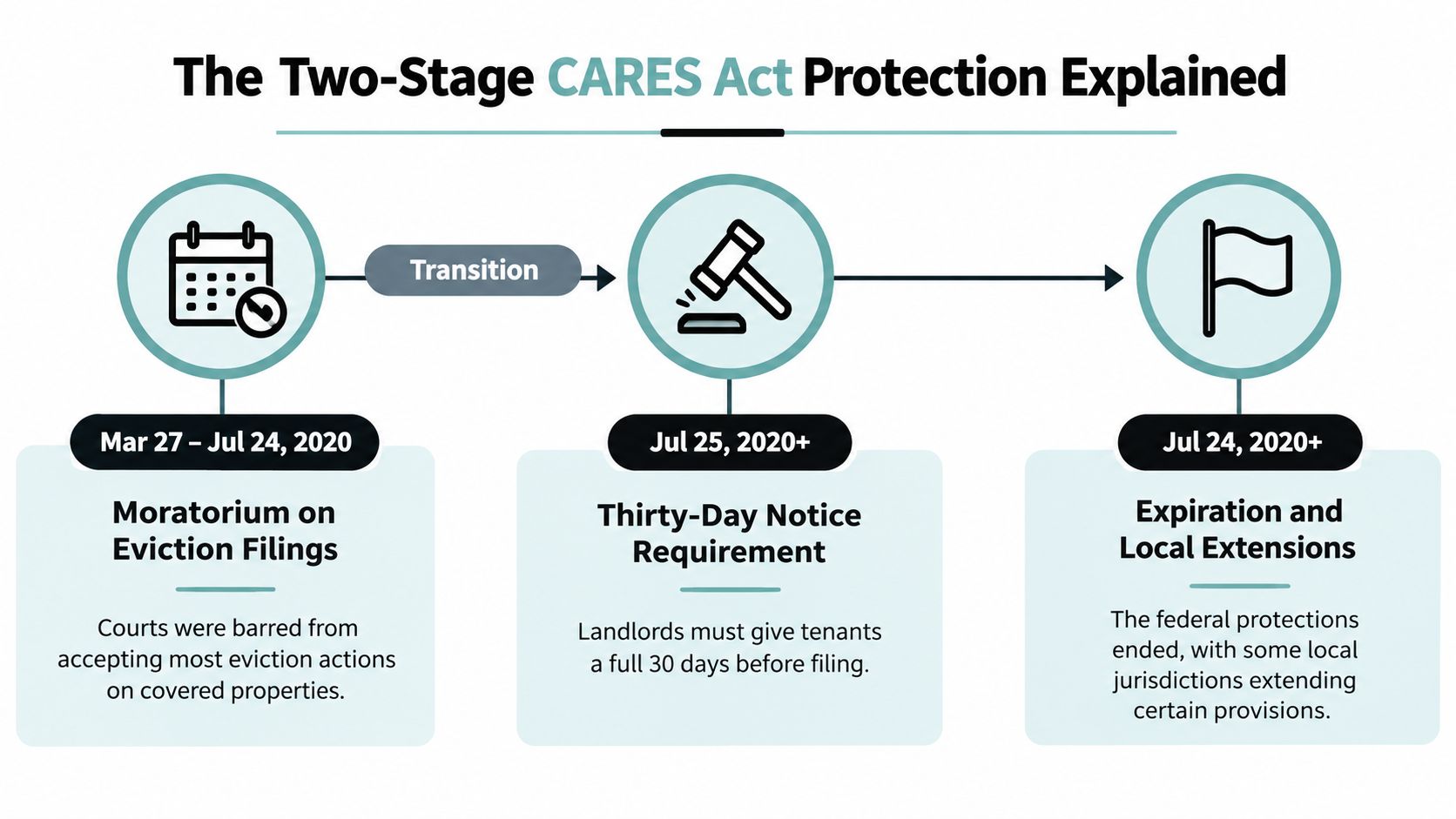
The timeline in plain English
| Period | Main protection | Practical meaning |
|---|---|---|
| March 27 through July 24, 2020 | 120-day filing moratorium | A covered-property landlord generally couldn't initiate a covered nonpayment eviction during the moratorium. |
| After July 24, 2020 | Separate thirty-day notice language | A covered-property tenant may have to receive at least thirty days' notice before being required to vacate. |
| Current disputes | Continuing enforceability is contested | Authorities and courts have disagreed about whether Section 4024(c) independently remains enforceable after the moratorium. |
The distinction matters because the filing ban expired, but the notice language didn't include a sunset date. The Texas State Law Library notes that the moratorium expired while the separate notice issue may continue. The Congressional Research Service discussion of Section 4024 explains the original two-stage framework and the post-moratorium notice issue.
A landlord should treat the coverage question as a legal compliance issue, not as a historical footnote. A tenant who receives a short notice should preserve it and investigate whether the rental unit qualifies.
Texas Notice Rules and How They Interact With the CARES Act
Texas Property Code § 24.005 generally requires a landlord to give at least three days' written notice before filing a forcible-detainer case when the tenant defaults or holds over. A written lease can provide a shorter or longer period. The Texas notice-to-vacate requirements under Section 24.005 should therefore be read together with the lease and any applicable federal rule.
The CARES Act doesn't replace Texas procedure in every rental. It operates as a federal overlay for a covered dwelling. If the property isn't covered, the Texas statutory default or lease period generally controls. If the property is covered, the federal thirty-day floor may control instead of a shorter three-day period.
| Element | Texas 3-Day Notice, Prop. Code § 24.005 | CARES Act 30-Day Notice, Section 4024 |
|---|---|---|
| Trigger | Default, nonpayment, or holdover, unless the lease changes the period | A qualifying covered dwelling and a termination requiring notice |
| Property scope | Texas rental property generally | Covered property connected to specified federal programs, assistance, or federally backed financing |
| Written notice | Required before a routine forcible-detainer filing | At least thirty days' notice may be required before the tenant can be required to vacate |
| Service | Personal delivery, permitted posting, or mailing under Texas law | Federal timing applies, while Texas delivery rules help establish valid service |
| Controlling period | Three days only when no longer lease or federal period applies | The longer federal period may control for a covered property |
Three practical outcomes
For a non-covered property, a valid lease clause or the Texas three-day default may govern. For a covered property during the disputed federal notice period, relying on only three days creates a substantial defense risk. For a later filing, the landlord still needs to evaluate the federal issue because the moratorium's expiration doesn't automatically resolve the separate notice language.
Texas delivery law matters in every situation. Section 24.005 permits personal delivery to the tenant or to a person at least 16 years old who resides at the premises, delivery by affixing the notice to the inside of the main entry door, or mailing it to the premises by regular, registered, or certified mail with return receipt requested. Preserve proof of the method and date.
Drafting and Serving a Compliant Thirty-Day Notice
A notice should make the deadline understandable to someone reading it at the kitchen table. On a potentially covered property, the document should identify the tenant, rental address, basis for termination, requested surrender date, and the federal notice issue. The landlord or authorized agent should sign and date it.
The landlord should take these steps:
- Confirm the property status. Review financing documents, subsidy agreements, program records, and the lease file.
- Identify the default. State whether the issue involves nonpayment, another lease violation, or a holdover.
- Calculate the deadline. Give at least the applicable federal period if the property qualifies. Use the provable service date as the starting point and don't file before the required period has run.
- Choose a permitted delivery method. Texas law recognizes personal delivery, delivery at the premises to a suitable resident, posting at the main entry door, and mailing by an authorized method.
- Preserve the evidence. Keep the notice, photographs, mailing records, tracking information, and a service declaration.
Certified mail often creates a clearer paper trail because the landlord can retain the mailing receipt, tracking record, and return information. Posting can also be permitted, but a photograph alone may not answer every question about when, where, and by whom the notice was affixed. Resources covering broader eviction notice tips for landlords can help with general drafting organization, but federal coverage still requires Texas-specific legal review.
A simple adaptable paragraph
The landlord demands that the tenant surrender possession of the rental premises at [address] after the lease violation described above. Because the premises may constitute a covered dwelling under Section 4024 of the CARES Act, the tenant is provided at least thirty days' notice to vacate, with surrender required no earlier than [date]. If the tenant doesn't surrender by that date, the landlord may pursue available legal remedies.
This is a starting example, not a universal form. The notice should match the lease, the actual default, and the property's legal status. The Notice to Vacate: Requirements and Timing covers what a valid Texas Notice to Vacate must contain before an eviction can be filed.
A delivery log can be simple:
- Date and time: When service occurred.
- Method: Hand delivery, posting, or mail.
- Recipient or location: Who received it or where it was posted.
- Server: Name and role of the person who delivered it.
- Evidence: Photograph, receipt, tracking record, or signed acknowledgment.
An unverified service affidavit can leave a landlord unable to prove the notice reached the tenant or that the deadline was calculated correctly. That problem can delay or defeat an otherwise valid possession claim.
Real-World Scenarios for Landlords and Tenants in Texas
A Houston-area landlord owns a duplex financed through a qualifying federally backed mortgage. The tenant falls behind on rent, and the landlord serves a three-day notice based on the Texas default. The landlord then files quickly, believing the short state notice is sufficient.
At the Justice Court hearing, the tenant presents the notice and documents showing the property's mortgage connection. The tenant argues that the CARES Act required a longer notice. The judge may dismiss or delay the case, depending on the court's treatment of the disputed federal provision and the evidence presented. The landlord then faces the practical burden of reviewing the property records, correcting the notice, and starting again.
The problem wasn't necessarily the unpaid rent. It was the failure to establish the property's status before serving the notice.
A tenant uses the notice period to create a plan
In San Antonio, a tenant living in a Section 8 voucher unit receives a properly documented thirty-day notice after nonpayment. Instead of ignoring it, the tenant requests the program records, keeps the envelope and notice, contacts rental-assistance resources, and communicates with the landlord in writing.
The tenant secures help with the balance and arranges a move-out if remaining isn't possible. The tenant leaves before a writ of possession becomes necessary and keeps copies of the payment and surrender communications. The longer notice doesn't erase the rent problem, but it gives the tenant time to pursue assistance, negotiate, or obtain advice.
These scenarios show why both sides need documents. A landlord should be able to prove coverage, service, and timing. A tenant should preserve the notice, identify the property's federal connection, and respond in writing rather than relying on an oral conversation.
Documentation, Court Filings, and When to Get Legal Help
A CARES Act notice defense often turns on paperwork. Texas courts have historically required eviction pleadings to address whether the premises were a covered dwelling and whether the landlord provided the required thirty-day notice. Texas Supreme Court emergency-order procedures also required qualifying petitions to state those facts.
Documents landlords should assemble
Keep the signed lease, rent ledger, payment records, financing certifications, subsidy or voucher agreements, notice, delivery proof, and relevant communications together. A coverage file should explain why the property is or isn't federally connected. The landlord should also preserve evidence showing the date of service and how the deadline was calculated.
Documents tenants should preserve
Tenants should save the entire notice, envelope, photographs of posted materials, rent receipts, lease, rental-assistance applications, and messages with the landlord. A tenant who believes financial hardship affected payment should preserve any sworn declarations or written communications describing that hardship. Those documents don't automatically defeat an eviction, but they can help counsel evaluate available defenses and negotiations.
In a Justice Court eviction, a tenant can raise the federal notice issue in a sworn answer or at the hearing, subject to the court's procedures and deadlines. A landlord may respond by arguing that the property isn't covered, that the notice complied, or that the federal provision doesn't apply under the circumstances. The legal treatment has not been uniform, so assumptions about how a particular court will rule are risky.
A short notice, missing proof of delivery, or uncertain federal status is a reason to seek advice before the hearing, not after judgment.
The tenant documentation guide for Texas eviction defense can help renters organize records. Landlords and tenants should seek a Texas landlord tenant lawyer promptly if a hearing is approaching, the notice appears defective, the other side disputes coverage, or the case includes habitability, retaliation, assistance-program, or rent-abatement issues.
Key Takeaways and Next Steps for Texas Renters and Landlords
The central point is simple, even though the legal analysis isn't. A covered property may trigger a thirty-day federal notice floor, while Texas's ordinary rule is at least three days unless the lease changes the period. The original 120-day CARES Act moratorium ended on July 24, 2020, but the separate notice language didn't include a sunset date, and its continuing enforceability remains disputed.
Landlords should use this checklist before filing:
- Verify coverage: Review mortgage, subsidy, voucher, LIHTC, public-housing, and program records.
- Read the lease: Look for a different notice period and identify the actual default.
- Use careful language: State the reason for termination and the earliest surrender date.
- Calendar the deadline: Count from provable service and don't rely on an unverified delivery date.
- Retain proof: Keep the signed notice, photographs, mailing records, tracking, and service declaration.
- Review the pleading: Address federal coverage when the facts make it relevant.
Tenants should take parallel steps:
- Read every notice: Don't assume a three-day deadline is valid.
- Check the property: Ask whether the home participates in a federal program or has qualifying financing.
- Keep all records: Save the lease, notice, envelope, payment history, and communications.
- Respond in writing: Request clarification and preserve evidence of any payment or assistance effort.
- Act before court: If served with an eviction petition, consider a sworn answer and legal advice promptly.
Your tenant rights and property rights both depend on procedure. A landlord may have a legitimate rent claim but still need the correct notice. A tenant may have a federal notice defense but still need to raise it with evidence and within the court's timetable.
If you need help with a CARES Act notice, covered-property analysis, eviction defense, or Texas lease dispute, The Law Office of Bryan Fagan, PLLC offers legal guidance for landlords and tenants, including notice review and preparation for Justice Court proceedings. Schedule a free consultation before the next filing or hearing deadline so you can understand your options and protect your rights.