Skip to content

A restaurant owner arrives before the morning shift and finds the front door lock changed. Inside are the kitchen equipment, payroll records, food supplies, and customer files. A notice mentions unpaid charges, while the landlord is also discussing a lien against property inside the space. The business owner now faces two urgent questions: Can the landlord lock the business out, and can the landlord keep or sell the property?
These questions are related, but they aren't the same. Texas commercial lockout rules appear mainly in Texas Property Code Chapter 93, while commercial landlord lien rights are addressed separately under Chapter 54. A careful analysis must consider the lease, the type of default, the required notice, access to the premises, ownership of the property, and the correct court process.
Navigating Commercial Tenant Lockout and Landlord Lien Challenges
A sudden lockout can stop a retail shop from making sales, prevent an office from accessing records, or leave a warehouse unable to ship inventory. The pressure becomes greater when the landlord claims a lien and threatens to restrict access to equipment, merchandise, files, or property belonging to another company.
Consider a small retailer that disputes a landlord's calculation of common-area maintenance charges. The landlord treats the disputed balance as delinquent rent, changes the locks, and leaves no clear instructions for obtaining a key. The retailer loses access to inventory and business records. Even if money is owed, the landlord's method may still create a Chapter 93 dispute.
The starting point is to separate possession from property enforcement. A lockout concerns whether the tenant may enter the leased premises. A lien concerns whether the landlord has a legally enforceable interest in certain property located there. One remedy doesn't automatically authorize the other.
Practical rule: A lockout doesn't, by itself, answer whether a landlord may hold, remove, or sell business property.
The sections below explain the statutory framework, common lawful and unlawful scenarios, lien enforcement concerns, compliance steps, and the rapid reentry process. Both landlords and tenants should treat the lease as a central document, preserve evidence early, and obtain advice from a Texas landlord tenant lawyer before taking action that could interrupt operations or trigger statutory damages.
Understanding Chapter 93 Key Concepts
A commercial tenant arrives to open for business and finds the locks changed. The landlord says rent is overdue, while the tenant points to disputed CAM charges or other lease accounting. Chapter 93 determines how to analyze the lockout, but the landlord's separate lien rights may affect property inside the premises. Treating those issues as one rule creates mistakes.
Texas Property Code Chapter 93 applies to commercial rental relationships, not residential tenancies covered by Chapter 92. Residential lockout guidance may therefore produce the wrong answer in a business dispute.
Start with five terms:
- Lockout: An intentional act that prevents a commercial tenant from entering leased premises, such as changing the locks or blocking access.
- Delinquent rent: Rent, or part of it, unpaid when due under the lease. Whether CAM, percentage rent, or late fees count depends largely on the lease and the parties' accounting.
- Writ of reentry: A court order that can restore temporary possession after an alleged unlawful lockout.
- Landlord lien: A separate legal interest that may secure rent against qualifying tenant property located on the premises. Commercial landlord lien provisions appear in Chapter 54.
- Distress warrant: A court-related enforcement tool that may be used in pursuing a commercial landlord's lien. It is not another name for a lockout.
Section 93.002 generally limits a landlord's intentional exclusion of a commercial tenant, subject to judicial process and recognized exceptions. Those exceptions include bona fide repairs, construction, emergencies, and delinquency in paying at least part of the rent. If the landlord changes the locks for a rent-related reason, a specific key procedure applies. The landlord or agent must post written notice on the front door identifying who can provide a new key. The key must be available during the tenant's regular business hours, and the tenant must pay the delinquent rent to receive it. (Texas Property Code Section 93.001)
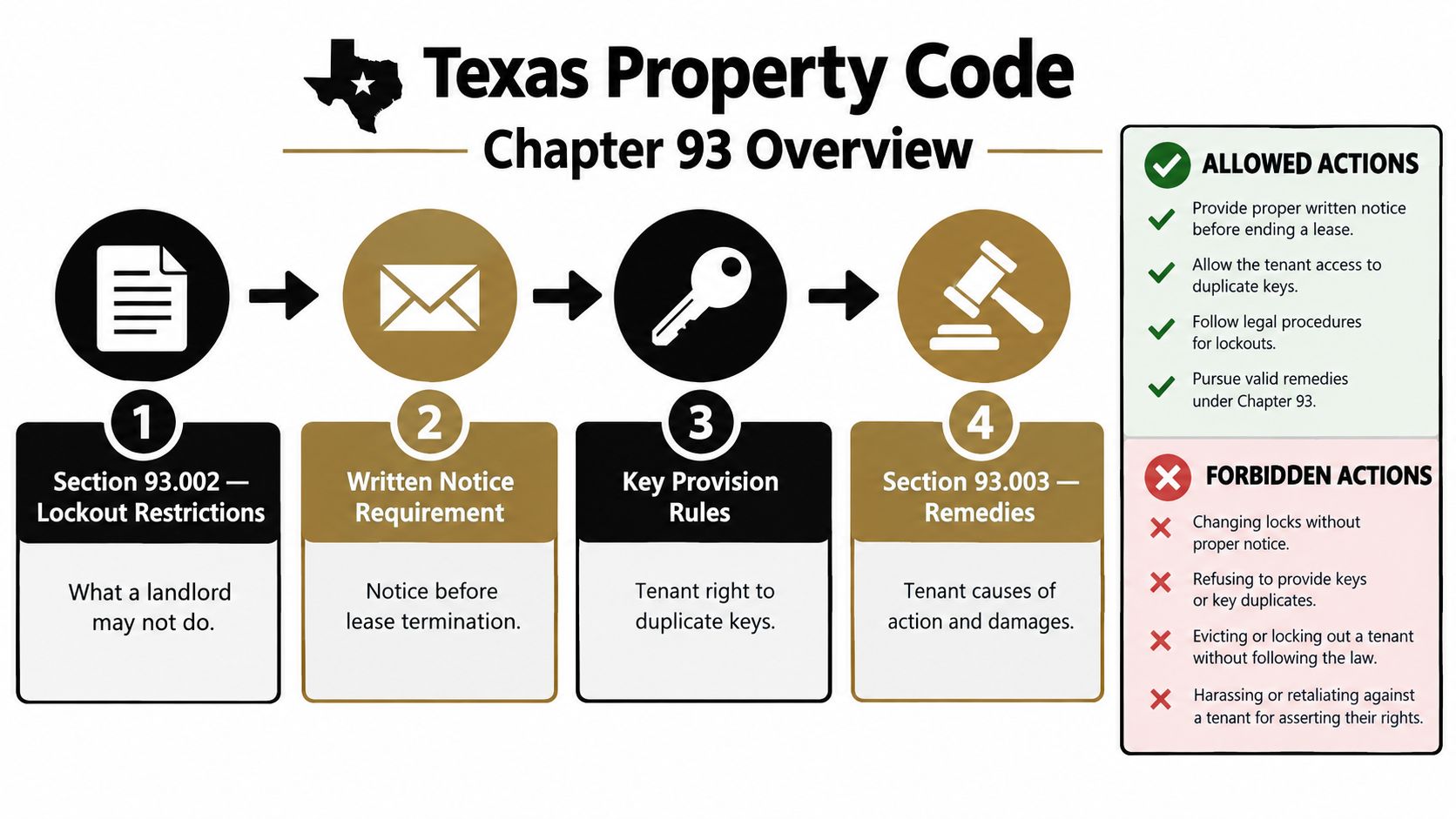
A statutory remedy may apply when the landlord violates the tenant's rights. The tenant may seek actual damages plus the greater of one month's rent or $500, reasonable attorney's fees, and court costs, subject to reductions for delinquent rent or other amounts owed, as noted in Texas Property Code Section 93.001. The lease still matters. Review its default, notice, cure, lien, and access provisions, including amendments and incorporated exhibits. For guidance, see how to read a commercial lease agreement.
Texas Property Code Chapter 93 Overview
Chapter 93 creates two connected but different tracks. Section 93.002 regulates the landlord's conduct, while Section 93.003 gives the tenant a court-based route to regain possession.
Under Section 93.002, the question isn't only whether rent is late. The analysis asks what the lease defines as rent, whether a default exists, whether the lease changes the statutory procedure, and whether the landlord provided the required access instructions after changing the lock. A landlord who follows a qualifying rent-related procedure may have a lawful basis for restricted access. A landlord who skips a required step may face a claim for unlawful exclusion.
Section 93.003 is designed for speed. The tenant must file a sworn complaint for reentry in the justice court serving the precinct where the premises are located. The complaint must state the facts supporting the alleged lockout. If the justice reasonably believes an unlawful lockout likely occurred, the court may issue an ex parte writ of reentry. That writ gives the tenant immediate, temporary possession while the case moves toward a final hearing. (Texas Property Code Section 93.003)
What the writ does
The writ isn't necessarily the final decision. It restores temporary access first, then allows the landlord to request a hearing. Service must be made on the landlord or an authorized operational representative, such as a management company, on-premises manager, or rent collector, using the same method applicable to a writ of possession in a forcible-detainer case.
A tenant preparing for this process should gather:
- The lease: Include amendments, addenda, and provisions defining rent or default.
- Payment records: Preserve checks, transfers, receipts, and account statements.
- Access evidence: Photograph changed locks, blocked doors, posted notices, and business-hour conditions.
- Communications: Save emails, text messages, notices, and requests for a key.
- Operational proof: Document interrupted sales, payroll work, inventory access, customer service, and contractual performance.
For a broader description of how Texas Property Code Chapters 91 through 94 and Chapter 24 govern rental relationships, see Texas Landlord-Tenant Law: An Overview. The overview is useful background, but a commercial lockout still requires close review of the particular lease and facts.
Lawful and Unlawful Lockouts
A tenant arrives before opening time and finds the commercial unit locked. Rent is overdue, but the landlord has posted no instructions and no way to obtain a key. That fact pattern shows why Chapter 93 lockout rules and landlord lien rights must be analyzed separately. The practical question is not only whether access may be restricted, but which rule applies and what the landlord may do next.
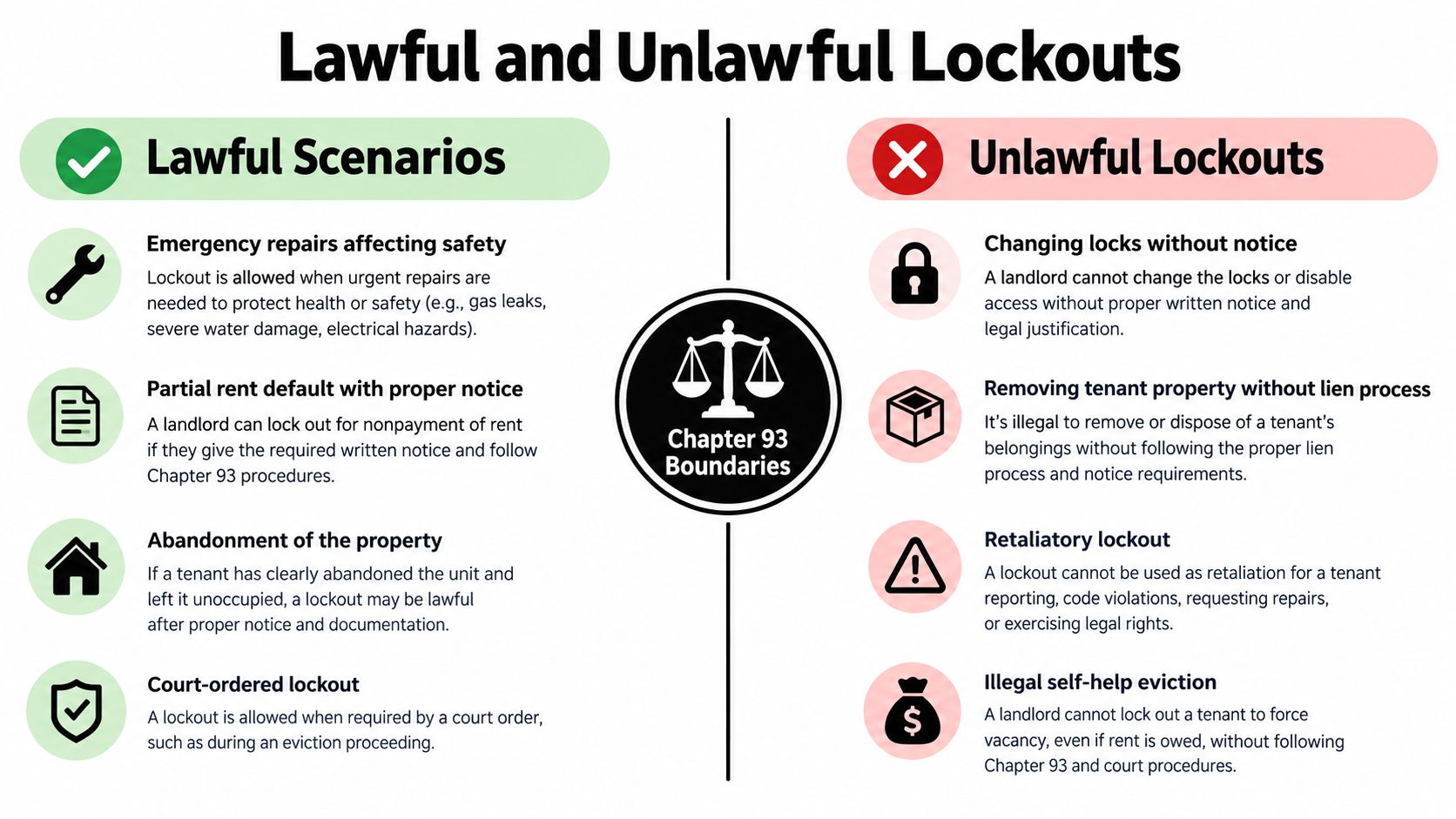
Chapter 93 permits a qualifying rent-related lock change only with specific notice steps. The landlord must place written notice on the tenant's front door, identify the person or company holding the new key, and make that key available during the tenant's regular business hours. The tenant must pay the delinquent rent to obtain it. (Texas Property Code Section 93.002)
Compare the situations
| Situation | Main issue |
|---|---|
| An emergency requires temporary access restrictions | Document the emergency and limit the restriction to the legitimate safety or property concern. |
| Repairs or construction affect entry | Communicate the work and avoid using it as a pretext to exclude the tenant. |
| The tenant is delinquent in part of the rent | Follow the notice and key procedure, then check whether the lease changes those requirements. |
| Locks change without compliant key notice | The tenant may have an unlawful lockout claim. |
| Property is removed or sold after the locks change | Analyze lien authority, ownership, notice, and enforcement procedure separately. |
Unpaid rent does not erase the notice requirement. A missing door notice, unavailable key, or lockout based on a non-rent dispute can change the result when no applicable exception covers the conduct. The tenant may seek possession or terminate the lease, and may pursue actual damages, the greater of one month's rent or $500, reasonable attorney's fees, and court costs, reduced by amounts owed to the landlord (Texas Property Code Section 93.002, cited above).
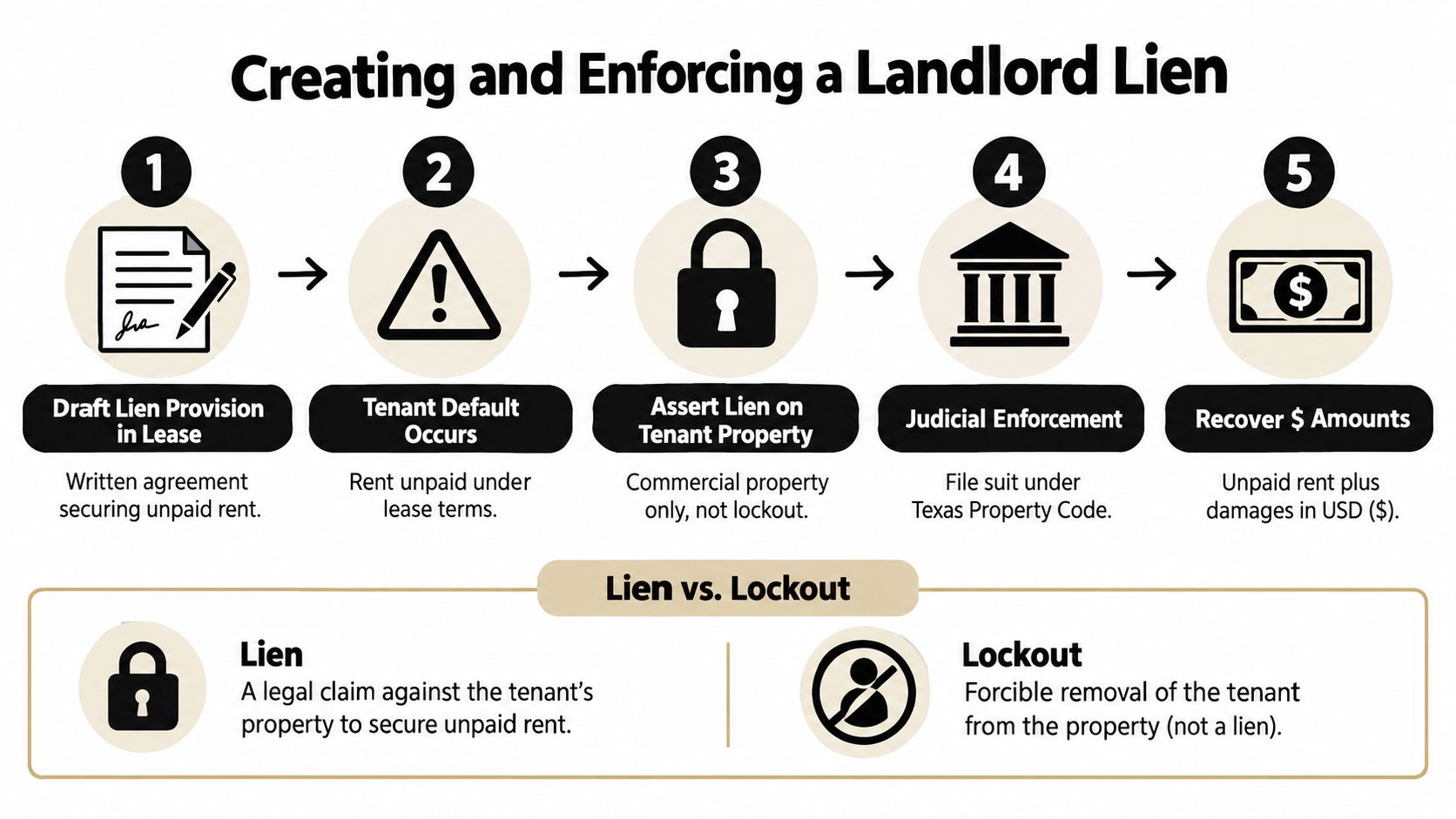
A lien is not the same as a lockout. A lawful lockout does not automatically give the landlord authority to keep, sell, or restrict access to equipment, inventory, records, or other personal property. Conversely, a landlord's belief that a lien exists does not make an otherwise unlawful lockout valid. Treating the two remedies as interchangeable can create separate liability, so each step should be tested against its own legal requirements.
Creating and Enforcing a Landlord Lien
Chapter 54 addresses commercial landlord lien rights over property located on the leased premises. Section 93.002 addresses lockouts for rent delinquency. They serve different functions, and changing the locks doesn't automatically establish authority to keep, sell, or restrict access to equipment, inventory, files, or personal property.
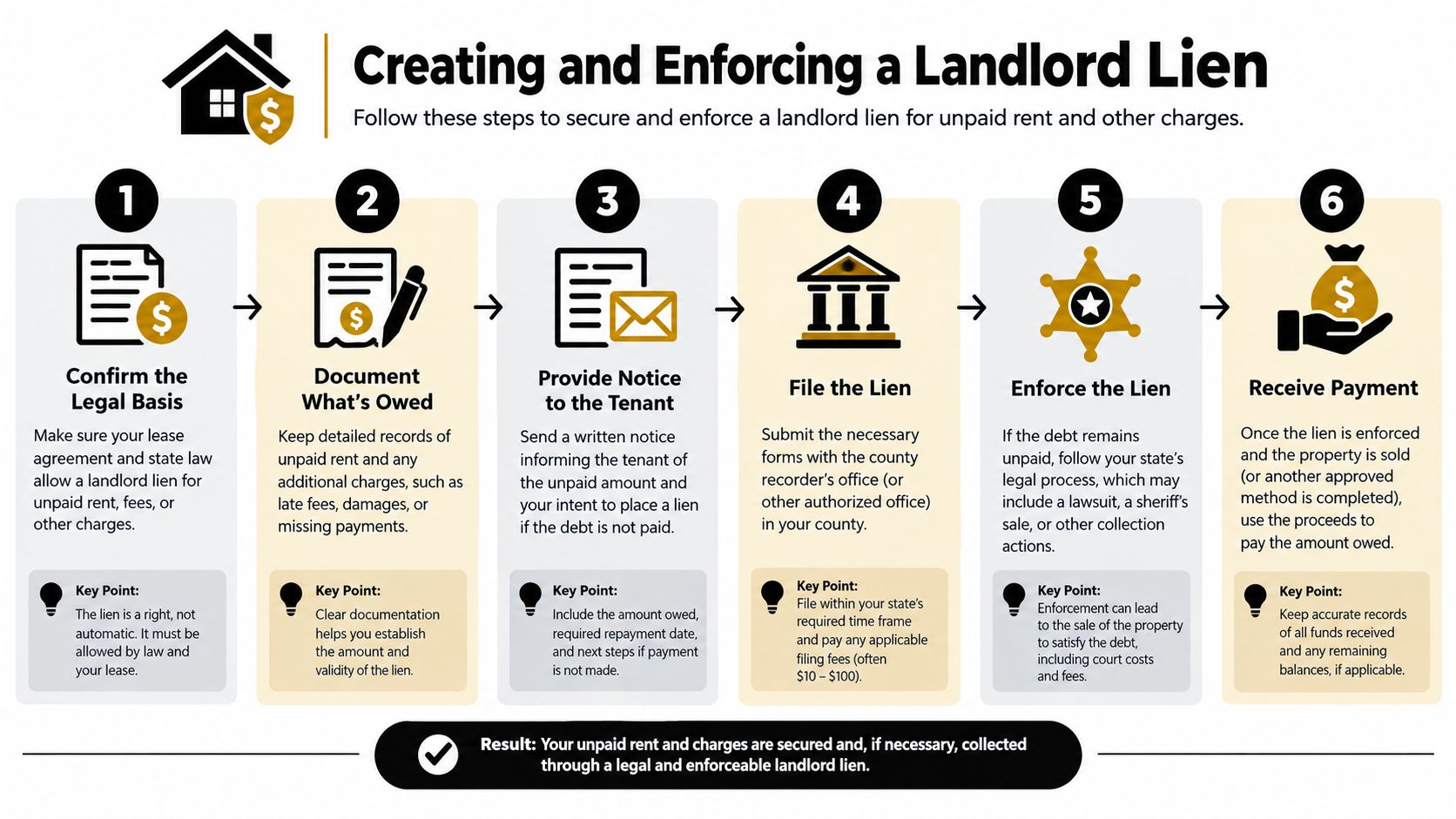
A landlord evaluating a lien should move carefully:
- Read the lease. Identify any lien provision, default definition, notice requirement, waiver language, and rules concerning property left on the premises.
- Identify the debt. Reconcile the amount claimed, including whether the lease treats CAM charges, percentage rent, or late fees as rent.
- Identify the property. Determine what belongs to the tenant, what belongs to vendors or lenders, and what may be excluded from lien enforcement.
- Confirm the enforcement path. Review applicable notice requirements, distress-warrant procedures, contractual terms, and due-process protections before removing or selling property.
- Create an inventory. Photograph and describe items without mixing tenant property with third-party property.
- Preserve access records. Record when access was restricted, who received notice, and whether the tenant requested property access.
The critical question after a lock change is not merely, “Who has the keys?” It is, “What legal authority governs each item inside?” A restaurant's leased ovens may be owned by a finance company. A retailer's inventory may belong to suppliers on consignment. An office's files may contain client property. A landlord's lien analysis must account for those possibilities.
Landlords managing controlled entry may also review a business gate access system as an operational tool for documenting authorized access. Technology can help manage entry records, but it doesn't replace statutory notice, lease compliance, or lien procedure.
Tenants who believe property has been improperly held should preserve ownership records and seek advice about how to release a lien on property. Don't assume that paying some amount, signing an access receipt, or abandoning the premises resolves every lien issue. The correct outcome depends on the lease, the debt, the property's ownership, and the enforcement steps used.
Landlord Compliance Steps
A landlord should treat a lockout as a controlled legal process, not an informal collection tactic. The safest approach begins before the default, with a lease that clearly defines rent, additional charges, notice methods, cure rights, access, and lien provisions.
Start with the lease
Review these questions before sending a notice:
- What counts as rent? Does the lease include CAM charges, percentage rent, late fees, or other amounts in the default calculation?
- What triggers default? Is a payment missed, disputed, or incorrectly credited?
- What notice is required? Check delivery methods, cure periods, timing, and whether the lease modifies Chapter 93.
- What property is covered? Confirm the lien language and consider third-party ownership, lenders, and consignment arrangements.
- What does waiver look like? Review past acceptance of payments, prior notices, and any written agreements that changed the parties' conduct.
A lease may supersede Chapter 93 to the extent of a conflict. That means a landlord shouldn't rely only on a statutory default rule when the contract contains notice-and-cure language or a procedure for reconciling disputed charges. (Texas justice-court training materials)
Reconcile before acting
Disputed CAM, percentage rent, and late-fee calculations deserve a written account statement. Show the charge, the payment received, the credit applied, and the balance claimed. If the landlord accepts a payment but fails to credit it correctly, the resulting default record may become difficult to defend.
If a lock change remains appropriate, prepare the front-door notice, identify the person or company providing the key, and make the key available under the governing statute and lease. Document the posting with photographs and a time-stamped internal record.
For any lien action, separately document the property, ownership information, notices, access requests, and enforcement decisions. A landlord should never treat a lockout as permission to sell property without confirming the lien procedure. The Law Office of Bryan Fagan, PLLC handles lease review, commercial defaults, evictions, and landlord-tenant disputes for parties who need a documented response plan.
Tenant Response and Reentry Process
A commercial tenant facing a lockout should act quickly, but shouldn't damage the lock, force entry, remove property, or create a confrontation. The first task is to build a clean factual record.
Preserve the evidence
Collect the lease and every amendment. Save rent ledgers, payment confirmations, bank records, invoices, and communications about disputed charges. Photograph the door, lock, notice, surrounding area, and any sign showing where a key may be obtained.
Write down the timeline while events are fresh:
- When did the tenant last enter?
- When was access denied?
- Who changed the locks or communicated the decision?
- What notice was posted?
- Where and when was a key supposedly available?
- Was payment demanded, and what amount was identified?
- What business operations were interrupted?
The tenant must file a sworn complaint for reentry in the justice court precinct where the premises are located. The tenant must state the lockout facts under oath. If the justice reasonably believes an unlawful lockout likely occurred, the court may issue an ex parte writ of reentry granting immediate, temporary possession while the dispute proceeds to a final hearing. (Chapter 93 commercial reentry procedure)
The writ must be served on the landlord or a qualifying representative, such as the management company, on-premises manager, or rent collector, using the service method applicable to a forcible-detainer writ. The landlord retains the right to a hearing, so temporary access doesn't necessarily resolve the underlying rent, lease, or lien dispute.
Track the financial remedy
A tenant may pursue actual damages plus the greater of one month's rent or $500, reasonable attorney's fees, and court costs, subject to reductions for delinquent rent or other amounts owed. Keep records of measurable business losses, replacement costs, missed obligations, and expenses caused by restricted access. A commercial eviction attorney can evaluate the reentry process, possession issues, and related lease claims together.
Real World Scenarios and Examples
A useful decision framework begins with the type of problem, not the emotion surrounding it.
A restaurant disputes CAM charges
The restaurant receives an account statement that includes CAM charges it believes were calculated incorrectly. The landlord changes the locks but posts no compliant key notice. The restaurant should preserve the statement, lease, payment history, photographs, and messages requesting access. The disputed calculation may affect whether rent was delinquent, while the missing notice creates a separate Chapter 93 concern.
The landlord should pause any property seizure. Kitchen equipment, food supplies, point-of-sale devices, and records may have different owners and different legal treatment. A lockout dispute shouldn't be allowed to become an unexamined sale of business assets.
A retail shop receives key instructions
A retail tenant is delinquent under the lease. The landlord changes the lock and posts written instructions identifying the person or company from whom a new key may be obtained. The instructions state when the key is available, and the tenant is told that payment of the delinquent rent is required.
That conduct fits the specific statutory lockout-and-key framework more closely than an unexplained denial of access. The parties still need to check whether the lease modifies the procedure and whether the amount claimed is accurate, but the landlord has created evidence addressing a central procedural requirement.
A warehouse landlord moves straight to sale
A warehouse landlord changes the locks and immediately moves tenant inventory toward sale without separately confirming the lien language, notice, property ownership, or distress-warrant requirements. That shortcut creates risk even if rent is unpaid. Inventory may belong to suppliers, lenders, or other parties, and a lien may not cover every item.
The practical dividing line is authority. Possession, access, lien enforcement, and sale each require their own legal analysis.
Landlords should obtain a lease and lien review before removing property. Tenants should avoid self-help and gather ownership documents immediately. A Texas landlord tenant lawyer can help either side choose between reconciliation, negotiated access, reentry proceedings, eviction, or lien litigation based on the actual documents.
Conclusion and Next Steps
Commercial disputes under Chapter 93 are often decided by details that seem small at the door, the wording of a notice, the definition of rent, the availability of a key, or the identity of the person who owns the property inside. The lockout rules and landlord lien rules should be analyzed separately, even when they arise from the same unpaid balance.
Landlords can reduce exposure by reviewing the lease, reconciling disputed charges, documenting notice, preserving access records, and following the correct lien process. Tenants can protect their tenant rights by preserving evidence, avoiding forced entry, filing a sworn reentry complaint when appropriate, and documenting business losses.
If you need help with an eviction, lease issue, or rental dispute, contact The Law Office of Bryan Fagan, PLLC for a free consultation today.
The Law Office of Bryan Fagan, PLLC offers lease reviews, commercial lockout guidance, lien analysis, reentry support, and eviction representation for Texas landlords and tenants. Visit The Law Office of Bryan Fagan, PLLC to discuss your dispute and request a free consultation.