A retail tenant discovers that rent is overdue, the landlord is demanding possession, and the next hearing may occur before the business can relocate its inventory. A commercial landlord, meanwhile, may be carrying unpaid rent, dealing with a vacant space, and trying to avoid a notice defect that sends the case back to the beginning. Commercial eviction Texas disputes move quickly, and the lease often matters as much as the statute.
Texas commercial evictions generally use the forcible detainer process in Texas Property Code Chapter 24, while Chapter 93 addresses important commercial-tenant remedies. The rules differ from residential eviction practice because commercial rental property falls outside the residential framework in Chapter 92. Whether you're a landlord seeking possession or a tenant protecting a business location, the practical priorities are the same: read the lease, preserve evidence, follow notice requirements, and act before a procedural deadline closes.
Facing a Commercial Eviction in Texas
A missed rent payment can become a possession case before the underlying business dispute is resolved. A tenant may contend that defective buildout work, disputed common-area charges, or promised repairs affected the rent. The landlord may read the lease as allowing immediate termination. Both sides can reach justice court while still arguing about what the lease required.
That is the central reality of a commercial eviction in Texas. A forcible detainer proceeding generally determines which party has the right to possess the premises. It usually does not resolve every contract or damages issue between the parties. A tenant seeking construction costs or a landlord seeking broader future losses may need to pursue those claims in a separate court or proceeding.
The process rewards preparation
Texas Property Code § 24.005 generally requires at least three days' written notice to vacate before a landlord files a forcible detainer case, unless the written lease sets a different period. The statute provides the baseline, while the lease may add cure rights, delivery requirements, or other pre-filing conditions.
For a landlord, a complete file can prevent dismissal and avoid restarting the case. For a tenant, the lease and notice may reveal a defense that is not apparent from the demand for possession. Keep the signed lease, amendments, payment records, notices, emails, photographs, and written communications together.
Practical rule: Treat a commercial eviction as a possession case supported by a contract, a notice record, and service documents. Do not assume the justice court will decide every related business claim.
The case may proceed through a justice court hearing, a county-court appeal, and a writ of possession. Texas Justice Court Training Center materials explain that procedural sequence. Statewide landlord and tenant caseload information is also reported monthly from January 2023 to the present through the Texas public court data portal. Those records show that these cases are routine in the court system, not that any particular case is automatic.
A small lease or notice defect can delay possession, increase legal expense, and disrupt a business's ability to operate or relocate. The practical trade-off is direct: careful preparation takes time before filing, but correcting a defective case after filing can cost far more.
Preparing for a Commercial Eviction
The strongest commercial eviction files are built before anyone files in court. Start with the lease, then test the facts against the lease's default and remedy provisions.
Review the lease before sending anything
Look for:
- Default definitions: Identify whether the problem involves unpaid base rent, additional rent, unauthorized use, abandonment, or another violation.
- Cure rights: Determine whether the tenant gets a contractual opportunity to correct the problem and how long that opportunity lasts.
- Notice method: Check whether notice must be delivered personally, by mail, through a commercial delivery service, or electronically when the parties agreed to that method.
- Termination language: Confirm whether the landlord may seek possession without terminating every future obligation under the lease.
- Guaranties and amendments: Include documents that may change payment duties or notice rights.
A practical guide to reading a commercial lease agreement can help identify these provisions, but a Texas landlord tenant lawyer should review unusual language before a landlord relies on it.
Build the evidence file
A landlord should preserve the payment ledger, invoices for additional charges, inspection records, photographs, prior warnings, and proof of delivery. A tenant should preserve cancelled payments, repair requests, landlord promises, records of denied access, and communications about disputed charges.
The next question is whether the lease requires a cure notice before the statutory notice to vacate. The three-day period is a statutory baseline, not a universal commercial deadline. If the lease provides a longer notice period or requires a specific sequence, following only the statute can produce an avoidable challenge.
The Notice to Vacate: Requirements and Timing resource addresses what a valid Texas notice must contain before an eviction can be filed. The notice should identify the premises, state the demand clearly, provide the applicable deadline, and follow the delivery method required by law and the lease.
Confirm the filing location
Commercial forcible detainer cases are typically filed in the justice court precinct where the property is located, making local venue and procedural timing important. Before filing, confirm the property address, precinct, tenant's legal name, registered-agent information when applicable, and the correct person or entity entitled to possession.
A tenant who receives a notice shouldn't wait until the hearing to inspect these details. A landlord who files before the lease deadline expires may face delay, added expense, or a new notice requirement.
Filing and Prosecuting the Forcible Detainer Action
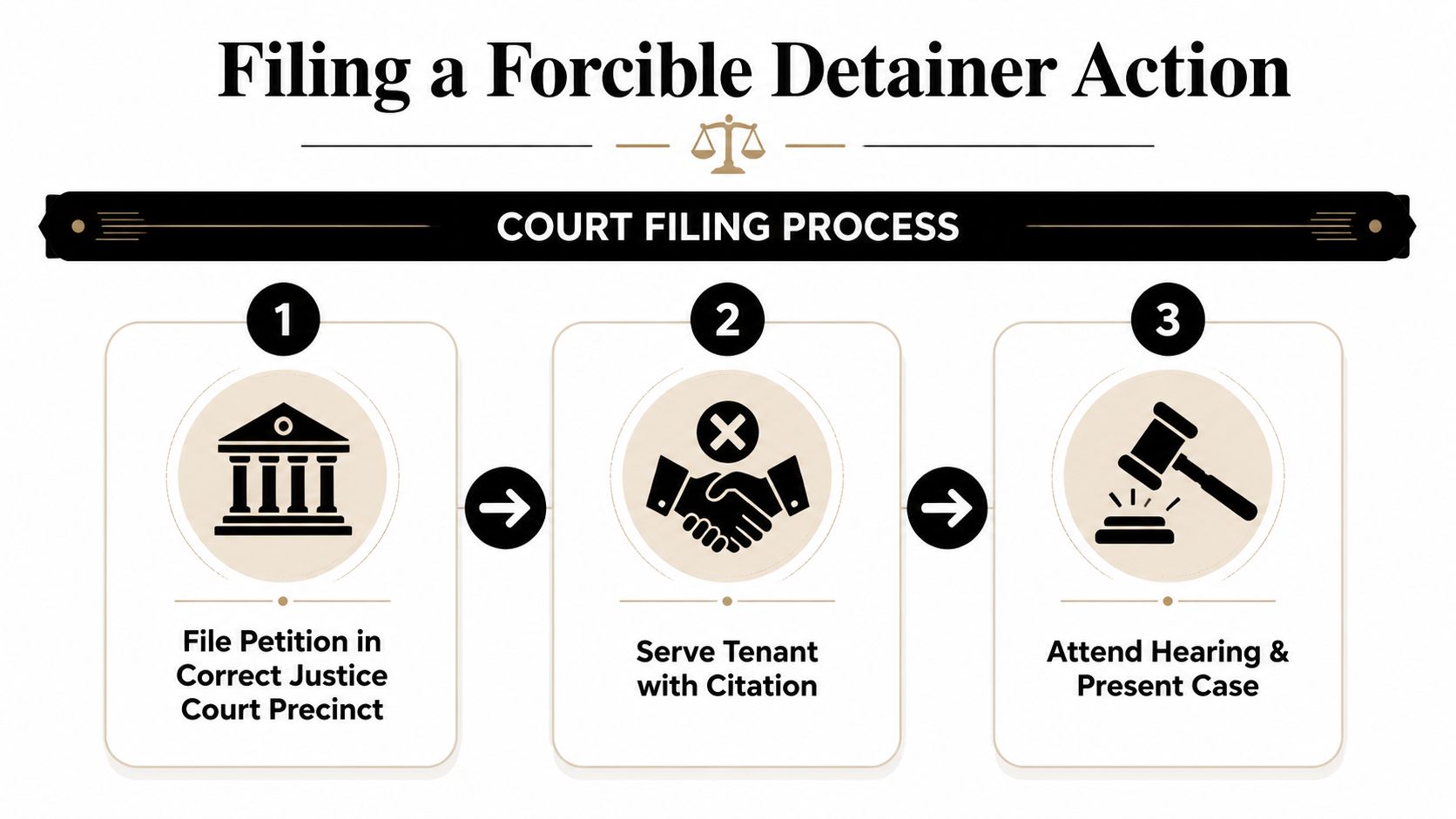
Once the applicable cure and notice periods have expired, the landlord may file a forcible detainer petition in the justice court precinct where the commercial property sits. The petition should be built around possession, not every dispute arising from the lease. Justice court can decide who has the immediate right to possession, while broader business counterclaims may require litigation in another court.
What happens after filing
The usual sequence is:
- Petition: The landlord identifies the premises, tenant, lease basis for possession, notices served, and amounts properly recoverable in the justice court action.
- Citation and service: The tenant must receive legally effective service. Under the 2026 procedural changes associated with SB 38, constables must attempt service within five business days. Texas eviction procedure guidance explains the commercial sequence and the need to satisfy each statutory requirement.
- Hearing: A trial window generally falls 10 to 21 days after filing, subject to court rules and service requirements. The landlord should bring the lease, notices, delivery proof, rent ledger, and witnesses. The tenant should bring payment records, relevant lease provisions, and documents supporting a defense to possession.
- Judgment: If the court finds that the landlord has the superior right to possession, it may enter judgment for possession. A tenant who does not appear may face a default judgment, subject to procedures for challenging it.
The Texas Property Code § 24.005 notice-to-vacate requirements provide a useful statutory check, although the lease may impose a different contractual notice period. The court will still examine whether the landlord followed the lease and delivered notice correctly.
Why speed changes strategy
The 2026 Texas eviction rule overhaul describes the SB 38 changes effective January 2026, including agreed electronic notice delivery, the five-business-day service-attempt requirement, and a 21-day appeal limit. It also discusses how uncontested matters may proceed from rent default to writ in roughly 30 to 60 days. Those timelines make early preparation important. A missing notice record, defective service, or incomplete lease file can erase the practical advantage of a possession-focused proceeding.
A consultation with a Texas landlord-tenant attorney can help either party assess the lease, notice history, evidence, and procedural options before the hearing. Waiting until a writ is imminent often leaves fewer workable choices.
Understanding Residential Versus Commercial Distinctions
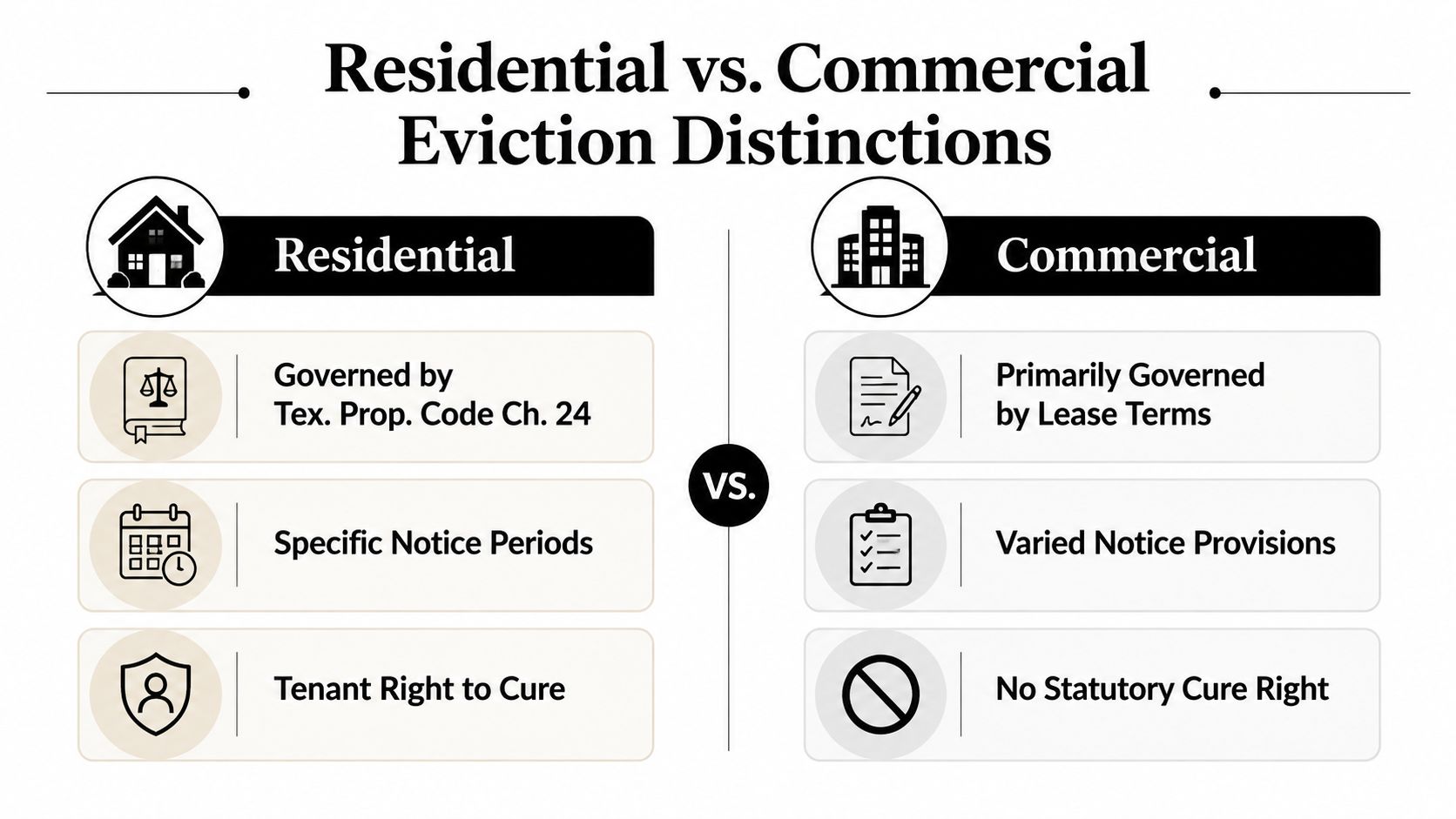
Texas separates residential and commercial rental relationships. Texas Property Code Chapter 92 applies to residential rental property, while Chapter 93 defines commercial rental property as property not covered by Chapter 92. Texas eviction deskbook materials explain this statutory distinction.
That classification affects the protections a tenant may expect. A retail store, warehouse, or office tenant shouldn't assume that residential rules concerning repairs, habitability, retaliation, or lockouts automatically apply to its lease. Commercial parties generally rely more heavily on negotiated contract language, including maintenance duties, operating requirements, insurance provisions, and default remedies.
The lease carries more weight
Consider an office tenant that stops paying rent because the landlord hasn't completed promised improvements. The tenant may have a contract claim, but that claim doesn't necessarily defeat the landlord's immediate possession claim. The result depends on the lease, the notice sequence, and whether the alleged breach provides a legally recognized defense to possession.
A shopping-center tenant may have a co-tenancy clause tied to anchor occupancy. A restaurant may dispute common-area maintenance charges. A retailer may claim that construction interference made the premises unusable. These facts can matter greatly in separate contract litigation, yet a justice court's possession-focused role may not allow the entire dispute to be tried in the eviction case.
The question in justice court is usually who has the right to possess the premises now, not who will ultimately win every claim arising from the lease.
Compare the practical effects
| Issue | Residential tenancy | Commercial tenancy |
|---|---|---|
| Primary statutory framework | Chapter 92 addresses residential rental property, with Chapter 24 governing forcible detainer procedure | Chapter 93 addresses commercial rental property, while Chapter 24 governs the possession action |
| Contract role | Statutory protections may supply important terms | Lease language often controls notice, cure, and default remedies |
| Broader disputes | Some statutory remedies may be relevant to the tenancy | Buildout, co-tenancy, offsets, and business-loss claims may require separate litigation |
| Lockout analysis | Residential lockout rules differ | Section 93.002 provides certain commercial lockout remedies subject to statutory requirements |
A commercial tenant still has rights. Improper notice, defective service, failure to follow the lease, and lack of a valid right to possession can matter. The mistake is assuming every business dispute can be resolved inside the forcible detainer case.
The following video provides additional context for the residential and commercial distinction:
Obtaining and Executing the Writ of Possession
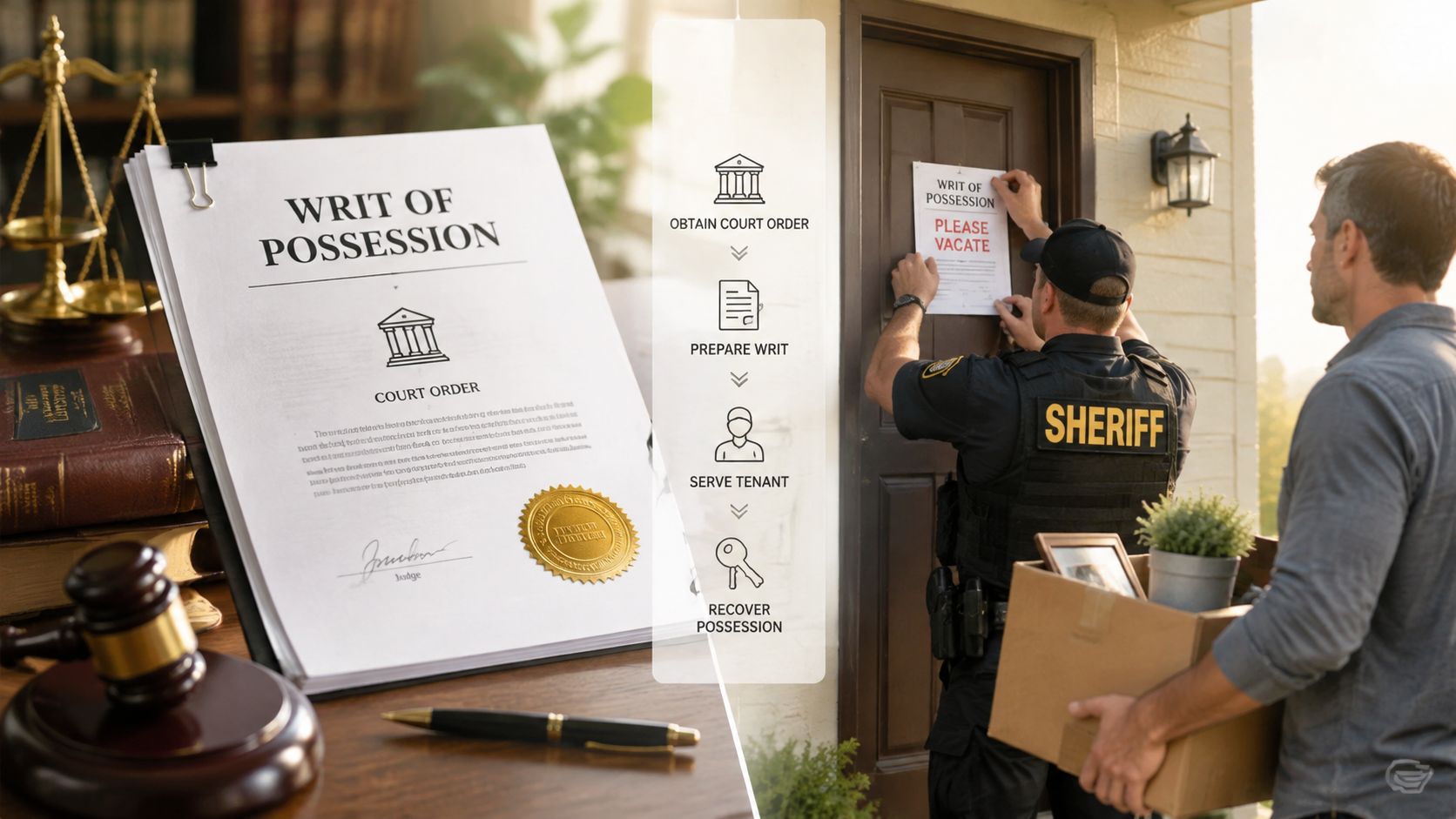
A judgment for possession doesn't mean the landlord should personally remove the tenant or change the locks. The formal enforcement tool is the writ of possession, which authorizes the constable to restore possession to the landlord.
The enforcement checklist
- Confirm the judgment: Review the justice court result and determine whether the tenant has appealed or pursued another available remedy.
- Request the writ: The landlord follows the court's procedure to obtain the writ after the applicable waiting requirements.
- Allow the required notice: Before execution, the constable provides 24-hour post-judgment notice. Texas eviction deskbook guidance describes this part of the possession process.
- Coordinate with the constable: The landlord or authorized representative should be present, arrange access, and avoid interfering with the officer.
- Secure the premises: After execution, the constable may return possession, which can include changing locks and handling property as permitted by law.
Commercial lockouts are limited
Section 93.002 allows certain self-help lockout remedies in commercial rent disputes. The remedy doesn't eliminate notice obligations, and the landlord must provide access to the new key during regular business hours if the tenant pays the delinquent rent. The Texas statute on commercial forcible detainer should be reviewed alongside the commercial lease and Chapter 93 requirements.
Self-help can be risky when the default involves something other than delinquent rent, when the lease adds conditions, or when the landlord restricts access beyond what the statute permits. A landlord who acts too aggressively may create a separate dispute over wrongful exclusion. A tenant facing a lockout should document the condition of the premises, preserve the posted notice, and seek legal advice promptly.
Common Tenant Defenses and Recovery Options
A tenant's first task is to separate a possession defense from a broader business claim. That distinction often determines whether the justice court can address the issue before the tenant loses access to the premises.
Defenses that may affect possession
A tenant should examine:
- Improper notice: The landlord may have used the wrong period, omitted required information, or delivered the notice through a method the lease doesn't allow.
- Unexpired cure rights: The landlord may have filed before the contractual cure period ended or treated a disputed charge as immediately enforceable.
- Payment or tender: Bank records, receipts, and written payment arrangements may challenge the claimed default.
- Lease authority: The landlord must show a present right to possession under the lease and the applicable law.
- Retaliation or discrimination: These allegations may matter, but the tenant should determine whether they can be heard in the possession case or require a separate action.
A tenant shouldn't assume that a strong counterclaim will stop the eviction. The post-2026 procedural environment emphasizes a possession-focused track, and commercial counterclaims or broader lease disputes may need to proceed separately. That's especially important for claims involving buildout expenses, co-tenancy, rent offsets, quiet enjoyment, or business interruption.
Separate recovery for landlords
A landlord may have claims for unpaid rent, lease charges, property damage, or other contractual losses. The possession judgment isn't necessarily the full measure of recovery. Evidence should distinguish amounts already due, repair costs, reletting expenses, and any later damages that require a separate breach-of-contract case.
Landlords should also consider how their conduct affects future claims. Accepting rent, sending conflicting termination messages, accepting keys, or reletting the premises can create arguments about whether the lease ended and what obligations remain. A coordinated written record is more useful than informal messages that point in different directions.
Appeals require immediate action
Under Texas Property Code § 24.007, a county court judgment in an eviction case generally cannot be stayed pending appeal unless the appellant files a supersedeas bond within 10 days of the judgment. The statute also limits possession appeals to cases involving premises used for residential purposes only, creating a significant practical restriction for commercial tenants. Property Code § 24.007 should be reviewed immediately after judgment.
Separate Texas court guidance explains that an appeal may involve a bond, cash deposit, or statement of inability to pay filed within five days after the judgment is signed, and the appeal bond may require the surety's contact information. Tarrant County justice court appeal information provides an example of the filing mechanics.
If you need help with a commercial eviction, lease default, notice challenge, or possession dispute, The Law Office of Bryan Fagan, PLLC can review the lease and court papers, explain your tenant rights or landlord remedies, and help you act before a critical deadline expires. Schedule a free consultation to discuss a practical strategy for protecting your business or property.