
A landlord is preparing screening criteria for a Texas rental and wants to avoid approving an applicant who may threaten resident safety. At the same time, a renter has received a denial letter that points to an old criminal record, possibly without explaining whether the record was an arrest, a dismissal, or a conviction. Both people need clear answers, not a vague statement that criminal screening is either always legal or always forbidden.
Criminal record screening sits between federal fair housing law, consumer-report accuracy rules, and the Texas Property Code. A policy can look neutral and still create unlawful disparate impact. A report can also contain information that's incomplete, outdated, or attached to the wrong person. This guide explains how Texas landlords can create a more defensible process and how tenants can challenge a denial that doesn't match the facts or the stated criteria.
If you're learning how background checks work in another setting, a resource about a volunteer background check can also help clarify the difference between screening information and a final decision. Housing decisions require additional care because renters have fair-housing protections and landlords must follow applicable Texas disclosure rules.
Why Criminal Record Screening Matters in Texas Rentals
A property manager may start with a simple rule: “No applicants with a felony.” The rule feels easy to apply, but it doesn't explain which offenses matter, how old a record may be, whether an arrest counts, or whether the applicant can correct an error. That lack of detail can create trouble even when the landlord's goal is resident safety.
The applicant on the other side may be looking at a denial based on a conviction from many years ago. The notice may not identify the screening company, explain the record, or show how the stated policy was applied. The renter may not know whether to contact the landlord, dispute the report, gather rehabilitation evidence, or speak with a Texas landlord tenant lawyer.
Why the same rule affects both sides
A landlord needs a screening process that addresses a legitimate housing concern without excluding people based on criminal history in the abstract. A tenant needs a fair chance to know what information was used and to correct information that doesn't belong in the decision.
The Fair Housing Act matters because criminal-history policies can disproportionately exclude protected groups even when the landlord didn't intend to discriminate. Texas law matters because landlords must disclose tenant-selection criteria with rental applications under Texas Property Code § 92.3515.
That means a sound process has several parts:
- Written criteria: The applicant should see the grounds for possible denial before applying.
- Accurate information: The landlord should confirm the identity, disposition, and date connected to each record.
- Relevant review: The decision should connect the record to a legitimate tenancy concern.
- Consistent treatment: The same criteria should apply to similarly situated applicants.
- Meaningful communication: A denied applicant should receive enough information to understand and challenge the decision.
Practical rule: A strict policy isn't automatically a safe policy. A documented, accurate, and consistently applied policy is more useful than an automatic exclusion that never asks whether the record is relevant.
This approach protects more than an application file. It helps a landlord explain a decision later and gives a tenant a clear path to respond. If a dispute grows into a claim involving discrimination, an eviction, or another rental issue, legal advice can help preserve evidence and identify the available options.
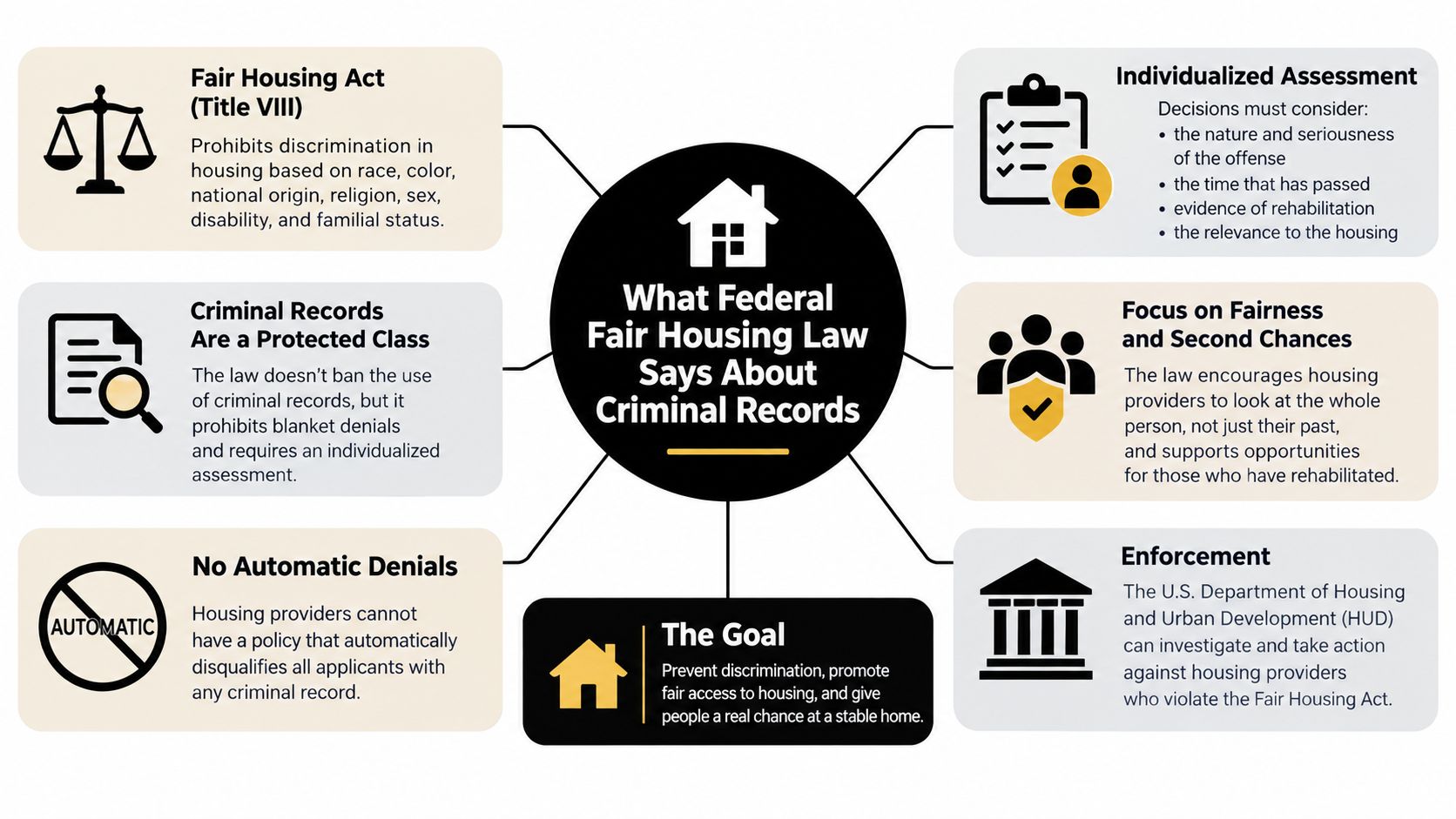
What Federal Fair Housing Law Says About Criminal Records
The Fair Housing Act doesn't require a landlord to ignore every conviction. It does require the landlord to think carefully about how a criminal-history policy operates.
HUD's framework can be understood in three steps.
First, look at the policy's effect
A policy may be written in neutral terms, such as “deny anyone with a criminal record.” It can still create a fair-housing problem if it disproportionately excludes people in a protected group. The applicant doesn't necessarily have to prove that the landlord intended to discriminate.
HUD's 2022 Office of General Counsel policy document reported that as many as 100 million U.S. adults, nearly one-third of the population, have a criminal record. HUD also cited research finding that, when providers used discretionary case-by-case criminal-record screening, White applicants were favored over similarly situated Black applicants 55% of the time. Those figures appear in HUD's policy document on criminal records and the Fair Housing Act.
The point isn't that every criminal-history inquiry is unlawful. The point is that a broad filter can affect a large group of renters and may create unequal results.
Second, identify the landlord's real interest
If a landlord relies on criminal history, the policy should serve a substantial, legitimate, nondiscriminatory interest. Resident safety, protection from serious property damage, and other genuine tenancy-related concerns may be legitimate interests. A general desire to rent only to people with “clean records” is much harder to connect to housing performance.
The screening filter should fit the problem. A recent conviction involving serious property damage may raise a different question from an old, unrelated conviction. An arrest that never led to a conviction raises a different question from a verified conviction. Treating all records alike makes the policy less precise.
Third, ask whether a less discriminatory alternative would work
Even if the landlord identifies a legitimate interest, the policy may remain vulnerable if a narrower approach could protect that interest with less discriminatory impact. Individualized review, offense relevance, recency, and rehabilitation evidence can make the process more customized.
The distinction between an arrest and a conviction is essential. An arrest isn't proof that a person committed a crime. A landlord that treats every arrest as a conviction may rely on an inaccurate assumption and expose qualified applicants to automatic exclusion.
HUD withdrew its 2016 criminal-record guidance in 2025, but the Fair Housing Act's disparate-impact framework still matters. For a broader explanation of protected categories, review Texas fair housing protected classes.
For a visual explanation of the concepts, watch this housing-law overview:
How Blanket Bans Create Discrimination Risk
A blanket ban usually sounds clear: “No felonies,” “no arrests,” or “no criminal record of any kind.” The problem is that these rules ignore the differences that matter to a fair and accurate decision. They may treat a recent serious conviction the same as a remote conviction, a dismissed charge, or a mistaken identity match.
An audit summarized in a Fair Housing Council report examined 25 investigations. It found evidence of criminal-screening policies with a disparate impact on Black applicants in 83.3% of the tests, with 50% showing clear evidence of discrimination and 33.3% showing some or potential evidence. The report also found that 83% of investigated properties screened applicants for criminal records. These figures are reported in the criminal-record audit report.

Why criminal history may be a poor housing shortcut
Criminal history doesn't necessarily predict whether someone will pay rent, follow lease rules, or care for a home. The available audit research recommends greater reliance on factors more closely connected to tenancy, including ability to pay rent, prior rental history, and personal references.
That doesn't mean those factors are perfect. It means a landlord should ask what the screening item proves. An old record may say little about the applicant's current stability. A report that lists an arrest without a conviction may say nothing reliable about the underlying conduct.
HUD identifies several practices that create particular risk:
- Ignoring offense differences: Treating every offense as equally serious.
- Ignoring age: Giving an old record the same weight as a recent one.
- Counting arrests as wrongdoing: Using an arrest that never resulted in conviction as proof of misconduct.
- Blocking explanations: Denying an applicant without considering rehabilitation or mistaken identity.
- Following a score blindly: Accepting an automated recommendation without checking the underlying records.
A quick comparison
| High-Risk Practice | Defensible Alternative |
|---|---|
| Deny anyone with any criminal record | Review only defined, relevant records under written criteria |
| Count arrests as convictions | Confirm whether the matter ended in dismissal, expungement, or conviction |
| Apply a lifetime ban | Use a time-limited and offense-specific review |
| Ignore rehabilitation | Invite evidence such as treatment completion, employment, and references |
| Accept a vendor score without review | Verify identity, disposition, dates, and the reason for the recommendation |
More screening isn't always safer screening. A poorly designed filter may exclude qualified renters while creating a record that suggests unequal treatment. A landlord should be able to explain why a particular record relates to a real housing concern, not merely point to the fact that a database produced a result.
Texas Rules for Tenant Selection and Screening Notices
Texas Property Code § 92.3515 focuses on transparency. When a landlord provides a rental application, the landlord must make the tenant-selection criteria available. The criteria must identify the grounds on which an application may be denied and may address criminal history, credit history, current income, and rental history.
The applicant must also acknowledge having had an opportunity to review the criteria. If the applicant doesn't satisfy the stated criteria or provides inaccurate or incomplete information, the application may be rejected and the application fee may not be refunded. The statute doesn't require every landlord to approve an applicant with a criminal record, but it does make the disclosed policy important. Review the Texas tenant-selection statute for the statutory language.
What disclosure should look like
A compliant process gives the applicant the written criteria before accepting the application. For example, a property manager might provide a document explaining that the property considers income, rental history, credit history, and narrowly defined criminal-history information. The applicant signs an acknowledgment showing that the criteria were available for review.
An undisclosed rule creates a different problem. Suppose the written application materials mention income and rental history but say nothing about criminal records. After receiving the application fee, the manager finds an old conviction and announces that the applicant is automatically denied under a rule that wasn't provided. The tenant should preserve the application, fee receipt, denial, and communications, then request the written criteria and the specific reason for the decision.
Why the written policy matters in Texas
Texas doesn't have a statewide fair-chance housing law or a general criminal-record look-back limit. That leaves landlords and applicants working with federal fair-housing principles, consumer-report accuracy requirements, and the provider's own written criteria.
A clear policy helps both sides. It tells a renter what information may matter before the renter pays to apply. It also gives a landlord a standard to apply consistently instead of making an improvised decision after seeing a report.
For related guidance about permitted screening questions and the application process, see Texas tenant screening laws and what landlords can ask. If the disclosed policy changes, the landlord should use the updated version for future applications rather than applying a new rule selectively to a pending applicant.
Building a Compliant Criminal History Screening Policy
A defensible policy starts with a narrow question: What specific tenancy-related concern does this screening rule address? The answer should guide the offense categories, the review period, the records considered, and the applicant's opportunity to respond.
A landlord might use language such as:
Sample policy language: “The property may review verified conviction records that are directly relevant to resident safety or protection of property. The property does not treat an arrest, dismissed charge, or expunged matter as a conviction. Decisions consider the nature of the offense, the date, its relationship to tenancy, and reliable information submitted by the applicant.”
This is a starting point, not a universal form. A landlord should have the policy reviewed for the property, the housing program, and the actual screening process.
Define relevance before reviewing an applicant
A policy should identify the types of conduct that may require closer review. The language should connect the offense to resident safety, property protection, or another legitimate housing objective. It shouldn't merely list every criminal category and impose the same result.
The policy should also distinguish:
- Arrests: An arrest alone doesn't establish that the applicant committed a crime.
- Dismissals: A dismissed matter shouldn't be treated as a conviction.
- Expunged or sealed matters: The landlord should follow applicable reporting and accuracy rules before relying on such information.
- Convictions: A conviction may receive individualized review when it's relevant, verified, and considered under the written standard.
Use time and context
A criminology review reports that differences in new-offense risk between people with and without prior arrests weaken rapidly, with risk beginning to approximate that of people without a record after roughly seven years. The finding supports time-limited, offense-specific screening rather than a lifetime ban. See the criminology review of recidivism risk.
A look-back period should not operate as a mechanical substitute for judgment. The landlord should still verify the record and consider the seriousness, relevance, and circumstances. A remote conviction may deserve less weight than a recent conviction involving conduct directly connected to the property's stated concern.
Require human review
Third-party platforms and algorithmic scores can contain inaccurate records, racial bias, or unsupported predictions. The landlord should review the source information instead of treating a score as the final answer.
Human review should confirm:
- The report belongs to the applicant.
- The matter is identified correctly.
- The disposition is clear.
- The offense date and review period are accurate.
- The record is relevant to the written policy.
- The applicant had a chance to provide mitigating information.
Rehabilitation evidence may include completed treatment, steady employment, personal references, education, or court records showing the final disposition. None of these items guarantees approval, but the process should allow the applicant to submit them.
Build an adverse-action process
If a consumer report contributes to a denial or less favorable rental term, the landlord should provide an adverse-action notice that identifies the reporting company and explains the applicant's rights to obtain and dispute the report. A practical notice can state:
Sample notice: “Your application was denied, or approved on different terms, in whole or in part because of information in a consumer report. The consumer reporting agency did not make this decision and cannot explain the property's specific decision. You may contact the agency to request a copy of the report and dispute information you believe is inaccurate or incomplete.”
The landlord should confirm the notice meets current federal requirements and preserve proof of delivery.
| High-Risk Practice | Defensible Alternative |
|---|---|
| “Any record means automatic denial” | “Only verified, relevant convictions receive review” |
| Vendor score controls the result | A trained reviewer checks the underlying report |
| No response opportunity | Applicant may submit concise mitigating evidence |
| Undisclosed policy | Criteria are provided with the application |
| Different treatment for similar applicants | Same rubric, review points, and documentation for everyone |
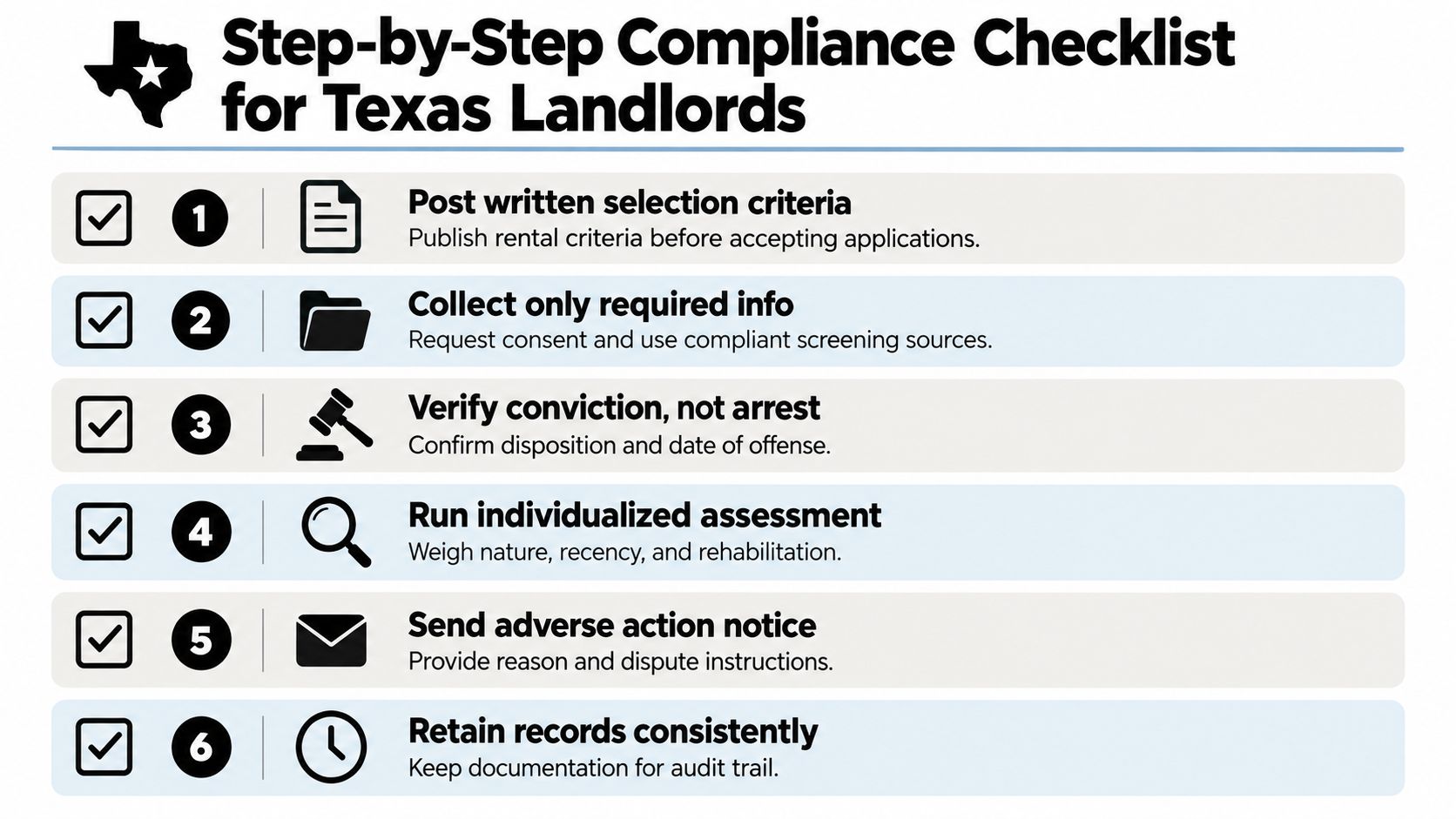
Step-by-Step Compliance Checklist for Texas Landlords
A written policy only helps if the property manager follows it for every applicant. Use this sequence before making a decision.
1. Provide the criteria first
Give the tenant-selection criteria with the rental application under Texas Property Code § 92.3515. Obtain the applicant's acknowledgment and keep the version that was effective when the application was submitted.
2. Collect only what the process requires
Obtain the authorization needed for consumer reports and use a reliable screening source. Don't run informal checks outside the stated process or ask one applicant for information that you don't request from others.
3. Verify the record
Confirm that the report matches the applicant. Identify whether each entry is an arrest, dismissal, expungement, sealed matter, or conviction. Check the disposition and offense date before treating the item as relevant.
4. Apply the written standard
Ask whether the record falls within the policy's defined offense categories and review period. Document the legitimate housing-related reason for considering it. HUD recommends accounting for whether the record is old, whether the conduct is relevant to tenancy, and whether the applicant can present circumstances not shown in the record. Its rental housing screening guidance also cautions that a blanket rule is materially different from evaluating a conviction's offense, date, and relationship to a legitimate safety concern.
5. Invite an explanation
Give the applicant a meaningful opportunity to submit rehabilitation evidence, correct mistaken identity, or provide final court records. Review the response before finalizing the decision, and record what information the reviewer considered.
6. Send the right notice and preserve the file
If the decision relies on a consumer report, send an adverse-action notice with the required reporting-agency and dispute information. Retain the criteria, acknowledgment, report, review notes, communications, decision, and delivery record so you can show how the same process operated for comparable applications.
A clean file should explain the decision without relying on memory or hindsight.
What Tenants Can Do After a Criminal Record Denial
Jordan applies for an apartment and receives a denial referencing “criminal history.” Jordan doesn't remember a recent conviction and suspects the report may list an old arrest under the wrong identity. The denial should not be the end of the process.
First, Jordan should request the adverse-action information and the screening report. The tenant should identify the reporting company, obtain the report, and check every entry for identity, date, disposition, and accuracy. An arrest isn't a conviction, and a dismissed, expunged, or sealed matter may require specific attention.
Next, Jordan should compare the denial with the tenant-selection criteria provided with the application. If the landlord used a rule that wasn't disclosed, changed the policy after receiving the application, or gave conflicting explanations, Jordan should preserve the application, acknowledgment, fee receipt, denial, report, and all messages.
The tenant can dispute inaccurate or incomplete information with the reporting company and provide the landlord with supporting records. A concise packet might include the final court disposition, proof of completed treatment, employment information, rental references, and a short explanation of present stability. Texas Fair Housing's summary of HUD guidance explains that a criminal-history restriction may be unlawful when it disproportionately affects a protected group and isn't necessary to serve a substantial, legitimate, nondiscriminatory interest. It also recommends distinguishing convictions from arrests and considering mitigating information beyond the record itself. See Texas rental application denial reasons for related guidance.
A tenant doesn't have a guaranteed right to approval just because a record is old or disputed. But you do have the right to understand the decision, challenge inaccurate information, and ask whether the landlord followed the disclosed criteria. If you're a landlord facing a screening dispute or a tenant challenging a denial, a consultation with The Law Office of Bryan Fagan, PLLC can help evaluate the report, policy, notices, and fair-housing concerns. Visit The Law Office of Bryan Fagan, PLLC to schedule a free consultation about your Texas rental dispute, screening decision, or tenant rights.