Dealing with a rental application dispute can be stressful, whether you're the landlord trying to fill a unit or the tenant waiting to hear back. In Texas, the screening process is legal, but it has rules that change the conversation in important ways. Texas Property Code requirements, plus federal Fair Housing Act and FCRA duties, shape what a landlord can ask, when they can ask it, and how they have to explain a denial.
A lot of confusion starts when a landlord thinks screening is just a private business decision. In reality, Texas tenant screening laws what landlords can ask depends on written disclosure, consistent criteria, and fair treatment. If those pieces are missing, a normal-looking application process can turn into a dispute over hidden standards, missing notices, or inconsistent decision-making.
Why Screening Rules Matter More Than Texas Landlords Realize
A landlord in Houston posts a duplex online, gets a stack of applications, and wants to move fast. A tenant in Dallas applies for an Austin apartment and hears nothing for days, then gets a vague denial. Both situations look routine, but screening is where many Texas rental disputes start.
Texas gives landlords broad room to screen, but it doesn't give them a blank check. The state requires written screening criteria and a signed acknowledgment before fees change hands, and federal law layers on anti-discrimination and credit-report rules. That means the key question isn't just what a landlord wants to know, it's whether the question is allowed, disclosed, and applied the same way every time.
The legal mix that actually controls the process
Texas law focuses on transparency. Under Texas Property Code Section 92.3515, the landlord has to give the applicant the selection criteria and possible denial grounds up front, then get the applicant's signed acknowledgment before collecting the application fee. Texas guidance also says landlords can use broad, objective screening data, but they have to disclose the standards and apply them consistently Texas Property Code Section 92.3515 overview.
Federal law fills in the rest. The Fair Housing Act limits discriminatory screening, and the FCRA controls background and credit checks, including written consent and the notice steps after a denial. That's why a landlord who only follows one set of rules can still create legal exposure.
Practical rule: if the criteria weren't written down before the application, they're already a problem.
For tenants, this matters because it gives you a way to spot hidden standards. For landlords, it creates a paper trail that can help defend a decision if someone later challenges it. The Law Office of Bryan Fagan, PLLC sees these disputes most often when the application process feels informal, but the law expects documentation.
How Texas Property Code Section 92.3515 Shapes Screening
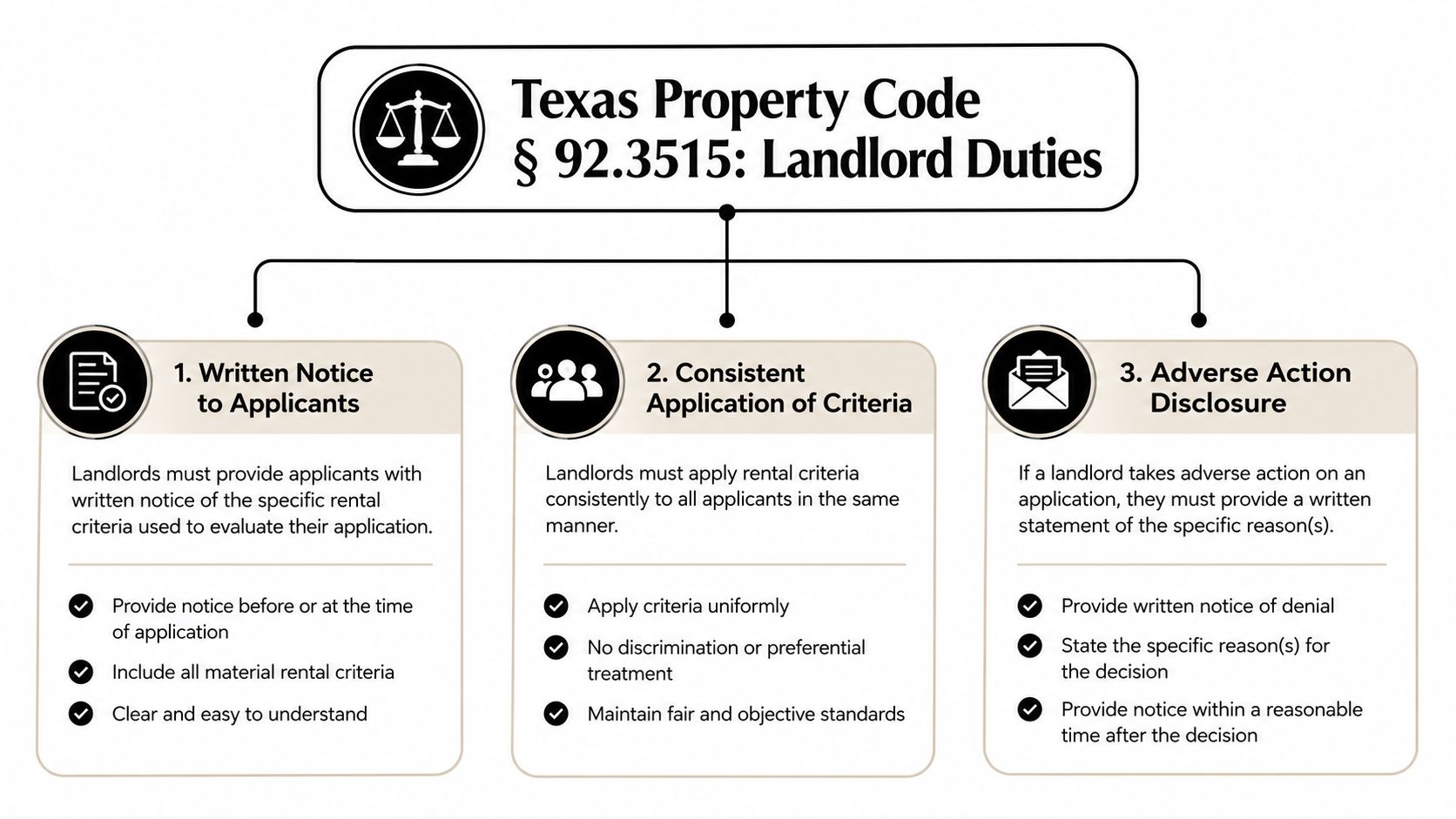
Texas Property Code § 92.3515 is the backbone of the screening process. It does not bar a landlord from using broad screening criteria, but it does require the landlord to put those criteria in writing and share them at the beginning. That matters because screening stops being a private hunch and becomes a process the applicant can see and compare against the stated rules.
A screening notice works like a menu that lists the available items before the applicant decides. Before anyone turns in the application, the landlord has to show the standards in play and the grounds that could lead to a denial. If those standards change after the application is submitted, the process starts to look uneven, even if the landlord thinks the change is minor.
What the statute requires in plain English
The landlord must give a printed notice of tenant selection criteria when the rental application is handed to the applicant. That notice has to identify possible denial grounds, including criminal history, prior rental history, current income, credit history, and whether the applicant provided complete and accurate information Texas Property Code § 92.3515.
The law also requires an acknowledgment. The applicant has to receive and sign that acknowledgment before paying fees, so the disclosure step comes first and the fee step comes after it. That sequence is easy to miss, and it is one of the most common compliance problems for landlords who handle applications casually.
Texas guidance describes this rule as a form of mandatory transparency. It does not narrowly limit every category a landlord may screen, but it does require the landlord to show the standards from the start and use them consistently Texas tenant screening laws 2025 summary.
Why the disclosure rule helps both sides
For landlords, disclosure cuts down on arguments about hidden standards. If the applicant knows the rules ahead of time, the landlord can point to the written criteria instead of trying to explain an unwritten judgment later. That kind of paper trail matters if the decision is questioned.
For tenants, the notice makes the process easier to understand and easier to challenge if the landlord departs from the stated criteria. It also gives applicants a clearer picture of what information will matter before they spend time and money on the application.
The legal takeaway is straightforward. Texas does not require landlords to accept every applicant, but it does require them to tell the truth about the standards they plan to use. That is why § 92.3515 carries so much weight in texas tenant screening laws what landlords can ask cases.
For a plain-English explanation of how the chapter fits together, see Texas Property Code Chapter 92 screening rules and the firm's discussion of Tenant Screening and Application Rules in Texas.
What Landlords Can and Cannot Ask in Texas
Landlords in Texas can ask a wide range of questions, but not every question belongs on the application. The safest screening questions are the ones tied to a written, objective criterion. The riskiest ones are the ones that drift into protected characteristics, inconsistent treatment, or information the landlord can't legally use the same way for every applicant.
Common application topics and where the legal line sits
Income and employment are generally fair game. Landlords commonly ask about job status, monthly income, and proof of income because those questions relate directly to whether the tenant can pay rent. Industry guidance also notes that many landlords use income benchmarks around 2.5× to 3× monthly rent, but those standards need to be applied consistently and with written consent before background checks Texas tenant screening questions and income benchmarks. If the landlord uses an income rule for one applicant and ignores it for another, that's where the legal risk starts.
Rental history and criminal history are also common screening categories in Texas. The state's screening framework allows those topics, but federal fair housing rules require individualized review, not automatic rejection. A blanket rule that says “any criminal history means no” is the kind of shortcut that creates trouble.
A landlord can ask broad questions. The problem starts when the answers are used differently from one applicant to the next.
Credit history is another common category, but the FCRA matters here. If a landlord or screening company pulls a consumer report, written consent comes first. And if the report drives a denial, the applicant needs the proper notice after the decision.
Household details, pets, and smoking are usually asked because they affect occupancy and lease compliance. Those questions are often legitimate if they're tied to property rules. But questions about family planning, marital status, religion, or other protected topics can create fair-housing concerns very quickly.
Quick comparison of common questions
| Topic Asked | Texas Permitted? | Federal Limit to Watch |
|---|---|---|
| Employment status and income | Yes, if used consistently | Must not be a cover for discrimination |
| Rental history and landlord references | Yes | Fair Housing consistency matters |
| Criminal history | Yes, with individualized review | Blanket bans can create fair housing risk |
| Credit history | Yes, with consent before reports | FCRA notice and dispute rights apply |
| Pets and smoking | Yes, if tied to property rules | Don't use as a proxy for protected status |
| Household occupancy | Yes | Avoid family-status discrimination |
| Protected traits or personal life details | No | Fair Housing Act limits this |
If a landlord wants a concrete benchmark, the firm's what is the 3 times rent rule in Texas page gives useful context for how some owners think about rent-to-income screening, but the key legal point is still consistency, not a magic number.
Required Disclosures, Consents, and Notices Under Texas and Federal Law
The paperwork matters as much as the questions. A landlord can use fair screening criteria and still create a legal problem by missing one written step or by getting the timing wrong. The safest process is simple to describe, but easy to mishandle in practice.
A tenant applies for a unit, hands over the fee, and later learns the landlord never gave the screening standards in writing. That is the kind of mistake Texas law tries to prevent. The better sequence starts before the fee changes hands, because the applicant should see the selection standards and sign the acknowledgment first.
The screening timeline that keeps problems down
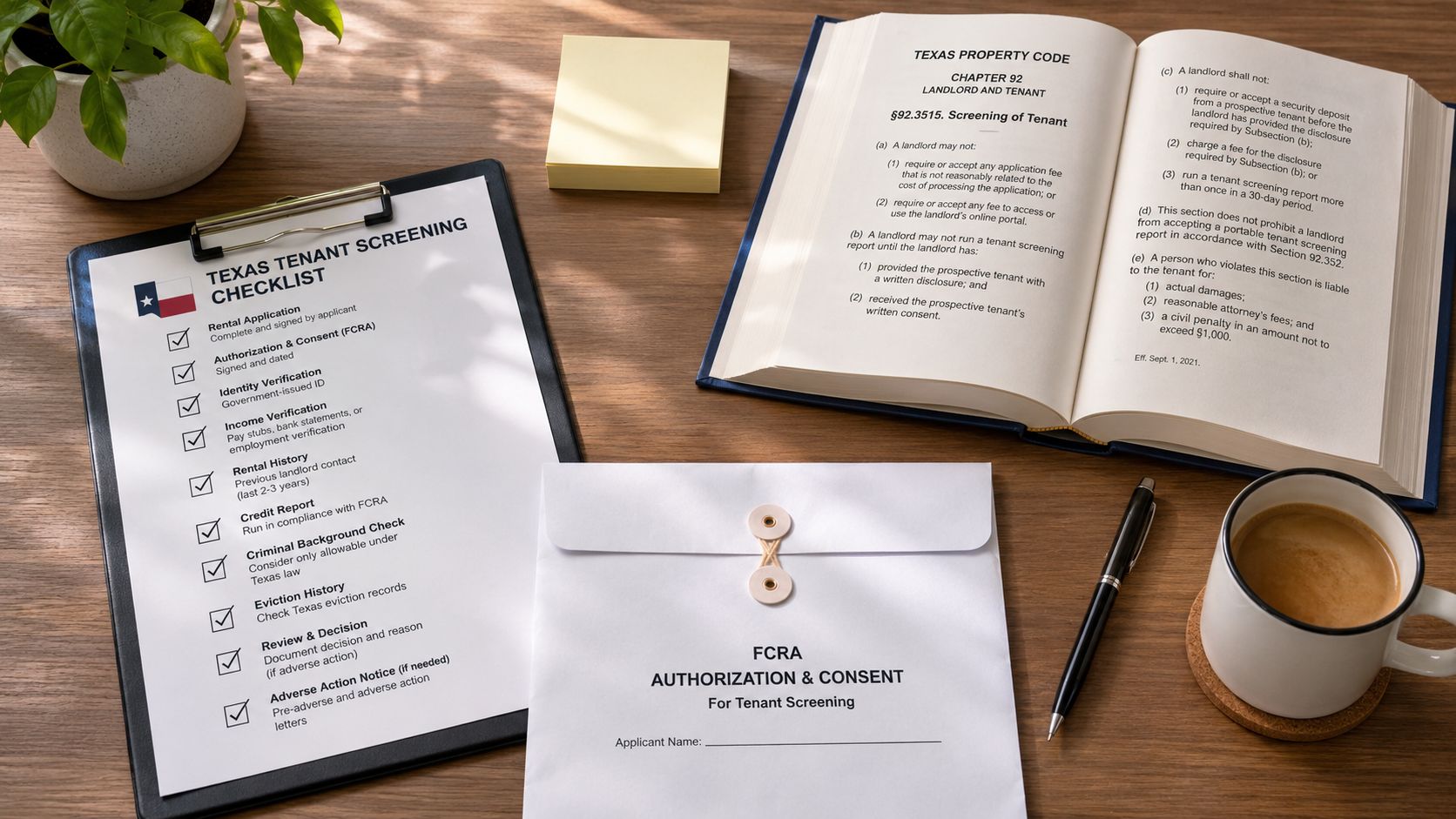
Start with the written screening criteria before the application fee is taken. Texas requires the applicant to receive the selection standards and sign an acknowledgment first Texas Property Code § 92.3515. If the landlord wants a background or credit report, the applicant also needs written consent before the report is run Texas screening consent guidance.
After the decision, the landlord has to send the proper denial notice. Texas summaries also note that applicants should receive written notice if they're denied, and FCRA rules may require a separate adverse-action notice that identifies the reporting agency and explains the applicant's dispute rights Texas tenant screening laws 2025 summary.
Most-missed duty: written consent must come before the background or credit check, not after the denial.
Most-missed judgment call: criminal history calls for individualized review, not an automatic rejection.
A criminal record is only one piece of the file. The landlord still needs to ask whether the item fits the stated criteria and whether the same standard is being applied to every applicant. If the review turns into a shortcut, the decision starts to look arbitrary instead of objective.
The fee rule landlords overlook
Texas sources say application fees are not capped by a statewide dollar limit, but they are expected to reflect actual screening costs, not an arbitrary markup. That means the landlord should be able to explain what the fee covers and keep records that match the process guidance on Texas application fees reflecting actual screening costs.
A simple way to think about it is this. If the landlord charges a fee for screening, the paperwork should show that the fee is tied to the screening work, not used as a vague extra charge. That is why the written criteria, consent, and denial steps all need to line up with the fee practice.
What Screening Looks Like in Real Texas Renting Scenarios
A family in San Antonio applies for a duplex. The landlord sees an old misdemeanor in the background report and immediately wants to deny the application. That reaction feels natural to many owners, but Texas screening law pushes the landlord to slow down and use the written criteria, not a reflex.
The right question is whether the offense matters under the stated standards and whether the landlord is reviewing it the same way for every applicant. If the landlord skips that review, the decision can start to look arbitrary instead of objective.
A denial that stayed within the rules
In the San Antonio scenario, the landlord gave the family the screening criteria when the application was provided, got the signed acknowledgment before collecting the fee, and reviewed the criminal history in context. The landlord also sent the written denial notice afterward. That process is much easier to defend because the steps match the Texas disclosure framework and the federal notice rules.
A screening process that crossed the line
A North Texas landlord used income standards for one applicant, but relaxed them for another applicant whose paperwork was stronger in other ways. That might sound flexible, but uneven application of criteria is exactly where Fair Housing risk shows up. Once the landlord starts making exceptions without a documented reason, the process stops looking neutral.
The same problem appears when a landlord denies one applicant for a criminal record but gives a different applicant a second look under nearly identical facts. Texas allows individualized review, but it also expects that review to be real, not selective. If the decision-making isn't consistent, the file itself becomes the weak spot.
What feels like ordinary landlord discretion is often where screening liability starts.
Both examples show the same lesson. Screening is not just about deciding yes or no. It's about proving that the decision came from the written criteria, the required notices, and the same process every time.
A Practical Screening Checklist for Landlords and Tenants

Landlord checklist
- Give written criteria first. Hand over the tenant selection standards before taking the application fee.
- Get the acknowledgment signed. Make sure the applicant signs before any fee is collected.
- Obtain FCRA consent. Do this before ordering a background or credit report.
- Apply one standard to all applicants. Keep the same written rules for every file.
- Review criminal history individually. Don't use a blanket ban.
- Send the denial notice. Put the decision in writing and include the report information if an adverse-action notice is required.
- Keep the paper trail. Save the application, criteria sheet, acknowledgment, consent, and denial notice together.
For landlords who want more context on the screening process, screening tenants in Maple Ridge is a useful outside reference because it shows how a checklist approach can support consistent review.
Tenant checklist
- Read the criteria before paying. Don't hand over money until you've seen the rules.
- Ask what gets someone denied. Income, rental history, and credit should be clear before you apply.
- Check the consent forms carefully. Make sure you know when a report will be pulled.
- Request the report if you're denied. If a background or credit report played a role, you may have rights under federal law.
- Challenge errors quickly. Dispute bad information with the reporting company if the file is wrong.
- Ask for the written denial. A vague phone call isn't enough to understand your rights.
If the application process feels off, a Texas tenant rights issue can turn into a broader rental dispute fast. A landlord who wants help tightening the process, or a tenant who thinks the denial was unfair, should treat the screening file like evidence, because that's exactly what it becomes later.
Your Next Steps and When to Talk to a Texas Tenant Lawyer
Texas screening law comes down to three pillars, transparency under state law, anti-discrimination under federal law, and paperwork under the FCRA. When those pieces line up, landlords reduce the risk of fair-housing complaints and applicants get a real chance to understand the decision. When they don't line up, a screening file can turn into the starting point for a denial challenge, an audit problem, or a broader landlord-tenant dispute.
If you're a landlord, tenant, or property manager in Houston, Dallas–Fort Worth, Austin, San Antonio, or a surrounding county, it helps to get the screening process reviewed before the dispute starts. You can also explore the firm's Texas landlord-tenant law overview for a broader look at how the Texas Property Code affects rental relationships.
If you need help with a screening dispute, denial letter, or rental application issue, The Law Office of Bryan Fagan, PLLC can review your situation and explain your options in plain English. Visit The Law Office of Bryan Fagan, PLLC to schedule a free consultation and get guidance on your Texas rental rights.