Dealing with a landlord dispute, a denied application, or an eviction threat can be stressful. A family may be told that a rental is “not suitable” because children live in the household. A tenant may be refused permission to keep a service animal. A landlord may be unsure which questions belong on an application and which ones create legal risk.
These situations are exactly where Texas fair housing protected classes matter. Fair housing law shapes everyday decisions about advertising, screening, lease terms, repairs, accommodations, and enforcement. It applies whether you rent a home in Houston, manage apartments in Dallas-Fort Worth, own a duplex in Austin, or lease property in San Antonio.
This guide explains the protected classes in plain English, shows how federal and Texas rules fit together, identifies common landlord and tenant mistakes, and outlines practical steps for responding to a possible violation. It also explains how the Texas Property Code fits into the broader landlord-tenant relationship, although fair housing claims may arise under federal and state civil rights laws as well.
Why Texas Fair Housing Matters to You
A landlord in Houston receives an application from a pregnant applicant with a child. The application otherwise appears complete, but the landlord worries that children will damage the property and tells the applicant the home has already been rented. In another situation, a tenant in Austin asks to keep a service animal in a no-pet building, and the property manager demands an additional pet deposit.
Neither decision becomes lawful because the landlord had a business concern. Fair housing rules require housing providers to evaluate people through neutral, lawful criteria rather than assumptions about a protected characteristic. Texas materials identify the baseline protected classes and explain that the rules reach advertising, rental screening, lease terms, repairs, and enforcement. The Texas Workforce Commission and Texas Department of Housing and Community Affairs fair housing overview provides that framework.
The rules affect ordinary rental decisions
A fair housing problem may appear in a written advertisement, a casual conversation during a showing, or the way a landlord responds to a repair request. Examples include:
- Advertising: A listing suggests that only single people, young professionals, or applicants who speak a particular language should apply.
- Screening: A landlord asks different questions of applicants or applies different standards to families, people with disabilities, or people from a particular national origin.
- Lease administration: A tenant receives different fees, services, renewal terms, or enforcement treatment because of a protected trait.
- Repairs and access: A landlord delays maintenance or refuses a disability-related request without evaluating it fairly.
The Texas Property Code still governs many parts of the rental relationship, including possession, repairs, notices, lease enforcement, and eviction procedure. A landlord who believes a tenant violated a lease must follow the applicable Texas process, not use a protected trait as a shortcut. A tenant facing an eviction or repair dispute should preserve notices and communications and consider speaking with a Texas landlord tenant lawyer before the conflict escalates.
Practical rule: Apply the same written criteria to everyone, document the reason for every important decision, and respond to accommodation requests in good faith.
The key question is usually not whether someone intended to discriminate. The question is whether a housing decision treated a person differently because of a protected class, or whether a neutral policy created an unlawful barrier. The sections below walk through that question one step at a time.
The Seven Protected Classes Explained
Texas fair housing law tracks the federal framework of seven protected classes: race, color, national origin, religion, sex, familial status, and disability. Texas training materials repeat this framework and explain how the categories operate in daily housing decisions. The following Texas fair housing training materials also discuss the broader meaning of national origin and the risk of language-based exclusion.

Race and color
Race concerns a person's racial identity or the racial group others perceive them to belong to. A landlord can't reject an applicant, steer them toward a particular part of a property, or impose different rental conditions because of race.
Color is related but distinct. It concerns the shade or tone of a person's skin. For example, an owner can't approve one applicant while imposing extra requirements on another because of skin color.
National origin
National origin can include ancestry, birthplace, ethnic background, and limited English proficiency. It isn't limited to citizenship. A property manager in Dallas-Fort Worth shouldn't create an English-only communication rule that functions as a proxy for excluding people from a particular ethnic or national background.
A landlord may use legitimate identity, income, and rental-history requirements, but those requirements must be applied consistently and tied to a lawful housing purpose.
Religion
Religion protects a person's religious beliefs and practices. A landlord shouldn't ask intrusive questions about a tenant's faith or refuse to rent because an applicant observes a particular religion. Housing decisions should focus on lawful qualifications, not religious assumptions.
Sex
Sex protects people from housing decisions based on sex. A landlord can't impose different terms because an applicant is a man or woman. Questions involving sex, gender identity, or sexual orientation can also raise additional federal or local legal issues, so a property manager should obtain legal advice before relying on a narrow state-law checklist.
Familial status
Familial status includes pregnancy, parents or legal custodians of children under 18, and people securing custody of a child. A “no kids” policy, a refusal to rent to a pregnant applicant, or stricter rules aimed at households with children can create serious exposure.
Disability
Texas guidance describes disability as a physical or mental impairment that substantially limits one or more major life activities, a record of such an impairment, or being regarded as having such an impairment. Disability rights can involve reasonable accommodations and modifications, not just equal access to an application.
Protected class status is the gateway question. Once a decision involves one of these categories, the landlord must examine whether the treatment was neutral and legally justified.
Federal Baseline and Texas Layering
Texas fair housing law developed alongside federal law. A Texas state presentation dates passage of the Texas Fair Housing Act to May 25, 1989, while the Texas Commission on Human Rights had been established earlier, on June 26, 1983. The Texas fair housing historical overview explains this development and the relationship between Texas enforcement and the federal Fair Housing Act.
The federal statute originally focused on race-based housing discrimination. Later amendments in 1974 and 1988 expanded federal protection to include additional groups, including sex, disability, and familial status. Texas law mirrors the federal seven-class baseline, which is why a complaint may involve both federal and Texas legal theories at the same time.
State rules are the floor
The seven categories provide the starting point for reviewing an application, advertisement, lease, repair decision, or eviction. They don't answer every local question. A city ordinance may provide additional protections that aren't part of the statewide baseline, and the applicable rule can depend on the property's location and the type of transaction.
In practice, renters and landlords in Houston, Dallas-Fort Worth, Austin, and San Antonio should ask whether local rules address issues such as source of income, gender identity, or veteran status. The state baseline itself doesn't add those categories, but a local overlay may affect how a housing provider must act.
Why neutral policies can still create risk
Suppose a landlord announces that all tenant communication must be in English. On paper, the policy sounds uniform. If it prevents meaningful communication with applicants or residents based on limited English proficiency and operates as a proxy for national origin, however, the policy may create fair housing concerns.
The same analysis applies to family rules, repair practices, and screening requirements. A landlord may have legitimate property standards, but the standard must be connected to a lawful purpose and administered consistently. History explains the legal structure. Local rules determine whether the state baseline is only the beginning.
Real-World Do's and Don'ts for Tenants and Landlords
Fair housing compliance often turns on small decisions made during a showing, phone call, application review, or repair request. A landlord may not intend to discriminate, yet a casual statement or inconsistent policy can still create a problem.
A landlord mistake
A property manager in San Antonio advertises a home as “ideal for young professionals” and tells an applicant with children that the owner prefers adults without kids. The manager then asks the family for extra deposit money because children supposedly create more risk.
The safer approach is to describe the property, not the preferred type of person. Use the same application process and lawful criteria for every applicant. A landlord can evaluate income, rental history, credit information, and other legitimate factors, but should avoid questions about pregnancy, children, religion, ancestry, or disability unless a specific legal issue makes the information necessary.
For practical guidance on what Texas law permits in screening applicants and handling application fees, review Tenant Screening and Application Rules in Texas. Landlords and managers can also review Texas tenant screening laws and what landlords can ask before revising forms or training staff.
A tenant misunderstanding
A tenant sees a landlord reject an application after a credit review and assumes discrimination because the applicant belongs to a protected class. Protected status alone doesn't prove a violation. The important facts include whether the landlord used the same standard for other applicants, whether the stated reason is supported by records, and whether the screening rule was used as a cover for unequal treatment.
Tenants should ask for written reasons when available, preserve the advertisement and application communications, and avoid making accusations that can't be supported. A landlord should retain the screening criteria, decision notes, notices, and related messages.
For both sides: A consistent written process is more reliable than memory, assumptions, or informal exceptions.
Everyday decisions to review
- Application questions: Ask about lawful qualification criteria, not protected traits.
- Advertising: Describe location, size, features, and lease requirements without suggesting who should live there.
- Deposits and fees: Apply the same lawful terms to similarly situated applicants.
- Repairs: Record requests and respond consistently, including when a tenant belongs to a protected class.
- Lease enforcement: Enforce the same rules across residents and don't use violations as a pretext for discrimination or retaliation.
- Credit concerns: If a tenant or applicant is dealing with a collection account that affects screening, a neutral educational resource such as Superior Credit Repair explains Cavalry Portfolio may help explain the issue, though it doesn't replace legal advice.
A “Section 8 not welcome” advertisement can create risk when it signals exclusion based on a rental assistance source. Because local protections may differ, landlords should check the rules applying to the property rather than relying only on the statewide seven-class list.
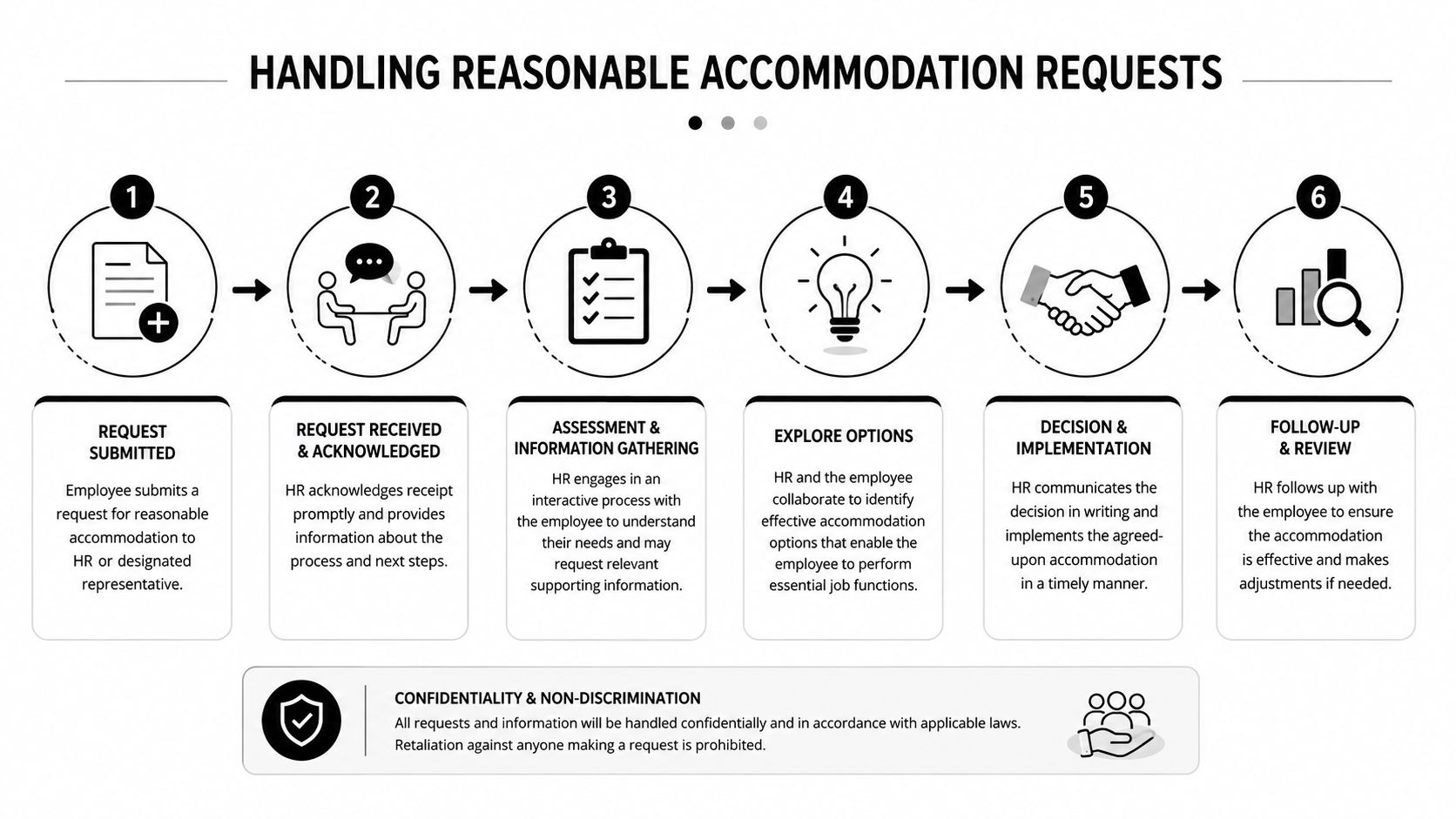
Handling Reasonable Accommodation Requests
A reasonable accommodation changes a housing rule, policy, practice, or service when a person with a disability needs that change to use and enjoy the home. A reasonable modification generally involves a physical change to the property. The request may concern an assistance animal, an accessible parking arrangement, a communication method, or another disability-related need.
Disability complaints make up a substantial share of national fair housing enforcement activity. The National Fair Housing Alliance's 2025 trends report states that disability-related discrimination accounted for 54.6% of complaints, compared with the other listed protected categories. That figure comes from the 2025 Fair Housing Trends Report, and it helps explain why landlords and tenants need a workable process for accommodation requests.
How a tenant should make the request
A tenant should make the request clearly and, when possible, in writing. The request doesn't need to use perfect legal language. It should identify the disability-related need and explain how the requested change connects to housing.
A useful written request can include:
- The rule or condition creating the problem.
- The accommodation or modification requested.
- The connection between the request and the disability-related need.
- A request for a written response.
A landlord may request reliable information when the disability or the need isn't obvious. Generally, the landlord may seek confirmation of the disability and information showing the connection between the disability and the requested housing change. The landlord shouldn't demand unrelated medical details or a complete medical history.
Service animals are not ordinary pets
A no-pet policy doesn't automatically answer a service or assistance animal request. If the animal is connected to a qualifying disability and the tenant provides legally sufficient support when it's needed, the landlord generally must evaluate the request as an accommodation rather than treating the animal as an ordinary pet.
That means a landlord shouldn't charge extra pet rent or a pet deposit because of the animal. The landlord may still address actual damage or conduct that violates neutral property rules, but the animal request must be handled through the accommodation analysis. Tenants considering an emotional support animal request can review whether a landlord can deny an ESA in Texas for questions to raise with counsel.
A good-faith conversation often prevents a paperwork problem from becoming a housing complaint.
Landlords should acknowledge requests, identify any necessary documentation, and respond without unnecessary delay. Tenants should explain the housing connection and keep copies of every communication. If the landlord denies the request, ask for the reason in writing and preserve the response.
Common Exemptions and Where They Stop
Fair housing exemptions exist, but they're narrow. A landlord shouldn't assume that owning a small property or renting a home privately eliminates every fair housing obligation.
Owner-occupied small buildings
An owner-occupied building with four or fewer units may qualify for an exemption when the owner lives in one of the units. The exemption depends on the actual facts, including the owner's occupancy and the building's structure. It isn't a general permission to discriminate in every interaction or advertisement.
Certain single-family rentals
A single-family home rented by the owner without a broker may qualify under specific conditions. The commonly described exemption involves an owner who owns three or fewer single-family houses at one time, but the conditions must be reviewed together. The owner must also avoid discriminatory advertising, and using a broker or property manager can affect the analysis.
Religious organizations and senior housing
Religious organizations may receive limited protection for noncommercial housing reserved for members, provided membership isn't determined by a protected characteristic. Senior housing may qualify when it meets specific age and occupancy requirements. A property doesn't become exempt merely because the owner calls it “senior-friendly.”
Use this checklist before relying on an exemption:
- Does the property meet the ownership and occupancy conditions?
- Is a broker, agent, or manager involved?
- Does the advertisement contain preference or exclusionary language?
- Is the organization's membership policy lawful?
- Does the senior housing program meet the required age and occupancy standards?
An exemption may change part of the analysis, but it doesn't erase obligations under leases, the Texas Property Code, local rules, or other civil rights laws. A landlord who receives a complaint should have the facts reviewed before taking action against the tenant.
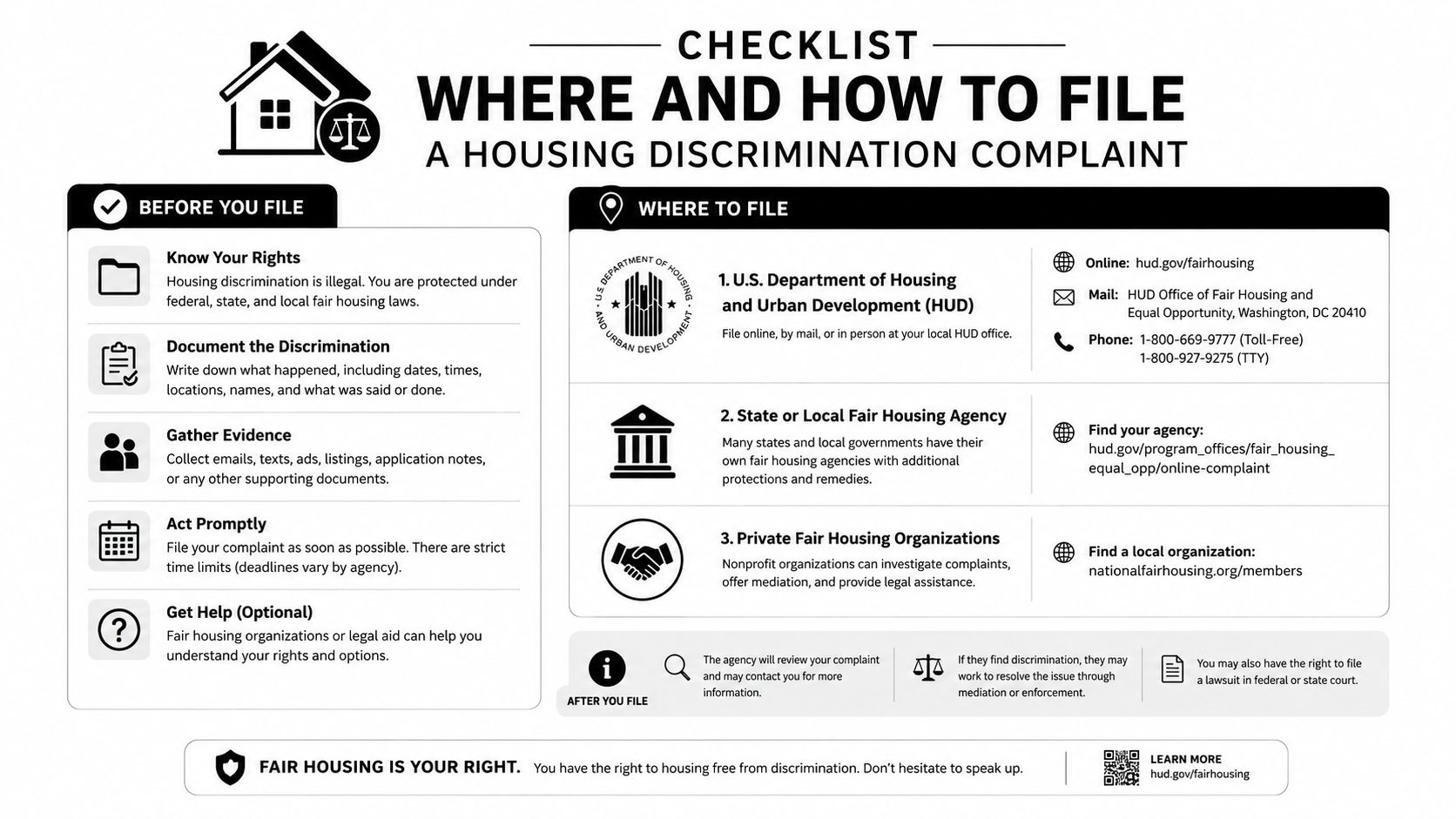
Where and How to File a Housing Discrimination Complaint
A Texas renter who believes a landlord or property manager treated them differently because of a protected class should act promptly. The Texas Workforce Commission Civil Rights Division handles housing discrimination matters under the state framework. A person may also contact the U.S. Department of Housing and Urban Development, commonly called HUD, about a federal fair housing complaint.
The Texas Workforce Commission housing discrimination page is a useful starting point for understanding the state process. A person should generally file with TWC within one year, and federal law generally uses a one-year filing period as well. Because deadlines and procedural choices can affect your rights, don't wait until the deadline is close.
Build the record before you file
Start with a simple timeline. Record the date of the application, showing, request, refusal, repair issue, notice, or other event. Then preserve the documents that show what happened.
- Save advertisements: Keep screenshots or copies of listings, including language that suggests a preference.
- Preserve communications: Store emails, text messages, letters, and voicemails.
- Identify witnesses: Write down names and what each person personally observed.
- Keep housing documents: Save applications, leases, notices, inspection records, and accommodation requests.
- Compare treatment: Note how the landlord treated similarly situated applicants or residents.
You may file an administrative complaint with TWC or HUD, or discuss a private lawsuit in state or federal court with an attorney. The best path depends on the facts, available evidence, timing, and the remedy you need.
Tenants can review how to file a complaint against a landlord for practical preparation. If the dispute involves business premises rather than a home, Commercial Lease Disputes in Texas addresses how commercial tenancies differ under Chapter 93.
Retaliation is a separate concern. Texas and federal law protect people who assert fair housing rights from being punished for making a complaint or participating in an investigation. Keep records of any rent increase, notice, service reduction, repair refusal, or other adverse action that follows a protected complaint.
Your Next Step Toward Fair Housing in Texas
The seven protected classes are the floor, not always the entire analysis. Local rules may add protections, disability requests require careful handling, and a neutral policy can still create problems if it operates as a cover for unequal treatment.
Tenants should document what happened and ask for written explanations. Landlords should use consistent screening criteria, neutral advertising, organized repair records, and a clear accommodation process. The Law Office of Bryan Fagan, PLLC offers a free 30-minute consultation to review a rental dispute, explain your rights, and help you choose a calm, strategic next step.
If you need help with an eviction, lease issue, discrimination concern, repair dispute, or rental disagreement, contact The Law Office of Bryan Fagan, PLLC for a free consultation today.
The Law Office of Bryan Fagan, PLLC helps Texas tenants and landlords evaluate fair housing concerns, lease enforcement, eviction issues, repairs, and related property disputes. Visit The Law Office of Bryan Fagan, PLLC to schedule a free consultation and discuss a practical legal strategy for your situation.