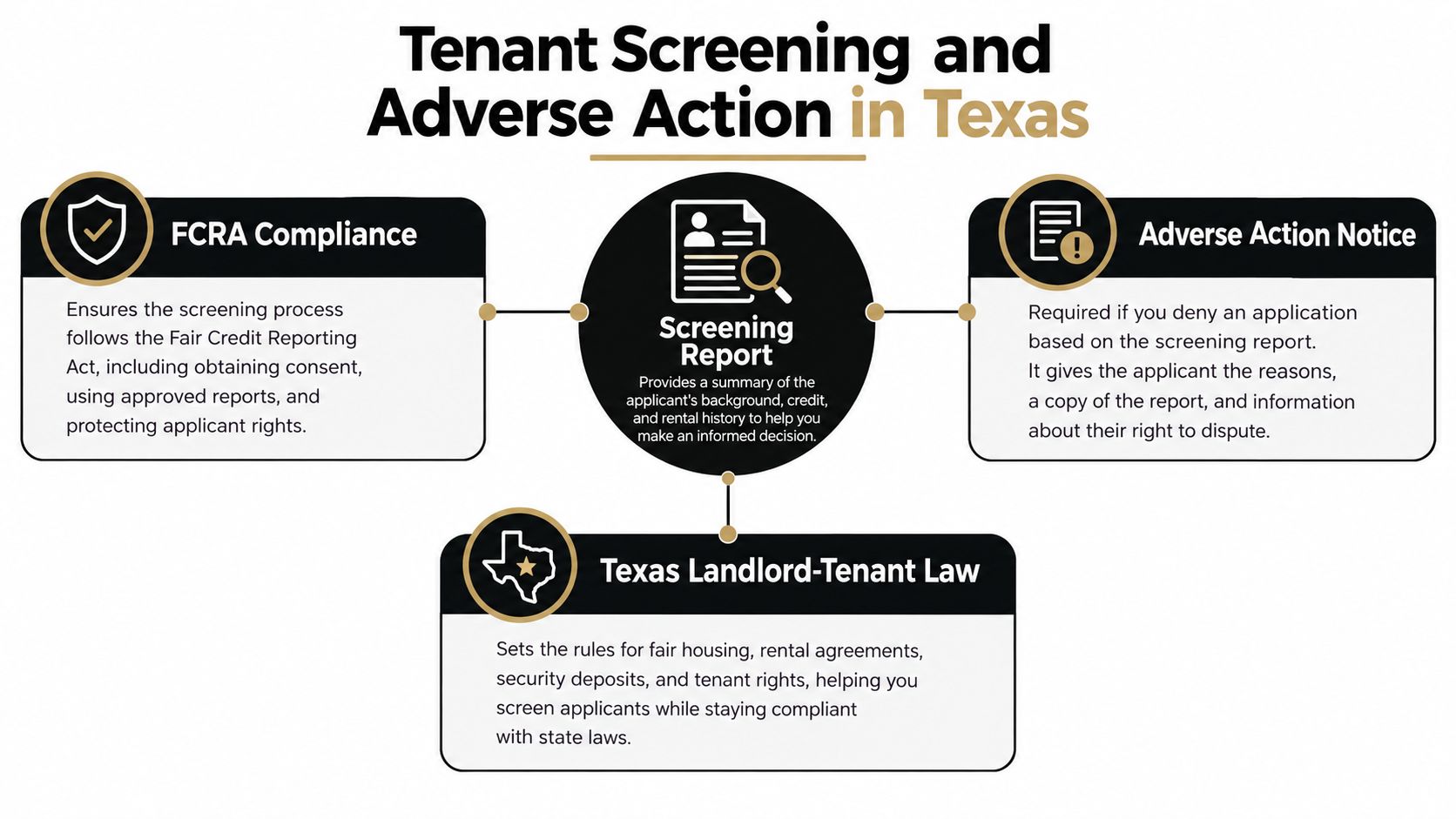
A landlord must provide an adverse-action notice when a tenant screening report contributes to an application denial or less favorable rental terms. The notice must identify the screening company and explain the applicant's right to dispute inaccurate information.
You may be facing this problem right now. You apply for a Texas rental, pay the application fee, and expect a straightforward answer. Instead, the landlord denies you, asks for a co-signer, raises the rent, or demands a larger security deposit without explaining what went wrong. The screening report may contain someone else's eviction, a duplicate court entry, or a case that was dismissed or sealed.
For landlords, the risk runs in the other direction. A property manager may believe that sending a generic rejection message is enough, especially when a third-party screening service made the recommendation. It isn't. The Fair Credit Reporting Act, or FCRA, places notice duties on landlords who rely on consumer reports, while Texas law separately regulates rental-application fees.
This guide explains the tenant screening report FCRA adverse action Texas rules in practical terms. It also addresses the gap between formal notice and meaningful transparency, because identifying a reporting company is useful only if the applicant can obtain the report, find the error, and challenge the decision.
Understanding Tenant Screening and Adverse Action
Maria applies for an apartment in Texas. Her income and references appear acceptable, but the landlord later says the application wasn't approved. The message doesn't explain whether the problem involved credit, rental history, or an eviction record. When Maria asks whether she can provide more information, the landlord says the screening company made the decision.
That response misunderstands the process. A tenant screening report can contain credit information, rental history, eviction information, and other background information supplied by a consumer-reporting agency. The FCRA treats these materials as consumer reports, and the landlord remains responsible for following the rules when report information influences the rental decision. The Federal Trade Commission's landlord guidance explains that the duty applies when report information leads to a denial or a less favorable rental term.
Adverse action is broader than rejection
An adverse action includes an outright denial, but it can also involve conditional approval. Suppose the landlord approves Maria only if she finds a co-signer, pays a larger security deposit, or accepts higher rent. If the report contributed to that condition, the landlord has taken adverse action even though Maria technically received approval.
The important question is causation. The report doesn't have to be the only reason for the decision. If it contributed to the denial or stricter terms, the notice requirement can apply. A landlord who relies on a report can't avoid the rule by saying that income, references, or another factor also played a role.
Practical rule: If the report affected the outcome, treat the decision as an adverse action and document it accordingly.
Why the report may be wrong
Tenant-screening data can be difficult to interpret. Regulators identified problems involving sealed records, unresolved eviction cases, multiple entries for one filing, and amounts that didn't match final judgments in the CFPB's rental-screening guidance. An eviction filing isn't automatically a final eviction judgment, and a database entry may not show what ultimately happened.
An applicant with a common name, a dismissed case, or a sealed matter may receive a notice that technically identifies the screening company but offers little practical explanation. That applicant should preserve the denial, request the report, and compare every entry against court records and personal documents. Guidance about criminal record screening and fair housing in Texas can provide additional context where criminal-history information is involved.
What an FCRA Adverse Action Notice Must Include
A compliant notice has a focused purpose. It tells the applicant that report information affected the decision, identifies the company that supplied the report, and explains how to challenge inaccurate or incomplete information. It doesn't turn the screening company into the decision-maker, and it doesn't require the landlord to provide a detailed narrative of every reason for rejection.
The required information
The notice must identify the consumer reporting agency by name, address, and telephone number. It must also explain three important points:
- The agency didn't make the housing decision: The landlord, not the screening company, decided to deny the application or impose the stricter term.
- The agency may not know the landlord's specific reasons: The reporting company generally can't explain why the landlord chose to reject the application.
- The applicant can dispute errors: The applicant has the right to challenge incomplete or inaccurate information with the reporting company.
The notice must also tell the applicant about the right to request a free copy of the report within 60 days. The FTC's consumer-report explanation confirms that the notice can be delivered orally, in writing, or electronically.
Written or electronic delivery is the safer practice for landlords because it creates a record. An oral notice may satisfy the delivery method, but it can leave both sides arguing about what was said, when it was said, and whether the reporting company's complete contact information was provided.
What the notice does not necessarily provide
Many applicants expect the notice to identify the exact record that caused the denial. Federal housing-reporting rules generally require the reporting company's contact information and dispute rights, but they don't necessarily require the landlord to explain the specific record that drove the decision. That gap can make a formally valid notice practically frustrating.
For example, a notice stating only that “information in a consumer report affected this decision,” followed by the agency's contact details, may satisfy the basic notice step. It still leaves the applicant needing to obtain the report and determine whether the problem is a duplicate eviction filing, an unresolved case, or mistaken identity.
Landlords should avoid blaming the screening service. The notice should accurately state the agency's role while documenting internally what report information contributed to the decision. Applicants should retain the notice because it establishes the identity of the agency and the date from which the 60-day free-report period is measured.
The federal adverse-action notice is separate from the eviction process. A landlord considering an eviction must also understand The Notice to Vacate: Requirements and Timing, including what a valid Texas notice must contain before an eviction can be filed.
Texas Application Fee Laws and FCRA Overlap
Texas treats the rental-application fee as its own issue. Texas Property Code § 92.351 defines an application fee as a nonrefundable amount paid to a landlord to offset the cost of screening an applicant for acceptance as a tenant. The statute's treatment of that fee doesn't replace federal FCRA duties.
That distinction matters because landlords and applicants often combine two separate questions. The first is whether the landlord handled the application fee properly. The second is whether a consumer report affected the rental decision and triggered an adverse-action notice.
One payment, two legal questions
Assume an applicant pays a nonrefundable screening fee, and the landlord later denies the application after reviewing a credit and eviction report. The fee issue concerns Texas Property Code § 92.351. The adverse-action issue concerns the landlord's reliance on the consumer report.
Paying the fee doesn't waive the applicant's federal rights. It doesn't authorize the landlord to hide the reporting agency, block a report request, or treat a screening vendor as the person responsible for the housing decision. Likewise, providing an adverse-action notice doesn't automatically resolve whether the application fee was disclosed or handled correctly under Texas law.
The applicant should keep a file containing:
- The application: Preserve the submitted form and any written screening criteria.
- The fee record: Save the receipt, payment confirmation, or other proof of the amount paid.
- The decision message: Keep emails, text messages, portal notices, and voicemail details.
- The adverse-action notice: Record when and how it arrived, along with the reporting company's details.
A landlord should maintain separate records for the application fee and the report-based decision. That simple separation helps prevent a property manager from sending a fee explanation when the applicant also needs a federal notice.
Where confusion creates risk
A landlord might say, “The fee covered the background check, so there's nothing more to provide.” That answer confuses payment for a service with notice of an adverse decision. The fee may help pay screening costs, but it doesn't eliminate the duty to notify an applicant when report information contributed to a denial or unfavorable lease condition.
Applicants can review the practical relationship between these issues in Texas law on application fees for rentals. If a landlord refuses to identify the reporting agency or declines to address an apparent reporting error, the applicant should preserve the records before deciding whether to send a demand, seek reconsideration, or consult a Texas landlord tenant lawyer.
Steps for Tenants to Dispute Inaccurate Screening Reports
A notice is useful only if you act on it. The dispute process should be organized, written, and supported by documents. Don't rely on a phone conversation alone, especially when the report involves an eviction record or a name that belongs to someone else.
Start with the notice and the deadline
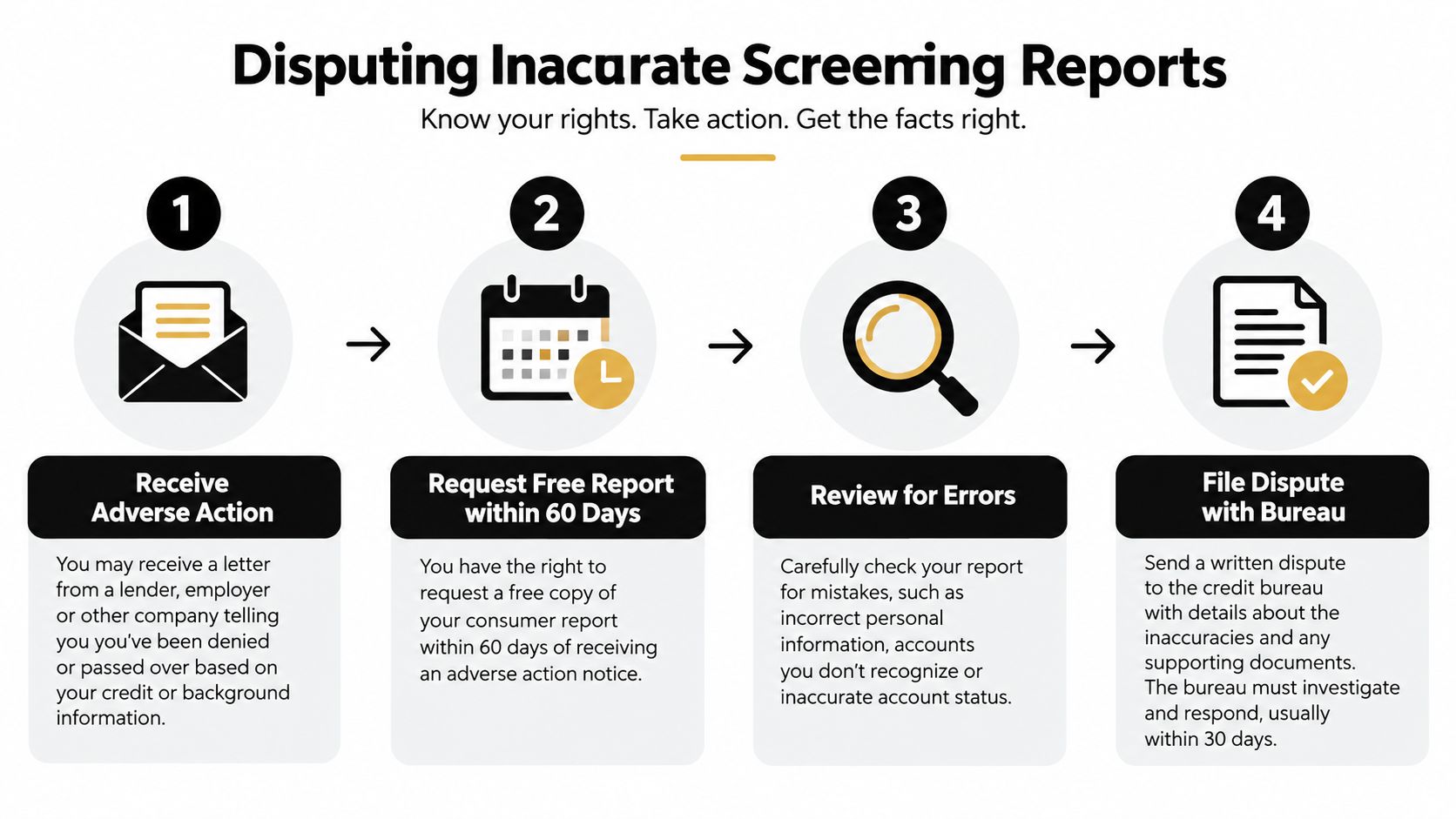
First, save the notice immediately. Note the date you received it, the delivery method, the landlord's stated decision, and the reporting company's name, address, and telephone number. Keep the rental application, fee receipt, lease terms offered, and every message exchanged with the landlord.
Second, request the free report within 60 days. The FCRA generally gives an applicant 60 days after receiving the adverse-action notice to request a free copy from the reporting company. Use the agency's official contact method and keep proof of the request.
Review each entry, not just the summary
When the report arrives, compare it with your records. Look for:
- Identity mistakes: A different person's eviction, debt, or criminal record may appear because names or other identifying information overlap.
- Duplicate entries: One eviction filing may appear multiple times and look like multiple proceedings.
- Unresolved matters: A filing may be shown without the dismissal, settlement, judgment, or other final result.
- Sealed or restricted records: Information that shouldn't be publicly reported may still appear in a database.
- Incorrect amounts: The report may list money that doesn't match the final court judgment or current records.
Write down the exact entry, why it's wrong, and what proves the correction. A court disposition, dismissal, satisfaction record, identity document, or sealing order can be more useful than a general statement that the report is inaccurate.
File the dispute and notify the landlord
Third, dispute each inaccurate item with the reporting company. Follow its dispute procedure, identify the specific entry, explain the error, and attach legible supporting documents. Keep copies of everything and use a delivery method that creates a record.
Fourth, notify the landlord in writing. Explain that you disputed the report, identify the challenged item, and attach enough information for the landlord to understand the issue. Ask whether the landlord will reconsider the application after the reporting company corrects the information.
You may be applying for another apartment while the dispute is pending. Tell future landlords that a report is under correction review, but don't assume they'll disregard it without documentation. A clean, dated file gives you a stronger explanation than a verbal denial that “the computer got it wrong.”
Commercial applicants should be careful not to apply residential assumptions to business premises. Commercial Lease Disputes in Texas addresses how Texas treats commercial tenancies differently under Chapter 93.
If the company refuses to correct an obvious error, the landlord won't reconsider, or the process appears discriminatory, gather the complete file for a Texas landlord tenant lawyer or another qualified attorney. Legal advice is especially important before making accusations, signing a lease with unfavorable conditions, or abandoning a potential claim.
Risk-Management Best Practices for Texas Landlords
A denial decision often looks simple on paper. In practice, the risk usually comes later, when an applicant asks why the report was wrong, why the notice was vague, or why one manager handled the file differently from another. The safest approach is to treat the screening report as one input, use written standards the same way each time, and keep a file that shows how the decision was made.

Build a process that can explain itself
Good risk management starts before the notice goes out. Review current records, check the details behind any adverse entry, and make sure the file reflects more than a shorthand label pulled from a vendor screen. As discussed above, confirm whether a reported eviction entry reflects a filing or a final judgment. Also watch for duplicate entries, sealed matters, unresolved cases, and amounts that do not match the underlying record.
A useful file should show:
- The criteria in effect: Keep the written screening standards that applied when the applicant submitted the application.
- The report relied upon: Preserve the report, or the relevant decision data, in a secure way.
- The report-based reason: Identify the information that contributed to the denial or less favorable term.
- The final decision: Record who made the decision and when.
- The notice delivery: Keep a copy of the adverse-action notice and proof of delivery.
Skip vague notes like “bad background.” They create trouble later. Write down the actual category of information that mattered, and whether the report affected a denial, a higher deposit, a co-signer requirement, or another condition. That kind of record does more than support formal compliance. It gives the landlord a clear, honest explanation if the applicant challenges the result, and it reduces the odds of a later explanation that does not match the original file.
Apply standards consistently
Landlords may screen for credit, rental history, or other lawful factors. Problems start when those standards shift from one applicant to the next, or when similar records get different treatment without a documented reason. Consistency protects the owner, the manager, and the applicant.
Criminal-history screening also needs judgment. A blanket response to any record can pull in dismissed matters, mistaken identity, or conduct with little connection to tenancy risk. A better process verifies the record, considers whether it is relevant to the tenancy decision, and leaves room for the applicant to point out an error before the file hardens into a final denial.
For what a landlord may legally ask during screening, review what Texas landlords can legally ask during tenant screening. For application-fee and screening rules, see Tenant Screening and Application Rules in Texas.
After a notice goes out, some applicants will dispute the report. Treat that as part of the process, not as a nuisance. A calm written response, a short reconsideration procedure, and a dated record of what was reviewed can resolve a bad report faster than refusing to engage. Property managers can also find rental dispute resolution tips for broader communication practices that help keep a screening dispute from turning into a larger conflict.
Conclusion and When to Seek Legal Help
The central rule is simple: when a tenant screening report contributes to a denial or less favorable rental term, the landlord must provide an adverse-action notice. The notice must identify the reporting company and explain the applicant's right to dispute incomplete or inaccurate information. Approval with a co-signer, higher rent, or a larger security deposit can still be adverse action when the report influenced the condition.
For tenants, the most common mistake is stopping after receiving a vague rejection. Save the documents, request the report within 60 days, inspect the underlying entries, and dispute each error in writing. An eviction filing isn't automatically a final judgment, and a record that appears under your name may belong to someone else or omit the outcome that resolves the case.
For landlords, the most common mistake is treating the screening vendor as the decision-maker. The vendor may provide the report, but the landlord decides whether to deny the application or impose stricter terms. A defensible process uses current information, distinguishes filings from judgments, applies written standards consistently, and preserves the report-based reason for the decision.
When a lawyer can help
A legal consultation can be useful when the notice omits the reporting company's information, the report contains a serious error, or the landlord refuses to reconsider after a correction. It can also help when the decision appears inconsistent with the treatment of comparable applicants, or when a tenant faces a related eviction, lease dispute, or housing discrimination concern.
Landlords may need advice before changing screening criteria, responding to a dispute, or deciding whether a conditional approval triggered federal notice duties. Tenants may need help preserving evidence, communicating with the reporting company, and evaluating whether the screening process caused a legally actionable harm.
The Law Office of Bryan Fagan, PLLC assists Texas landlords and tenants with screening disputes, lease issues, evictions, and other property conflicts. A Texas landlord tenant lawyer can review the notice, report, application file, and communications and help you choose a practical next step.
If a tenant screening report affected your rental application or your property-management decision, The Law Office of Bryan Fagan, PLLC can review the records, explain your rights under the FCRA and Texas Property Code, and discuss possible next steps in a free consultation. Contact the firm with the adverse-action notice, screening report, application documents, and related messages so the issue can be evaluated clearly.