Skip to content

Dealing with a landlord dispute or eviction can be stressful, especially when the next message, notice, or court date could affect your home or your rental income. A tenant may be staring at a notice to vacate after reporting serious repairs. A landlord may have discovered extensive damage, unpaid rent, or an unauthorized occupant and feel pressured to act immediately.
Texas property dispute resolution isn't one single process. Most rental conflicts move through one of four paths: negotiation, mediation, arbitration, or litigation. The path you choose affects cost, timing, control, possession, and the chance of recovering money. The evidence you preserve at the beginning often matters more than the argument you make later.
When a Rental Problem Becomes a Real Property Dispute
Consider a tenant who returns from work to find the locks changed. The tenant believes the landlord used self-help eviction tactics. The landlord believes rent is overdue and the lease was violated. Both sides are angry, but anger doesn't establish who acted lawfully. The lease, notices, payment records, communications, and court documents do.
Now consider a landlord who discovers damaged flooring, unpaid utilities, and several months of disputed charges after a tenant moves out. The landlord sees a large repair bill. The tenant sees ordinary wear and an unfair attempt to keep the security deposit. Without dated photographs, inspection reports, invoices, and a proper accounting, both positions become harder to prove.
Practical rule: Choose a resolution path only after you identify your goal. Keeping possession, recovering money, ending a tenancy, preserving a business relationship, and creating a court-enforceable result may require different strategies.
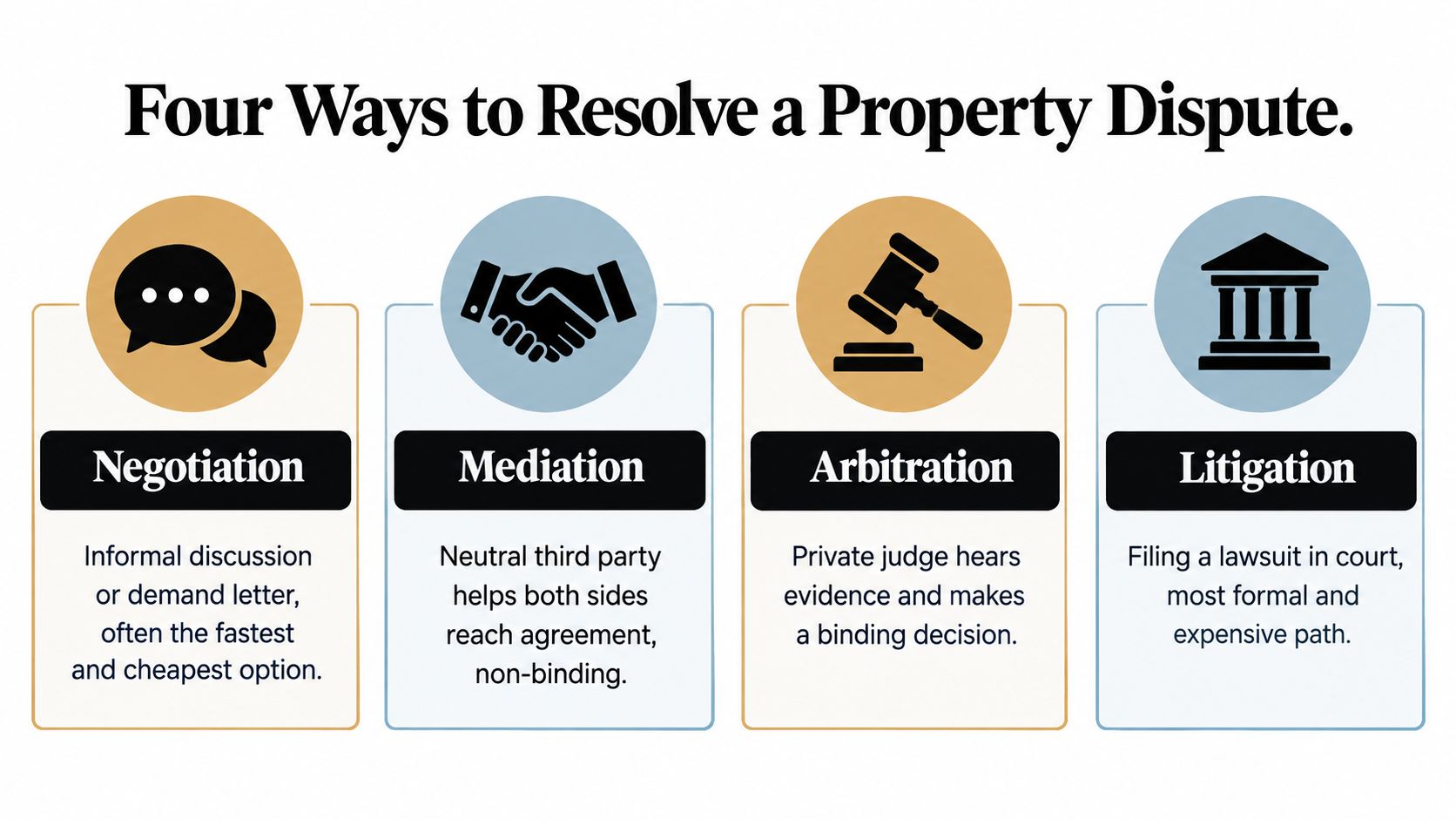
The four paths are straightforward:
- Negotiation is a direct conversation, demand letter, payment plan, repair agreement, or move-out arrangement.
- Mediation uses a neutral third party to help the landlord and tenant reach a written settlement.
- Arbitration places the dispute before a private decision-maker when the lease requires or permits it.
- Litigation asks a court to decide the dispute and enter an enforceable judgment.
Texas law supplies important guardrails at each stage. Notice requirements can determine whether an eviction was filed too early. Repair protections can limit what a lease may waive. Security-deposit rules can turn a disagreement into a deadline and accounting problem.
The first days matter because evidence disappears, deadlines run, and informal conversations become difficult to prove. Start a folder immediately. Save the lease, notices, texts, emails, photographs, payment records, inspection reports, repair requests, and every court paper. Then speak with a Texas landlord tenant lawyer before a missed deadline turns a negotiable dispute into a judgment.
The Disputes Texas Landlords and Tenants Face Most Often
Texas rental conflicts usually fall into a few familiar categories. Identifying the category helps you find the governing rule and the evidence that will carry the most weight.
Eviction and nonpayment
A landlord may claim unpaid rent, a lease violation, or holdover after the lease ends. A tenant may argue that rent was paid, the notice was defective, the amount is wrong, or the landlord failed to follow the lease.
Texas generally requires at least three days' written notice before an eviction lawsuit, unless the written lease provides a different period. The counting period begins when the notice is delivered. A lease requiring a longer notice period can control, so both sides should compare the notice with the actual lease before filing or responding.
The strongest evidence includes the lease, rent ledger, payment confirmations, notice, delivery proof, and any written agreement about late rent or repairs. A tenant should never ignore court papers. A landlord should never assume that an unpaid balance automatically authorizes a lockout.
Security deposits
Texas Property Code Section 92.102 defines a security deposit as advance money, other than a rental application deposit or advance rent, primarily intended to secure the tenant's performance under a residential lease. Section 92.104 addresses deductions, and Texas generally requires the landlord to refund the deposit by the thirtieth day after surrender when the legal conditions are met.
The tenant must provide a written forwarding address for refund purposes. The landlord should preserve the move-in and move-out condition records, receipts, work orders, and itemized accounting. A tenant sees an improper deduction when a landlord charges for ordinary wear. A landlord sees a legitimate deduction when documented damage exceeds ordinary use.
For a broader explanation of how Texas Property Code Chapters 91 through 94 and Chapter 24 govern the rental relationship, review Texas Landlord-Tenant Law: An Overview.
Repairs and habitability
A tenant may report unsafe conditions, water intrusion, broken air conditioning, plumbing problems, or other conditions affecting health or safety. A landlord may believe the condition was caused by tenant negligence, lack of access, or delayed reporting.
Texas Property Code Section 92.006 generally limits the ability to waive repair duties and tenant remedies concerning conditions that materially affect the physical health or safety of an ordinary tenant, subject to statutory exceptions. A tenant should provide written notice and preserve photographs. A landlord should document responses, contractor visits, access attempts, completed work, and any tenant-caused condition.
A property manager handling recurring pests should also keep professional treatment records. For Montgomery rental properties, Montgomery landlord pest solutions may help identify a practical maintenance resource, but treatment records still need to match the specific unit, date, condition, and work performed.
Entry, privacy, and lease violations
Tenants may complain about repeated entry without proper notice, surveillance, harassment, or utility shutoffs. Landlords may investigate unauthorized pets, occupants, alterations, or commercial use of a residential property.
The lease matters, but a lease doesn't give either party permission to ignore Texas law. Preserve entry notices, messages, photographs, witness information, inspection reports, pet records, and any communication about consent.
| Dispute Type | Primary Texas Law | Strongest Piece of Evidence |
|---|---|---|
| Eviction or nonpayment | Texas Property Code and lease notice terms | Lease, ledger, notice, and delivery proof |
| Security deposit | Sections 92.102 and 92.104 | Forwarding address, inspections, photographs, invoices, and accounting |
| Repairs and habitability | Section 92.006 and related repair provisions | Written repair request, dated photos, access records, and work orders |
| Entry and privacy | Lease terms and applicable Texas law | Entry notices, messages, video, and witness records |
| Unauthorized pet or occupant | Lease terms and enforcement notices | Signed lease, inspection records, notices, and communications |
Negotiation, Mediation, Arbitration, and Litigation Compared
The right path depends on what you need the result to accomplish. Negotiation offers the most control and usually the least procedural expense, but it works only when both sides can communicate and verify the facts.
Negotiation may involve a demand letter, a payment plan, a repair schedule, a move-out agreement, or a written agreement to dismiss a case after payment. It's realistic when the parties have a shared interest in avoiding cost and can state the terms precisely. It's weak when one party needs immediate possession, refuses to communicate, or has already ignored clear obligations.
Mediation adds a neutral person who helps the parties reach a voluntary settlement. The mediator doesn't decide who wins. The settlement should state the amount due, payment dates, possession deadline, repairs, dismissal or nonsuit terms, confidentiality, and consequences of default.
Texas's Eviction Diversion Program places mediation and rental assistance inside the court process. When the statutory conditions apply, the judge delays the case for sixty days, and the case information is treated as confidential. The program has resolved or stopped evictions for more than 25,000 renter households and distributed more than $243 million in rental assistance, according to the Texas Supreme Court's program summary. A court-based diversion process can be valuable, but it isn't a permanent defense if the case is reinstated.
Arbitration depends heavily on the lease clause. A private arbitrator hears evidence and issues a decision that may be enforceable as a judgment. Arbitration can provide privacy and a more focused process, but it may limit ordinary court review and can be a poor fit when urgent possession, emergency repairs, or a nonparty is involved.
Litigation provides the formal court process. In an eviction case, it can lead to judgment and a writ of possession. Litigation is necessary when the other side won't participate, a binding ruling is required, or the facts involve serious claims such as retaliation, lockout, habitability, or substantial damages.
For help evaluating whether mediation fits your dispute, review the firm's information about Texas real estate mediators. Whatever path you choose, attach the same evidence folder to the decision. A weak document trail makes every path slower and more expensive.
A Real Example Resolving a Move-Out Security Deposit Dispute
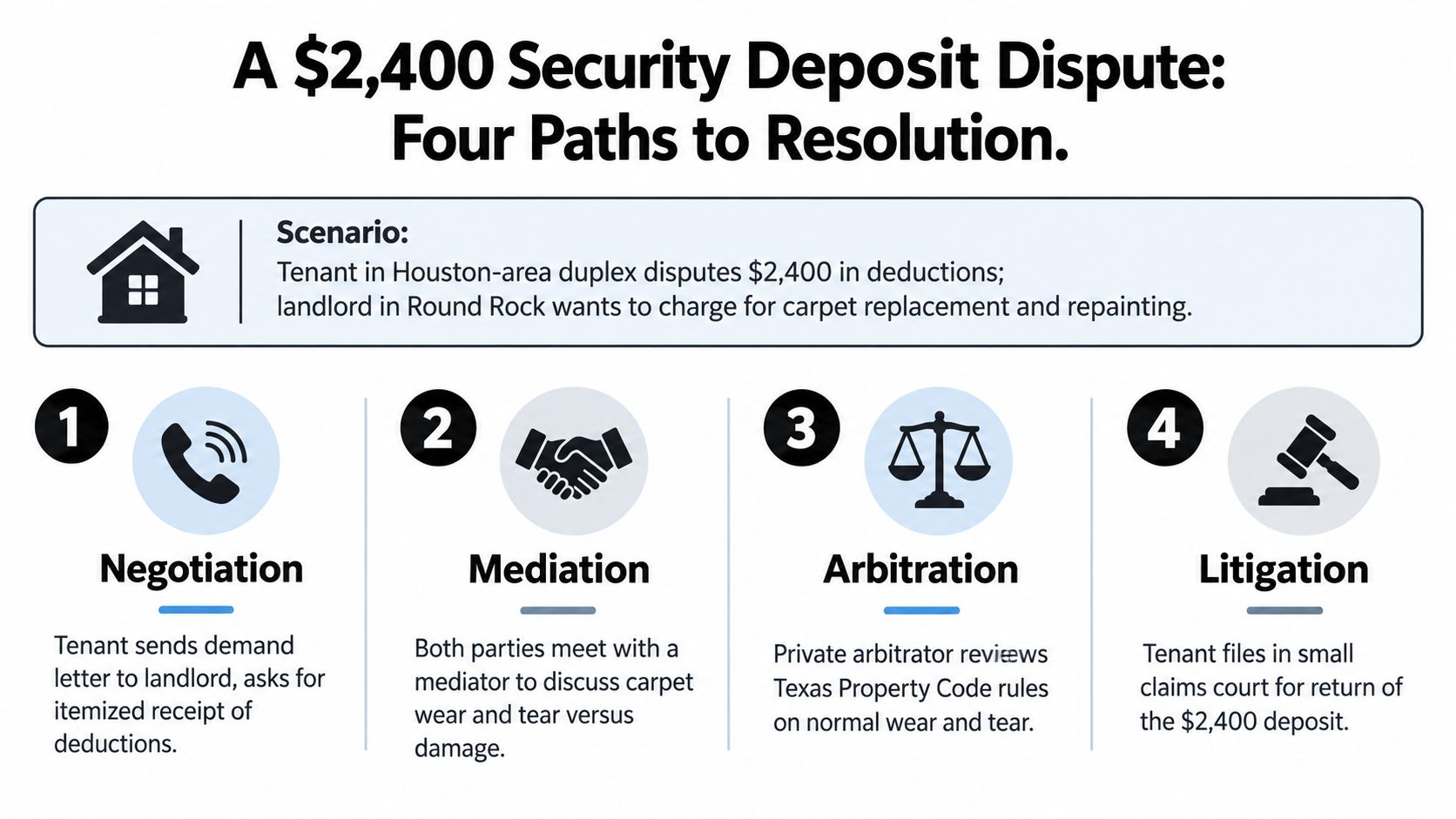
Suppose a tenant moves out of a Houston-area duplex and disputes $2,400 in deductions. The landlord, located in Round Rock, believes the tenant caused carpet damage and left walls requiring repainting. The tenant believes the carpet reflected ordinary wear and the repainting charge was excessive.
The first question is not who sounds more convincing. It's whether the landlord can connect each charge to a documented condition, a reasonable repair scope, and a cost. Texas law generally requires the landlord to refund the deposit by the thirtieth day after surrender, but the duty is tied to receiving the tenant's written forwarding address. When deductions are covered by Section 92.104(c), an itemized list is required when the tenant has paid all rent and no rent controversy exists. The parties should review the Texas security deposit itemized deduction rules before sending a demand or filing a claim.
Negotiation should come first if the accounting is fixable. The tenant can request missing invoices or challenge specific charges. The landlord can separate uncontested amounts from disputed charges and provide a written explanation. If the parties agree, the settlement should state the payment date and whether either side releases further claims.
Mediation is useful when the disagreement concerns wear versus damage. Arbitration may apply if the lease contains a valid arbitration clause. Litigation may be appropriate if the parties cannot agree and the evidence supports a claim. Before selecting a forum, preserve:
- The lease: Include deposit terms, inspection provisions, and notice requirements.
- Condition records: Keep move-in and move-out reports, dated photographs, and video.
- Repair proof: Save invoices, work orders, contractor communications, and payment records.
- Payment history: Preserve the rent ledger and proof of deposit payment.
- Forwarding-address evidence: Keep the written address notice and delivery confirmation.
- Accounting: Retain the landlord's itemized deductions and all delivery records.
A tenant planning a move should coordinate move-out notice timing alongside the lease's surrender requirements, while still sending legal notices through a traceable method. The same evidence folder works for repair disputes, lease violations, and habitability claims.
How Long Texas Property Disputes Actually Take
Deadlines control Texas eviction disputes. A tenant who waits for a perfect legal theory may lose the practical chance to keep possession. A landlord who files before the notice period ends may create an avoidable procedural problem.
The opening days
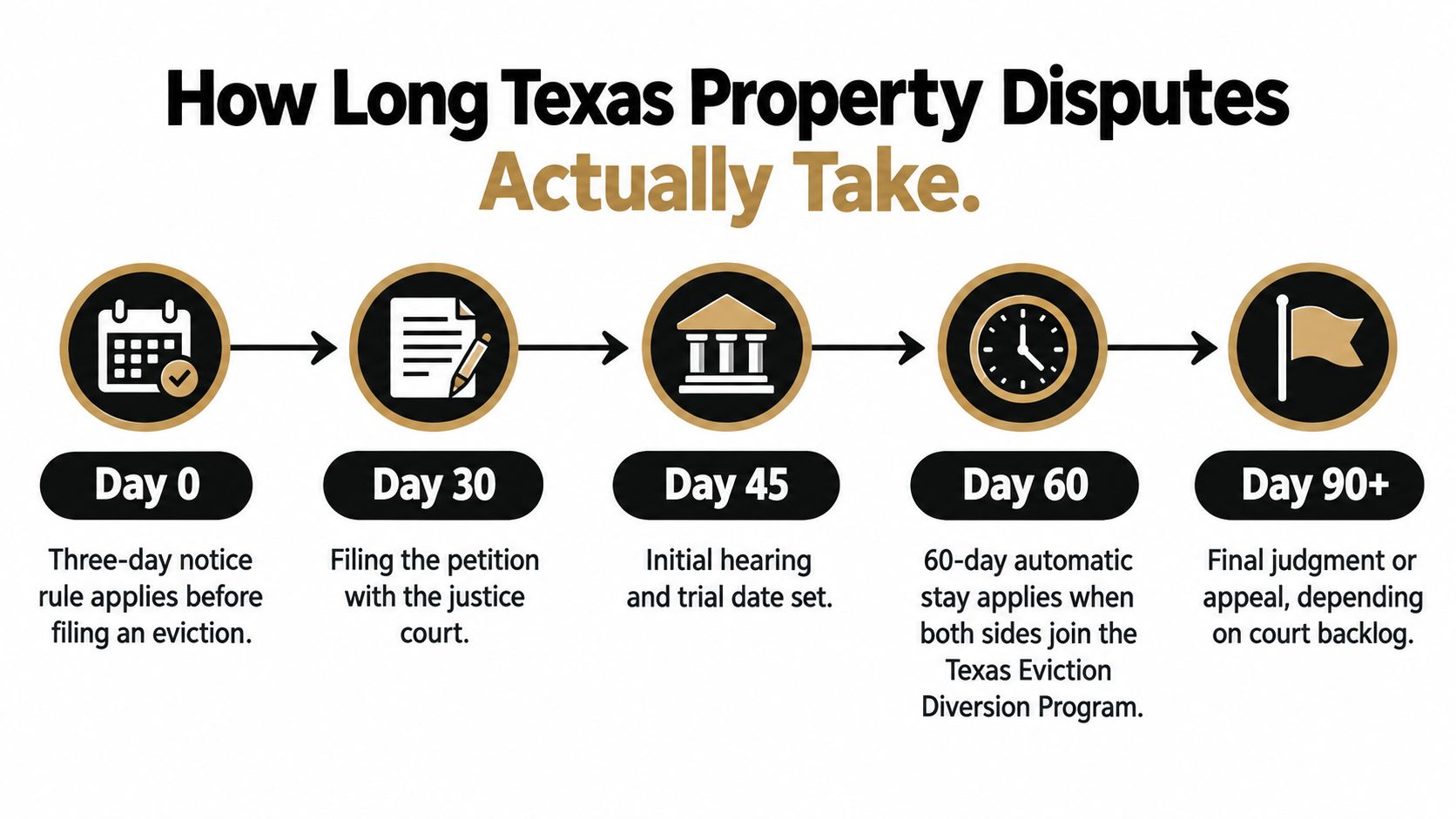
Before filing an eviction, the landlord generally must provide at least three days' written notice unless the lease requires another period. The notice period begins when the notice is delivered. On day one, the tenant should photograph the notice, preserve the envelope or posting, compare it with the lease, and organize payment and repair records. The landlord should record the date, time, delivery method, amount claimed, and lease provision involved.
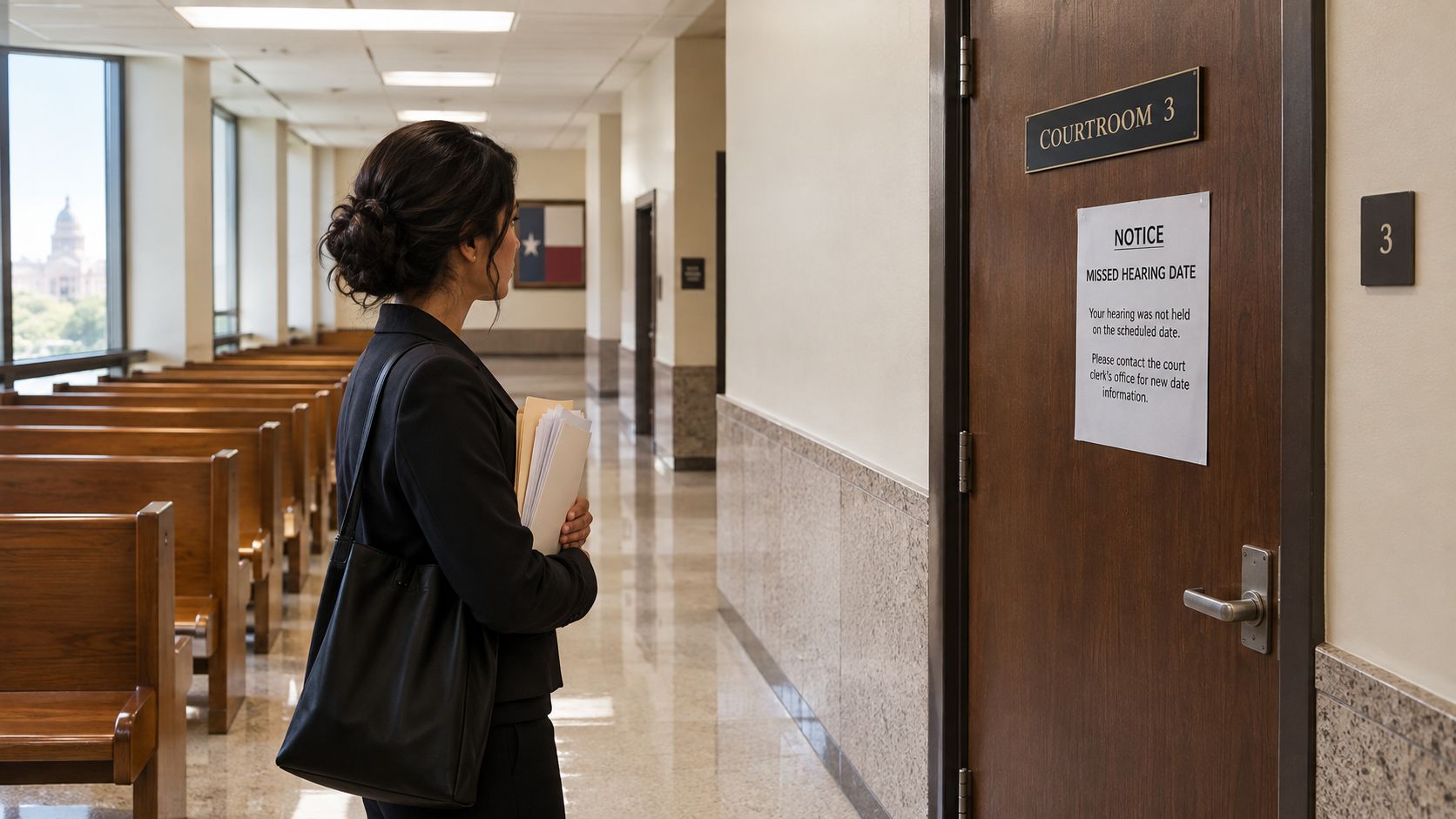
A court case then moves on its own schedule. Missing the hearing can result in a default judgment. A tenant should confirm the court, hearing date, appearance method, and available language or disability accommodations rather than assuming a phone call to the landlord cancels the case.
Diversion and appeal
When the Texas Eviction Diversion Program applies, the judge delays the proceeding for sixty days. During that period, the parties can pursue rental assistance, payment terms, repairs, or a move-out agreement. A landlord may request reinstatement. If the case is reinstated, the judge must set trial within twenty-one days.
After judgment, a party may generally perfect an appeal by filing an appeal bond, cash deposit, or Statement of Inability to Afford Payment of Court Costs within five days after the judgment is signed. The Texas courts' eviction materials explain the diversion process and the procedural setting. The Texas courts' referral materials also address the notice and appeal timing rules.
A calendar is part of your evidence. Put every notice, hearing, payment date, repair appointment, and appeal deadline in one place.
On day seven, the tenant should know whether an answer, appearance, payment, or diversion application is required. By day thirty, both sides should have a complete chronology and a written position. Don't confuse a delay with a resolution. A case is resolved only when the written agreement or court order says what happens next.
What to Do in the Next 30 Days as a Landlord or Tenant
A clear plan beats a vague promise that the other side will act fairly. Use the next thirty days to create a record, protect deadlines, and test whether settlement is realistic.
Tenant playbook
Start with written communication. Send repair requests, deposit demands, and responses to notices through a method that preserves delivery proof. Keep dated photographs, videos, payment confirmations, lease pages, inspection records, and every text message in a single folder.
Then review the notice against the lease. If you receive an eviction citation, confirm the court and appearance information immediately. Ask about mediation or diversion when available, but don't assume that a pending assistance application eliminates the need to appear.
Avoid withholding rent without first confirming the statutory procedure and the facts supporting it. A serious repair complaint can support important rights, but an incorrect rent strategy can give the landlord an additional ground to pursue.
Landlord playbook
Record the date, time, and method of every notice. Before filing, verify the lease's notice period, the amount claimed, the tenant's payment history, and whether an earlier agreement changed the due date or cure terms.
At surrender, separate ordinary wear from chargeable damage. Calendar the deposit deadline immediately, confirm the forwarding address, gather the invoices and work orders, and prepare an itemized accounting supported by records. Don't charge a tenant for a condition you can't connect to the tenant's conduct or a reasonable repair cost.
What both sides should put in writing
If you settle, write down the exact amount, payment dates, possession terms, repair duties, dismissal or nonsuit terms, confidentiality provisions, and consequences of default. A handshake may end the argument for a day. A signed agreement tells each party what happens when the next payment or deadline arrives.
Where Self-Help Stops Working in Texas
A missed court date can produce a default judgment before you have explained your side. A lockout, utility shutoff, retaliation allegation, habitability dispute, discrimination claim, or major damage claim requires more than a phone call or template letter. At that point, choose the right path: negotiate only when the facts and deadlines are controlled, mediate when both sides can participate meaningfully, arbitrate when the agreement requires it, and litigate when court protection or enforcement is necessary.
Texas Property Code Section 92.008 addresses utility interruption and certain landlord conduct affecting a tenant's possession. A landlord should not change locks, remove property, or shut off utilities to force a tenant out without confirming the lawful process. A tenant should not treat a serious dispute as permission to ignore court papers. Save the lease, notices, payment ledger, repair records, photographs, and every communication before choosing a forum.
Self-representation becomes harder in commercial lease enforcement, disputes involving multiple units, complicated security-deposit accounting, or competing claims for repairs and rent. A form cannot identify a lease modification, explain an inconsistent ledger, preserve an appellate issue, or establish which evidence supports each claim. Your folder should include the signed lease and amendments, notices, invoices, inspection records, photographs, and a dated chronology.
Access can determine which path is realistic. A 2025 Texas legal-aid analysis reported people-served penetration of 1.56% in rural counties, 2.16% in urban and metropolitan counties outside Harris County, and 1.93% in Harris County, according to The reported Texas rural-justice analysis. The analysis identified distance, broadband, language needs, self-representation, and court infrastructure as access factors. It also describes seven legal-aid organizations establishing 170 rural legal outposts.
Mediation is not automatically available or fair. Oregon community resolution centers mediated 1,490 post-filing eviction cases in fiscal year 2025, representing 5.2% of 28,358 statewide eviction filings, according to the Oregon legislative document. The comparison reinforces practical requirements: confirm participation, transportation, language access, timing, and the documents supporting your position.
If travel or broadband is limited, write a dated chronology, store communications in two places, confirm the court and deadlines, request language or disability accommodations, and separate safety emergencies from ordinary lease disagreements. Those steps reduce procedural mistakes while you seek a free case assessment.
When Hiring a Texas Property Lawyer Pays for Itself
A lawyer often pays for the service by preventing the wrong move. Representation is especially valuable when you're defending an eviction, facing a possible default judgment, asserting habitability or retaliation claims, enforcing a commercial lease, or disputing a security deposit involving several units.
A Texas landlord tenant lawyer can review the lease, notice, ledger, repair history, and court papers in the right order. A tenant may need an eviction attorney to identify defective notice, payment proof, retaliation facts, or appeal deadlines. A landlord may need counsel to correct a notice, document damage, prepare a lawful filing, or turn a proposed settlement into enforceable terms.
The Law Office of Bryan Fagan, PLLC offers a free thirty-minute consultation that can evaluate the lease and notices, identify the strongest defenses or claims, and outline the next step. Depending on the matter, the firm may discuss a flat-fee or limited-scope arrangement where available. For general cost context, you can also compare property tax attorney costs, though a rental dispute requires its own facts and fee discussion.
Come prepared with the lease, notices, payment records, photographs, repair communications, inspection reports, and court information. You can also review the firm's Texas rental lawyer services before the consultation.
The Law Office of Bryan Fagan, PLLC helps Texas landlords and tenants assess evictions, lease disputes, repairs, security deposits, and other property conflicts with practical guidance tied to the Texas Property Code. Schedule a free consultation by visiting The Law Office of Bryan Fagan, PLLC and bring your lease, notices, timeline, and evidence folder so you can leave with a clear next step.