Texas has no fixed dollar limit for a move-out cleaning charge, but a landlord can only collect the actual, reasonable cost of cleaning beyond ordinary wear and tear. In Texas, that usually means the bill has to match real turnover work, not routine cleaning that comes with normal living.
Moving out is stressful enough without a surprise deduction from your security deposit. The lease is ending, the keys are almost turned in, and then the landlord sends a cleaning charge that feels too high or too vague. Texas law gives both sides a framework, and once you understand it, the question becomes less about a magic number and more about proof, lease language, and timing.
Understanding Your Rights on Move-Out Cleaning Charges
A common move-out fight starts the same way. The tenant thinks the unit was left in good shape, the landlord sees extra cleanup, and the security deposit becomes the battleground. In Texas, that dispute doesn't turn on guesswork. It turns on whether the charge is tied to the tenant's legal responsibility under the lease and whether the landlord can document the cost.
What the real question is
The better question isn't “How much can a landlord charge for cleaning in Texas?” It's “What condition did the tenant leave behind, and what did it cost to fix?” That distinction matters because Texas Property Code § 92.104 allows deductions for damages and charges the tenant is legally liable for, which is why a clear lease clause often matters more than any supposed flat fee. For practical move-out prep, Neat Hive Cleaning's move-out advice is a useful reminder that a neat walkthrough before keys are returned can prevent a lot of deposit friction.
A simple tenant and landlord example
Think of a tenant who vacuumed, wiped counters, and mopped the floor, but left grease on the stove and trash in a closet. That's different from a tenant who left the apartment broom-clean and ready for ordinary turnover. One may support a modest cleaning charge, the other may not support much of anything beyond normal inspection items.
Practical rule: if the charge sounds like a routine turnover cost, ask whether it's really tied to tenant-caused cleanup beyond normal use.
Texas also doesn't publish a statutory price list. In the market, cleaning charges often land somewhere around $100 to several hundred dollars, and published Texas guidance commonly places typical single-family or apartment cleaning fees at $150 to $500 or about $50 to $90 per hour when cleaners are billed by the hour. Those figures are benchmarks, not legal caps, but they help you spot a charge that's wildly out of line.
The Reasonable Cost Rule Under Texas Law
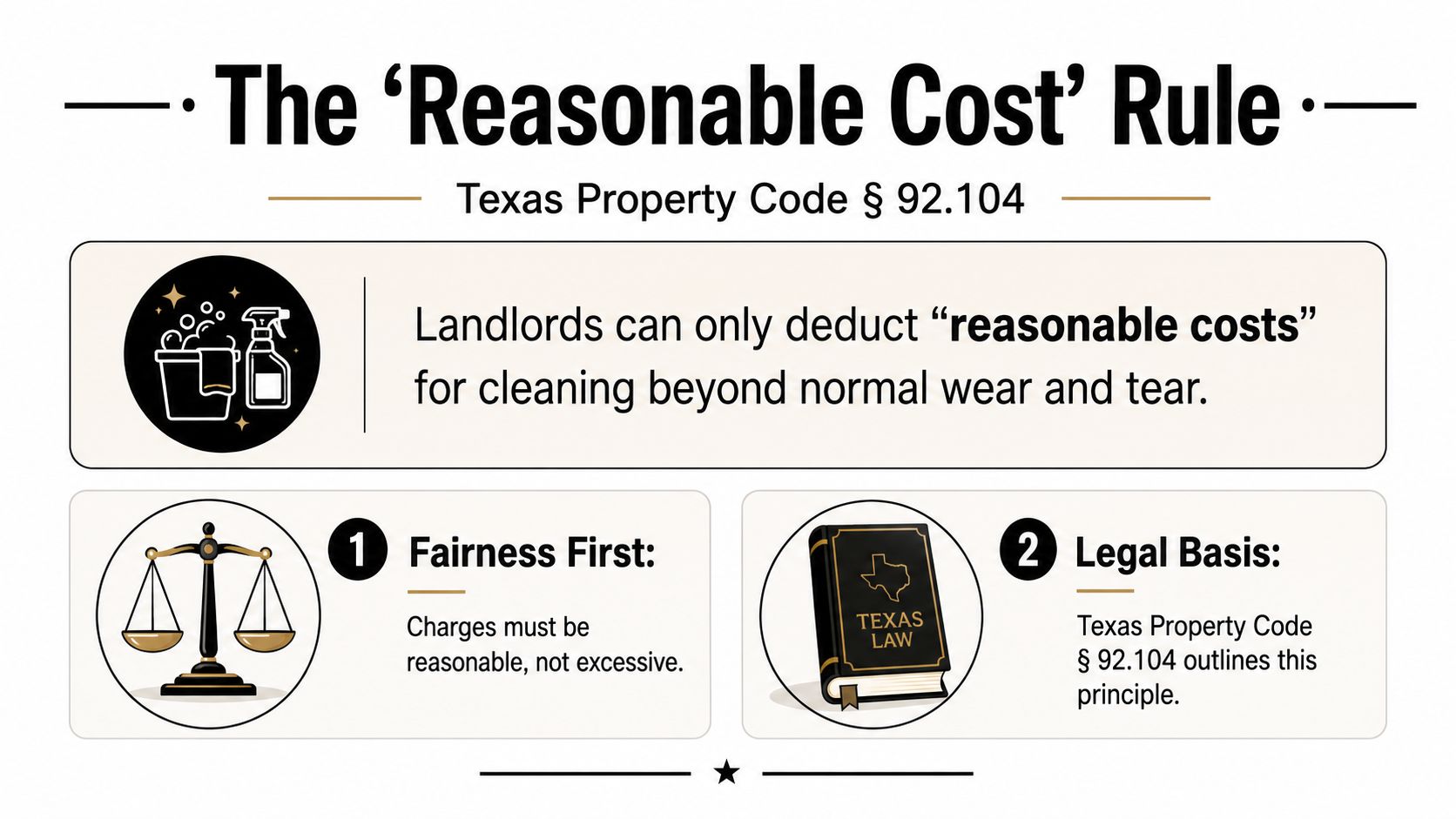
Texas does not set a statutory dollar cap on cleaning charges. Instead, the charge has to reflect the landlord's actual, reasonable cost for cleaning beyond normal wear and tear. That's the core rule, and it's why a charge that looks like a penalty, rather than reimbursement, often becomes vulnerable in a deposit dispute.
What reasonable means in practice
Reasonable means the landlord can connect the bill to a real service, a real invoice, or a real internal cost that was necessary to restore the unit. It does not mean the landlord can pick a round number because the lease is ending. If a landlord hires a cleaner, the invoice should match the work. If the landlord does the work personally, the claimed amount should still be tied to actual cleanup effort, not a made-up fee.
Texas Property Code § 92.104 is the legal anchor for this approach, because it allows deductions for amounts the tenant is legally liable for under the lease. That's also why a lease that clearly covers move-out cleaning standards matters so much. The statutory rule and the lease work together.
Using market pricing as a reality check
Market guidance is not the law, but it can show whether a deduction is in the right range. Published Texas landlord and property-management guidance commonly describes move-out cleaning fees as falling around $150 to $500 for a typical rental unit, or about $50 to $90 per hour for hourly billing. Those numbers help you evaluate whether a landlord's charge is plausible or inflated. You can review the market framing in Texas Landlord-Tenant Law: An Overview, which explains how Texas Property Code Chapters 91-94 and Chapter 24 shape the rental relationship.
A landlord who charges far more than the documented cleanup work usually has a problem. So does a tenant who left the place in a condition that obviously required extra labor. The law tries to put both sides back where they should be, not to give either side a windfall.
Distinguishing Normal Wear and Tear from Actual Damage
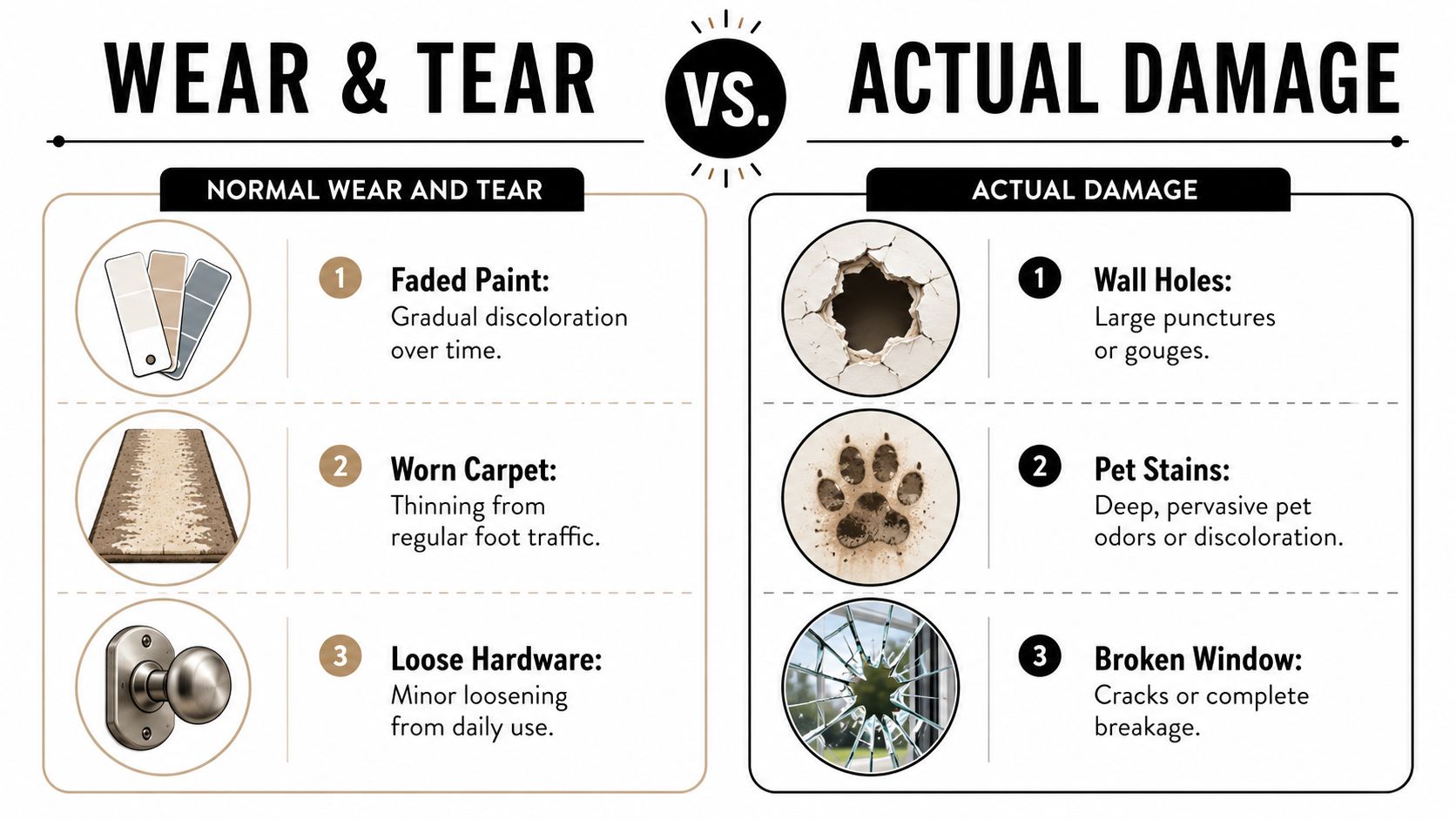
A move-out inspection usually turns into a fight over labels. A landlord may call a charge “cleaning,” while the tenant sees ordinary living conditions that should not come out of a deposit. Texas law draws a real line between normal wear and tear and actual damage, and the label alone does not control the result.
Normal wear and tear is the gradual effect of living in a home. Actual damage is extra harm that goes beyond ordinary use and requires repair, replacement, or specialized cleaning. A faded wall from sunlight is one thing. A hole in the wall, pet urine in carpet padding, or burned flooring is another. For a more direct explanation of that line, see can a landlord keep a deposit for normal wear and tear in Texas.
Side-by-side examples that usually hold up
A faded paint edge from sunlight is normal wear and tear. A hole punched through drywall is damage. A worn path in a hallway carpet is expected in a busy home. Pet urine soaked into the carpet backing is different, because that can require odor treatment or replacement work.
A practical checklist helps both sides sort the charge before the argument gets personal:
- Faded paint, minor scuffs, and small nail marks: usually wear and tear.
- Large holes, broken blinds, and shattered fixtures: usually damage.
- Dust on baseboards or normal floor soil: usually part of turnover.
- Grease buildup, trash, or heavy grime: often supports a charge if the cleaning went beyond ordinary use.
- Light carpet wear from foot traffic: usually not chargeable.
- Stains, odors, or burns on carpet: can support a charge if they exceed normal use.
That checklist works best when it is tied to the actual condition of the unit, not a general suspicion that the tenant should pay something. A landlord who documents what was found has a much stronger position than one who just picks a round number and calls it cleaning.
For tenants trying to understand the line, a practical comparison helps more than legal jargon. What a Landlord Can and Cannot Deduct From a Deposit is a useful companion resource because it focuses on which charges are permitted and which are not.
Carpet cleaning and the gray areas
Carpet cleaning comes up constantly because it sits right on the edge between turnover and damage. Landlords generally cannot charge for routine carpet shampooing unless the lease specifically requires it or the carpet has stains, odors, or similar issues that go beyond ordinary use. A tenant who cleaned on their own may still face a charge if the unit was not left in a reasonably clean condition.
The hard part is the gray area. A tenant may point to vacuum lines and a wiped floor, while the landlord points to embedded odors or residue that need more than a quick pass with a mop. The answer depends on what the surface looked like, what the lease required, and whether the work went past ordinary housekeeping.
If you are dealing with hardwoods instead of carpet, tips for cleaning hardwood floors can help you judge what a reasonable final-clean standard looks like without crossing into damage or over-cleaning.
A Landlord's Legal Duties for Security Deposit Deductions
A landlord's paperwork matters as much as the cleaning bill itself. Once the tenant provides a forwarding address, Texas law generally gives the landlord 30 days to return the deposit or send an itemized list of deductions. That deadline is one reason cleaning charges need to be specific, supported, and tied to the actual condition of the unit.
What itemized really means
An itemized list should state the charge, explain the reason for it, and show the amount. “Cleaning fee” by itself is too vague to carry much weight. “Deep cleaning of kitchen grease buildup” or “carpet odor remediation in living room” gives the tenant enough detail to understand what the landlord says happened and how the amount was calculated.
Texas law also treats missed deadlines seriously. Under Texas Security Deposit Law, a landlord who wrongfully withholds a deposit after failing to meet the statutory requirements may face substantial consequences, including liability for three times the wrongfully withheld amount plus attorney's fees. That is why careful landlords keep receipts, notes, photos, and invoices ready before the deadline runs out.
Why timing changes the whole dispute
The timing rule protects both sides. A tenant cannot wait without limit and then complain that the deductions were unclear, and a landlord cannot wait and then assemble a post hoc explanation later. Once the forwarding address is provided, the clock starts, and the landlord should act as if the deposit may be reviewed in court.
Texas Attorney General guidance also explains that landlords may deduct for repairs or charges only after the tenant has failed to fix a condition that falls within the lease or the statute, and the law presumes 7 days is a reasonable repair window for certain habitability issues after proper notice. That does not mean every cleaning dispute turns on a repair deadline, but it does show how seriously Texas treats notice and documentation.
The practical lesson is simple. A landlord who documents what was found has a much stronger position than one who picks a round number and labels it cleaning.
How to Formally Dispute Unfair Cleaning Charges

A tenant who thinks the charge is unfair shouldn't guess, argue by text, or hope the landlord changes course. Use a process. A clean record, a written demand, and, if needed, a court filing usually put the issue on firmer ground.
Step 1, gather the proof
Start with the lease, move-in photos, move-out photos, and every message about cleaning or repairs. If you have a walkthrough checklist, keep that too. The point is to compare what the unit looked like when you moved in with what it looked like when you left.
Practical rule: if you can't show the condition of the unit before and after, the dispute gets harder to win.
Also look at the itemized deduction statement. If it says “cleaning” but gives no detail, that's a red flag. If it lists a carpet deodorizing charge, check whether the lease required professional carpet service or whether the carpet had a specific issue.
Step 2, send a formal demand letter
A demand letter should be short, direct, and calm. State the facts, identify the amount you dispute, explain why the charge is unreasonable or unsupported, and ask for a refund by a specific deadline. Certified mail is smart because it creates a paper trail.
If you want a model for structure and tone, How to Write a Demand Letter to Landlord Texas lays out the approach in practical terms. Keep the tone professional. Angry language usually hurts more than it helps.
Step 3, consider Justice Court if the dispute stays unresolved
If the landlord refuses to fix the deduction, Justice Court may be the next step. Texas tenants often bring deposit disputes there because the amount in controversy and the legal questions are usually straightforward. Bring your lease, photos, receipts, demand letter, and the landlord's itemization.
A Justice Court judge will usually want to know one thing first, whether the charge was supported by the condition of the unit and the paperwork. If the landlord can't explain the cost, the case gets simpler for the tenant. If the tenant left behind real cleanup work, the landlord's records matter a lot.
When You Need a Texas Landlord-Tenant Lawyer
The answer to how much can a landlord charge for cleaning in Texas comes down to reasonableness, documentation, and the difference between routine turnover and actual tenant-caused cleanup. If the landlord keeps the deduction narrow, itemized, and tied to real costs, the charge may stand. If the landlord throws out a vague bill, misses the deadline, or tries to treat ordinary wear and tear like damage, the tenant has room to challenge it.
That's the point where a Texas landlord tenant lawyer can make a real difference. Legal help is especially useful when the landlord refuses to communicate, claims an unusually high amount without proof, or starts retaliating after the tenant questions the deduction. It also matters when the dispute overlaps with repairs, eviction threats, or other lease problems, because the cleaning issue may be just one part of a larger conflict.
The Law Office of Bryan Fagan, PLLC works with Texas tenants and landlords on rental disputes, security deposit issues, and lease enforcement questions. In a close case, a lawyer can help sort out what the lease says, what the Property Code allows, and what evidence will matter most if the dispute goes further.
If you're trying to protect your deposit, defend a deduction, or avoid making a mistake that turns into a bigger case, don't wait until the deadline has passed. Get the paperwork in order, keep the communication in writing, and get legal advice before the dispute hardens.
If you need help with an eviction, lease issue, or rental dispute, contact The Law Office of Bryan Fagan, PLLC for a free consultation today.