Skip to content

Your key won't turn, your landlord isn't answering, and you don't know where you'll sleep tonight. If you're asking, “How much can I sue a landlord for wrongful eviction?” you need more than a promise that you have rights. You need a realistic way to value your losses and a plan for protecting your housing.
Coming Home to a Lock You Did Not Change
Consider a hypothetical Dallas renter returning from a weekend away. The apartment has a new lock, a notice is taped to the door, and some belongings are missing. The landlord's message says the tenancy is over, but the renter hasn't seen a court judgment.
The immediate questions aren't legal abstractions. Where are the medications? Can the children get their school clothes? Who pays for temporary lodging?
Don't confuse a landlord's demand to leave with legal authority to remove you. Texas provides a court-based remedy for tenants who have been unlawfully excluded, including a procedure to request restoration of possession under Texas Property Code §92.009.
Separate Your Housing Emergency From Your Money Claim
Your immediate objective may be getting back inside. Your financial objective is different: identifying what the landlord did, which remedies apply, and what losses you can prove.
Keep those objectives separate when you speak with a lawyer or court clerk:
- Access: Explain whether you're still locked out and whether essential belongings remain inside.
- Court status: Identify any eviction petition, judgment, or writ you've received.
- Financial harm: Start recording expenses and missing property without guessing at values.
Your lease belongs in that file, too. Read provisions about possession, notices, default, access, and property removal. For readers dealing with a separate land-rental arrangement, LiveDocument's discussion of clauses that matter in land leases offers a useful contract-review starting point, but it shouldn't replace analysis of residential tenant protections.
Practical rule: Decide what you need the court to do now before deciding how much money to demand later.
That approach matters whether the rental is in Houston, Dallas, Austin, or San Antonio. You don't need to arrive with a polished lawsuit. You do need an accurate timeline, the documents you already have, and a clear explanation of whether you're seeking access, compensation, or both.
What Texas Law Calls a Wrongful Eviction
“Wrongful eviction” describes several different problems, not a single claim with a standard payout. The Texas Attorney General's renter-rights guidance explains that landlords cannot evict without cause or otherwise disturb a tenant's right to peace and quiet.
The legal question is what the landlord did. A defective notice, a changed lock, and destruction of your belongings require different analysis.
Identify the Conduct Before Naming the Claim
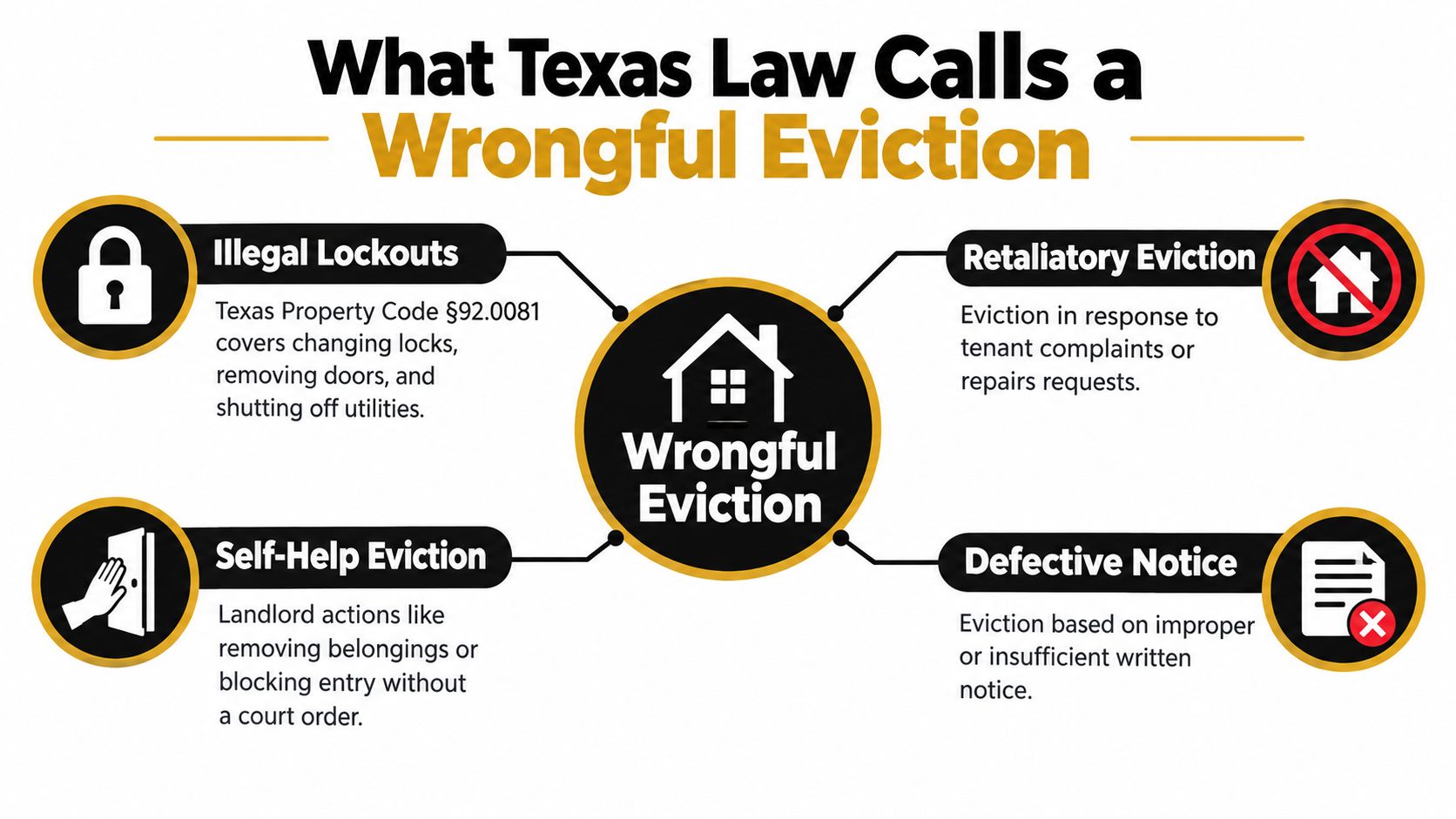
- Unlawful lockout: The landlord excludes you in violation of the residential lockout rules. Texas Property Code §92.0081 addresses prohibited exclusion and removal of certain doors, fixtures, and landlord-provided items.
- Self-help removal: The landlord uses personal action, such as taking belongings or blocking access, instead of obtaining lawful possession through court.
- Constructive eviction: The claim concerns conditions or interference serious enough to force you out, rather than a physical removal. Leaving an unpleasant apartment doesn't automatically establish this claim.
- Retaliatory or discriminatory conduct: The landlord's reason for seeking removal may create a separate issue. Preserve communications connecting the action to your complaints or other protected circumstances.
The following visual groups several warning signs. Its notice and utility examples require their own legal analysis; don't assume every branch creates the same remedy under the lockout statute.
A Lock Change Isn't Always an Eviction
Precision matters. The Texas State Law Library's lockout guide explains that a temporary rent-related lock change can be permitted under strict conditions, including providing a key on request whether or not rent has been paid. A temporary lockout isn't permission to permanently exclude a tenant.
Likewise, interrupted utilities require separate review rather than automatically fitting every part of §92.0081. Tell your attorney exactly which service stopped, who controlled it, and what communications accompanied the interruption.
For the lawful route, The Texas Eviction Process Explained describes how a forcible detainer case proceeds under Property Code Chapter 24. The distinction between a judgment and actual enforcement is also addressed in this explanation of the Texas writ-of-possession and five-day rule.
For landlords, the recommendation is straightforward: don't turn a rent dispute into a separate liability problem by improvising possession enforcement.
The Five Categories of Damages You Can Claim
Build your demand by legal category, not by choosing a large round number. Texas Property Code §92.0081 provides a residential unlawful-lockout framework that can include actual damages, a civil penalty of one month's rent plus $1,000, reasonable attorney's fees, and court costs, as described in the Texas statutory materials.
That framework doesn't make every expense recoverable. You still need to connect the claimed loss to conduct that supports the remedy.
Five Damages Categories at a Glance
| Damage Category | What It Covers | Texas Source | Burden of Proof |
|---|---|---|---|
| Actual damages | Proven housing, relocation, property, income, and related losses | Applicable statutory, contract, or other damages claim | Establish the loss, amount, and causal connection |
| Statutory civil penalty | The prescribed penalty for a qualifying violation | Property Code §92.0081 | Establish the statutory violation |
| Additional statutory penalty | Qualifying property-removal or key-refusal conduct | Applicable lockout provisions | Prove the specific conduct triggering relief |
| Exemplary damages | Punishment for sufficiently serious misconduct | Applicable Texas exemplary-damages law | Heightened proof and compliance with legal limits |
| Attorney's fees and court costs | Eligible litigation expenses | Applicable fee-authorizing provision | Establish entitlement and reasonable recoverable amounts |
Economic Losses Need a Paper Trail
Hotel receipts, moving invoices, storage bills, replacement-value evidence, and employer records are stronger than a general statement that the lockout cost you money. Explain why each expense was necessary and how it resulted from the landlord's conduct.
For damaged or missing property, identify the item, its condition, its value, and the evidence supporting that value. Do not just list the price of a new replacement without explaining your calculation.
The additional statutory penalty also requires care. Property removal and refusal to provide a key can affect the analysis, but don't assume overlapping conduct permits unlimited stacking of penalties. This discussion of illegal-lockout remedies and tenant damages provides related guidance.
Punishment Isn't the Same as Emotional Distress
Exemplary damages address unusually culpable conduct, not ordinary inconvenience. The Texas legislative analysis discussing aggravated wrongful-eviction conduct describes a heightened evidentiary standard involving fraud, malice, or gross negligence and discusses proposed remedies for aggravated circumstances.
A legislative proposal is not an existing entitlement. Don't add mental-anguish damages to your demand merely because the experience was frightening or humiliating. Ask counsel to identify the current legal basis and necessary proof.
Finally, attorney's fees aren't an unrestricted reimbursement promise. Separate what your lawyer charges from what a court may require the opposing party to pay. That distinction affects both settlement strategy and your likely net recovery.
Justice Court Versus County or District Court
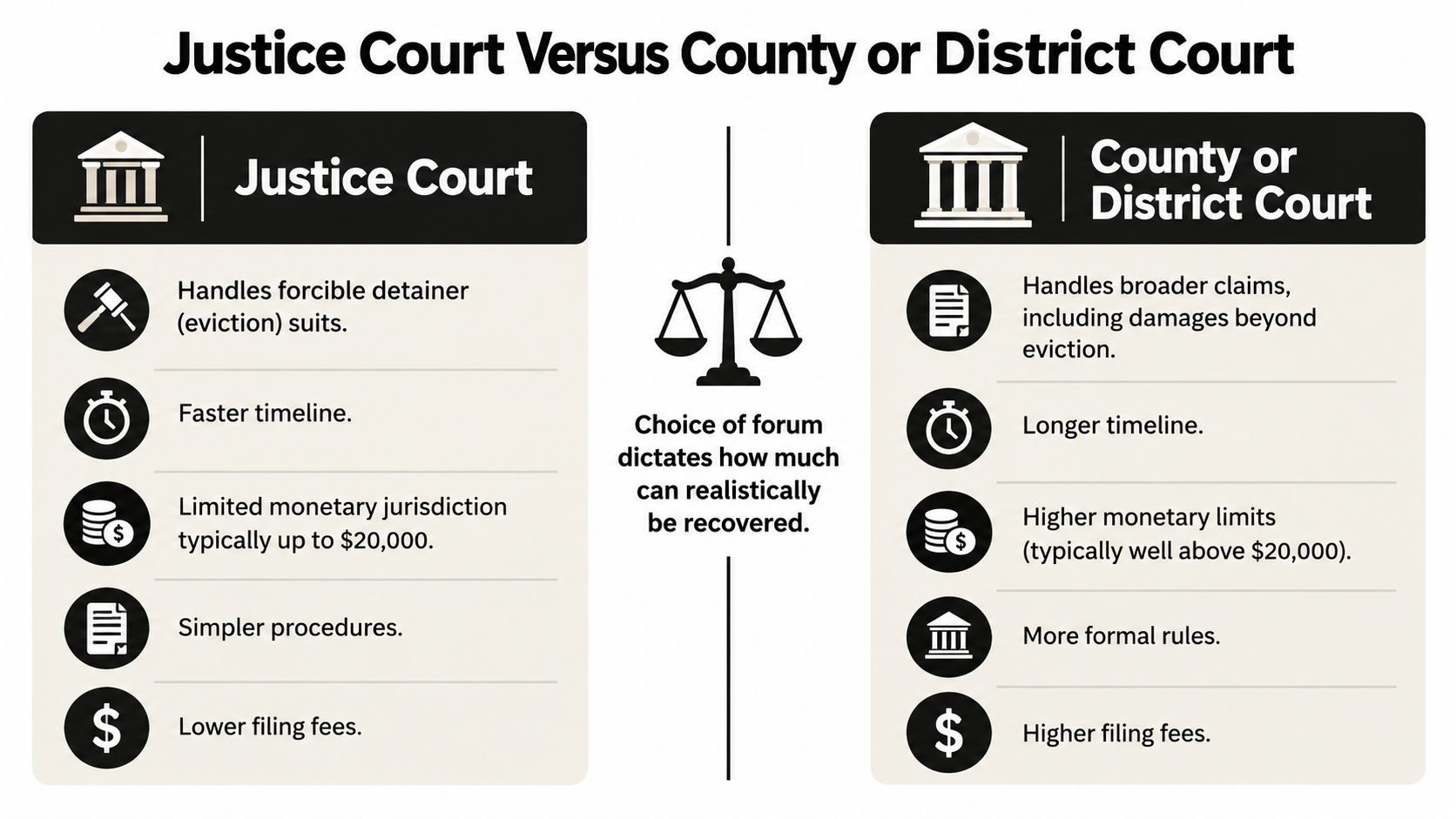
Choose the court based on the relief you need, not just the amount you want. A request to restore access and a lawsuit seeking broader damages serve different purposes.
This comparison provides general orientation. Verify current jurisdictional limits, filing fees, and procedures before relying on the visual's monetary or timing descriptions.
Justice Court Addresses the Immediate Possession Problem
For an ongoing unlawful lockout, the reentry procedure discussed earlier starts with a sworn complaint in the justice court precinct where the property is located. The immediate purpose is access, not a final valuation of every related loss.
An eviction case likewise focuses on the immediate right to possession. Bring relevant evidence to that proceeding, but don't assume the court will decide every property-loss, lease, or other damages issue.
A Separate Damages Action May Still Be Available
Texas Property Code §24.008 preserves the distinction between possession and other claims. It states that an eviction suit doesn't bar a separate action for trespass, damages, waste, rent, or mesne profits, as explained in this Texas appellate opinion addressing separate landlord–tenant claims.
In plain English, losing possession doesn't necessarily erase a claim about an earlier independent wrong. Conversely, claiming an unlawful lockout doesn't eliminate the landlord's ability to pursue rent legally owed.
For a broader lawsuit, counsel should evaluate:
- Available jurisdiction: Can the proposed court hear the claims and requested relief?
- Necessary parties: Who committed the conduct, signed the lease, or bears potential liability?
- Litigation expense: Will discovery and disputed property valuations make the case expensive to prove?
- Enforcement: Is there a realistic path to collecting a judgment?
Don't assume court limits vary merely because the property sits in a different precinct. Verify the governing rules rather than relying on a local custom or an online summary.
For additional context while reviewing your eviction paperwork, this video is available:
Settlement timing is case-specific. Neither a justice-court filing nor a district-court petition guarantees a fast offer, and a larger demand doesn't necessarily improve your negotiating position. A documented claim filed in the proper forum is more useful than an impressive number attached to the wrong procedure.
Two Worked Examples From Real Numbers
The most useful answer to the dollar question combines a calculation with an explanation of what could defeat it. A statutory formula supplies a starting point. Evidence determines whether the court accepts the components.
A Short Lockout With Documented Lodging Costs
Texas Law Help's lockout guidance illustrates a renter paying $1,500 monthly rent who incurs $800 in temporary lodging: the renter could pursue the $2,500 statutory penalty, the documented lodging expense, eligible additional damages, court costs, and reasonable attorney's fees, subject to offsets.
That is a claim framework, not an automatic settlement offer. The renter should attach the lease showing rent, proof of the unlawful exclusion, and the lodging receipt rather than sending an unexplained total.
| Claim component | Supporting evidence |
|---|---|
| Statutory penalty | Lease and evidence establishing the qualifying violation |
| Temporary lodging | Receipt, payment confirmation, and dates connected to exclusion |
| Other actual losses | Separate records establishing each additional expense |
| Additional penalty, if applicable | Evidence of qualifying key refusal or property removal |
| Offsets | Accurate ledger showing rent or other amounts legally owed |
If the renter also alleges missing furniture, that requires its own proof. A photograph showing furniture before the lockout helps establish existence, but the renter still needs evidence of loss, responsibility, and value.
A useful demand lets the reader trace every requested payment to a legal remedy and a supporting record.
A Constructive-Eviction Case With Separate Defendants
A Texas Supreme Court constructive-eviction record reports a judgment against one defendant that included $23,331.37 in actual damages and $200,000 in capped exemplary damages. The same litigation produced a separate $783,731 contract-damages judgment against another defendant.
Those figures don't establish a residential wrongful-eviction price list. They demonstrate why the legal theory, lease terms, defendants, causation, and proof matter.
Don't combine awards against different defendants and present the result as what an ordinary renter should expect. Don't assume a constructive-eviction judgment predicts the value of a temporary lockout, either.
The practical exercise is to separate compensatory losses from any punishment-based claim. Then evaluate offsets, litigation costs, and collectability, including whether any insurance covers the alleged conduct. Insurance coverage requires review, not an assumption that the landlord's policy will pay.
If an unfavorable possession judgment is also involved, Appealing a Texas Eviction Judgment explains how either party can appeal a Justice of the Peace eviction ruling. Treat that as a separate procedural issue, not something that can wait while you negotiate damages.
Steps to Take Right Now to Protect the Claim
Preserve evidence before arguing about a settlement amount. Your goal is a file that another person can understand without relying entirely on your memory.
Use this checklist to organize the physical and digital records.

Secure the Record and Address Access
- Document the scene: Photograph the changed lock, posted notices, property condition, and belongings outside. Keep original files.
- Save communications: Preserve complete message threads, emails, and voicemails, including your request for access and the landlord's response.
- Build a dated loss schedule: Record each expense, why you incurred it, and where its receipt is stored.
- Address ongoing exclusion: Ask about the reentry procedure already discussed rather than waiting until every loss is calculated.
This guide to evidence that helps tenants in Texas eviction cases can help you organize relevant records. Landlords should preserve the same categories of evidence, including notices, payment ledgers, and court documents.
Protect Any Appeal Before Negotiating
Texas Supreme Court materials state that an eviction appeal may be perfected by filing an appeal bond, cash deposit, or Statement of Inability to Afford Payment of Court Costs within five days after the justice-court judgment is signed. Those materials also address a ten-day supersedeas-bond requirement for staying a county-court judgment, so don't assume the initial appeal indefinitely prevents enforcement; review the Texas Supreme Court's eviction-appeal materials.
Get the signed judgment and ask counsel or the clerk about the applicable filing requirements immediately. Missing an appeal deadline can restrict your possession remedies, but it doesn't automatically erase every separate damages claim.
Make a Demand That Can Be Evaluated
After addressing urgent deadlines, prepare an itemized demand. Identify the conduct, cite the applicable remedy, attach supporting records, and distinguish documented losses from disputed estimates.
Before signing a settlement: Check whether the release covers only money, or also possession, property retrieval, rent balances, and other claims.
Don't assume a demand letter pauses court deadlines. If negotiations stall, choose representation and a forum based on legal complexity, evidence, and likely net recovery.
A straightforward receipt dispute and a case alleging threats, retaliation, or deliberate property destruction call for different levels of preparation. An eviction attorney can help you evaluate that difference without promising that every alleged wrong will produce a damages award.
What Actually Moves the Number Up or Down
What you can request, what you can prove, and what you can collect are different amounts. Keep those distinctions in view before accepting an offer or paying to litigate.
Evaluate the Claim, Not the Headline
- Documentation: Contemporaneous receipts and messages are more persuasive than reconstructed estimates.
- Conduct: A disputed procedural error requires different analysis from deliberate destruction or threats.
- Mitigation: Explain the reasonable steps you took to avoid unnecessary losses.
- Offsets: Account for rent and other amounts legally owed.
- Collectability: Investigate available assets and applicable insurance rather than assuming payment.
- Forum and expense: Compare the likely recovery with the cost and difficulty of proving it.
Eviction statistics reinforce why the underlying event matters. Reporting on Eviction Lab's work states that fewer than half of Texas eviction cases filed in 2016 resulted in an eviction, and its analysis of 3.6 million court records found that 22% of filings contained ambiguous resolution information or falsely represented eviction history, according to the Texas Observer's examination of eviction records.
A filing alone therefore isn't proof of a completed wrongful eviction or an automatic damages award. Obtain the actual court record before assigning financial losses to it.
My recommendation is to value the case conservatively first: provable economic harm, clearly available statutory remedies, and realistic offsets. Evaluate exemplary damages separately rather than using them to inflate an otherwise unsupported demand.
A Texas landlord tenant lawyer should help you answer both questions: What legal relief fits the conduct, and what evidence supports the amount? That's the practical foundation for protecting tenant rights while giving landlords a fair opportunity to address a documented claim.
The Law Office of Bryan Fagan, PLLC offers a free consultation to review your lockout, eviction paperwork, documented losses, and options for resolving the dispute. Bring your lease, court notices, messages, and receipts so the discussion can focus on your specific claim and urgent deadlines. Visit The Law Office of Bryan Fagan, PLLC to schedule your consultation and develop a clear next-step strategy.