
A broken air conditioner, a leaking ceiling, or a serious plumbing failure can make you wonder whether you can stop paying rent until your landlord acts. If you're searching for “withholding rent Texas,” the safest answer is also the most important one: Texas doesn't recognize a general right to withhold rent because a landlord hasn't made repairs. Stopping payment can expose you to a nonpayment eviction, damages, and penalties.
Texas law does give tenants narrow repair remedies. The strongest practical choices are usually a properly documented repair request, statutory repair-and-deduct, or a court action asking for repairs or other relief. The facts matter, especially whether the condition materially affects physical health or safety, whether you gave the required written notice, and whether your lease changes the repair process.
When the A/C Dies and the Rent Stops Coming
Maria rents a mid-rise apartment in Houston, not far from I-45. In late July, her central air stops cooling. She calls the landlord twice and sends a text. A maintenance contractor eventually diagnoses a dead compressor, but the landlord still doesn't provide a firm repair date.
Maria is frightened, uncomfortable, and angry. She decides to withhold her August rent and transfers $900 into her own escrow account. Within weeks, she receives a notice to vacate for nonpayment under Texas Property Code Section 24.005. She believes the broken A/C gives her the right to stop paying. Her landlord treats the unpaid rent as a lease default.
Maria's situation is common, but her legal conclusion may be wrong. A serious repair problem doesn't automatically turn rent into optional money. A tenant's rights depend on the condition, the notice, the lease, and the remedy the tenant chooses. A guide to Texas law concerning no air conditioning in an apartment can help frame the issue, but a lawyer would still need to examine Maria's specific facts.
The questions her lawyer would ask first
Before advising Maria, a Texas landlord-tenant lawyer would want clear answers:
- Did the condition affect health or safety? A dead compressor during extreme summer heat may support a serious repair claim, but the legal analysis depends on the actual condition and its effect on an ordinary tenant.
- Did she send a written seven-day repair notice? Phone calls and texts may show notice, but they don't necessarily satisfy every statutory requirement or prove delivery.
- What does the lease say? Some repair-and-deduct rights can be affected by contrary written lease terms. The lease may also contain notice, access, or maintenance provisions.
Maria might have had a strong position. She might also have had a defensible repair claim. But moving the rent into her own account didn't necessarily protect her from eviction. The central question isn't whether her frustration was justified. It's whether she used a remedy Texas law provides.
What the Texas Property Code Allows
Texas law separates three different responses to a serious repair problem. Section 92.0561 covers repair-and-deduct, allowing a tenant to subtract qualified repair costs from a later rent payment. Section 92.0563 offers a court-based route when the landlord fails to address a qualifying condition. Section 92.058 addresses the financial consequences of withholding rent in violation of the repair-and-deduct rules.
The repair duty generally concerns conditions that materially affect the physical health or safety of an ordinary tenant. That threshold is higher than discomfort or a cosmetic defect. A damaged fixture, an unpleasant temperature, or a delay that does not create a qualifying health or safety condition may not support these remedies. The condition, notice, landlord's responsibility, and lease language all affect the result.
The Texas Property Code and tenant-rights overview is a useful starting point for finding the relevant provisions. For broader context, Texas Landlord-Tenant Law: An Overview explains how Texas Property Code Chapters 91 through 94 and Chapter 24 govern rental relationships.
The provisions side by side
| Property Code Section | What It Does | Does It Allow Withholding Rent? |
|---|---|---|
| Section 92.0561 | Provides a limited repair-and-deduct remedy for qualifying health or safety conditions, subject to statutory requirements and a cap of the greater of one month's rent or $500. | No general withholding. It permits a qualified deduction, not unlimited nonpayment. |
| Section 92.0563 | Allows a tenant to ask a court for remedies such as an order requiring repairs, a rent reduction, actual damages, a civil penalty, and eligible court costs and attorney's fees. | No. It creates a court remedy rather than permission to keep rent. |
| Section 92.058 | Allows a landlord to recover actual damages when a tenant withholds rent in violation of the repair rules. After written notice of illegality and penalties, a bad-faith violation can trigger a civil penalty of one month's rent plus $500. | No. It identifies the financial exposure created by improper withholding. |
Section 92.0563 also places limits on the landlord's duty. The statute addresses known latent material defects, and a tenant's termination right is narrow. Leaving under a lawful termination theory is different from remaining in the home while stopping rent payments.
The Texas Attorney General's position is consistent with this structure. Texas law does not give tenants a free-standing right to keep rent whenever a landlord delays or fails to respond. Before withholding any payment, identify the specific statutory remedy, follow its notice requirements, and calculate the potential exposure under Section 92.058.
The Narrow Lane Where Withholding Rent Is Lawful
A tenant facing an unresolved repair may feel justified in stopping rent. The outcome turns on whether the tenant used a remedy Texas law recognizes. Texas does not provide a general legal right to withhold rent for repair problems, and missed payments can lead to nonpayment consequences. A health-and-safety condition may support statutory repair remedies, but it does not automatically authorize self-help withholding.
A tenant may have a stronger position in a few narrow situations. The lease might contain an express rent-abatement clause for a specified condition. If the lease clearly authorizes reduced or suspended rent under defined circumstances, its exact language controls. A general promise to maintain the property is not the same as a rent-abatement provision.
Constructive eviction is another possible theory when a dwelling becomes so unusable that the tenant leaves. It does not authorize a tenant to remain in the unit, stop paying, and announce that constructive eviction occurred. The condition, the tenant's conduct, notice, the landlord's response, and the decision to vacate all matter.
The parties may also agree to mutual rescission or a written settlement. A landlord might release the tenant from the lease, credit rent, or place disputed amounts in escrow. Put every term in writing. Identify the dates and amounts, and state what happens to possession and future rent.
Practical rule: If you plan to rely on a lease clause, constructive eviction, or settlement, preserve the evidence before stopping payment or leaving.
These exceptions are narrow and fact-heavy. Legal review often matters because the wrong assumption can turn a repair dispute into an eviction case. A tenant who stays, withholds rent, and waits for the landlord to accept that position may find that the court sees only unpaid rent.
Treat withholding as a litigation decision, not a pressure tactic. Confirm that the lease authorizes it, that the tenant has vacated when the legal theory requires it, or that the landlord signed a binding agreement. If none of those facts exists, use the statutory repair-and-deduct or court-order process instead. That approach avoids the financial exposure tied to unlawful withholding, including the potential one month's rent plus $500 civil penalty described under Section 92.058.
Repair-and-Deduct Versus a Court Order
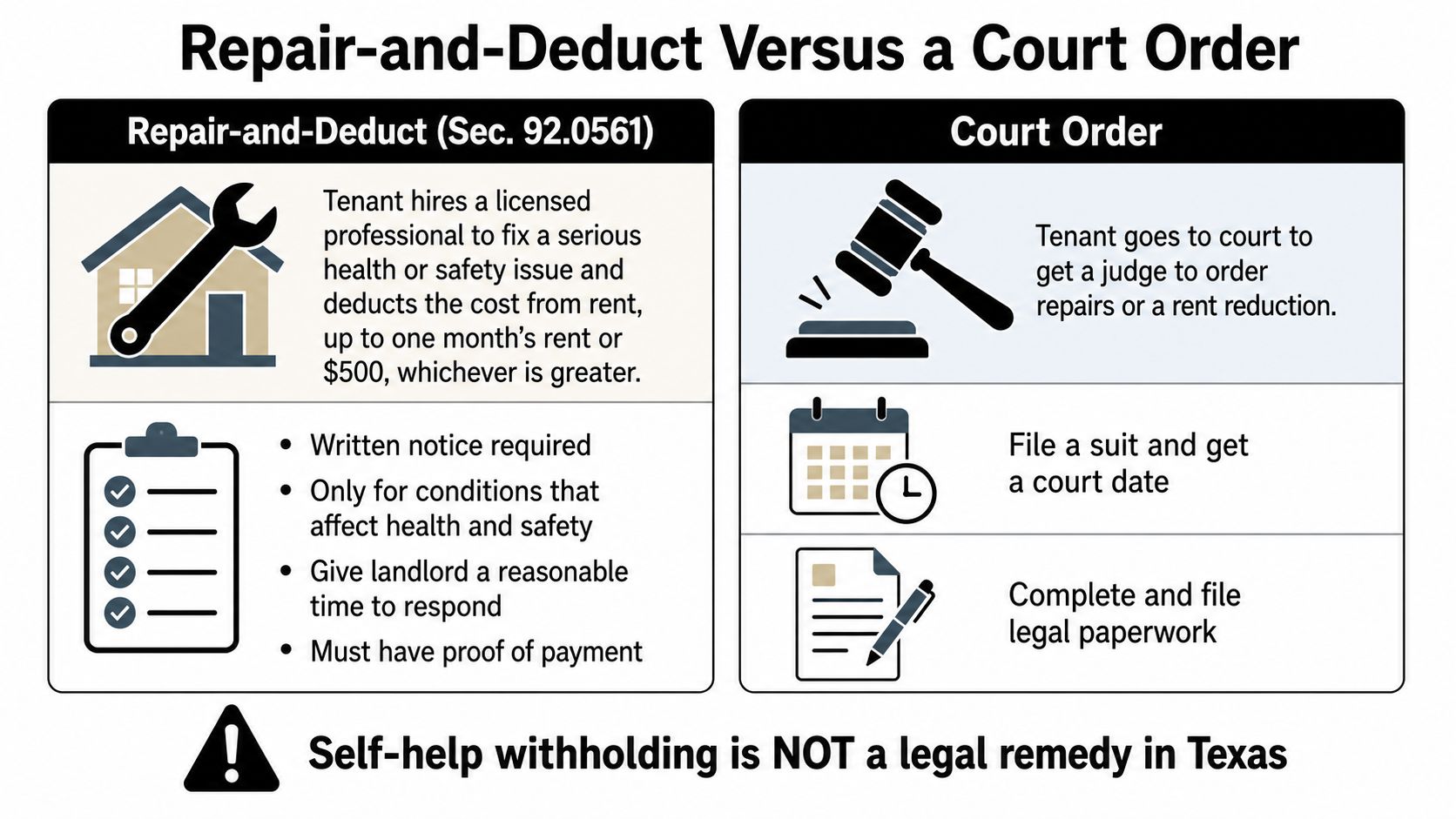
A tenant facing an unresolved safety problem has two structured remedies. Repair-and-deduct can resolve a qualifying repair faster, provided the tenant follows each notice and documentation requirement. A court order puts the dispute before a judge, who can decide whether repairs, reduced rent, damages, or other relief is appropriate.
Section 92.0561 requires several conditions before a tenant hires a qualified professional and deducts the cost. The defect must materially affect physical health or safety, the landlord must be responsible, and written notice must be delivered. The deduction cannot exceed the greater of one month's rent or $500, as explained in Texas repair-and-deduct law. The tenant should keep the contractor's license information, estimates, invoice, payment record, photographs, and proof of delivery. A missing step or incorrect deduction can turn a repair into an eviction defense problem.
Section 92.0563 uses a court process. Filing, service, paperwork, and a hearing take longer, but the judge can create an enforceable record. If the statutory claim succeeds, available relief may include an order requiring repairs, a rent reduction beginning with the first repair notice, a civil penalty equal to one month's rent plus $500, actual damages, and court costs and attorney's fees.
Which path fits the dispute
Repair-and-deduct fits a defined repair with a clear invoice when the landlord received proper notice and failed to act. The tenant must calculate the deduction carefully and preserve every supporting record.
A court order is usually the better choice when responsibility is disputed, the repair is expensive, failures continue, or the tenant needs a formal rent reduction. Both sides can present the lease, notices, photographs, inspection records, and communications.
Neither remedy turns the full monthly rent into a bargaining tool. The statutory deduction has a cap, and a judge may reject a claim that fails the health-and-safety standard. A safer path treats withholding as a litigation decision. Pressure tactics carry eviction and money risks. aalaj
Steps to Take Before You Skip a Rent Payment
Don't begin by skipping the payment. Begin by building a record that shows the condition, your notice, the landlord's response, and the money you spent or lost.
Build proof before the condition changes
Use a written request delivered in a way that creates evidence, such as certified mail or another trackable delivery method. Photograph and date the defect, keep temperature logs when heat or cooling is involved, save texts and emails, and preserve medical notes if the condition affects your health.
Use a simple notice format:
Repair notice: “This is written notice that [describe the condition] materially affects the physical health or safety of an ordinary tenant. Please arrange for repair and provide access instructions. This notice is delivered on [date].”
Don't claim that every defect materially affects health or safety. Describe the facts, explain the effect, and attach photographs when appropriate.
Follow the statutory process carefully
The repair notice should give the landlord the required opportunity to respond. The statutory process commonly turns on a written seven-day notice, but the correct notice method and timing depend on the lease and the facts. Confirm delivery and keep the receipt.
If access is a problem, send a separate letter:
Access request: “I will make the premises available for inspection and repair at reasonable times. Please provide proposed dates and identify any contractor who will enter the unit.”
If you plan to place money aside, understand the distinction between preserving funds and legally withholding rent. A private account doesn't automatically transform nonpayment into a protected escrow arrangement. A written agreement with the landlord or a court-approved process is safer.

Keep the documents a judge will want
Organize the lease, notices, delivery confirmations, photographs, contractor estimates, paid invoices, rent ledger, inspection reports, and all communications in date order. If repair-and-deduct applies, the deduction cannot exceed the greater of one month's rent or $500, and the statutory cap applies separately under Section 92.0561. Confirm the amount before deducting anything.
The following video offers general educational context, but it doesn't replace legal advice about your lease or pending eviction:
Two Texas Tenants, Two Very Different Outcomes
Consider two tenants in Harris County dealing with the same basic problem, a broken central A/C during July.
Tenant A stops paying rent. The tenant uses the saved money for a hotel, sends messages to the landlord, and waits for the system to be repaired. The landlord serves a Section 24.005 notice to vacate for nonpayment. The dispute ends with a move-out agreement and a judgment for unpaid rent.
Tenant A may have had a legitimate complaint about the A/C. The problem was the remedy. The tenant stayed outside the statutory process, treated the full rent as unavailable to the landlord, and had to defend a nonpayment claim while trying to prove the repair issue.
Tenant B handles the same kind of problem differently. The tenant sends a Section 92.0561 seven-day repair notice, keeps proof of delivery, hires a licensed HVAC contractor for $1,400, deducts only the amount permitted by the statutory cap, and pays the following month's rent in full. The tenant preserves the invoice, photographs, and contractor records. The landlord repairs the system before the next summer.
The difference isn't whether the repair mattered. The difference is whether the tenant used a remedy the statute recognizes.
Tenant B still might face a disagreement about responsibility, notice, the contractor, or the deduction. But the tenant has a documented legal theory and an evidentiary record. Tenant A has an unpaid-rent problem layered on top of the repair dispute.
These examples aren't promises about a particular court result. They show why procedure often determines the practical outcome. A Texas eviction attorney can assess the facts before a tenant makes a payment decision that changes the entire dispute.
The 2025 Reform Push and What It Means for You
Texas law remains restrictive on rent withholding, but the legislature has seen reform pressure. SB 882, introduced in 2025, would expressly allow rent withholding until repairs are completed, with repayment due by the second business day after completion, according to the bill text at Texas SB 882.
The proposal highlights the gap between what some tenants believe fairness requires and what current Texas law permits. It would address clearer definitions of unlivable conditions, a defined withholding process involving notice and escrow, limits on landlord retaliation, and possible deduction caps. A proposal is not enforceable law.
| Issue | Current Texas Law | Proposed 2025 Reform |
|---|---|---|
| Withholding rent | No general right to withhold rent for repair problems. | Would create an express withholding process for qualifying conditions. |
| Notice and money handling | Tenants generally use repair-and-deduct or court remedies. | Would use defined notice and escrow requirements. |
| Repayment | Improper withholding can expose a tenant to actual damages and, after the required written warning, a bad-faith civil penalty of one month's rent plus $500 under Section 92.058. | The proposal identifies repayment by the second business day after completion. |
| Retaliation and limits | Existing rights depend on the current Property Code and lease. | Would address retaliation limits and possible deduction caps. |
Until a bill becomes law, tenants must follow the current framework. Section 92.0561 remains the repair-and-deduct path, Section 92.0563 remains the court-remedy path, and Section 92.058 remains a warning against treating proposed reform as present authority.
Get a Texas Landlord-Tenant Attorney on Your Side
A repair dispute becomes risky when a tenant stops paying before confirming the available remedy. Follow this order: document the condition in writing, send a proper repair notice, and pursue repair-and-deduct or a court order before relying on any withholding theory.
A Texas landlord-tenant lawyer can review the lease, assess whether the condition materially affects physical health or safety, check notice and delivery, and determine whether the landlord must make the repair. Counsel can also evaluate an eviction notice, proposed settlement, rent-credit agreement, or claim under Section 92.0563.
Bring the records that establish what happened:
- Your lease: Include addenda covering repairs, notices, utilities, access, rent credits, or deductions.
- Your repair file: Include photographs, videos, temperature logs, inspection reports, contractor estimates, and paid invoices.
- Your communication record: Save emails, texts, maintenance requests, call logs, and proof of delivery.
- Your payment history: Bring rent receipts, bank records, ledger entries, and any notice to vacate or court papers.
The Law Office of Bryan Fagan, PLLC assists Texas tenants and landlords with repair disputes, nonpayment issues, evictions, lease enforcement, and Property Code questions. A consultation can identify practical outcomes, such as negotiated repairs, a written escrow arrangement, an eviction defense, or recovery under Section 92.058 when the facts support it.
A serious repair does not automatically authorize rent withholding, and landlords who ignore qualifying conditions still face consequences under existing law. Have the facts reviewed before the next rent deadline, particularly after receiving a notice to vacate.
If you face a repair dispute, threatened eviction, or uncertainty about withholding rent in Texas, The Law Office of Bryan Fagan, PLLC can review your lease, notices, and repair records. Schedule a free consultation to discuss a lawful repair strategy, defense options, or the next step for protecting your tenancy.