A tenant's death can leave a rental in limbo fast. One day the unit is occupied, the next the family, landlord, or property manager is trying to figure out who has the right to enter, who can collect the belongings, and whether rent keeps running. Under Texas Property Code, the answer is specific, and that matters because the wrong move can turn a painful situation into a property dispute.
For Texas tenant death lease obligations, the biggest mistake is assuming the lease ends automatically. It doesn't. Texas law creates a structured path for winding down the tenancy, and that path protects both sides when it's followed carefully. The key is knowing who may act, what proof matters, and how to handle the tenant's property and deposit without creating avoidable liability.
Practical rule: When a tenant dies, pause before entering the unit or making changes. The statute gives you a process, and following it usually protects everyone better than acting on instinct.
When a Tenant Passes Away in Texas
A family member finds the keys on the counter. A property manager gets the call from a neighbor. A landlord opens the mail and learns the sole tenant has passed away. In each of those moments, the first reaction is usually confusion, because the lease still exists even though the person who signed it is gone.
Texas law gives this situation a legal framework instead of leaving everyone to guess. Under Texas Property Code Section 92.0162, the estate representative may terminate the lease, and the termination becomes effective on the later of the 30th day after written notice or the date all statutory conditions are met. That 30-day timeline matters because it converts an open-ended problem into a defined wind-down period under Texas Property Code Section 92.0162.
Why the lease does not simply disappear
The death of a tenant does not erase the lease by itself. Rent and other charges can continue until the statutory termination date, and the estate remains responsible for delinquent unpaid rent and property damage that existed before termination. That distinction is often where families and landlords talk past each other.
A landlord may need time to secure the unit and document what's inside. The estate may need time to identify who can act, collect the deceased tenant's belongings, and decide whether probate action is necessary. Those competing needs are exactly why Texas law is more structured than a casual move-out.
What practical compliance looks like
The safest approach is to treat the matter as a controlled transition, not an immediate cancellation. Written notice starts the process. Property removal and any required inventory complete it.
A landlord who rushes disposal or a family member who removes property without documenting it can create a dispute that was entirely avoidable.
For a broader look at early lease endings in Texas, Lease Termination and Breaking a Lease in Texas is useful background on the lawful grounds for ending a Texas lease early for both parties. The post-death rule is narrower, but it sits in the same legal neighborhood, and understanding that overlap helps prevent mistakes.
How to Terminate the Lease Under Texas Law
Texas does not let anyone casually end a deceased tenant's lease. The statute is narrow, and the details matter. The early-termination right applies only when the deceased was the sole occupant of the dwelling, and the estate representative has to follow the steps in the right order.
Step one, give written notice
The estate, not the heirs personally, gives written notice to the landlord. That notice is the trigger for the statutory timeline, and it should be clear enough that the landlord can tell the notice is being given under the deceased-tenant rule. A short letter that identifies the tenant, the unit, and the person acting for the estate is usually better than a vague email.
Step two, remove the property under the statute
The tenant's property has to be removed under Texas Property Code § 92.014 before termination becomes effective. If the landlord requires an inventory, the representative also has to sign it. Until those conditions are satisfied, rent and other lease charges can continue to accrue.
Step three, count the 30-day wind-down correctly
The termination is effective on the later of 30 days after notice or the date all conditions are met. That makes the 30-day period a real legal milestone, not a courtesy period. If the family gives notice on day one but takes longer to remove the property or sign the inventory, the lease does not end early just because time passed.
Step four, document what ends and what doesn't
Future rent stops when termination becomes effective. Past obligations do not disappear. The estate can still owe delinquent unpaid rent and damage claims that existed before termination, and that is where landlords need clear records and families need realistic expectations.
| Statutory point | Practical effect |
|---|---|
| Written notice | Starts the termination process |
| Property removal | Must happen before termination is effective |
| Inventory if requested | Can be required by the landlord |
| 30-day timing rule | Sets the earliest possible end point |
| Pre-termination debts | Can still be pursued |
If a family member asks, “Can we just hand over the keys and be done?”, the answer is usually no. A keys-only handoff does not satisfy the statute. The process has to be completed.
Who Can Act on Behalf of the Deceased Tenant
The hardest question after a tenant dies is often not what the law says, but who is allowed to use it. Texas law is narrower than many people expect. The estate has the termination right, and the rule applies only if the deceased was the sole occupant of the rental dwelling.
Heirs, children, and caregivers are not automatically the right actor
A child may be involved in the funeral and the cleanout, but that alone doesn't make the child the estate representative. A roommate may have practical access to the property, but if the deceased was not the sole occupant, the post-death termination rule does not fit cleanly. An informal caregiver may be the person who handled appointments and daily needs, but again, authority depends on legal status, not closeness.
That is the gap most online guides miss. People often ask whether the landlord must accept “someone in the family” as enough proof. The better question is whether the person can show a lawful basis to act for the estate and satisfy the statutory steps.
What proof landlords can reasonably ask for
Landlords should reasonably ask for documentation that shows who is speaking for the estate. That might include probate papers, letters of administration, or other proof that the person has authority to handle the decedent's affairs. If no formal representative has been appointed yet, the landlord should be careful, because accepting the wrong person's instructions can create later claims from other family members.
A useful outside reference for families trying to understand the broader probate path is Texas estate settlement steps. It helps explain why authority can be unclear early on, especially when the estate is unprobated or only partially organized.
Practical rule: If more than one person claims the right to act, the landlord should ask for proof instead of picking a side.
What if probate has not started
That is common. It doesn't mean no one can act, but it does mean the parties should slow down and document everything. A landlord can ask for written instructions, keep a copy of all notices, and avoid releasing property to someone whose authority is still disputed. Families can reduce friction by naming one point of contact and keeping communications in writing.
Handling Personal Property and Inventory Requirements
Texas Property Code § 92.014 gives structure to the hardest part of the process, the deceased tenant's personal property. It is designed to let the landlord handle the unit without becoming the accidental custodian of lost or disputed belongings, while still protecting the estate's rights.

What the landlord may require
After the death of a sole-occupant tenant, the landlord may remove and store the tenant's property. The landlord can also require the person removing the property to sign an inventory. If the tenant had been furnished the statute and knowingly failed to designate contact information after the landlord requested it, the landlord's responsibility for post-death property handling becomes much narrower.
That doesn't mean the landlord should be casual about the unit. It means the landlord should be methodical. Photograph the premises, list the items left behind, and keep the records with the lease file. The point is to show what was there, when it was handled, and who took possession.
How families should approach removal
Families should ask for a reasonable time, show up with the right authority, and document what they take. If the landlord wants an inventory, sign it only after checking that it accurately reflects what was removed. A blanket signature on an unread list is a mistake.
The statute also allows the landlord to handle storage and disposal within its own framework, which is why timing and notice matter so much. For a deeper look at abandoned-property issues that often overlap with these situations, see Texas tenant abandonment of property rules.
A clean paper trail protects everyone. If the estate later asks what happened to a laptop, a watch, or medical records, the inventory is often the first document that settles the question.
The video below can also help families and managers understand the practical flow of estate-property handling.
Security Deposit Deductions and Prohibited Penalties
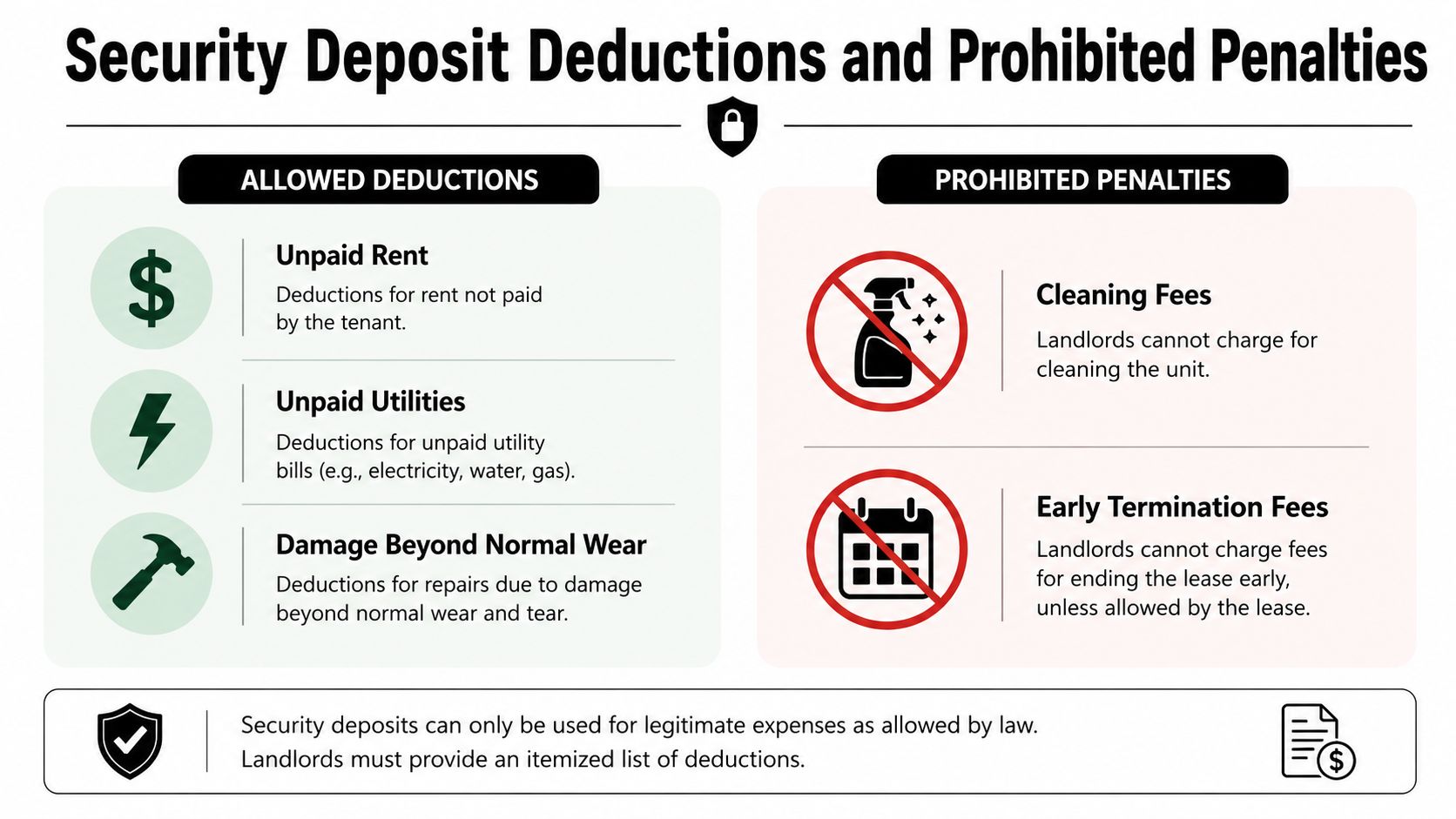
Money is where misunderstandings usually sharpen into conflict. Texas law allows a landlord to keep a security deposit for lawful reasons, but it does not let the landlord impose a penalty just because the lease ended after a tenant's death. That distinction matters a lot in a Texas tenant death lease obligations case.
What can usually be deducted
Texas law allows the landlord to hold a deposit for unpaid rent and other lease breaches, and § 92.014 also allows lawful deductions tied to the deceased tenant's property handling, including the cost of removing and storing the property. That means the deposit can be used for actual, documented obligations, not as a punishment for the death itself.
The cleanest way to think about it is this. Actual cost is one category. Penalty is another. The first can fit the statute. The second usually can't if it exists only because the tenant died.
What usually causes disputes
Cleaning charges are often the flashpoint. So are hauling fees, storage fees, and claims for damage that were never photographed or described. If the landlord wants to deduct any of those items, the landlord should connect each deduction to a real lease breach or statutory allowance and keep records that support the amount.
A proper itemized deduction process matters even more when the estate is informal or family members disagree about who should receive the refund. For a related breakdown of deposit disputes, Texas security deposit itemized deduction rules is a helpful companion resource.
How to sort lawful charges from prohibited ones
| Lawful if documented | Risky if treated as a blanket charge |
|---|---|
| Unpaid rent owed before termination | A fee imposed only because the tenant died |
| Property damage before termination | An unexplained lump-sum deduction |
| Cost of removing and storing property | Charges with no paper trail |
The better practice is simple. Inventory the deductions, link each one to a lease term or statute, and send the accounting to the person lawfully entitled to the refund. Families can then check the math instead of guessing.
Special Situations and Common Complications
Not every death case fits the clean sole-occupant model. That's where real-world friction starts. A spouse may still be in the unit. A roommate may have rights under the lease. Two siblings may both insist they're in charge. None of those situations should be handled by guesswork.
Co-tenants and shared occupancy
If the deceased was not the sole occupant, the deceased-tenant termination rule does not fit neatly. A surviving co-tenant may still remain bound by the lease, and the landlord may need to examine the lease language before making changes. That is one reason a quick review of the rental agreement matters before anyone removes belongings or changes access.
Unprobated estates and disputed family claims
Families often want to settle things quickly, but authority can be unclear when probate hasn't started. In those cases, the landlord should avoid releasing property to whichever relative calls first. Written requests, copies of authority documents, and careful notes protect everyone if the estate later disputes the handoff.
For families dealing with cleanup after an unattended death, a practical outside resource is Safe cleanup from Restore Heroes. It's relevant when the unit needs more than ordinary move-out cleaning and the family needs a specialized cleanup plan.
Utilities, access, and communication
Utility transfer should be handled separately from the lease termination issue. Locks should not be changed just because the landlord is anxious to secure the property. If the family is unresponsive, the landlord should continue documenting attempts to communicate and follow the lease and statute rather than improvising.
When the facts are messy, documentation beats speed. A landlord who writes down every contact attempt usually ends up in a better position than one who acted quickly but left no record.
When to Consult a Texas Landlord-Tenant Attorney
This is the point where legal help saves time, money, and conflict. If the estate is unprobated, if multiple relatives are making claims, if the landlord wants to deduct storage or damage costs, or if the lease language seems to conflict with the statute, a Texas landlord tenant lawyer can sort out the next move before the dispute escalates.
A landlord or family member should also get legal guidance if property has already been removed, if the security deposit is being withheld, or if someone believes the other side failed to follow the statutory notice process. The earlier the issue is reviewed, the easier it is to preserve evidence and avoid unnecessary friction. For more on choosing the right time to get help, see when to hire a Texas rental lawyer.
If you're looking for broader tenant-rights education outside Texas, a general resource like Palm Beach County tenant rights can show how different states approach rental issues, but Texas follows its own statute and its own deadlines.
If you need help with a lease termination, deposit dispute, or post-death property issue, contact The Law Office of Bryan Fagan, PLLC for a free consultation. The right advice now can keep a difficult situation from becoming a costly legal fight.
The Law Office of Bryan Fagan, PLLC helps Texans handle lease terminations, security deposit disputes, and post-death property issues with practical guidance rooted in the Texas Property Code. If you're dealing with a deceased tenant's lease or a disputed estate handoff, visit The Law Office of Bryan Fagan, PLLC to get help that's focused on protecting your rights and reducing conflict.