Dealing with a tenant dispute or an empty unit can turn a normal day into a legal guessing game. The lights are off, the rent is late, and the tenant won't answer calls or texts, so you're left asking a hard question, has the tenant abandoned the property, or are you about to make a costly mistake under the Texas Property Code?
Texas landlord-tenant law is tricky because abandonment isn't decided by one simple rule. A landlord has to look at the lease, the facts on the ground, the notices sent, and the statute that applies to the property or the move-out situation. A tenant, on the other hand, needs to understand when silence, absence, and left-behind belongings can legally change the landlord's rights.
When a Texas Tenant Walks Away and What Comes Next
A landlord opens the door and sees a quiet unit, a stack of mail, and maybe a few belongings still inside. The tenant hasn't paid rent, hasn't answered messages, and hasn't been seen for days, so the natural instinct is to treat the place as abandoned and move fast.
That's exactly where people get into trouble. In Texas, abandonment is a legal conclusion, not just a gut feeling, and the wrong move can trigger a lockout fight, a property dispute, or a claim that the landlord acted too soon.
Why this situation creates so much confusion
Texas doesn't use one simple statewide day-count for every abandonment scenario. The rules split into different timelines depending on whether you're dealing with a lease-based abandonment issue, a commercial or residential presumption, or the separate rules for abandoned personal property under state law. Under Texas Property Code § 93.002(d), a tenant is presumed to have abandoned premises when property is being removed in an amount substantial enough to show probable intent to abandon, while Texas Property Code § 91.006 separately requires landlords to mitigate damages if the tenant abandons the leased premises in violation of the lease. You can read the statutory starting point in the Texas Property Code § 93.002.
Practical rule: don't ask only, “Has the tenant left?” Ask, “What proof do I have that the tenant intended to leave, and what does the lease allow me to do next?”
A Texas tenant abandonment of property rules analysis is really a documentation exercise. A landlord needs proof of vacancy, proof of nonpayment or silence, proof of notice, and proof that the lease language supports the next step. A tenant who moved out unexpectedly may still have rights if the landlord jumps to conclusions too early.
One useful way to think about it is this. Abandonment is like a trail of clues, not a single footprint. The more formal the paper trail, the safer the next step.
What readers usually need to sort out first
The questions are often practical, not academic. Is the unit residential or commercial? Did the lease define abandonment? Was anything left behind? Did the landlord send certified mail, or just rely on a phone call?
For commercial lease disputes, Texas treats the analysis differently under Chapter 93, which is why Commercial Lease Disputes in Texas matters when business property is involved. Residential leases can still create abandonment issues, but the facts, notices, and timelines need to be matched to the right legal path.
If you're a landlord, tenant, or property manager facing this right now, the safest move is to slow down long enough to confirm the legal theory before touching the property. If the facts are messy, a Texas landlord tenant lawyer can help you avoid treating a temporary absence like a final move-out.
What Abandonment Means Under Texas Law

Abandonment in Texas usually means more than just “the tenant isn't home.” It means the facts show the tenant likely gave up possession, and the lease or statute gives the landlord a basis to treat the unit that way. A landlord has to be able to point to something concrete, not just a hunch, because the safest cases are the ones backed by records, notices, and lease language.
A practical way to understand it is this. Abandonment is a pattern the landlord can prove, not a single clue taken out of context. If the lease says the landlord may treat the unit as abandoned after vacancy, delinquency, and silence line up together, each part of that pattern still needs to be documented before property is moved or the lock is changed.
The three common triggers in Texas leases
Many Texas residential leases use a mix of triggers to define abandonment. Practice summaries of Texas landlord-tenant leases commonly describe about 5 to 7 days of absence, about 5 to 10 days of rent delinquency, and no communication from the tenant about an extended absence as the kind of pattern that supports a presumption of abandonment. Those lease-based triggers matter because Texas leaves much of the operational detail to the contract itself, not just to one universal statute. See the discussion of common lease patterns in the Texas landlord-tenant abandonment summary.
The point is not that a landlord can act the moment a timer runs out. The point is that the lease may turn a cluster of facts into a legal presumption, which then changes what the landlord may do next. If the lease says absence plus delinquency plus silence equals abandonment, the landlord still needs to document each piece. A landlord who keeps the rent ledger, copies of notices, and notes about the property condition is in a much stronger position than one who only relies on memory.
How the statute fits with the lease
Texas Property Code § 93.002(d) uses a different type of wording. It focuses on whether property is being removed in an amount substantial enough to show probable intent to abandon. That language is especially important in commercial settings, because the statute ties the presumption to observed removal activity, not just to an empty room. The same kind of careful reading applies when a landlord is trying to match lease language with Texas Property Code Chapter 92, because the lease and the statute do not always point in exactly the same direction.
The Texas A&M Real Estate Center guide also emphasizes that for commercial tenancies, a tenant is presumed to have abandoned the premises only when goods, equipment, or other property in a quantity substantial enough to indicate probable intent to abandon is being removed outside the normal course of business. For residential and manufactured-home tenancies, landlords still need to document vacancy and removal patterns before touching anything left behind. See the guide from Texas A&M's landlord and tenant materials at Landlord and Tenant Guide.
A tenant's silence matters, but silence alone usually isn't the whole story. A landlord who documents the lease, the rent ledger, the vacancy signs, and the notice history is in a much better position than one who assumes the worst.
The short version is this. Texas abandonment rules are built from facts, lease language, and intent. If the facts don't line up cleanly, the landlord shouldn't guess.
The Texas Property Code Sections That Govern Abandonment
A landlord who opens a unit and sees half the furniture gone may be looking at abandonment, or may be looking at a tenant in the middle of an unannounced move. Texas law treats those situations differently, so the first job is to match the facts to the right statute before anyone touches the property.
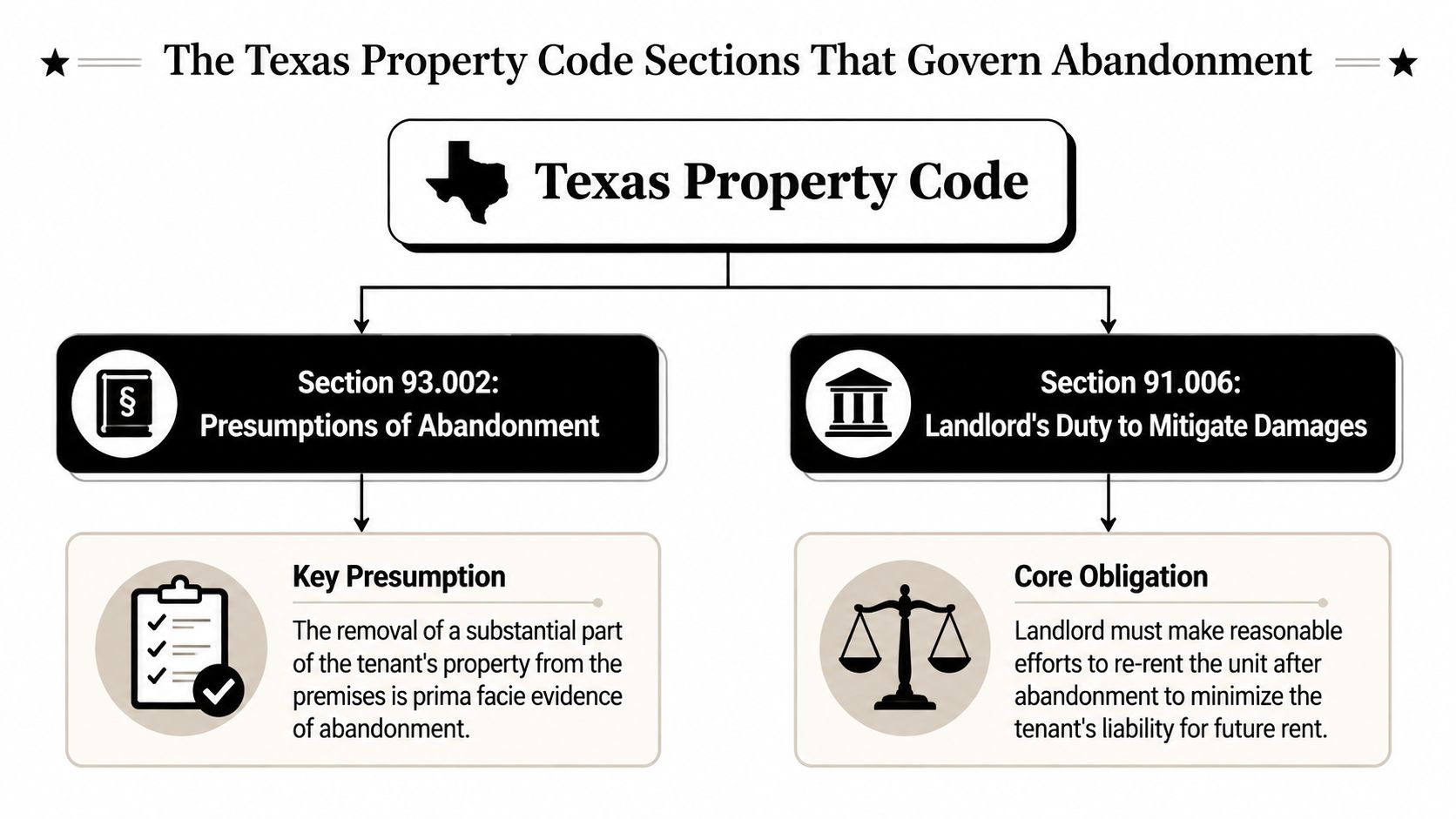
Texas Property Code § 93.002 and § 91.006 do different jobs, and confusing them can lead to bad decisions. One helps frame when abandonment can be presumed from the facts, and the other tells the landlord what duty still remains after abandonment is established.
Section 93.002 and the abandonment presumption
Section 93.002 matters because it shows that Texas does not use one simple rule for every case. A tenant is presumed to have abandoned premises when property is being removed in an amount substantial enough to show probable intent to abandon. That point matters most when a landlord is watching conduct, not just counting missed rent payments. You can review the statute at the Texas Property Code § 93.002.
For a landlord, the practical lesson is straightforward. The statute rewards careful observation and documentation. If you see furniture hauled out, equipment disappearing, or other major signs of move-out, write down what you saw, when you saw it, and why it looked more like departure than a temporary absence.
A lease can help, but it does not replace proof. If the lease says a tenant must give notice before vacating, that language may support your position, yet the landlord still needs facts that show abandonment rather than guesswork.
Section 91.006 and the duty to mitigate
Texas Property Code § 91.006 requires a landlord to mitigate damages if the tenant abandons the leased premises in violation of the lease. Any lease term that tries to waive that duty is void. The duty applies to residential and commercial leases entered on or after September 1, 1997, and the landlord cannot leave a vacant unit empty and keep building a rent claim. The legal text is available through Texas Property Code § 91.006.
That does not give the tenant a free pass. It means the landlord has to take reasonable steps to reduce losses, usually by trying to re-rent the property. A vacant apartment or storefront is not a blank check for unpaid rent. The landlord's file should show the effort to limit damages, because that is part of the statutory story as much as the tenant's move-out.
How to read these sections together
The two provisions work in sequence. First, the facts and lease language have to support abandonment. Then the landlord must mitigate damages and handle the property the way Texas law requires. A tenant who abandoned the unit may still owe rent under the lease, but that claim is limited by the landlord's reasonable efforts after the move-out.
A simple lease example makes the difference easier to see. If a lease says left-behind property is abandoned only after notice and a short waiting period, the landlord still has to match that language with the statutory rules before treating the unit as free and clear. If the lease is silent, the landlord has even more reason to document what happened instead of relying on assumptions.
| Texas Property Code section | What it addresses | Why it matters |
|---|---|---|
| § 93.002 | Presumption of abandonment from removal of substantial property | Helps determine when the landlord may treat the unit as abandoned |
| § 91.006 | Duty to mitigate damages after abandonment in violation of the lease | Requires reasonable efforts to reduce the rent loss |
The Two Timelines That Decide When Property Can Be Moved
Texas uses different clocks depending on what kind of abandonment you're dealing with. If you pick the wrong timeline, you can end up with a wrongful-self-help claim even when you thought you were being careful.
The 30-day warehouseman path after eviction
After an eviction and writ of possession, Texas guidance says a warehouseman may store the tenant's property, acquire a lien, and sell the property if the tenant does not pay within 30 days. That path is tied to the post-eviction process, not to a landlord deciding the tenant is gone. The state guidance appears in Texas abandoned property rules for tenants.
The 60-day path when the unit is already abandoned
When property remains on premises already abandoned by the tenant, the landlord may store it and dispose of it only after 60 days if the tenant does not claim it, and certified-mail notice to the last known address is required before disposal. That means the property doesn't become disposable the moment the door is open or the lights are off. The landlord has to wait, notify, and then follow through carefully. The same state guide explains that distinction.
How lease language can shorten the practical notice window
Industry summaries of Texas leases note that some standard Texas Association of Realtors-style forms treat left-behind property as abandoned after a 2-day notice period, while other landlords use longer buffers such as 30 to 60 days for risk management. Those shorter lease provisions can affect how quickly a landlord may act, but they don't erase the need to follow the right legal pathway. The lease still needs to be read together with the statute and the facts.
| Triggering event | Storage period | Notice requirement | Outcome |
|---|---|---|---|
| Post-eviction with writ of possession | 30 days | Warehouseman process applies | Property may be stored and sold if not claimed and paid for |
| Property on premises already abandoned | 60 days | Certified-mail notice to last known address | Property may be stored and later disposed of if unclaimed |
| Lease-based abandonment provision | Depends on lease language | Often includes short contractual notice | Landlord may treat the unit as abandoned if facts match the lease |
A landlord doesn't get credit for choosing the easiest timeline. The right question is whether the facts match the legal path you're using.
A Real Scenario Where a Landlord Got It Wrong
A landlord notices that the apartment is dark, the rent is late, and the tenant isn't returning calls. The landlord changes the locks, hauls the furniture to the curb, and lists the unit for rent the same day.
Then the tenant shows up with a moving truck and a lawyer.
That's the kind of scenario that turns a bad guess into a full legal problem. The tenant's attorney will ask for the lease, the rent ledger, the text messages, the certified-mail receipts, photos of the unit, and the exact date the landlord entered the property. If the landlord skipped those steps, the story starts to look less like abandonment and more like self-help.
Why a good-faith belief isn't always enough
Believing the unit was abandoned doesn't automatically protect the landlord. The court will still look at whether the landlord had enough evidence, whether the lease allowed the retaking, and whether notice was handled properly. In that fight, the tenant may argue the landlord entered too soon and disposed of property without legal authority.
The risk is bigger when personal property is involved. A couch, computer, business equipment, or family belongings can become the center of the dispute if they're thrown out before the right waiting period ends. Once that happens, the case is no longer just about unpaid rent.
When the facts are murky, the safest assumption is that the landlord should keep documenting instead of acting like the lease dispute has already been decided.
The practical lesson is blunt. If the landlord can't prove abandonment, the landlord shouldn't pretend the proof exists. In close cases, a Texas landlord tenant lawyer can help decide whether the facts support retaking possession or whether an eviction case is still the cleaner route.
What Texas Landlords Should Do Step by Step
Once a landlord suspects abandonment, speed matters, but so does the paper trail. The goal is to act quickly enough to protect the property without creating a lockout or property claim.

Start with evidence, not with the lock
Take dated photos of the exterior, the interior if you have lawful access, the condition of utilities, and any belongings left inside. Save returned mail, write down each call attempt, and keep witness statements from managers, maintenance staff, or neighbors when they're available. A landlord who creates a dated log is building a defense before the dispute starts.
Send the notice the lease and statute support
The notice should go to the tenant's last known address, and certified mail is the safest route when the abandonment timeline requires formal notice. A simple sample notice might say, “We believe the premises may have been abandoned based on the facts observed. Please contact us immediately and advise whether you intend to return or retrieve property.” That kind of notice should match the lease and the statute, not just the landlord's frustration.
Handle the unit and the belongings separately
Storage of left-behind property is not the same thing as re-renting the unit. A landlord needs to secure the premises, inventory items, and follow the waiting period that applies to the legal pathway being used. If you're unsure what secure storage should cost or how property management budgets can work, a neutral self storage cost guide can help you think through storage planning without guessing.
The Texas A&M property inspection checklist for landlords is also useful as a practical reference point when documenting condition before and after move-out, and you can review it in the property inspection checklist for landlords.
Know when to stop improvising
If the tenant is still reachable, still disputing abandonment, or has significant property inside, pause and get legal guidance before disposing of anything. You can also use the video below as a general visual guide for how landlords should think about the process.
A basic notice process is helpful, but it's not a substitute for a lawyer's review when the facts are unclear.
Why Texas Landlords Still Have to Mitigate Damages
Even a clear abandonment doesn't let a landlord ignore the next step. Texas Property Code § 91.006 still requires reasonable efforts to reduce losses, and a lease clause that tries to waive that duty is void. That rule is a protection for both sides, because it prevents a landlord from letting a unit sit empty just to drive up the former tenant's rent bill.
What reasonable mitigation looks like
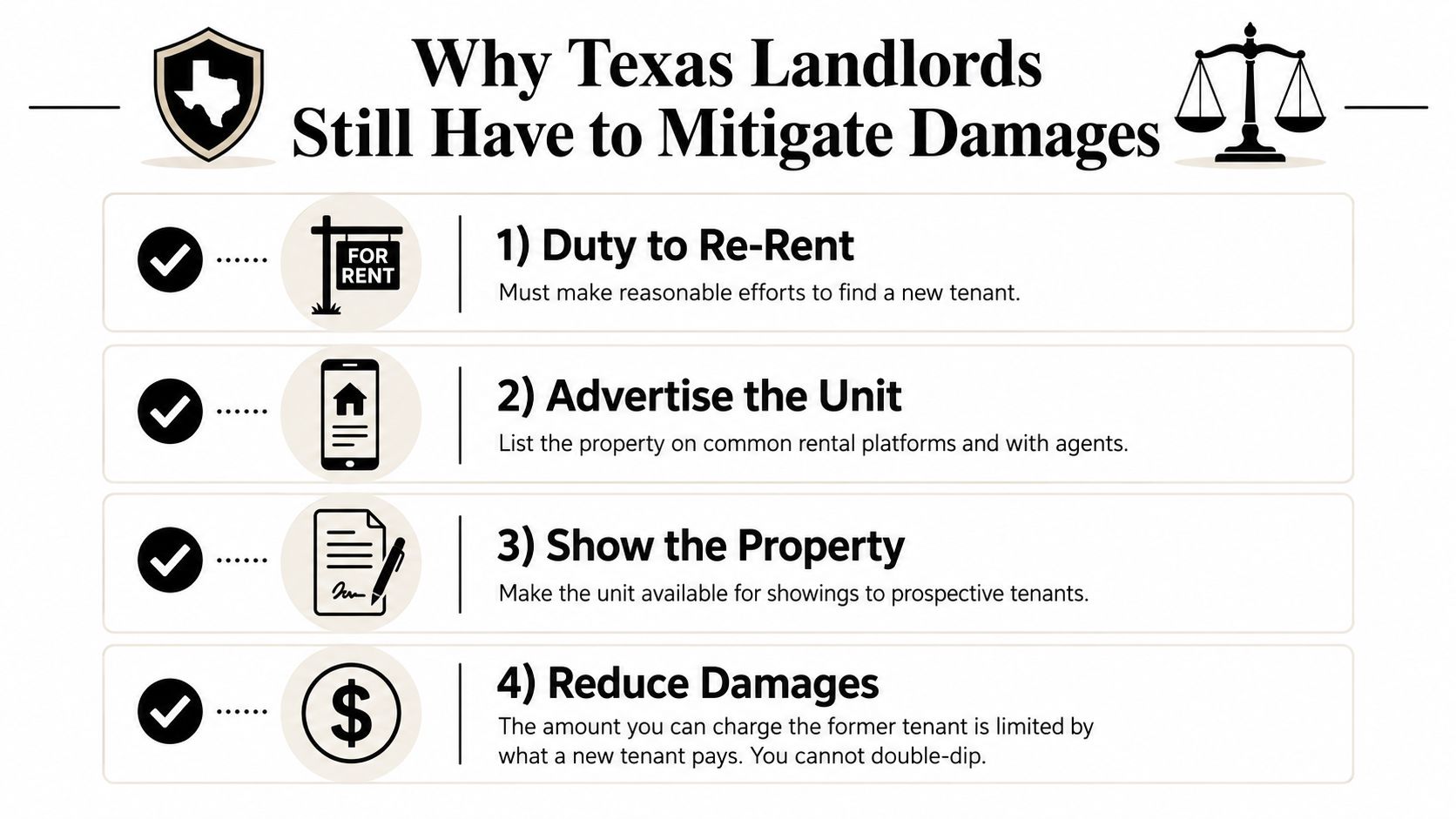
Reasonable mitigation usually means trying to re-rent the unit on normal terms, showing it to qualified prospects, and keeping records of marketing efforts. The landlord should document listings, showings, and application reviews so there's a clear record of the effort to limit losses. The duty doesn't ask for perfection, but it does require action.
The landlord still may recover unpaid rent that accrued before a new tenant moved in, but the claim is limited by what reasonable mitigation would have done. In plain English, the landlord can't double-dip. That's why the duty to mitigate is central to any Texas tenant abandonment of property rules analysis.
Why this helps tenants too
A tenant who left early often worries that the landlord will keep the place empty and charge the full remaining term. Texas law pushes against that. The landlord has to make a reasonable effort to replace the lost rent, which keeps the damage claim tied to actual loss instead of speculation.
If the unpaid-rent issue continues after move-out, the how to collect unpaid rent after tenant moves out resource can help frame the collection side of the problem in a broader way. For landlords, that usually means keeping the mitigation file together with the rent ledger, photos, and the notice history.
If the landlord doesn't document marketing and re-rental efforts, the rent claim gets much harder to defend.
Mistakes to Avoid and When to Call a Texas Attorney
The fastest way to turn an abandonment issue into a lawsuit is to move too soon. Changing the locks, throwing out belongings before the waiting period ends, skipping certified mail, or assuming a text message is enough proof can all create avoidable problems.
The mistakes that show up most often
- Changing the locks without a solid basis. A landlord needs proof, not just suspicion, before treating the unit as abandoned.
- Discarding property too early. Left-behind belongings need to be handled under the correct timeline and notice process.
- Skipping certified mail. If the statute or lease calls for formal notice, an ordinary text message usually won't give the same protection.
- Confusing silence with consent. A tenant not replying doesn't automatically prove abandonment.
- Mixing abandonment with eviction steps. The landlord should pick the right legal path and follow it consistently.
When the tenant denies abandonment, the unit contains a lot of personal property, or the lease is commercial, the issue becomes more sensitive. That's the point where a Texas landlord tenant lawyer can review the lease language, the statutory timeline, and the evidence before anyone takes another step.
The Law Office of Bryan Fagan, PLLC helps landlords and tenants evaluate abandonment disputes, property removal questions, lease issues, and eviction problems under the Texas Property Code. If your facts are messy or you're not sure whether you can lawfully retake the unit, don't guess.
If you're dealing with a possible abandonment, a lockout concern, or a dispute over property left behind, The Law Office of Bryan Fagan, PLLC can help you review the lease, the notices, and the timeline before you act. Visit The Law Office of Bryan Fagan, PLLC to learn more and schedule a free consultation for help with your Texas rental dispute.