Dealing with a lease clause you didn't expect can be frustrating, especially when it shows up right before move-in. A renter in Houston, Dallas, or Austin may see a line requiring renters insurance, proof before keys are handed over, and sometimes a liability minimum that looks bigger than they expected. A landlord, on the other hand, often sees that same clause as a simple way to manage risk.
That's where the confusion starts. Texas renters insurance requirements explained comes down to one question: is the requirement coming from Texas law or from your lease? Those are not the same thing, and knowing the difference can save you from signing something you don't understand or trying to enforce a rule the lease never says.
Why Renters Insurance Comes Up on Almost Every Texas Lease
A first-time tenant opens a one-year lease and spots a clause requiring renters insurance with $100,000 in liability coverage and proof before move-in. The tenant may assume the state requires it, because why else would it show up in so many leases? The landlord may see it as ordinary risk management, like a deposit term or an HOA rule.
That mismatch is the whole story. A landlord's policy usually protects the building, not the tenant's furniture, clothes, electronics, or personal liability exposure, and renters insurance is designed to fill that gap. The Texas Department of Insurance notes that the average renters policy in Texas costs about $20 per month, which helps explain why many landlords treat it as a practical lease condition rather than a heavy burden (Texas Department of Insurance).
A common lease-day surprise
This issue often surfaces right after approval, when the tenant is ready to sign and the lease includes a coverage deadline. That is the moment people start asking whether the rule comes from Texas law, from the lease, or from both.
If you are shopping for a policy for the first time, it helps to compare options before you commit. A consumer resource like compare insurance for young adults can help you understand how coverage choices and pricing may vary. For a closer look at tenant-rights rules in Texas, see Texas Property Code tenant rights guidance.
The key question is whether your lease makes it mandatory.
Once you separate those two ideas, the rest is easier to read. You can tell whether you are dealing with a statewide rule or a lease condition the landlord can enforce through the contract you signed.
What Texas Law Says About Renters Insurance
Texas does not create a statewide rule that forces every renter to carry insurance. The legal split is simple, but it matters a lot in a dispute. A requirement imposed by state law is different from a requirement written into a lease, and rent, deposits, and occupancy rules all work the same way.
Texas Property Code Section 92.0131 is the statute people usually point to when they explain that a landlord may require renters insurance as a lease condition. If the lease says coverage must be maintained, a lapse can be treated as a lease violation, which is why the exact wording matters so much (Texas Property Code Section 92.0131 guidance). The Texas Department of Insurance also explains that landlords may require renters insurance in the lease, which matches the idea that this is mainly a contract term, not a statewide mandate.

Why the distinction matters
If a rule comes from state law, the tenant has very little room to negotiate it. If it comes from the lease, the tenant can still read the clause closely, ask for clarification, and try to narrow the language before signing.
That difference is where many people get tripped up. A landlord may say, “insurance is required,” and a tenant may assume that means Texas law requires it. The better question is whether the lease is creating the duty under Section 92.0131, or whether some other statute is doing the work.
A lease clause can also spell out proof-of-insurance mechanics, which is where disputes often start. The landlord may want the declarations page, renewal notices, or a certificate showing the policy is still active. The clause may also say when proof is due, what happens after cancellation, and whether the tenant must keep the landlord listed as an interested party.
For a broader look at how tenant-rights rules fit into Texas residential leases, see Texas Property Code tenant rights guidance. That kind of review helps you compare the insurance clause with the rest of the lease, instead of reading it in isolation.
What a Typical Texas Renters Policy Covers
A standard renters policy is usually built around a few core protections. It's not just one bucket of money, and it's not just a formality to satisfy the lease.

The four parts tenants should recognize
Personal property coverage helps protect your belongings if they're stolen or damaged. Personal liability coverage helps if someone is injured in the home and you may be legally responsible. Medical payments to others can address smaller injury claims. Additional living expenses may help if you have to live somewhere else while your unit is being repaired.
The part many tenants miss is how a policy pays. Texas renters policies often pay claims on an actual cash value basis unless the policy is upgraded to replacement cost, which means reimbursement can be reduced for depreciation instead of paying full replacement value (actual cash value and liability coverage in Texas renters policies). That difference matters more than the monthly premium, because two policies that look similar on paper can produce very different claim outcomes.
A cheap policy can still leave you underpaid if you never checked how the claim gets valued.
What to look at before you buy
Tenants should review these items carefully:
- Coverage for belongings. Make sure it matches what you own.
- Liability limits. Many Texas leases use about $100,000 as a common benchmark (Texas renters insurance coverage norms).
- Valuation method. Actual cash value and replacement cost are not the same thing.
- Premium. The average Texas renters policy costs about $20 per month (Texas Department of Insurance).
For landlords drafting a lease, the lesson is simple. State the minimums clearly, and don't assume the tenant understands the policy structure just because they checked a box. For tenants, the right move is to buy enough coverage to match your real exposure, not just the lease minimum.
How Landlords Enforce Renters Insurance Requirements
A Texas landlord usually enforces a renters insurance clause through the lease, not through some separate state rule. The lease says the tenant must keep coverage active, tells the tenant when proof is due, and gives the landlord a way to confirm the policy does not lapse.
What proof usually looks like
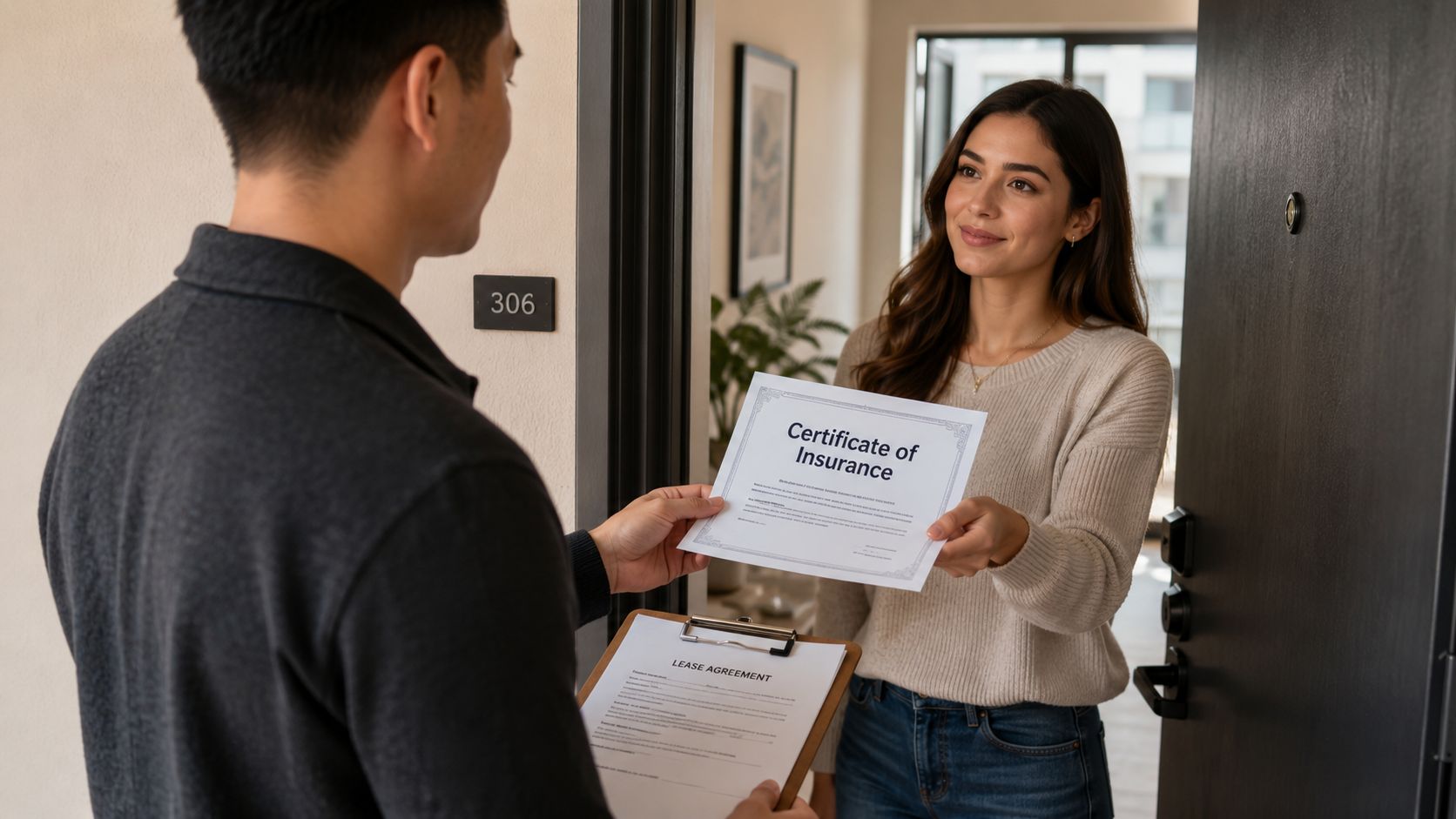
In practice, landlords usually ask for a declarations page or a certificate of insurance that shows the policy is active. A well-drafted lease also says when the proof must be turned in, whether it has to be provided before move-in, and whether the landlord must be listed as an interested party so notice goes to the right place if the policy changes or ends.
A tenant often thinks the job is done after buying the policy. The landlord's perspective is different. The issue is not just whether coverage existed once, but whether the tenant kept it in force for the full lease term and kept the proof current. For a closer look at what strong lease wording should cover, see a reference for how to include lease agreement terms.
Texas-focused consumer guidance also shows why this requirement shows up so often in ordinary leases, with one source reporting that 75% of insured renters have coverage because a landlord required it (Texas renters insurance requirement data). That figure does not make every lease clause fair or clear, but it does show how common the requirement has become in day-to-day leasing.
If the policy lapses, many leases treat that lapse as a breach. From there, the lease may allow a notice to cure, later termination if the breach is not fixed, or a landlord-placed policy if the lease specifically permits it. The key point is that the remedy comes from the contract language, not from a single statewide rule that operates the same way in every case.
Where tenants still have position
A tenant usually cannot ignore the clause if the lease clearly requires coverage, but there is still room to decide how the requirement is satisfied:
- Their own carrier
- Their own deductible
- Their own coverage level above the minimum
- How they provide proof
That choice matters because the lease usually sets the floor, not the entire policy. A landlord should write the enforcement language clearly, since vague wording invites arguments over whether a policy was late, whether a renewal copy was required, or whether an email attachment counted as proof. A tenant should keep every declarations page, renewal notice, and email showing the policy stayed active, because those records often matter once a landlord raises noncompliance.
A Texas landlord-tenant lease clause works best when it states the minimum coverage, the proof required, and the consequence of a lapse in plain English. A tenant who wants to understand how a lawyer would frame those terms can use Lease Termination and Breaking a Lease in Texas as a guide for the kind of lease language that creates disputes, especially when insurance problems get tied to move-out issues.
Sample Lease Language for Renters Insurance Clauses
Good lease drafting gives everyone fewer excuses later. A clean clause tells the tenant exactly what to buy, when to show proof, and what happens if coverage ends.
A clearer version
A strong clause usually says something like this in substance, the tenant must maintain renters insurance throughout the term, keep at least the stated minimum liability limit, deliver a certificate of insurance before move-in, and give updated proof whenever the policy renews. It also says a lapse is a lease violation.
A weak clause usually says only that the tenant “must have renters insurance.” That sounds simple, but it leaves open major questions about the minimum limit, acceptable proof, whether the landlord can demand a renewal copy every year, and what counts as noncompliance.
| Better language | Weaker language |
|---|---|
| Sets a minimum coverage amount | Leaves the amount unspecified |
| Requires coverage throughout the term | Does not say whether renewal is required |
| Requires a certificate of insurance or declarations page | Does not say what proof counts |
| Defines a lapse as a violation | Says nothing about what happens if coverage ends |
Why the wording matters
Ambiguity leads to arguments. A tenant may think they complied because they bought a policy once, while the landlord may believe the tenant had to keep it active for the entire lease and renew it on time.
That is why specific wording helps both sides. It reduces the chance of a dispute over whether the tenant met the requirement, and it makes enforcement easier if the tenant later stops paying for the policy. When a lease is this important, the clause should be readable, measurable, and tied to a real proof deadline.
Tenant Rights and Negotiation Tips That Actually Work
Tenants often have more power than they think before they sign. If the lease requires renters insurance, you can usually shop for the cheapest compliant policy that still satisfies the landlord's terms. You can also ask whether the minimum liability requirement is necessary for your situation or whether a lower amount would still meet the landlord's risk concerns.

Practical moves that help later
A tenant can ask to be added to the policy as an interested party for notice purposes instead of a loss payee, if the carrier allows it. That request often makes more sense than turning the landlord into a payment recipient for a tenant's personal property claim.
Before move-in, photograph and video your belongings room by room. That habit helps if a later claim turns into a dispute over what you owned and what condition it was in before the loss. The Texas insurance guidance encourages exactly that kind of documentation approach for property inventories and photos (Texas insurance guidance on documenting property).
If a landlord seems to be using an insurance clause to pressure you after a repair complaint or another conflict, don't guess. Retaliatory or discriminatory lease terms may raise separate legal issues, and a tenant may need a closer review of the lease, the timeline, and any notices that came before the new demand.
Keep your paperwork. A tenant who can show dates, photos, and policy documents is in a much stronger position if the landlord later says the policy lapsed.
If the disagreement is part of a larger eviction fight, how to negotiate with a landlord before eviction in Texas may help you understand settlement options. If the dispute escalates to court, Appealing a Texas Eviction Judgment explains how either party can appeal a Justice of the Peace eviction ruling.
Common Misconceptions About Renters Insurance in Texas
A lot of Texas lease disputes start with a simple misunderstanding. Tenants assume the landlord's policy will pay for their clothes, furniture, electronics, or other personal items after a fire, theft, or water loss. That usually is not how it works. The building policy protects the owner's property interest, while renters insurance is the policy that follows the tenant's belongings.
The next mistake is treating renters insurance like a luxury item that can be ignored. In practice, many landlords ask for it because the monthly cost is modest compared with the disruption a loss can cause. Texas insurance guidance also treats it as a common part of residential renting, which is why the clause shows up so often in standard leases (Texas Department of Insurance).
Three other myths that cause disputes
One myth is that any policy will do. That can be a problem if the lease requires a particular level of coverage, or if the tenant later learns that the policy pays actual cash value instead of replacement cost. Those two valuation methods can lead to very different claim results, so the policy language matters as much as the premium (Texas renters policy valuation guidance).
Another common belief is that a landlord can never require renters insurance. Texas Property Code Section 92.0131 is often cited for the point that a landlord may include the requirement as a lease condition, so the key question is usually not whether the clause can exist, but what the lease says and how it is enforced (Texas Property Code Section 92.0131 guidance).
The third myth is that the clause is always a sign of bad faith. In many leases, it is just a risk-allocation term. A landlord may want proof of coverage because one uninsured loss can create conflict over responsibility, and a tenant may want the clause narrowed so the policy is limited to the tenant's own property and personal liability.
Proof-of-insurance rules matter here. A lease may require a declaration page, the insurer's name, a policy number, or notice if the policy lapses. Some landlords ask for annual renewal certificates, while others want proof only at move-in unless the lease says otherwise. The practical question is whether the lease creates a clear paper trail, or whether it leaves room for a later argument about whether the tenant complied.
For property owners dealing with broader upkeep issues, rodent prevention for property managers is useful context because habitability problems and insurance questions often surface in the same dispute.
A plain-English reading usually clears up most of the confusion. The law and the lease are not the same thing. One tells you what Texas permits, and the other tells you what the parties agreed to in that unit. Once you separate those two, it becomes easier to tell whether a renters insurance clause is a real lease duty, a negotiable term, or just a misunderstanding about who pays for what.
When to Talk to a Texas Tenant Rights Attorney
Some problems are too messy to solve by guessing. If a landlord adds a mid-lease insurance requirement, threatens eviction after a lapse notice, refuses to renew because of a coverage dispute, or tries to force you onto an overpriced landlord-chosen policy, it's time to get legal advice.
Situations that deserve a closer look
You should also talk with a Texas landlord tenant lawyer if the insurance issue is tied to:
- Repairs or habitability
- Security deposit disputes
- Illegal entry or privacy violations
- A broader eviction notice
- Commercial lease terms, if the space is not residential
A tenant rights review can also help if the clause seems unclear, retaliatory, or inconsistent with the rest of the lease. Landlords benefit from the same kind of review when they want a clause that is enforceable without creating avoidable conflict later.
For commercial tenants and landlords, the same basic problem shows up in a different form. The insurance requirement may be part of a longer negotiated lease package, and the drafting needs to match the actual business risk, not just copy a residential form.
If you need help sorting out a rent insurance dispute, a lease violation notice, or a tenant-rights issue, you can schedule a free 30-minute consultation with The Law Office of Bryan Fagan, PLLC. Their team helps Texans review lease language, respond to enforcement problems, and protect property rights before a small paperwork issue turns into a bigger legal fight. The short consultation can give you a clear next step and a better sense of where you stand under the Texas Property Code.
If you're dealing with a renters insurance clause, a lease dispute, or an eviction threat tied to coverage, The Law Office of Bryan Fagan, PLLC can help you read the lease, understand your rights, and respond with a practical plan. Visit The Law Office of Bryan Fagan, PLLC to schedule your free consultation and get guidance for your Texas rental situation.