Dealing with a pet charge dispute can feel small until you see the lease in black and white. One line says pet deposit, another says pet fee, and a third says pet rent, and suddenly you're trying to figure out what you'll ever get back, what's legal, and what a landlord can keep when you move out. In Texas, that confusion matters because the label on the lease can change how the money is treated, and a bad label can turn into a deposit fight, a refund demand, or a claim in small claims court.
| Criteria | Pet Deposit | Pet Fee |
|---|---|---|
| Refundability | Refundable if there's no covered damage | Non-refundable |
| Legal treatment | Treated like a security deposit under Texas law | Treated as a contractual charge |
| Move-out accounting | Itemized deductions may be required | No refund accounting required |
| Best use | Protecting against pet damage | Charging for the privilege of allowing a pet |
| Risk if mislabeled | Can create refund disputes | Can create enforceability problems |
Why Pet Charges Cause So Many Texas Lease Disputes
A tenant moves in, signs the lease, and notices three separate pet charges. One is called a deposit, one is called a fee, and one is monthly rent. The tenant assumes all of it is nonrefundable because it all sounds like “pet money,” then gets angry when the landlord keeps part of the deposit at move-out.
That fight starts because the words are not interchangeable. Under the legal backdrop described in the research brief, Texas historically gave landlords broad flexibility on pet charges, with no state cap on the amount in older practice, while the lease label determined whether the money came back at move-out. The problem is simple: if the lease language is sloppy, both sides walk away with different expectations and the dispute starts the day the pet leaves.
The money is what people fight about
Tenants usually care about one question, “Do I get this back?” Landlords care about a different one, “Can I keep enough to cover damage?” Those are not the same question, and Texas pet rules turn on that difference.
A refundable deposit belongs in the security-deposit bucket. A nonrefundable fee does not. That distinction affects move-out notices, deduction letters, and how quickly a landlord has to respond after the tenant surrenders possession. If you mix the labels, you create an argument before anyone even starts counting scratches, odors, or carpet stains.
Practical rule: If the lease says “deposit,” expect refund rules. If it says “fee,” expect a nonrefundable charge. That one word changes the entire fight.
The confusion also spills into broader tenant rights issues. A landlord who thinks every pet charge is automatically kept at move-out may overreach. A tenant who thinks every pet-related charge must come back may miss a valid deduction tied to actual damage. That's why Texas landlord tenant lawyer searches often start with pet disputes and end with security deposit questions.
How Texas Law Defines Pet Deposits and Pet Fees
A tenant moves out expecting a refund. The landlord points to the lease and says the charge was never refundable. That fight usually starts because the lease mixed up pet deposit, pet fee, and pet rent, even though Texas treats each one differently.
Texas treats these charges differently because they serve different purposes. A pet deposit belongs in the security-deposit system, so it is refundable if the property comes back in acceptable condition and the landlord follows the Texas Property Code rules for deductions and timing. A pet fee is a nonrefundable contractual charge for allowing the pet in the home, so it is not handled like a deposit.
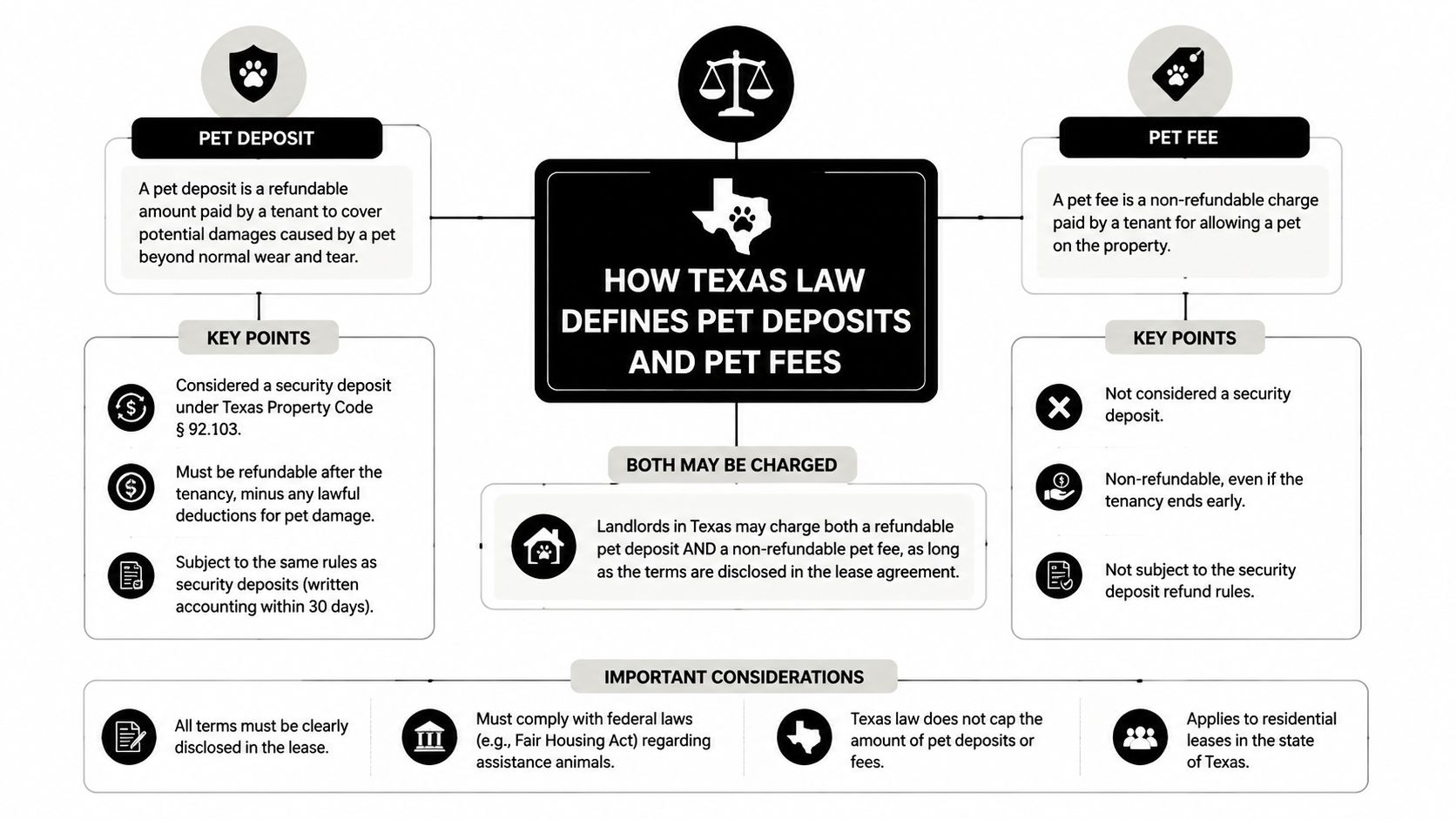
The refund question is the dividing line. If money is refundable, the landlord has to document any deduction and return what is left within the security-deposit timeline under Texas Property Code § 92.103, and our Texas security deposit law guide explains that timeline in plain English. If money is nonrefundable, the landlord is collecting a fee, not a deposit. A clause that calls something a “nonrefundable deposit” causes trouble because the word deposit still points to refund rules the landlord cannot wipe away with label choice.
Where pet rent fits
Pet rent is different again. It is a recurring monthly charge added to regular rent, so it is not a one-time payment and it is not treated like a refundable deposit. If the lease uses pet rent, the landlord should put it in the rent section and define it clearly, because missed payment, late fees, and eviction calculations get messy when the charge is buried in the wrong part of the lease.
That same distinction is why What a Landlord Can and Cannot Deduct From a Deposit matters. A deductible deposit has to be handled as a deposit. A fee does not. If the landlord wants a charge that disappears on day one, call it a fee. If the landlord wants money held against damage and returned later if nothing is owed, call it a deposit.
Texas Property Code rules also matter because the security-deposit refund timeline affects real money, not a technical detail. A landlord who labels a refundable charge as a fee can trigger disputes over deductions and timing. A tenant who paid a true fee cannot later demand a refund just because the pet caused no problems.
A clean lease uses clean words. That is the fastest way to avoid a fight over pet charges.
Pet Deposit vs Pet Fee Side by Side
A landlord who wants damage protection and a landlord who wants a charge for permission are making two different choices. A pet deposit is a returnable reserve tied to the condition of the rental. A pet fee is the price of allowing the pet in the unit. Texas lease language should reflect that split clearly, because move-out disputes start when the paper trail is sloppy.
| Texas Pet Deposit vs Pet Fee Comparison | Pet Deposit | Pet Fee |
|---|---|---|
| Refundable | Yes, minus valid deductions | No |
| Linked to property condition | Yes | No |
| Return deadline | Governed by Texas security-deposit timing | Not returned |
| Typical market use | Used when landlord wants damage protection | Used when landlord wants a one-time charge |
| Move-out paperwork | Itemized deductions matter | No refund statement required |
| Dispute risk | Higher if deductions are unclear | Higher if lease wording is sloppy |
A 2026 national lease review covering 2,454 Texas leases found that 62% of Texas rental agreements allowed pets, but only 12% of pet-friendly leases charged a pet deposit, while the national deposit rate in pet-friendly leases was 17%. That research brief also described a typical national range of $100 to $300 for pet deposits. The point is simple. Pet charges were common enough to fight over, but the structure changed from lease to lease, which is why label choice matters so much.
That difference matters even more once Texas moves into the September 2025 HB 410 rules. Leases signed before that date stay under the old framework until they are renewed. A renewal can reset the pet-charge terms. Month-to-month holdovers after the first lease term are another gray area, because the charge structure depends on whether the tenancy is continuing under the old deal or has rolled into a new rental agreement. Landlords who assume every pet charge survives unchanged are inviting a dispute.
What happens in a real dispute
A landlord who collects a $300 pet deposit and then sees a dog tear up one bedroom carpet can deduct for actual damage if the lease and the move-out paperwork support it. The deduction has to match the loss. A landlord who collects a $300 pet fee already spent that money from a legal standpoint, and cannot later recast it as a refundable bucket just because the pet caused damage anyway.
That is why courts and demand letters focus on labels, itemization, and proof. If the charge is a deposit, the landlord needs a lawful basis for each deduction and has to handle the return correctly. If the charge is a fee, the tenant does not get a refund just because the apartment came back clean. Texas landlord tenant lawyer consultations turn on that distinction because it decides whether the money was held for damage or taken as a completed charge.
What HB 410 Changes for Leases Signed After September 2025
Texas House Bill 410 is the biggest shift in the state's pet-charge rules in years. The bill text says that for a lease allowing a pet, a landlord may collect either a one-time refundable pet deposit or a monthly pet fee capped at $20, but not both. The Legislature placed the measure to take effect on September 1, 2025. That is a hard change, not a casual clarification.

The practical effect is blunt. For new leases or renewals on or after that date, the old Texas habit of stacking pet charges is gone. Under the earlier framework described in the brief, landlords could charge pet deposits, pet fees, and pet rent without a state dollar cap. HB 410 resets that model by forcing a choice between a refundable deposit and a capped monthly fee.
Renewal is where the fight starts
The part most guides miss is the transition. The brief says existing leases signed before September 1, 2025 stay under the old framework until renewal. That means a tenant who signed earlier does not get a mid-lease rewrite just because the law changed. The old terms keep running until the lease is renewed.
That creates the core client question, though. What counts as a “new” lease? A formal renewal almost certainly does. A month-to-month holdover or a mid-lease amendment is where the argument starts, and that is exactly where careful legal review matters. If you are a landlord, don't assume a casual addendum preserves the old structure. If you are a tenant, don't assume the landlord can keep stacking charges after the new law date just because the original lease was older.
The brief also notes that the monthly pet fee cap of $20 is well below common market ranges in apartment guides, which makes the new rule economically significant for future leases. The cap changes what landlords can realistically collect each month, so the older pet-rent model no longer works the same way for leases that fall under HB 410.
How to read a legacy lease
If your lease was signed before September 1, 2025, look at the renewal language, not just the original pet clause. If the lease renews, the landlord may need to bring the pet terms into compliance with the new rule. If you are month-to-month, do not guess. Review the actual paperwork and the renewal history before you assume the old charges are still valid.
Bottom line: pre-September 2025 leases are one thing, renewals are another, and new leases after that date must follow the HB 410 either-or rule.
Assistance Animals Are Not Pets Under Texas Law
A lot of pet deposit disputes are not really pet disputes at all. They involve an emotional support animal or service animal, and that changes the analysis completely. TexasLawHelp says it is unlawful to charge extra rent, demand a pet deposit, or charge any fees for an assistance animal, while the tenant remains liable for actual damage.
That is the line landlords have to respect. An assistance animal is not treated as a pet for charge purposes, so the whole pet-fee discussion stops if the animal qualifies under fair housing rules. The tenant can still be responsible for damage, but the landlord cannot collect a pet deposit just because the animal lives in the unit.
What landlords should ask
The question is not “Can I charge something anyway?” The better question is whether the documentation supports an accommodation and whether the charge language in the lease needs to be pulled out immediately. If the answer is yes, the landlord should stop treating the animal like an ordinary pet.
A careful lease review matters here because sloppy pet language can accidentally violate fair housing rules. Landlords should keep pet clauses and assistance-animal clauses separate, and they should not call a disability-related charge a “deposit,” “fee,” or “animal surcharge” just to get around the law. That approach creates legal exposure fast.
If you need a deeper Texas-specific discussion of that distinction, the internal resource on Can a Landlord Deny an ESA in Texas is the right place to start. It is the kind of issue that looks simple until the paperwork hits your desk.
Damage is still damage
The tenant's animal may still tear up flooring, scratch doors, or leave odor behind. If that happens, the landlord can pursue actual damage through the normal deposit and damages process. What the landlord cannot do is collect an extra charge at the front end just because the animal is an assistance animal.
Do not let a pet policy bleed into a fair housing problem. Those are separate legal tracks, and Texas landlords get burned when they confuse them.
How to Review Your Lease and Resolve Pet Charge Disputes
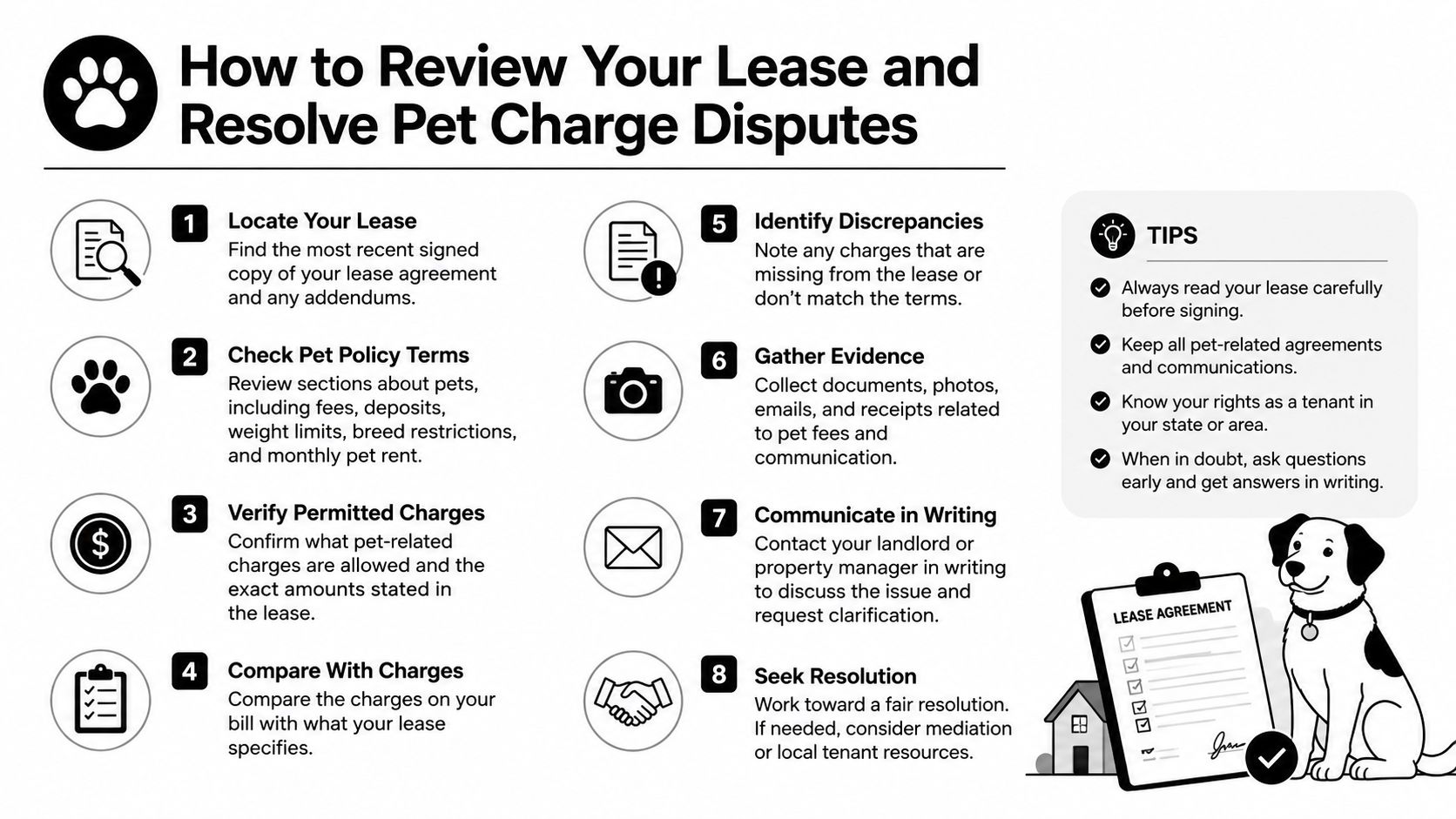
Start with the lease, not with the argument. Read the exact pet language and circle three things, whether the charge is labeled deposit, fee, or rent, whether the lease date falls before or after September 1, 2025, and whether the animal is an ordinary pet or an assistance animal. Those three details usually tell you which rules apply before anyone starts threatening court.
Tenants should then ask for a written explanation of any deduction from a refundable pet deposit. If the landlord is keeping money, the landlord should be able to explain the damage, the cost, and the lease language that allows the deduction. If the landlord cannot do that, the tenant should send a written demand letter before filing in small claims court, because a paper trail matters more than a phone call.
A practical checklist for tenants and landlords
- Check the lease date first. A pre-September 2025 lease may still be under the old structure until renewal, while a newer lease has to follow HB 410.
- Match the label to the treatment. A deposit should be handled like a deposit, and a fee should not be treated like a refundable bucket.
- Document the property condition. Move-in and move-out photos are the difference between a real deduction and a guess.
- Ask for itemized deductions. If money is withheld from a deposit, ask what was deducted and why.
- Use written notices. Texts and emails are easier to prove than verbal conversations.
- Separate pet disputes from ESA issues. If the animal is protected, the pet-charge conversation is the wrong conversation.
- Audit renewal language. A renewal can change the legal status of the pet charge even when the original lease was fine.
- Get legal help early. Once the disagreement turns into withholding or threats, the timeline starts to matter.
Landlords should also tighten their lease templates now, especially if they still use older pet clauses. Document actual damage with photos, repair invoices, and move-in comparison photos. That is what supports a deduction under the Texas Property Code, not a vague statement that the pet was “messy.”
If you want a step-by-step demand-letter path, the guide on How to Write a Demand Letter to a Landlord in Texas is the right next read. It fits the point where a disagreement stops being a conversation and starts being a claim.
When to Contact a Texas Landlord Tenant Lawyer
Call a lawyer when the lease language is unclear, the landlord is trying to stack charges after September 1, 2025, or a refund dispute has turned into a deadline problem. If the charge involves an assistance animal, get advice before you respond, because that issue can turn into a fair housing complaint fast. If you are a landlord, you need a lease that matches current Texas law. If you are a tenant, you need to know whether the money being withheld is legal.
Texas Property Code issues around deposits, refunds, and deductions are technical enough that guessing is a bad strategy. A Texas landlord tenant lawyer can review the lease, explain your rights under the Texas Property Code, and tell you whether the dispute is a demand-letter problem, a security-deposit problem, or a courtroom problem. That is the right move when money is at stake and the paperwork is messy.
If you need help with a pet charge dispute, a lease renewal issue, or a security-deposit problem, The Law Office of Bryan Fagan, PLLC handles Texas landlord-tenant matters for both landlords and tenants. Schedule a free consultation, get clear answers, and protect your rights before the other side makes the dispute worse.
If you need help with an eviction, lease issue, or rental dispute, contact The Law Office of Bryan Fagan, PLLC for a free consultation today. Visit The Law Office of Bryan Fagan, PLLC to get guidance on Texas pet deposit vs pet fee rules, lease renewals, and deposit disputes before the deadline or deduction fight gets harder to fix.