Dealing with a landlord dispute or eviction can be stressful, but a clean, signed move-in checklist can save you from a fight before it starts. In Texas, that first walkthrough is not a formality. It is the baseline that decides who pays when a landlord later points to a stain, a broken lock, or a dented door and calls it your damage.
A Houston renter can walk in on day one, see a carpet stain, a cracked tile, and a smoke detector without a battery, then assume it's minor and start unloading boxes. That's a mistake. Under Texas move-in condition checklist law, what gets written down at move-in can shape a deposit dispute, a repair dispute, and even a habitability argument later, because the checklist becomes evidence of the unit's original condition. If you're a tenant, that paper trail protects your money. If you're a landlord, it protects your deduction letter from looking made up after the fact.
Why Your First Hour in a Texas Rental Matters More Than You Think
A tenant opens the front door, sees a stain on the carpet, and hears the landlord say, “That was already there.” The tenant shrugs, sets down the first box, and keeps moving. Three months later, after move-out, the landlord deducts for the stain, the cracked tile, and a missing battery in the smoke alarm, and now everybody is fighting about what existed on day one.
That's why the first walkthrough matters so much. Texas law doesn't treat the move-in moment as a casual courtesy. It treats it as the starting point for later arguments over damages, repairs, and security deposit deductions. The written checklist is the record that lets a judge compare what the unit looked like when you took possession to what it looked like when you left.
Practical rule: If you didn't write it down at move-in, expect the other side to argue it wasn't there.
The smartest tenants act like the apartment could become evidence in court, because sometimes it does. The smartest landlords do the same. A room-by-room checklist is not about being picky, it's about creating a clean paper trail that can settle who pays without a long fight.
The checklist also matters because it helps frame later complaints. A broken appliance, a leak, or weak HVAC isn't just an annoyance if it was documented when you moved in. It can become part of a repair record, a retaliation dispute, or a claim that the unit had pre-existing problems that should never have been charged back to the tenant.
What the Texas Property Code Says About Move-In Checklists
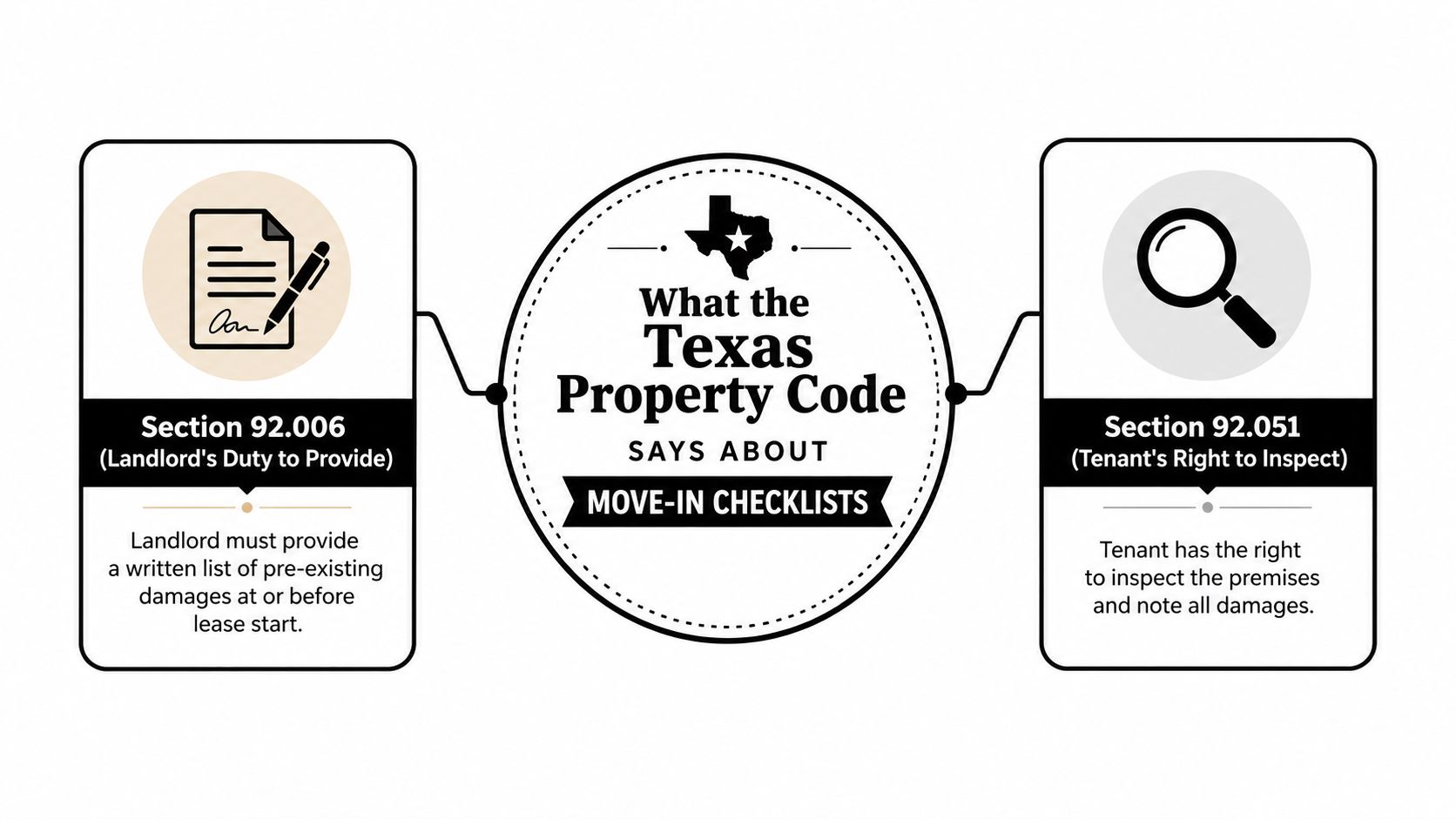
Texas has two Property Code sections that control the checklist fight in plain English. Section 92.006 requires the landlord, before or at the start of the tenancy, to give a written list of property conditions or damages the landlord knows about and wants the tenant to fix, which is why so many move-in forms are room-by-room inventories. Section 92.103 gives the landlord 30 days after the tenant surrenders the premises to return the deposit or send an itemized list of deductions, and the move-in checklist becomes the comparison point for that letter. See the statutory framework discussed in Texas Landlord-Tenant Law: An Overview, which summarizes how Texas Property Code Chapters 91-94 and Chapter 24 govern the rental relationship.
The interaction is simple. The checklist creates the starting line, then the deposit deadline forces the landlord to justify any deductions against that baseline. If the landlord's move-out letter doesn't line up with what was documented at move-in, the landlord is on weaker ground.
Think of the checklist like a timestamp on a text message. It proves what was said, and when. Without that timestamp, both sides are left arguing from memory, and memory loses fast in a deposit case.
One more point matters for real-world disputes. Texas guidance often treats the checklist like a deposit tool, but that's only half the story. The legal value of your notes depends on whether they're framed as pre-existing damage, repair requests, or health-and-safety defects. That distinction can decide whether the paper becomes a weapon in a deposit fight or the backbone of a repair claim.
Two Legal Jobs a Move-In Checklist Does Without You Realizing It
The same form can do two very different jobs. First, it sets the deposit baseline, which is the original condition record the landlord uses to justify any deduction. Second, it acts as a repair and habitability log, which is the written proof a tenant can later use to ask for HVAC repairs, leak repairs, pest treatment, or lock fixes.
A tenant who notices weak air conditioning on move-in day should not treat that as a casual complaint. If it gets written into the checklist, it shows the issue existed before the tenant's use could have caused it. A landlord who documents scratched hardwood does the same thing from the other side, because now there's proof the scratch was already there before the tenant unpacked a single chair.
A checklist that only protects the deposit and ignores repair issues is incomplete. In Texas, that missing second layer is where a lot of real fights begin.
The habitability angle matters because some checklist items are not cosmetic at all. If the form captures leaks, pest evidence, or faulty locks, it can support later claims that the landlord knew about a condition affecting health or safety. That's where a checklist stops being a simple inventory and starts becoming evidence.
The best documentation pages make both jobs obvious. They mark the condition of the unit and also preserve the tenant's ability to say, “I reported this on day one.” If you're a tenant, that gives you a strong position. If you're a landlord, it's protection against a claim that you ignored a problem you never knew existed.
For tenants building that paper trail, a strong record also helps if the dispute ends up in court. tenant documentation for court in Texas eviction defense is the same discipline, use precise notes, keep copies, and don't rely on memory after the fact.
What a Strong Texas Move-In Checklist Should Actually Capture
A defensible checklist doesn't say “looks fine.” That kind of wording is nearly useless when a dispute lands in front of a judge. It needs specific, room-by-room notes that identify what was broken, stained, loose, missing, or already worn when the tenant moved in.
The items that matter most
- Doors and locks: Note sticky handles, missing deadbolts, loose strike plates, and keys that don't work properly.
- Windows and latches: Record cracked glass, broken latches, and windows that won't stay open or shut.
- Smoke alarms: Document whether they're present and functioning.
- Appliances: List stoves, ovens, refrigerators, dishwashers, and any other appliance the lease includes, plus visible defects.
- Flooring: Write down stains, torn carpet, chipped tile, warped boards, or water marks.
- Walls and paint: Note nail holes, large scuffs, peeling paint, and obvious patchwork.
- Plumbing fixtures: Capture drips, leaks, slow drains, loose faucets, and damaged sinks or tubs.
- Water damage or pests: Put pre-existing moisture damage, mold-like staining, insects, or droppings in writing.
A note like “clean” can be twisted later. A note like “4-inch stain, center of living room carpet” is harder to argue with because it pins down exactly what was there. That's the difference between a vague memory and usable proof.
Photos help, but they don't replace words. Date each photo, date each page, and make sure the checklist and the pictures match. Texas guidance on checklist use emphasizes writing things down, sharing a copy with the landlord, and keeping a copy for yourself, because that's what gives your later position credibility.
For landlords creating a repeatable process, a room-by-room inspection format like the one discussed in property inspection checklist for landlords keeps the record organized and makes later deductions much easier to defend.
Timelines and Best Practices for Tenants and Landlords
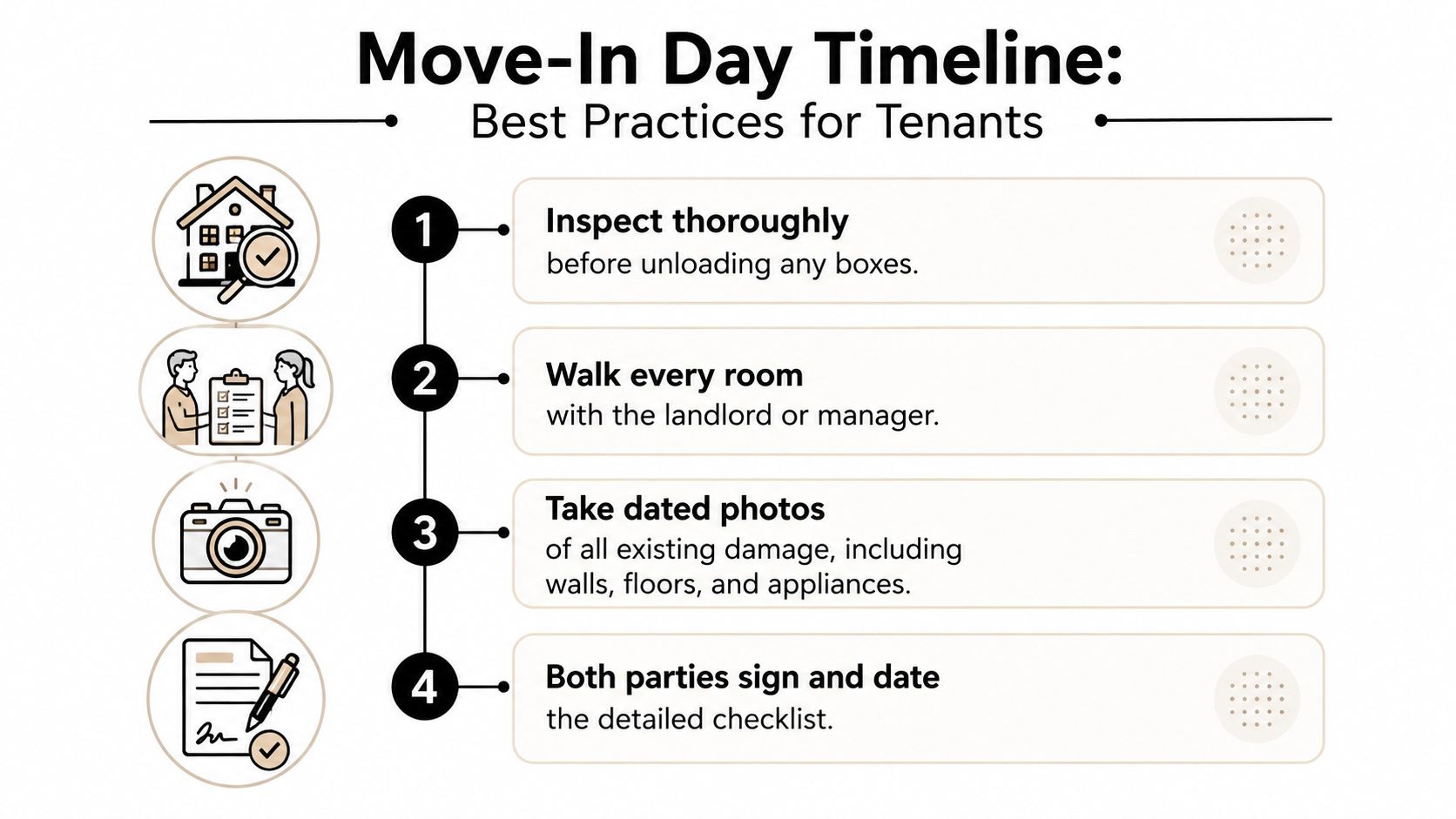
Move-in day should run on a strict sequence. Tenants should inspect before unloading boxes, walk every room with the landlord or manager, take timestamped photos, fill out the form together, sign and date each page, and ask for a copy before the keys change hands. Keep that packet with your lease, because it may matter months later when the landlord claims you caused the damage.
Landlords need a different kind of discipline. Under Section 92.006, the written condition list must be provided at or before lease start if the landlord knows of conditions or damages and wants the tenant to correct them. The landlord should then walk the unit with the tenant, keep signed copies, and store the photos with metadata so the record survives a dispute.
A lease file without signatures is weak. A deduction letter without a clean move-in record is weaker. And once move-out happens, Section 92.103's 30-day deadline starts ticking, which means sloppy front-end paperwork can wreck an otherwise reasonable back-end deduction letter.
Best practice: Do the walkthrough before furniture blocks the floors, because the hidden stain under the couch won't help anybody later.
If you're moving or managing turnover on a tight schedule, use a real move plan, not a rushed handoff. A timeline resource like the 2026 moving timeline for Boston is useful for thinking through sequencing, even though Texas deposit law still controls the checklist and deadline issues on the rental side.
For landlords who want a clean deduction process, the next stop is the itemized deduction rules at Texas security deposit itemized deduction rules. That's where the checklist and the move-out letter need to match.
Real-World Scenarios Where the Checklist Won or Lost the Case
A Fort Worth tenant walks into a unit and sees a leaking dishwasher, a stained subfloor, and damp discoloration near the cabinet base. She writes it down, snaps photos, and gets the landlord to sign the checklist. Months later, when the landlord tries to deduct for water-related damage, she points to the move-in notes and the photos, and the deduction gets reversed because the defects were documented before she arrived.
That's how checklist specificity pays off. The tenant didn't just complain. She built proof.
The second story goes the other way. A tenant signs a generic “clean” checklist, takes no photos, and never adds notes about a damaged door. At move-out, the landlord deducts for that door, calls it tenant-caused damage, and the tenant has nothing reliable to show it was pre-existing. The charge sticks because the tenant handed over a blank record and hoped memory would do the work.
The difference between those two outcomes is not luck. It is documentation. A careful checklist gives a tenant strong standing in a deposit dispute and provides a landlord evidence when a charge is challenged.
This also ties back to repair and retaliation issues. If the checklist records a broken lock, pest evidence, or a leak, that note can support a later repair request and may become part of a separate dispute if the landlord ignores the problem or retaliates after it's reported. Texas tenants and landlords both lose when they treat the checklist as a throwaway form instead of litigation evidence.

Common Pitfalls That Quietly Cost Texas Renters and Landlords
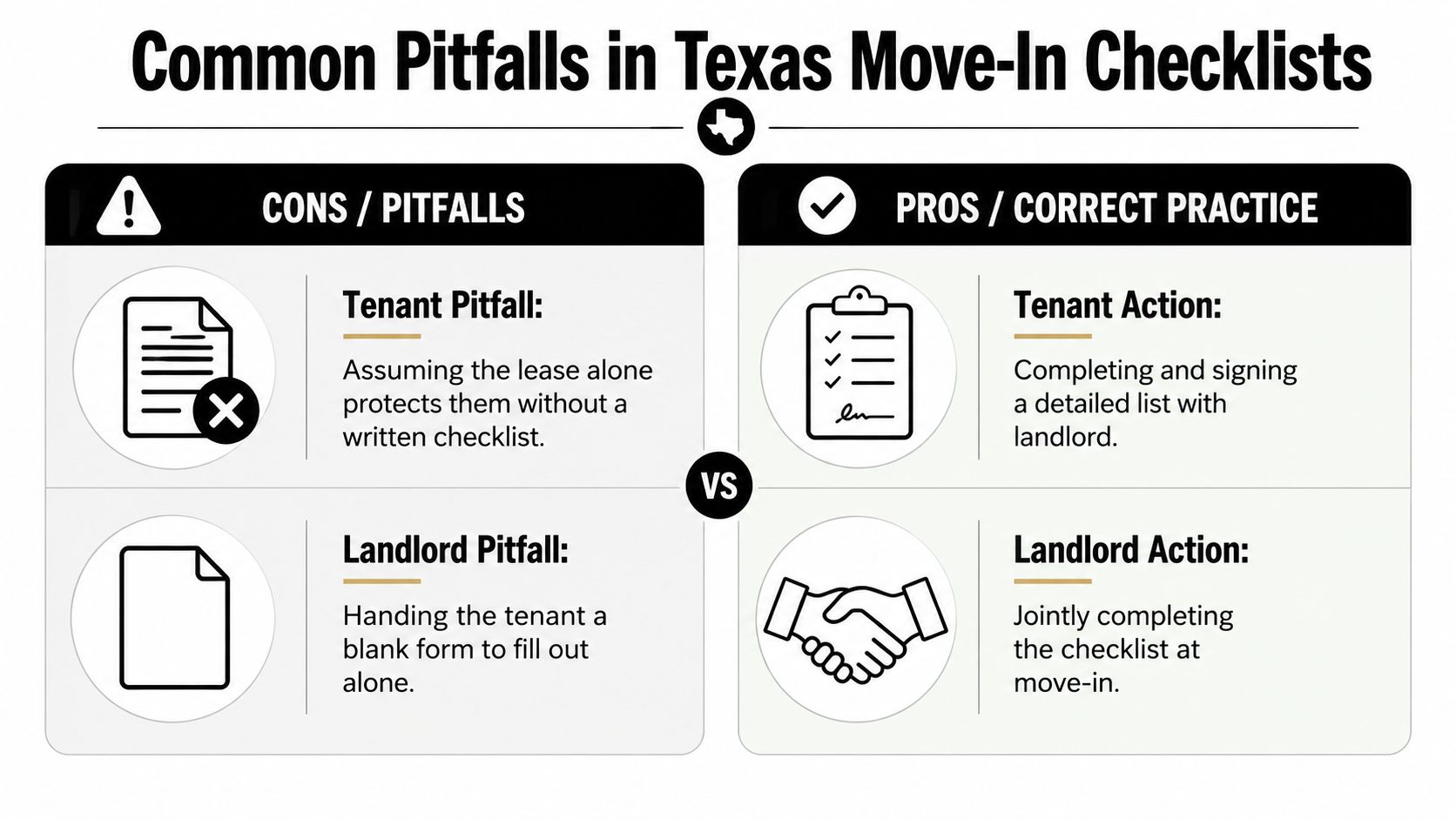
The most common mistake is simple. Tenants never get a written checklist and assume the lease alone will protect them. It won't, not when the landlord later points to a damaged surface and says the tenant caused it.
Landlords make their own expensive mistakes. Handing over a blank form and filling it in later invites trouble, because it looks like the record was created after the dispute began. Relying on photos without notes, or notes without dates, leaves the same weakness, the record feels unfinished.
- Tenant mistake: Signing a vague form and hoping a quick walkthrough will be enough.
- Landlord mistake: Letting one side control the checklist without a joint review.
- Shared mistake: Treating repair issues and deposit issues as separate worlds when the same notes can affect both.
These errors can cost real money. A bad checklist can turn a defensible deduction into a denied deduction, or turn a legitimate charge into a credibility problem. It can also leave a tenant stuck proving a repair problem without the one document that shows the issue existed on day one.
When to Bring in a Texas Landlord-Tenant Attorney
If the landlord won't provide the written list, if the deposit is still missing after the 30-day deadline without an itemized letter, or if the checklist ties into a repair issue affecting health or safety, stop handling it casually. That's when a Texas landlord tenant lawyer can step in, review the paperwork, and decide whether the issue is a deposit dispute, a repair dispute, or a retaliation problem.
The right checklist often decides the case, but only if it was done correctly. If yours was rushed, unsigned, or never copied, get legal help before the other side builds its story first.
If you need help with a move-in checklist, a security deposit dispute, or a repair problem tied to your rental, The Law Office of Bryan Fagan, PLLC can review your documents and explain your options in plain English. Visit The Law Office of Bryan Fagan, PLLC to schedule a free consultation and get focused help on your Texas rental dispute today.