Dealing with a landlord dispute can be stressful, especially when someone shows up at your door and you're not sure whether you had any warning at all. In Texas, that confusion is common because landlord entry is usually controlled by the lease, not by one statewide notice rule. If you're a tenant worried about privacy, or a landlord trying to avoid a misstep, the safest place to start is the actual entry clause in the lease and the written record around it.
Why Texas Entry Notice Rules Feel Unclear
A lot of people expect Texas to have a simple rule, like “the landlord must give 24 hours' notice.” That is not how it works here. Texas does not set one statewide advance-notice rule for ordinary landlord entry, so the answer usually turns on the lease both sides signed and the written record around it.
Why the same situation can feel legal to one person and wrong to another
If a landlord texts about a showing and the tenant never sees it, the landlord may believe notice was given, while the tenant feels blindsided. That gap is exactly why Texas landlord right of entry notice rules trip people up. In some leases, the landlord has to give notice and explain the reason. In others, the lease is looser, and the tenant's protection comes from general reasonableness and the right to quiet enjoyment.
The hard part is that Texas does not use a one-size-fits-all statute for ordinary entry. That makes lease drafting a central compliance tool for landlords and a privacy tool for tenants. It also means a tenant cannot assume the same entry rule applies just because a friend's apartment complex handles notice that way.
Practical rule: if the lease is silent, do not guess. Read the entry clause first, then look at how the landlord communicates.
For a closer look at how access rules and tenant rights fit together, see A Landlord's Right to Enter in Texas and Texas tenant rights under the Property Code. The core issue is not just whether entry happened, it is whether the entry matched the lease, the timing, and the purpose.
What Texas Law Says About Landlord Entry
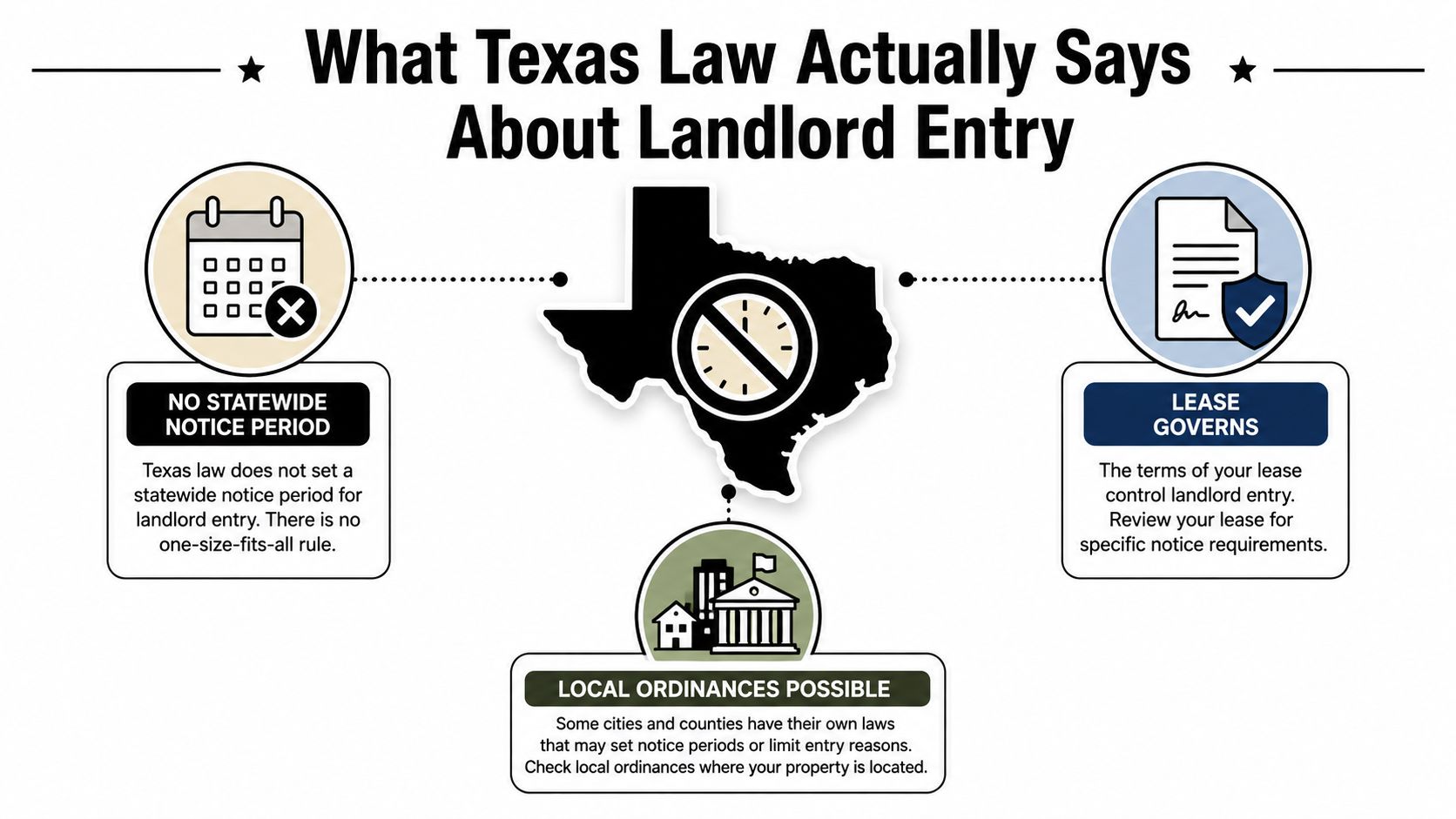
Texas does not have a statewide statute that sets a mandatory advance notice period for landlord entry into a residential unit. That is the part that confuses people most. There is no single statewide clock that tells every landlord when notice must be given. In practice, the lease usually does that work, while local rules and the Texas Property Code may fill in a few related tenant protections. Texas Property Code 92 tenant rights
What that means for a lease
A lease can require notice, or it can stay quiet on the subject. If it requires notice, that language controls more than a casual text message or a habit the parties slipped into over time. If it is silent, the tenant still has privacy rights, but the question becomes whether the entry was reasonable and tied to a legitimate property purpose.
That is why both landlords and tenants should read the access clause before there is a dispute. A landlord who writes clear entry language lowers the chance of conflict later. A tenant who reads the clause before move-in knows whether the lease promises notice, what kind of notice it promises, and what kinds of visits are covered.
The value of a written entry clause is straightforward. It tells the parties who may enter, why entry is allowed, and how notice should be delivered. It also gives both sides a standard they can point to instead of arguing from memory or habit.
Why this is a contract issue first
Texas handles entry differently from states that use a blanket statewide notice rule. Here, the starting point is the contract the parties signed, not a universal code provision. That is why property managers spend so much time on lease wording, and why a vague clause can create avoidable conflict later.
For a closer look at how tenant protections fit together with entry questions, review Texas Property Code 92 tenant rights and the practical guidance in plumbing help for landlords. The point is simple. Ordinary access usually turns on the lease first, and privacy disputes often begin when that language is unclear.
Permissible Reasons and Timing for Entry
Most valid entries start with a legitimate reason that the lease recognizes. Repairs, inspections, showings, maintenance, and pest control are the most common examples. A landlord isn't supposed to treat the unit like open territory, though, the visit has to line up with the lease and with a real property need.
Common reasons that usually appear in leases
A routine repair after a leak report is different from a casual walk-through. A scheduled inspection is different from dropping by to “check things out.” Showings for prospective tenants or buyers can be allowed, but they should still follow the notice terms in the lease and happen at reasonable times.
The timing matters as much as the reason. Many Texas leases use 24 hours of notice, but that number is contractual, not a statewide rule. If the lease says 12 hours, 24 hours, or another period, that language is what controls, unless some other law or local rule changes the analysis.
A landlord who enters at 9 p.m. for a routine check will usually have a harder time defending that visit than one who schedules it during the day with written notice.
How to think about a compliant entry
First, check whether the lease allows the purpose. Second, check whether the notice was given in the way the lease requires. Third, ask whether the time was reasonable for the reason given. A plumbing repair during business hours looks very different from a late-night visit that isn't urgent.
For landlords who deal with recurring maintenance issues, especially water and fixture problems, practical preparation matters. A helpful outside resource on rental property maintenance is plumbing help for landlords. Good documentation and a clear reason for entry go a long way toward avoiding conflict.
The easiest habit is also the most protective, send notice early, tie it to a real purpose, and keep the visit within the lease terms. That approach protects a landlord's right to access and a tenant's right to peace.
Notice Content and Delivery Methods
A notice works best when it says exactly what it needs to say and nothing vague enough to invite a fight later. The tenant should be able to tell who is coming, when they're coming, why they're coming, and how long the entry should take. If the notice leaves those points fuzzy, a landlord may still have a problem even if the visit itself was well intentioned.
What a proper notice usually includes
A strong notice usually identifies the date, the intended entry date, the time window, the reason for entry, and the person entering if that's known. That can be a landlord, property manager, vendor, or contractor. The point is to make the notice specific enough that the tenant can plan around it and verify whether the entry stayed within the agreed limits.
Vague text messages often cause trouble because they don't say enough. A call without a written follow-up can be even worse, since it leaves no clean record of what was promised. If the lease permits electronic notice, that can work, but the lease should spell that out clearly.
| Delivery Method | When It Works | When It Fails |
|---|---|---|
| Hand delivery | When the lease allows personal delivery and the notice is clear | When no one receives it or the delivery can't be proven |
| Door posting | When the lease permits posting and the notice is readable | When the posting is vague, missed, or not authorized |
| When the lease allows mailed notice and enough time is built in | When timing is too tight for the notice to matter | |
| Email or text | When the lease authorizes electronic notice | When the lease doesn't allow it or the message is too unclear |
For a broader notice discussion, see how much notice a landlord has to give in Texas. The core point is simple, delivery only counts if it matches the lease.
A clean notice versus a sloppy one
A clean notice says, “On Tuesday between 10 a.m. and noon, maintenance will enter to repair the bathroom sink.” A sloppy notice says, “We may stop by tomorrow.” The first gives the tenant real information. The second creates confusion and often leads to a dispute about whether the entry was valid at all.
Common Exceptions and the Emergency Gray Area
True emergencies change the rules. Fire, flooding, gas leaks, and similar urgent conditions can justify entry without advance notice, because waiting could make the harm worse. The problem is that some landlords stretch that idea too far and call a convenient visit an emergency after the fact.
A realistic example
A tenant leaves for work and comes home to find a maintenance worker in the apartment because the landlord said there was a “possible leak.” If there really was water pouring through the ceiling or a gas smell in the building, that can be a legitimate emergency entry. If the landlord used the word “emergency” just to get in for a routine inspection, that's a different story.
Texas-facing guidance says the lease controls ordinary entry and that emergency access is the main exception, but the gray area is often what happens after the landlord is already inside. Was there a real condition that needed immediate action? Did the landlord document what happened? Was the visit limited to the problem at hand? Those details matter.

Why the pattern matters more than one visit
A single urgent entry may be defensible. A repeated pattern of calling ordinary entries emergencies is where landlords start to create real risk. That's because repeated access can feel like harassment even when each entry is dressed up as necessary. Written records help both sides, the landlord can show why the entry happened, and the tenant can challenge a claim that doesn't hold up.
If a tenant believes a landlord entered without proper notice or keeps using weak emergency excuses, the tenant should put the objection in writing right away. A written demand creates a record and gives the landlord a chance to correct the problem before it escalates into a larger privacy or lease dispute.
Tenant Rights and Practical Remedies
Texas Law Help says a tenant who doesn't have a lease clause requiring advance notice can still ask in writing for notice before entry, such as 24 hours. If the lease does require notice and the landlord enters for a different reason or without the required notice, the tenant should send a written demand. Texas Law Help tenant privacy guidance

Step-by-step response when entry feels wrong
- Read the lease entry clause. Find the exact language on notice, timing, and reasons for entry.
- Request notice in writing. If the lease is silent, ask for advance written notice before future access.
- Document every entry. Save texts, photos of posted notices, emails, and a short log of dates and times.
- Send a written demand. If the landlord ignored the lease, put the violation in writing and ask for compliance.
- Escalate if the pattern continues. Repeated entries may justify legal advice from a Texas landlord tenant lawyer.
A tenant who wants a more direct example can compare a proper notice request with the facts discussed in landlord entering an apartment without permission in Texas. That kind of record is often what turns a vague complaint into a credible claim.
What landlords should do differently
Landlords should keep entries infrequent, tied to a clear purpose, and documented every time. If the lease says notice is required, give the notice the way the lease says to give it. If the unit needs access often, update the lease or add a written access procedure instead of relying on informal habits.
A simple notice paragraph can help both sides. “Landlord may enter the unit for repairs, inspections, or showings with advance written notice as required by the lease, except in a true emergency.” That kind of language is clear, limited, and easier to enforce than a vague promise or a surprise visit.
Sample Notice Language and Compliance Tips
Good notice language protects both sides. It gives landlords a lawful path to access and gives tenants a clear way to challenge a visit that doesn't match the lease. It also keeps arguments from turning into guesswork, which is where most entry disputes get worse.
Sample language landlords can adapt
“Landlord may enter the premises for repairs, inspections, maintenance, pest control, or showings, provided Landlord gives advance written notice as required by this lease and enters only at reasonable times, except in a true emergency. Notice may be delivered by the method allowed in this lease, and the tenant may request scheduling coordination when practical.”
That kind of clause works because it says what the landlord can do, when notice is needed, and when entry can happen without notice. It also avoids the mistake of promising unrestricted access, which invites conflict and weakens the tenant's sense of privacy.
Side-by-side compliance habits
For landlords, the safest habits are simple. Keep the purpose specific, keep the notice in writing, and keep a record of when the notice went out and when the entry happened. If contractors are involved, name them when possible so the tenant knows who's coming.
For tenants, the best habits are just as practical. Save every notice, write down every unexpected entry, and respond in writing when something doesn't match the lease. If the landlord improves the process after a written objection, that may solve the issue before it becomes a bigger case.
If you're managing repeated access issues, lease drafting questions, or a privacy dispute, the right legal help can make the next step clearer. The Law Office of Bryan Fagan, PLLC handles Texas rental disputes, lease review, and entry-related conflicts for both landlords and tenants, and that kind of guidance can help you avoid a bigger problem later.
When to Talk to a Texas Landlord-Tenant Lawyer
Texas landlord right of entry notice rules are unusual because the statute is silent and the lease does most of the work. That means the right answer depends on the document in front of you, the way notice was given, and whether the landlord's reason fits the lease and the facts. If you keep those three points in view, a lot of the confusion starts to clear up.

When legal help makes sense
Repeated unannounced entries are a red flag. So are repairs used as a pretext for access, retaliation after a tenant complaint, or lease language that seems one-sided and hard to enforce. If the landlord's conduct is starting to affect your privacy, your repair rights, or your ability to stay in the unit peacefully, talking to a lawyer early can save time and stress.
A free consultation can help you decide whether the issue is a lease problem, a documentation problem, or a dispute that may need formal action. That matters because entry disputes often overlap with repairs, retaliation, eviction, or security deposit issues, and you don't want to treat all of them the same way.
Bottom line: read the lease, keep a written log, and answer in writing when the entry doesn't match the rules.
If you need help with a landlord entry dispute, lease issue, or tenant privacy concern, schedule a free consultation with The Law Office of Bryan Fagan, PLLC. The firm helps Texans sort out rental problems with clear legal guidance, practical next steps, and a focus on protecting your rights under Texas law.
If you need help with an eviction, lease issue, or rental dispute, contact The Law Office of Bryan Fagan, PLLC for a free consultation today.