Dealing with a landlord dispute or unsafe rental condition can be stressful. You may come home to sewage backing up through a bathroom drain, discover that a gas line is leaking, or find that the air conditioning has stopped working during a punishing Texas summer. A landlord may see a maintenance ticket, while you see a serious threat to your health, safety, or ability to live in the property.
The phrase Texas implied warranty of habitability sounds broad, but Texas law is narrower and more procedural than many online explanations suggest. The law doesn't promise perfect comfort or a problem-free home. It creates a legal baseline for conditions that materially affect the physical health or safety of an ordinary tenant, with specific rules about notice, rent status, timing, and available remedies.
For tenants, the details can determine whether a repair claim succeeds or whether an attempted rent deduction creates an eviction risk. For landlords, a written notice, a missed response, or poor records can change the direction of a dispute quickly.
What the Texas Implied Warranty of Habitability Actually Covers
Suppose a tenant walks into the bathroom and finds sewage spreading across the floor. That condition isn't a cosmetic annoyance. It can make the dwelling unsafe or unsanitary, especially if the landlord ignores a prompt request for help. A failed air conditioner presents a more fact-specific question. Texas law may focus on whether the condition materially affects physical health or safety, rather than treating every loss of comfort as a legal violation.
The practical meaning of habitability is a safe, sanitary, and livable residential premises. Texas doesn't treat the warranty as a blanket promise that every appliance will always work or that the property will meet a tenant's preferred standard. A faded wall, an outdated countertop, or a minor inconvenience may call for maintenance, but those conditions don't automatically meet the statutory threshold.
The Texas Attorney General's renters' rights guidance emphasizes the importance of written repair notice and explains that repair disputes depend on the condition and the tenant's compliance with the required process.
Safety matters more than appearance
Examples that may support a habitability dispute include a serious sewage backup, a dangerous gas leak, or a major electrical hazard, when the facts show a material effect on health or safety. By contrast, cosmetic defects usually fall outside the core repair framework.
A hot-water problem receives special treatment. Texas law identifies hot water below 120 degrees Fahrenheit as a qualifying condition when the landlord failed to maintain the required temperature, as explained in Texas Property Code Chapter 92.
Practical rule: Don't label a condition “uninhabitable” and stop there. Describe what happened, how it affects health or safety, when you notified the landlord, and what evidence supports your account.
The Texas habitability law guide can help tenants and landlords place a repair problem within this narrower Texas framework. The key question isn't whether the property feels imperfect. It's whether the condition qualifies under the law and whether the tenant followed the required steps.
How Texas Courts Established the Habitability Standard
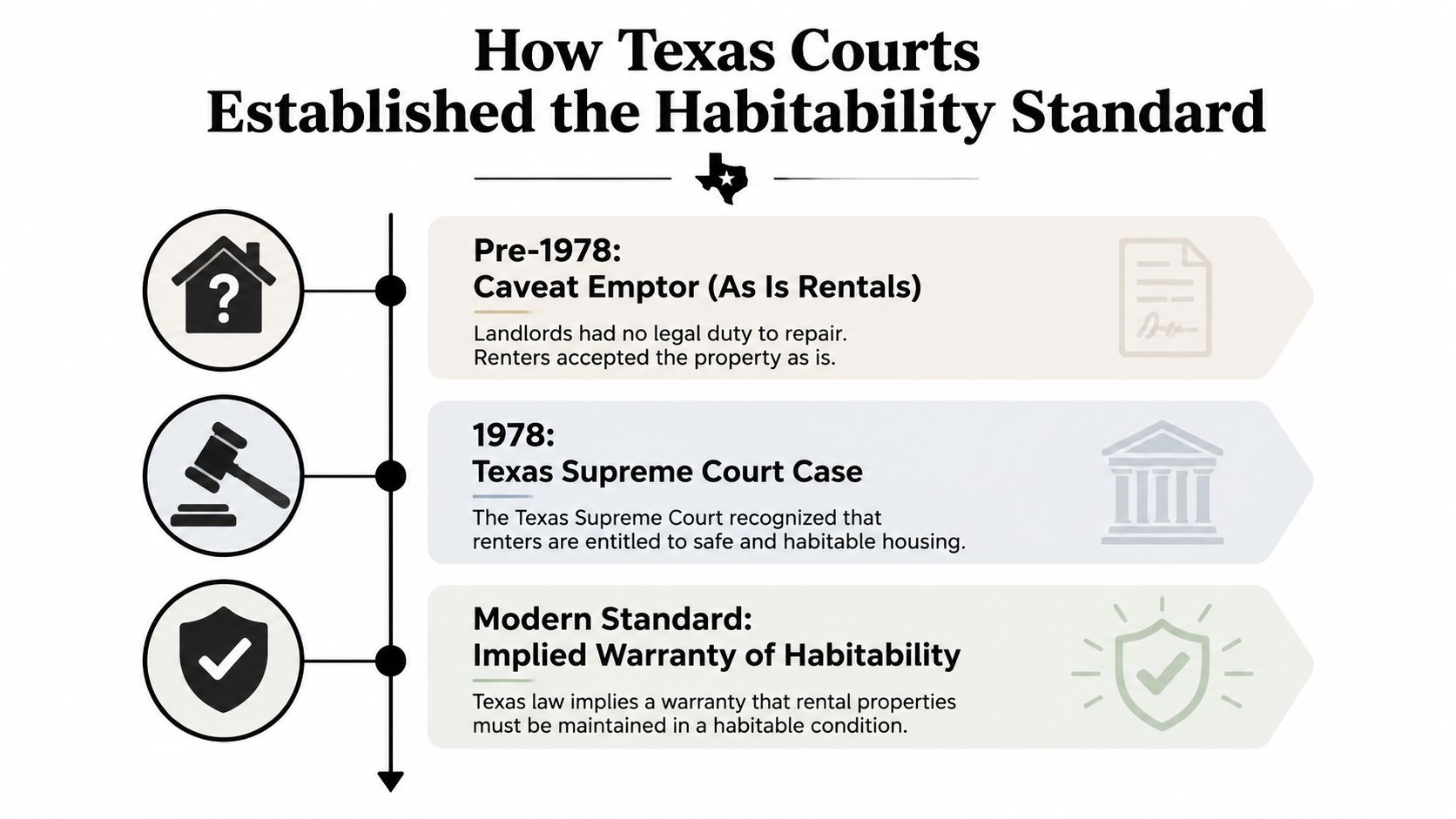
Texas's modern habitability concept has an important judicial starting point. In 1978, the Texas Supreme Court decided Kamarath v. Bennett and formally recognized an implied warranty of habitability in residential rentals. The court held that a landlord owes tenants a dwelling that is “habitable and fit for living.”
The decision also explained that the warranty is imposed by law, not merely created by the lease. A breach exists when a defect makes the premises “unsafe, or unsanitary, or otherwise unfit for living therein.” Those words matter because they describe a legal baseline tied to the condition of the dwelling, not a promise of luxury or convenience. The full decision is available in Kamarath v. Bennett.
From caveat emptor to a legal baseline
Before that ruling, Texas residential lease law followed a stronger caveat emptor, or “buyer beware,” approach. In practical terms, tenants had fewer legal tools when a residential property contained serious defects. Kamarath moved Texas away from treating a home rental as purely an “as is” transaction and toward an enforceable standard for residential living conditions.
That history helps explain a common source of confusion today. People often discuss the “implied warranty” as though it alone answers every repair question. It doesn't. The court supplied an important foundation, but later legislation placed many repair disputes within the detailed rules of Chapter 92 of the Texas Property Code.
For a broader overview of how Texas Property Code Chapters 91 through 94 and Chapter 24 govern the rental relationship, see Texas Landlord-Tenant Law: An Overview. The modern dispute usually turns less on an abstract promise and more on whether the tenant satisfied statutory conditions.
A tenant may have a serious defect, yet still struggle to obtain a statutory remedy if notice went to the wrong place, rent was not current, or the condition didn't materially affect health or safety. A landlord may believe a repair was handled responsibly, yet lack the records needed to show timely and diligent action.
The Three Triggers That Activate Your Repair Rights
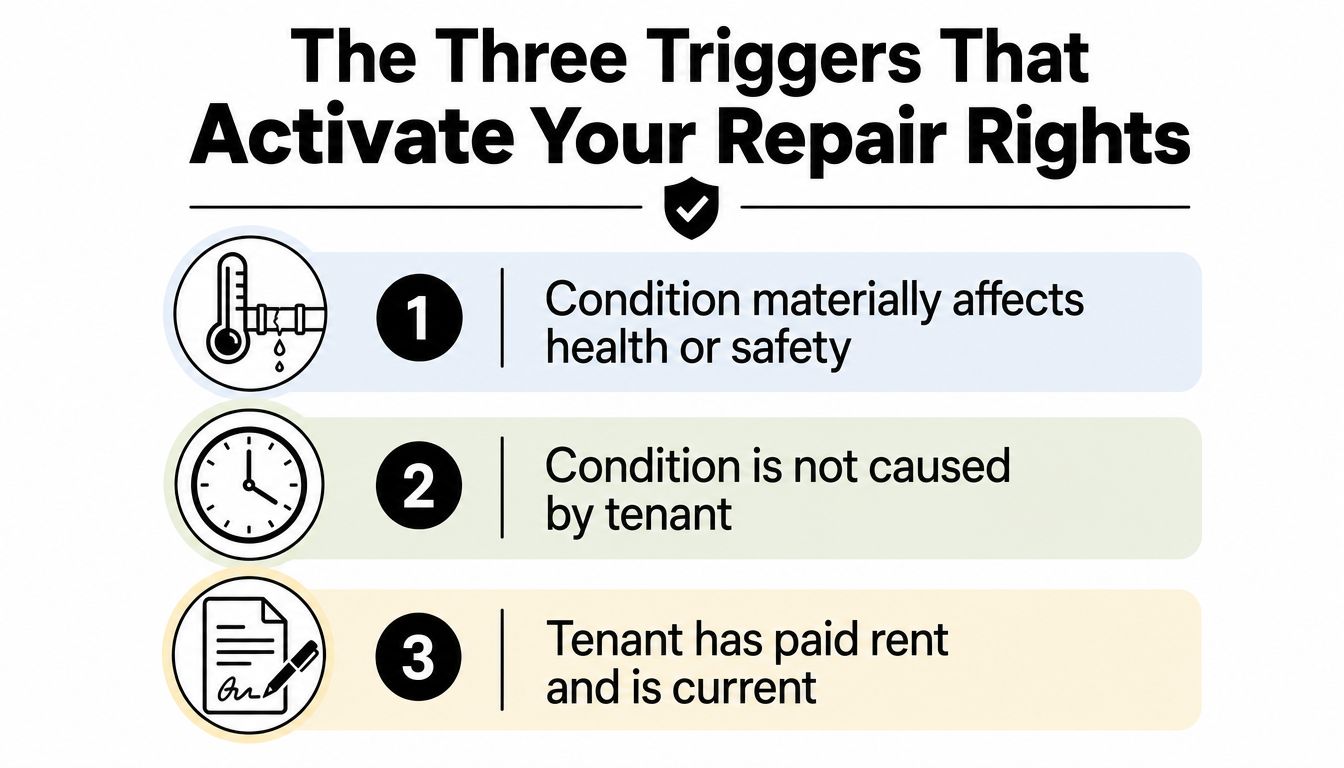
Texas Property Code Section 92.052 doesn't activate a landlord's repair duty merely because a tenant reports a problem. The tenant generally must establish three connected facts. Treat them as the foundation of a repair claim.
First, give notice the right way
The tenant must specify the condition to the place where rent is normally paid. Sending a message to a former property manager or leaving a note with a neighbor can create a proof problem. Use the rent-payment address or method identified in the lease, and keep a copy of everything sent.
Second, stay current on rent
The tenant must be current on rent when notice is given. This rule can feel harsh when the defect is serious, but it remains a central part of the statutory framework. A renter who is behind may need to bring rent current before relying on the repair-and-remedy process.
That doesn't mean a landlord may ignore a dangerous condition. It means the tenant's statutory repair claim can be affected by rent status, so the lease, payment records, and dates need to be reviewed together.
Third, show a qualifying condition
The condition must materially affect the physical health or safety of an ordinary tenant. A serious gas leak may plainly meet that standard. A sewage backup or major electrical danger may also qualify when the evidence supports a safety risk.
A faded paint job, a scratched cabinet, or a preference for a newer appliance usually won't meet the same threshold. Hot water below 120 degrees Fahrenheit is an alternative statutory qualification when the landlord failed to maintain the required temperature, according to Section 92.052 of the Texas Property Code.
Before sending notice, collect the facts that later may matter:
- Describe the condition: State what is broken, where it is located, and what happened.
- Record the effect: Explain the health or safety concern without exaggeration.
- Confirm payment status: Keep rent receipts or bank records showing whether rent was current.
- Preserve evidence: Save photographs, videos, inspection reports, and communications.
A tenant who can prove notice, current rent, and a qualifying condition is in a far stronger position than someone who relies only on a verbal complaint.
How to Give Proper Notice and Track Repair Timelines
A repair dispute often turns on the paper trail. A tenant may remember reporting a broken system, while a landlord may remember promising to call a contractor. Courts need more than memory. They look for records showing what was reported, when it was reported, where notice was sent, and what happened afterward.
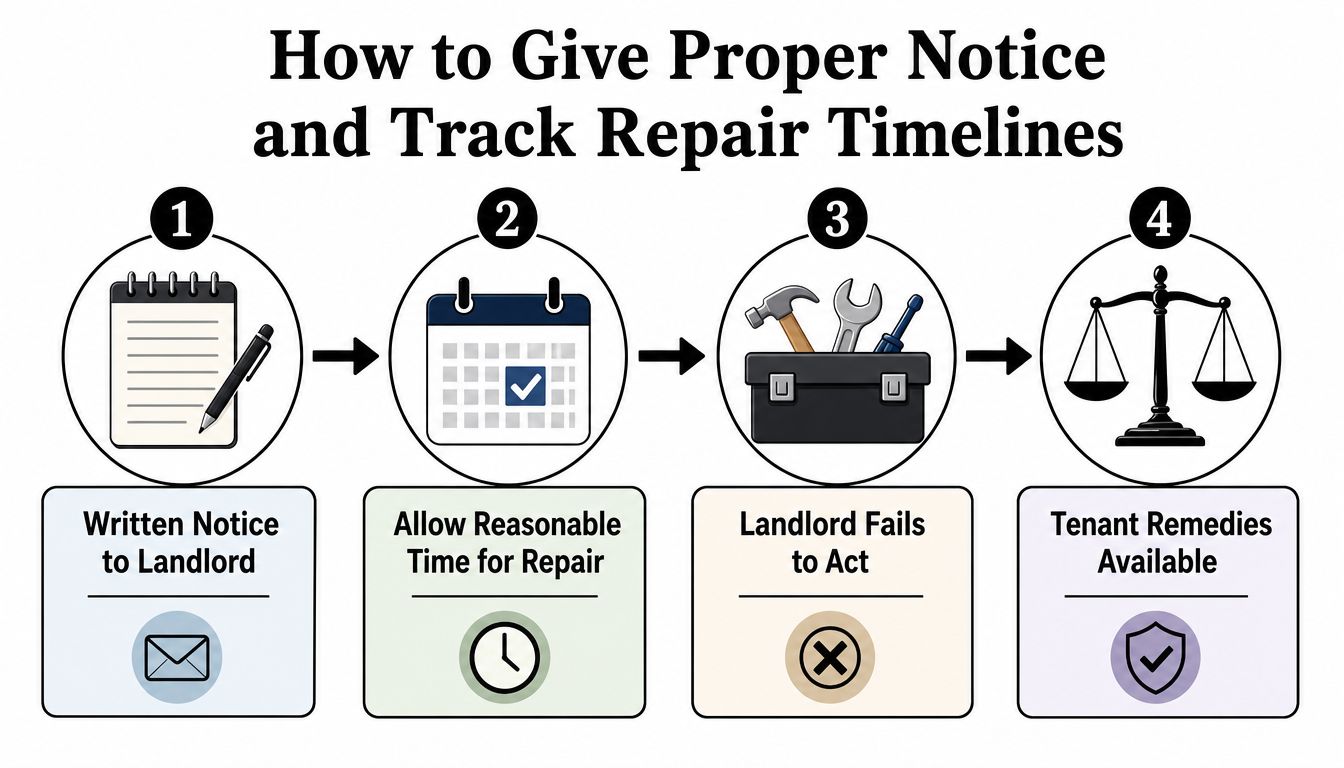
Build a usable notice record
Write a clear repair request. Identify the address, the affected room or system, the date you noticed the problem, and the way it affects health or safety. Avoid insults or threats. A direct factual message is easier to use later.
Send it to the proper place. The statutory framework focuses on notice to the place where rent is paid. For serious disputes, written notice by certified or registered mail can create useful proof of delivery. Keep the letter, receipt, tracking information, and any returned card.
Document the condition. Take dated photographs and videos. For a water problem, show the affected area and any continuing leak. For a utility failure, record notices from the utility provider and communications with the landlord. Don't alter or stage evidence.
Track the response. Write down calls, appointments, contractor visits, cancelled appointments, and promised completion dates. Landlords should keep work orders, invoices, parts records, and messages showing diligent repair efforts.
The statutory framework uses a seven-day repair benchmark after the landlord receives notice of the tenant's intent to repair. The Texas Property Code repair provisions include this timing rule, while the facts of the condition determine whether a faster response is necessary.
A seven-day benchmark isn't permission to ignore an emergency. No water, inadequate heat, a gas leak, or another urgent safety condition may require faster action, particularly during extreme weather.
The State Bar of Texas explains the repair process and possible remedies in its landlord-tenant repairs guide. If the landlord doesn't respond appropriately, don't jump straight to withholding rent. Review the notice sequence, rent status, qualifying condition, and lease language first.
For a practical written-notice approach, see how to request repairs from a landlord in Texas. Tenants and landlords should both understand that timing can affect the remedy, not just the merits of the complaint.
Comparing Your Legal Remedies When Repairs Are Ignored
When a qualifying condition remains unresolved after proper notice, Texas law may provide more than one path. The right choice depends on the severity of the condition, the quality of the documentation, the tenant's ability to relocate, and the financial consequences of acting incorrectly.
| Remedy | When to Use | Key Limitation | Risk Level |
|---|---|---|---|
| Lease termination | The landlord fails to address a qualifying condition after the required notice process | The tenant must follow the statutory sequence and prove the condition and notice | Moderate |
| Repair and deduct | A tenant needs a permitted repair and can document the cost | The deduction can't exceed one month's rent or $500, whichever is greater (Section 92.0561) | High if done incorrectly |
| Lawsuit for damages | The tenant has losses or needs a court remedy | The tenant must prove the statutory violation, damages, and required notice | Varies |
Lease termination
Ending the lease can make sense when the condition materially affects health or safety and the landlord fails to take the required steps. A tenant should not move out because a repair feels frustrating. The tenant should preserve the notices, allow the legally relevant opportunity to respond, and obtain advice before treating the lease as terminated.
Repair and deduct
Repair and deduct is not a general permission to hire any contractor and subtract any invoice from rent. The statutory cap is the greater of one month's rent or $500, and the tenant still must satisfy the notice and other requirements. Keep estimates, receipts, proof of payment, and evidence that the repair addressed the reported condition.
A deduction that exceeds the permitted amount, concerns a nonqualifying defect, or follows inadequate notice can expose a tenant to a rent dispute or eviction case.
A lawsuit for damages
A lawsuit may be appropriate when the tenant suffered documented losses, the landlord's failure caused harm, or the dispute requires a court's involvement. Evidence may include notices, photographs, repair estimates, temporary housing records, medical documentation when legally relevant, and payment records.
Landlords should review what to do when a Texas landlord ignores repair requests before choosing a response strategy. A prompt, documented repair effort may resolve the issue. If litigation has started, preserving records and avoiding retaliatory conduct becomes especially important.
Common Misconceptions That Cost Tenants and Landlords
The most expensive mistake is treating the phrase “implied warranty” as a shortcut. Texas's statutory framework is narrower than many summaries suggest, and the procedure can matter as much as the defect.
Misconception one, a tenant can withhold rent. Texas law doesn't give tenants a general right to stop paying rent whenever a repair is delayed. Rent status is one of the mechanics that can affect repair rights under Section 92.052. A tenant who withholds rent without understanding the statute may invite a nonpayment claim.
Misconception two, every maintenance problem is a habitability violation. A broken fixture, cosmetic defect, or inconvenience may deserve attention without materially affecting the physical health or safety of an ordinary tenant. The legal question requires facts, not just a label.
Misconception three, landlords have unlimited time. They don't. Texas uses a seven-day benchmark in the repair framework, and emergency conditions can demand faster action. The landlord's obligation is generally tied to diligent repair efforts, so contractor calls, appointment records, parts orders, and written updates can become important evidence.
Heat, cooling, and utilities require careful analysis
Repair disputes increasingly focus on cooling, heat, water, and utility failures during extreme weather. The answer still depends on the specific condition and the statutory process. A tenant should describe the actual effect on health or safety, while a landlord should investigate promptly and document the response rather than dismissing the complaint as ordinary discomfort.
Retaliation is a separate concern
A landlord shouldn't respond to a repair complaint by using eviction threats, harassment, or other prohibited conduct. A tenant also shouldn't assume that every later lease action proves retaliation. The timing, reason, communications, and surrounding facts matter, so both parties should preserve records.
For landlords: A professional response is safer than an emotional one. Acknowledge the request, investigate the condition, communicate the plan, and keep proof of each step.
When to Contact a Texas Landlord Tenant Lawyer
Legal advice becomes especially valuable when the condition presents an immediate danger, the landlord threatens eviction after a complaint, or the tenant is being pushed out for requesting repairs. A landlord may also need counsel when a tenant misuses the repair statute, stops paying rent, makes unauthorized deductions, or claims a defect that the evidence doesn't support.
A Texas landlord tenant lawyer can help organize the timeline around the lease, notice, rent status, property condition, and response. A tenant facing an eviction may need an eviction attorney to identify defenses and protect the record. A landlord may need help enforcing lease terms while still complying with the Texas Property Code.
Before a consultation, gather:
- The lease and addenda: Include repair, notice, utility, and payment provisions.
- The timeline: List the defect, every notice, each response, inspections, and repair attempts.
- Payment records: Show rent status and any disputed deductions.
- Condition evidence: Preserve photographs, videos, invoices, estimates, and inspection materials.
- Court documents: Bring every notice, citation, petition, or hearing paper.
The Law Office of Bryan Fagan, PLLC offers a free 30-minute consultation to evaluate a landlord-tenant dispute, explain the available options, and develop a practical strategy in plain language. Getting advice early can help a tenant avoid an unsafe move-out decision or help a landlord respond without creating additional liability.
If you need help with an eviction, lease issue, repair dispute, or habitability claim, contact The Law Office of Bryan Fagan, PLLC for a free consultation. Bring your lease, notices, payment records, and repair documentation so the firm can help you understand your rights and choose the next step.