Dealing with a landlord dispute or possible eviction can feel overwhelming when you're trying to protect your home, your income, or your property. The search for answers often begins when a notice is already on the door, rent is already late, or a lease problem has started to spiral.
Texas eviction laws are strict, fast-moving, and procedural. That matters for both sides. If you're a tenant, one missed deadline can cost you valuable options. If you're a landlord, one mistake in the notice or court filing can derail an otherwise valid case. The good news is that the Texas Property Code gives you a roadmap. Once you understand the steps, the process becomes far less mysterious and much more manageable.
Understanding Your Rights in a Texas Eviction
An eviction in Texas is a court process, not a private decision. A landlord can't unilaterally decide that a tenant has to leave and remove them without following the law. A tenant also can't assume that receiving a notice automatically means the case is over. Rights and obligations exist on both sides, and the details matter.
The legal case is commonly called a forcible detainer lawsuit. In plain terms, that means a court decides who has the right to possess the property. The issue is usually possession first, with other disputes sometimes handled separately.
Why the rules matter so much
Texas courts expect landlords and tenants to follow the process closely. The court looks at basics like whether proper notice was given, whether the lease supports the landlord's claim, and whether deadlines were met. In practice, many eviction disputes turn on procedure just as much as the underlying facts.
For landlords, that means paperwork and timing are risk management tools. For tenants, it means documents, payment records, repair requests, and communications can make a real difference.
Practical rule: Don't treat an eviction as an informal conflict. Treat it as a legal process from the first written notice forward.
What you should focus on first
If you're a landlord, start by confirming the lease terms, the reason for removal, and the exact notice required before filing. If you're a tenant, read every document carefully and compare it to your lease, your payment history, and the events that led up to the notice.
A Texas landlord tenant lawyer or eviction attorney often starts with the same basic questions:
- What happened first: Nonpayment, a lease violation, a holdover, or something else.
- What paperwork exists: Lease, notices, texts, emails, ledgers, photos, and repair requests.
- What deadline applies: Notice periods, court appearance dates, appeal deadlines, and any special defenses.
That early review often shapes everything that follows.
Legal Grounds for Eviction in Texas
A landlord in Texas needs a legally recognized reason to evict. Frustration alone isn't enough. Courts want to see a valid basis tied to the lease or to the tenant's continued possession of the property.
Nonpayment of rent
This is the most common ground. If rent isn't paid as required by the lease, the landlord can begin the process by serving a written notice. Under Texas Property Code Section 24.005, a landlord must give at least three days' written notice to vacate before filing a forcible detainer suit, unless the lease clearly sets a shorter or longer period.
A simple example helps. If rent was due and unpaid, and the lease doesn't change the notice period, the landlord can't post notice on Monday and file the case that same day. The notice period must fully expire first.
Lease violations other than rent
A tenant can also face eviction for violating material lease terms. Common examples include keeping an unauthorized pet, causing serious property damage, or violating occupancy rules. The lease language matters here. Courts usually want to see the exact lease term that was broken and proof of the violation.
A landlord who says, “The tenant is difficult,” usually doesn't have enough. A landlord who says, “The lease bars unauthorized animals, and I have photos and written warnings,” has a much clearer case.
Holding over after the lease ends
Some cases involve no new misconduct at all. The lease ends, and the tenant stays. Texas law still requires the landlord to use the court process to recover possession. Even after expiration of the lease term, self-help removal isn't allowed.
A tenant who remains after the lease term doesn't lose all legal protection. The landlord still has to follow the formal eviction process.
Occupancy disputes can get complicated
Not every case fits neatly into a standard apartment scenario. Roommates, family arrangements, and oral agreements can create disputes about whether someone is a tenant or merely a guest. That issue can affect how the case begins and what proof the court expects.
Commercial cases add another layer. Commercial Lease Disputes in Texas discusses how Texas treats commercial tenancies differently under Chapter 93, which is important because the rules and risks are not always the same as in residential cases.
What works and what doesn't
Landlords usually do best when they keep the case narrow, document the lease breach, and avoid emotional side disputes. Tenants usually do best when they challenge the actual legal basis for the case rather than relying on general unfairness.
A strong eviction claim starts with a clear reason. A weak one often starts with assumptions.
The Critical First Step The Notice to Vacate
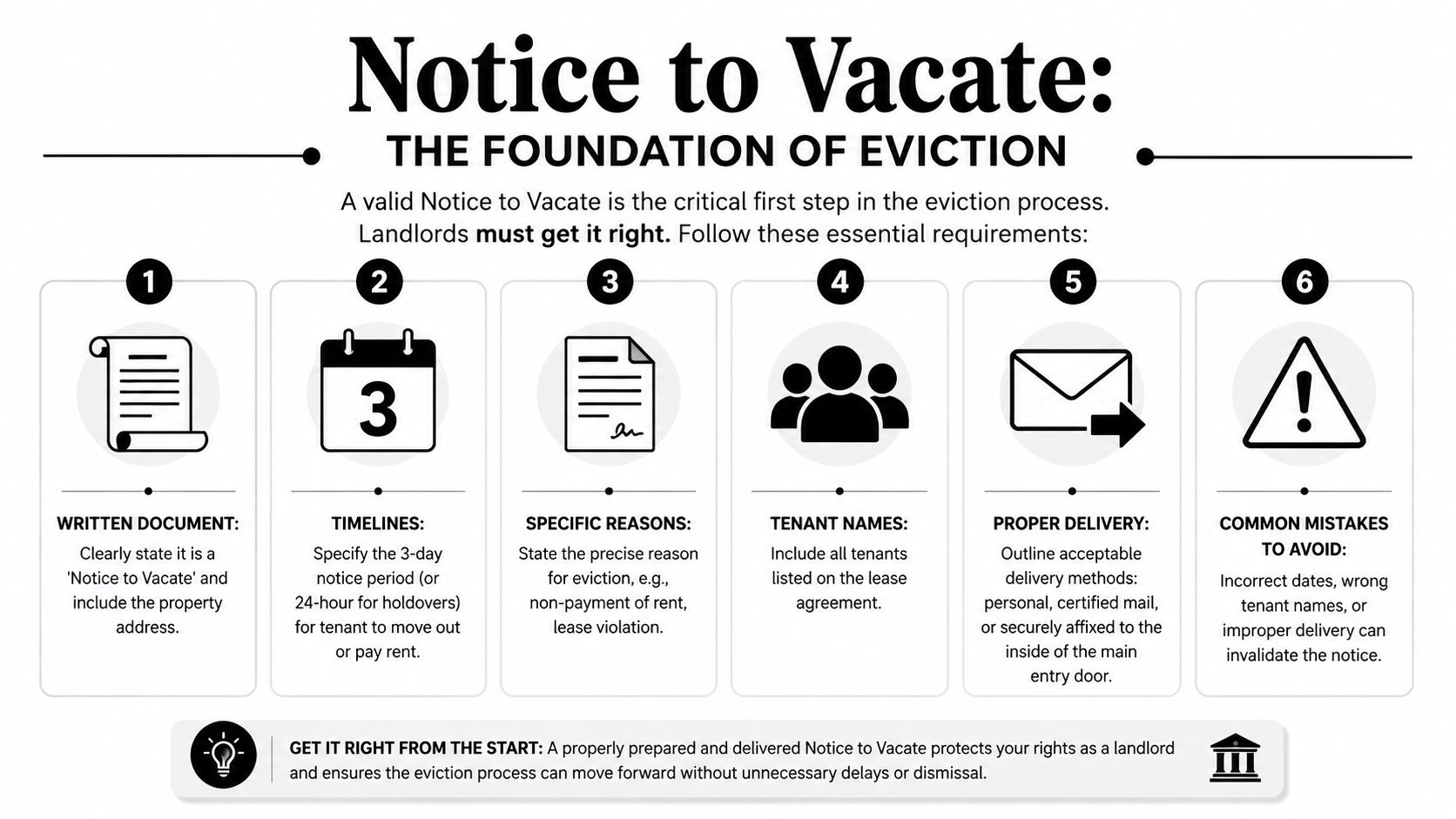
Most eviction cases rise or fall on the notice. If the notice is defective, the court may dismiss the case even when the tenant really does owe rent or violated the lease. That's why this first document deserves care.
What a valid notice should do
A proper notice should clearly identify the property, the tenant or tenants, and the reason the landlord is demanding possession. It should also give the tenant the correct amount of time to comply or leave, based on the lease and the law.
For many readers trying to get the basics right, this guide to understanding eviction notice requirements is a useful overview of how notice forms are commonly structured and where people make avoidable mistakes.
Delivery matters as much as wording
A notice isn't just about what it says. It also has to be delivered in a legally acceptable way. Delivery disputes come up often in court because one side says notice was given and the other says it wasn't.
Landlords should keep copies and proof of delivery. Tenants should keep the envelope, take a photo of the posting, and note the date they received it.
Notice sample for nonpayment: “You are hereby notified to pay the full rent due or vacate the premises within the time allowed by law and the lease. If you do not do so, an eviction suit may be filed.”
That sample is only a starting point. The exact language may need to match the facts of the case.
A major technical change to know
Under this discussion of the new Texas notice rule, as of January 1, 2026, if the tenant was not previously delinquent in the month the notice is given, a nonpayment notice must be phrased as “pay rent or vacate” rather than a generic notice to vacate. The same source explains that getting this wrong can invalidate the eviction case.
That kind of detail surprises many landlords. It also gives tenants a real procedural issue to examine if the notice seems off.
A practical checklist
Before the case goes to court, review whether the notice includes the basics:
- Correct parties: Every tenant named in the lease should be addressed where appropriate.
- Correct reason: Nonpayment, holdover, or lease violation should be stated clearly.
- Correct timing: The notice period must match the law and the lease.
- Correct wording: Special phrasing may be required in some nonpayment cases.
- Correct delivery: The method used should be one the court will accept.
If you want a deeper explanation focused on residential practice, this article on what is a notice to vacate in Texas is a helpful companion.
Navigating the Texas Eviction Lawsuit
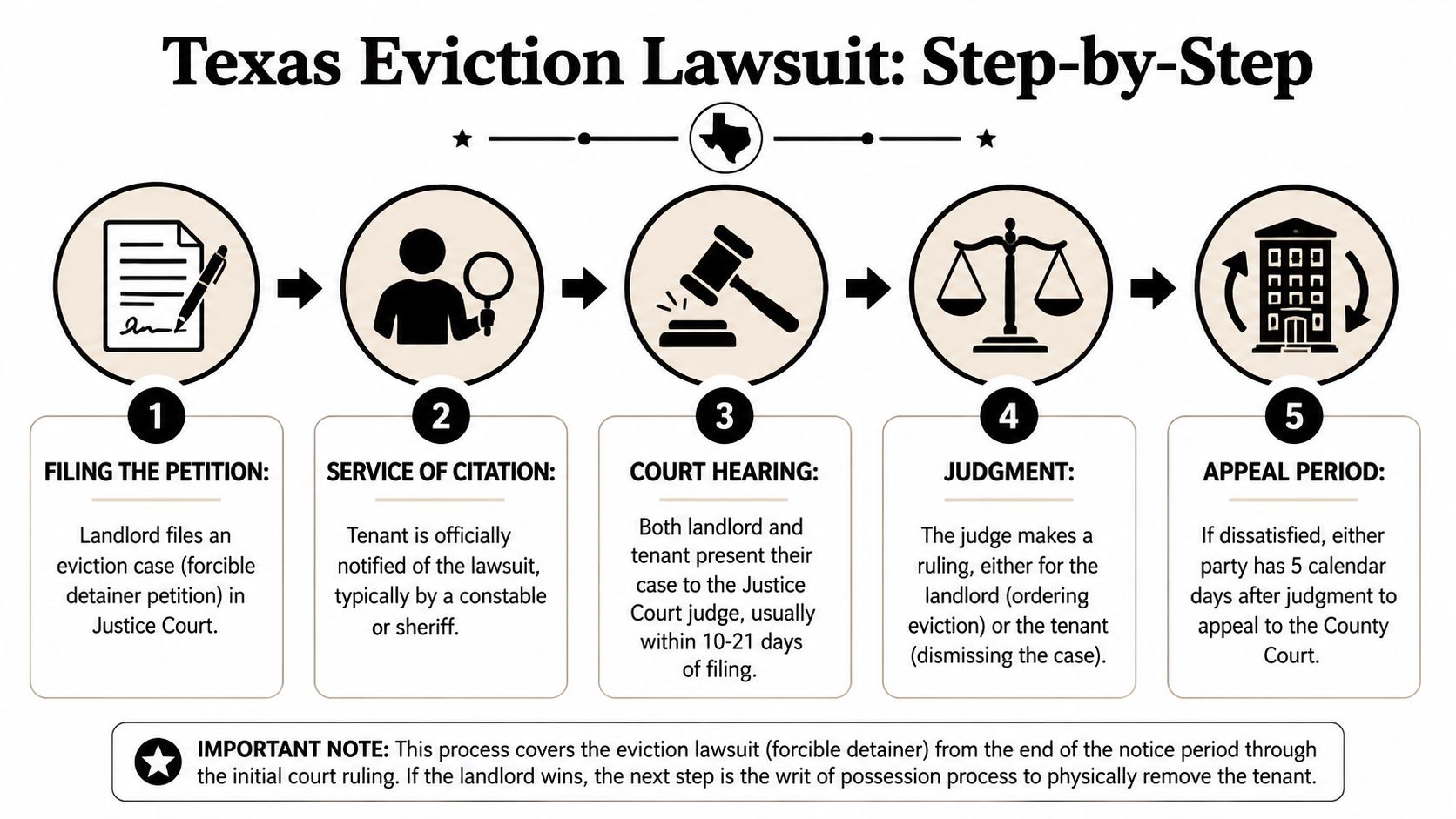
Once the notice period expires without a resolution, the dispute moves into court. For most residential cases, that means a filing in Justice of the Peace court. The lawsuit is the formal point where each side needs to stop guessing and start preparing evidence.
A quick visual helps if you're trying to understand the sequence.
What filing the case looks like
The landlord files a petition alleging the basis for possession. The tenant is then served with citation, usually through a constable or similar official process. Once service happens, the case starts moving quickly.
Before recent reforms, many Texas eviction cases already moved on short timelines. Standard hearings typically occurred within 10 to 21 days after filing, according to this overview of the Texas eviction process. That same source notes the process historically involved a notice period, a Justice Court case, and then post-judgment deadlines.
The 2025 changes made timing even tighter
Texas made substantial changes to the system. On June 20, 2025, Governor Greg Abbott signed SB 38 into law, and the statute imposed a 21-day limit on appeals, required constables to attempt service of the eviction petition within five business days, and introduced a summary disposition process that can allow judgment without a trial when there are no actually disputed facts, potentially resolving a case in less than 10 days from service of the petition, as described by the National Apartment Association summary of SB 38.
For landlords, that can reduce delay when the facts are straightforward. For tenants, it means delay tactics are less likely to buy meaningful time. Preparation has to start immediately.
What to bring to court
Both sides should expect the judge to focus on simple, concrete proof. The court usually won't care much about personal accusations that don't connect to the legal issue of possession.
Bring documents that help the judge answer the key questions:
- For landlords: Lease, ledger, notice to vacate, proof of delivery, photos, and communications tied to the alleged breach.
- For tenants: Receipts, bank records, repair requests, text messages, witnesses, and any document showing payment, waiver, retaliation, or bad notice.
- For both sides: A timeline. Courts appreciate an organized chronology.
This video gives a general visual explanation of how the hearing process works in practice.
What tends to help in real cases
The strongest landlords present a clean file and stick to the lease violation. The strongest tenants focus on a real defense, not a general sense that the situation is unfair.
Court is usually not the place to tell the whole history of a bad relationship. It's the place to prove the legal issue in front of the judge.
If you want a broader walkthrough of filings, service, hearing practice, and enforcement, a related discussion of the Texas eviction process explained can help you frame the case from start to finish.
Common Defenses and Tenant Rights
An eviction filing doesn't mean the landlord automatically wins. Tenants have defenses, and landlords need to understand them because procedural errors and legal defenses can undo a case that looked straightforward on paper.
Improper notice and paperwork errors
A defective notice is one of the most common problems. If the notice gave the wrong deadline, named the wrong tenant, used the wrong wording, or wasn't delivered properly, the case may fail before the judge ever reaches the deeper facts.
Landlords sometimes underestimate how technical this is. Tenants sometimes overlook it entirely. Both sides should read the notice line by line.
Self-help eviction is illegal
Texas law sharply limits what a landlord can do without a court order. Under Texas Property Code guidance summarized here, a landlord may not remove doors, windows, locks, or similar components to force a tenant out. A landlord also can't lock a tenant out overnight to pressure payment and call that an eviction.
That matters because some cases start with a legitimate complaint but become much riskier when a landlord takes unlawful shortcuts.
Disability-related conduct can require accommodation
One of the most overlooked defenses involves disability. Under Disability Rights Texas guidance on eviction and accommodations, federal and state law require landlords to consider reasonable accommodations when the alleged lease violation is connected to a tenant's disability. If the tenant can show that link and show that a reasonable policy change could eliminate the problem, the accommodation may stop the eviction.
A common real-world example is behavior that a landlord labels as a lease violation but that is tied to a mental or physical disability. The legal question becomes whether the problem can be addressed through an accommodation rather than removal.
A lease rule is not always the end of the analysis when disability law applies.
Repair issues and retaliation concerns
Some tenants believe poor conditions automatically defeat an eviction. That's not always true. But repair issues can matter, especially when the dispute involves retaliation or a landlord's failure to address serious health and safety problems.
The repair statutes are technical too. Under the Texas Attorney General's renters' rights explanation, certified mail notice can be important, and if the first notice was not sent by certified mail, a second notice may be required before certain remedies become available. That doesn't create a universal eviction defense, but it can shape the tenant's legal position.
Build the defense with documents
If you're defending an eviction, gather your records before the hearing date. Strong defenses are usually documented, not improvised in the courtroom. This guide on tenant documentation for court in a Texas eviction defense is a useful starting point.
A practical defense file often includes:
- Payment proof: Receipts, screenshots, bank confirmations, or money order stubs.
- Housing condition evidence: Photos, inspection reports, and written repair requests.
- Accommodation records: Medical support documents, letters, and prior requests.
- Communication history: Texts and emails that show what happened and when.
What Happens After the Eviction Judgment
The judge's ruling is important, but it isn't the last step. After judgment, timing becomes even more important because the window to act is short for both sides.
Here is the post-judgment sequence in a simple visual format.

The appeal window comes first
Following an eviction judgment, Texas law gives the parties a mandatory 5-day appeal window. If the tenant wants to stop immediate enforcement, that deadline is critical. According to Texas Tenant Advisor's explanation of the eviction timeline, if no appeal is filed, the landlord can pursue a Writ of Possession, and the constable must post a final 24-hour notice before physical removal.
That final notice period is not optional. It sets the last legal window before the lockout.
What landlords should expect
A judgment for possession does not authorize a landlord to personally remove the tenant. The landlord still has to follow the court's enforcement process. In practical terms, that means requesting the writ and coordinating with the constable rather than trying to take over the property alone.
Texas law also places the constable at the center of the physical removal process. Only law enforcement has authority to carry out the writ.
What tenants should do immediately
If you lost at the hearing, don't wait to “see what happens.” Decide quickly whether you will appeal, negotiate move-out terms, or prepare to leave before the writ is executed.
A short action list helps:
- Review the judgment: Confirm the exact date it was signed.
- Count the deadline carefully: Appeal rights are time-sensitive.
- Plan around the final notice: Once the writ posts, the remaining time is very limited.
- Protect your property: Move important documents, medicine, and essentials first.
When judgment is entered, hesitation becomes expensive. The next deadline arrives fast.
If you need more focused help evaluating your next move, an attorney can review whether an appeal is realistic or whether negotiation is the better path.
When to Contact a Texas Eviction Attorney
Some eviction disputes are simple on paper but dangerous in practice. A notice can be defective. A hearing can be set quickly. A disability accommodation issue can change the legal analysis. A landlord can also lose time and money by filing too early or trying to fix a bad case after the fact.
You should strongly consider legal help if the case involves disputed notice, disability-related conduct, repair complaints, a commercial lease, high unpaid rent, or an appeal. You should also get advice if you're a landlord trying to comply with fast-changing Texas eviction laws, or a tenant trying to protect your tenant rights before a court date arrives.
For people trying to decide whether representation makes sense, this guide on when to hire a Texas rental lawyer is a practical place to start. A lawyer's role isn't just courtroom argument. It often includes reviewing notices, identifying defenses, organizing evidence, and helping you avoid mistakes that can't be undone later.
The Law Office of Bryan Fagan, PLLC helps landlords and tenants with eviction filings, lease disputes, and related Texas Property Code issues across Texas. If you're searching for a Texas landlord tenant lawyer or eviction attorney, getting advice early usually gives you more options than waiting until the constable is at the door.
If you need help with an eviction, lease issue, or rental dispute, contact The Law Office of Bryan Fagan, PLLC for a free consultation today.