
Dealing with a landlord dispute or eviction can be stressful, especially when your rental arrangement was made with a handshake instead of a signed document. Maybe you've paid rent in cash, shared a home with a former partner, or stayed in a property because a family member told you that you could live there. You may be asking, “Do I have tenant rights without a lease in Texas?”
In many situations, the answer is yes. Texas law looks at the facts of the occupancy, not only whether someone can produce a formal contract. Rent payments, permission to live in the home, messages, utility contributions, and the landlord's conduct can help show an oral or implied rental arrangement. The Texas Attorney General's renter guidance also explains that important protections under Texas Property Code Chapter 92 can apply to renters without a written lease.
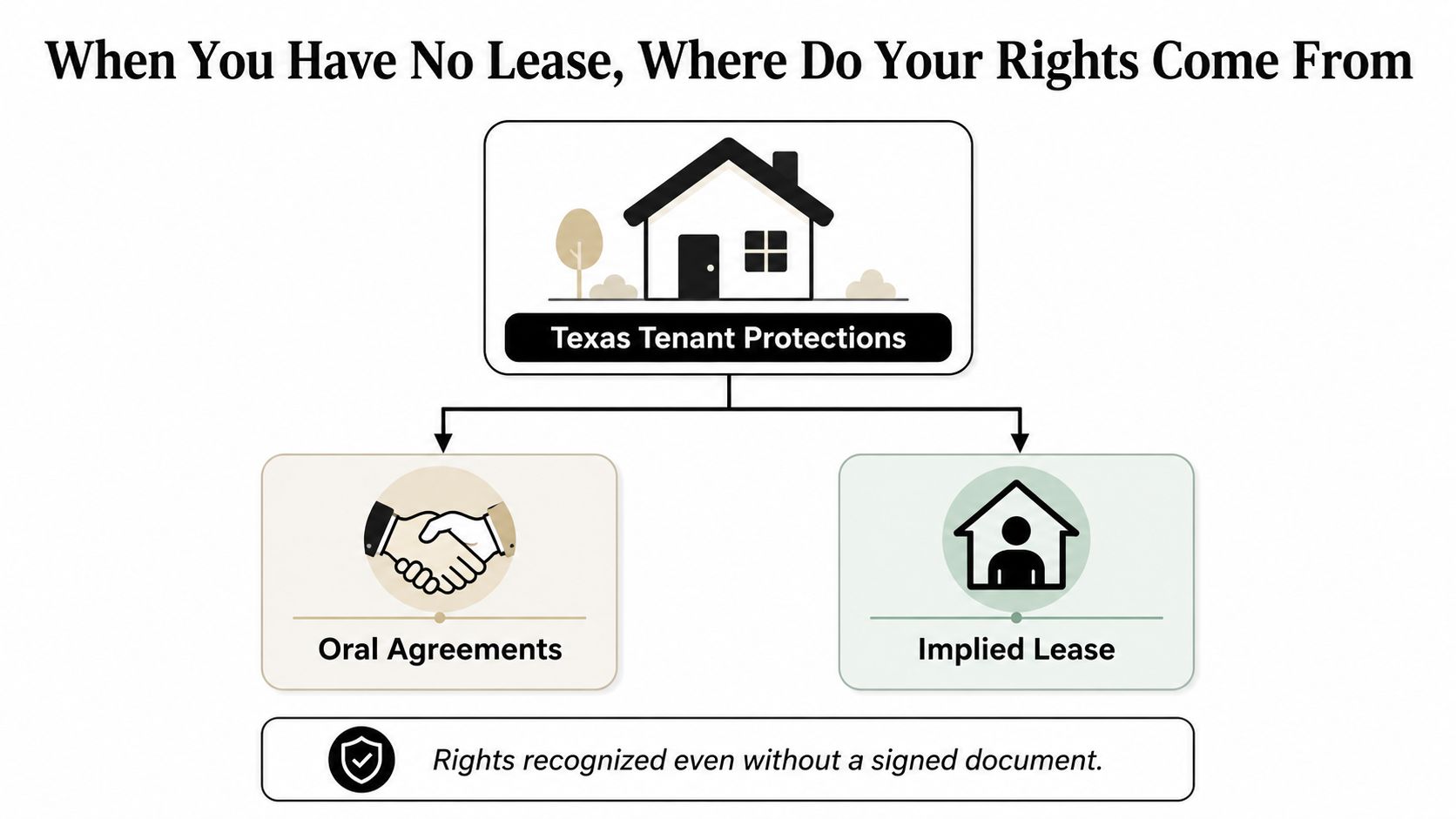
When You Have No Lease, Where Do Your Rights Come From
A Houston worker pays rent in cash every month. The original agreement was never signed, and the landlord now says, “There's no lease, so you have no rights.” That statement is too broad. Cash payments may be harder to prove than electronic transfers, but they can still support an argument that the parties formed an oral or implied rental arrangement.
Texas law provides a legal framework even when paperwork is missing. Texas Property Code Chapter 92 addresses residential landlord duties involving repairs, security devices, security deposits, retaliation, and quiet enjoyment. Section 24.005 also establishes a notice requirement before a landlord files a forcible detainer case against a tenant at will, tenant by sufferance, or other holdover occupant, unless the parties made a different written agreement.
The evidence that can fill the paperwork gap
Start by gathering proof of what both sides agreed to and how they behaved:
- Payment records: Bank statements, money-order receipts, cash receipts, or messages about rent can support your account.
- Terms in writing: Texts or emails may show the rent amount, due date, utilities, parking, pets, or other promises.
- Permission to occupy: A key, mailing address, move-in messages, or the landlord's repeated acceptance of rent can help distinguish a resident from a trespasser.
- Witness testimony: Roommates, relatives, neighbors, or property managers may have direct knowledge of the arrangement.
You can learn more about how Texas treats a verbal arrangement through this guide to verbal rental agreements in Texas.
Federal fair housing protections may also matter if the dispute involves discrimination. Local rules in cities such as Austin, Dallas, and San Antonio can add requirements in some housing situations, so the property's location matters. A written lease normally gives clearer answers about late fees, pets, utilities, and maintenance responsibilities. Without one, the Texas Property Code supplies an important statutory floor, while disputed verbal terms may need to be proved through evidence.
Are You a Tenant, a Guest, or a Holdover Occupant
The label attached to your occupancy can change the legal process. TexasLawHelp's guidance on people living together without a lease emphasizes that a person who received permission to live in a home may be a tenant even without a written contract, while a short-term guest may have a different status. Courts and law enforcement may look at rent, contributions, length of stay, mailing address, privacy, and the parties' conduct.
A tenant generally has permission to occupy the property as a residence and may pay rent or contribute money or services connected to the household. A college student who stays on a couch for a brief visit, keeps belongings elsewhere, and pays nothing looks more like a guest. A sister who has her own room, receives mail there, and pays half the utility bill presents a stronger tenancy argument.
A holdover occupant remains after a rental term or permission has ended. This can include someone who stayed after an agreement ended, a roommate whose relationship with the primary tenant broke down, or a former romantic partner who refuses to move after the relationship ends. The person's status remains fact-specific, but a landlord generally cannot avoid formal eviction procedures by calling a resident a guest.
| Status | Key Facts | Eviction Path | Protections |
|---|---|---|---|
| Tenant | Permission to live there, rent or household contribution, residential use | Formal eviction process may be required | Chapter 92 protections may apply |
| Guest | Short visit, no rent exchange, no continuing right to occupy | May sometimes be asked to leave without an eviction | Depends on the facts and any agreement |
| Holdover occupant | Remains after permission or a rental term ends | Section 24.005 notice and court process may apply | Notice and court protections can still matter |
Practical rule: Before sending a demand to leave, identify whether the person is a guest, tenant, or holdover occupant. The wrong label can lead to the wrong legal remedy.
Property owners and managers can also benefit from practical guidance on managing a commercial property, although residential occupants are generally governed by a different statutory framework. For business premises, Commercial Lease Disputes in Texas involves the way Texas treats commercial tenancies differently under Chapter 93.
How the Three-Day Notice and Eviction Process Works
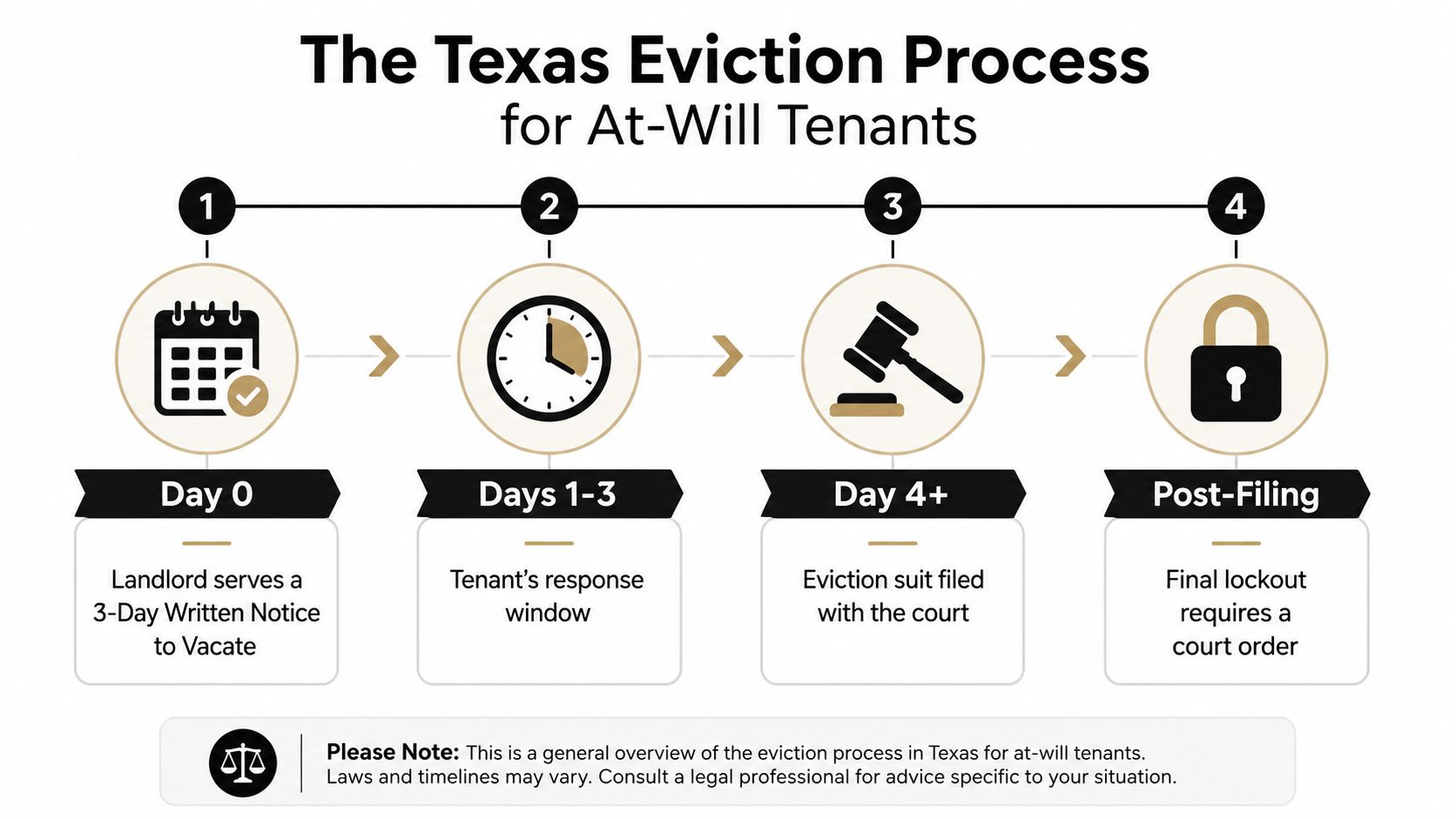
For a tenant at will, tenant by sufferance, or holdover occupant, Texas Property Code Section 24.005 generally requires at least three days' written notice to vacate before the landlord files a forcible detainer suit, unless a written agreement provides a different notice period. The statutory baseline is explained in Section 24.005 of the Texas Property Code.
The notice is not the same as a court order. It gives the occupant a chance to move, communicate with the landlord, or seek legal advice before a case is filed. If the occupant remains, the landlord may file an eviction case in the appropriate justice court. The court then gives both sides an opportunity to present evidence about possession, notice, rent, permission, and defenses.
What the process means in practice
The sequence usually looks like this:
- Written notice is delivered. The notice should identify the demand to vacate and comply with the applicable delivery rules.
- The notice period runs. The landlord must wait the required period before filing, unless a valid written agreement changes it.
- An eviction case is filed. The tenant should read the citation carefully and attend the hearing.
- The judge decides possession. A ruling may favor the landlord or tenant, depending on the evidence and legal requirements.
- A writ may be enforced. If the landlord wins and the tenant doesn't leave, the constable, not the landlord, carries out the court-authorized removal.
A landlord can't replace this process with a lock change, utility shutoff, removal of doors, or disposal of belongings. Those actions can create separate legal problems, even when the landlord believes the occupant no longer has permission to stay.
If you've received a notice, this explanation of a 3-day eviction notice in Texas can help you identify the immediate issue. Don't ignore a court date. Bring payment records, messages, photographs, and anything showing why the notice or eviction claim is inaccurate.
Repair Rights and Habitability Without a Signed Lease
A missing signature doesn't erase a landlord's duty to address conditions that materially affect a tenant's health or safety. Under Texas Property Code Section 92.052, repair obligations can apply when the landlord is liable for the condition and the tenant has given the required notice. The Texas Attorney General identifies repair rights as part of the protections available to renters under Chapter 92, including those living under oral arrangements.
The first step is usually written notice that clearly describes the condition. Keep a copy, explain where the problem is, and request a reasonable response. A broken lock, sewage backup, flooding, loss of potable water, dangerous electrical condition, or serious heating or cooling problem may require prompt attention, but the specific remedy depends on the facts and the statute.
Repair and deduct requires careful compliance
Section 92.0561 has technical requirements. The timing differs by hazard:
- Sewage or flooding: A tenant may seek immediate repair after giving notice.
- Loss of potable water: The landlord has three days after the tenant's notice of intent to repair, according to the statute's repair-and-deduct framework. Section 92.0561 explains the applicable requirements.
- Other health or safety conditions: The landlord generally has seven days after notice under the statutory framework.
- Deduction limit: The deduction is capped at the greater of one month's rent or $500, subject to the statute's conditions and documentation requirements. The same statutory source explains the cap and procedure.
| Step | Standard Repair Request, Chapter 92 | Repair-and-Deduct, Section 92.0561 |
|---|---|---|
| Notice | Describe the health or safety condition in writing | Give the required notice and, where applicable, notice of intent |
| Landlord response | Allow a reasonable opportunity to address the problem | Follow the hazard-specific waiting period |
| Tenant action | Preserve evidence and pursue statutory remedies if needed | Use a qualified repair and document the expense |
| Financial result | Possible court remedies or other statutory relief | Deduct only within the statute's requirements and cap |
A tenant may have additional remedies, including ending the tenancy or asking a court to order repairs, when the statutory conditions are met. For practical maintenance terminology, a Bear Valley Plumbing & Heating guide can help explain service issues, but it doesn't replace Texas legal advice. Before withholding rent or deducting a repair bill, review the Texas repair-and-deduct rules with care.
Quiet Enjoyment, Illegal Entry, Retaliation, and Security Deposits
Tenant protections extend beyond the question of whether the landlord can recover possession. The Texas Attorney General describes a renter's right to quiet enjoyment, which means the landlord cannot improperly interfere with the tenant's reasonable use of the home. Entry rules depend on the agreement and applicable law, and emergencies are treated differently from routine inspections or repairs.
A tenant should respond to repeated or improper entry in writing. State the date, explain that the entry wasn't authorized or properly noticed, and ask the landlord to coordinate future non-emergency access. A lock change, utility shutoff, or other attempt to force someone out without court process may be more serious than an ordinary notice dispute.
Retaliation and deposits require records
Texas law also restricts retaliation after a tenant asserts certain rights, such as requesting repairs or raising habitability concerns. TexasLawHelp's repair guidance describes a six-month retaliation protection period when the tenant has paid rent and followed lease terms. The facts still matter, and the landlord may have an independent lawful reason for an action, so preserve the timing of every request and response.
Security deposit rules apply even when the rental arrangement wasn't signed. Under Texas Property Code Section 92.103, the landlord must refund the deposit on or before the 30th day after the tenant surrenders the premises, as explained in the statutory security deposit rule. The tenant should provide a forwarding address and keep proof of surrender. The landlord should identify lawful deductions as required by the applicable provisions.
| Protection | Rule | Timeframe |
|---|---|---|
| Quiet enjoyment | Don't substantially interfere with lawful residential use | Applies during the tenancy |
| Repair retaliation | Certain retaliatory conduct may be restricted after protected complaints | Six-month protection period described by TexasLawHelp |
| Security deposit | Refund or account for the deposit after surrender, subject to lawful deductions | On or before the 30th day |
| Court possession process | Don't use self-help to remove a resident who claims tenancy | Before physical removal, follow court procedures |
The deposit claim has priority over claims of the landlord's creditors under Section 92.103. That rule can matter if the property owner faces financial distress. A tenant without a written lease should still treat the deposit as a documented financial issue, not as an informal favor.
Real Scenarios Where No-Lease Tenants Run Into Trouble
A roommate pays rent for six months, sends the money electronically, and keeps personal belongings in the home. The property changes owners, and the new owner says the roommate must leave immediately because no lease exists. Those facts support a tenant or implied-lease argument more strongly than a brief guest arrangement. The new owner may need to use the Section 24.005 notice and eviction process rather than changing the locks.
During the next several days, the roommate should preserve payment records, messages, and proof of residence. If a written notice arrives, the roommate should check whether it gives the required time and whether the person serving it has authority. A court hearing may turn on whether the occupant had permission, whether rent was accepted, and whether the notice properly ended the occupancy.
A second situation involves a family member who moved in rent-free after a divorce. The family member helped repair the home, receives mail there, and has been living there continuously. The homeowner calls the person a guest. The family relationship and lack of rent don't automatically resolve the issue. The evidence may support a license, guest arrangement, or tenancy, depending on the original permission and the parties' conduct.
The homeowner should avoid putting belongings outside or changing the locks while the resident claims a right to occupy the home. The family member should not assume that helping with repairs automatically creates a lease. Both sides need to document the agreement and obtain advice before taking action.
A third example involves a verbal promise about rent. The landlord agrees to one amount, accepts payments, then demands a higher amount during the agreed rental period and threatens eviction when the tenant refuses. Text messages and payment history may help establish the original terms. The tenant should keep paying the undisputed amount if advised that doing so is appropriate, avoid accepting a new term accidentally, and respond to any notice before a case is filed.
Your Documentation Toolkit and Sample Notice Language
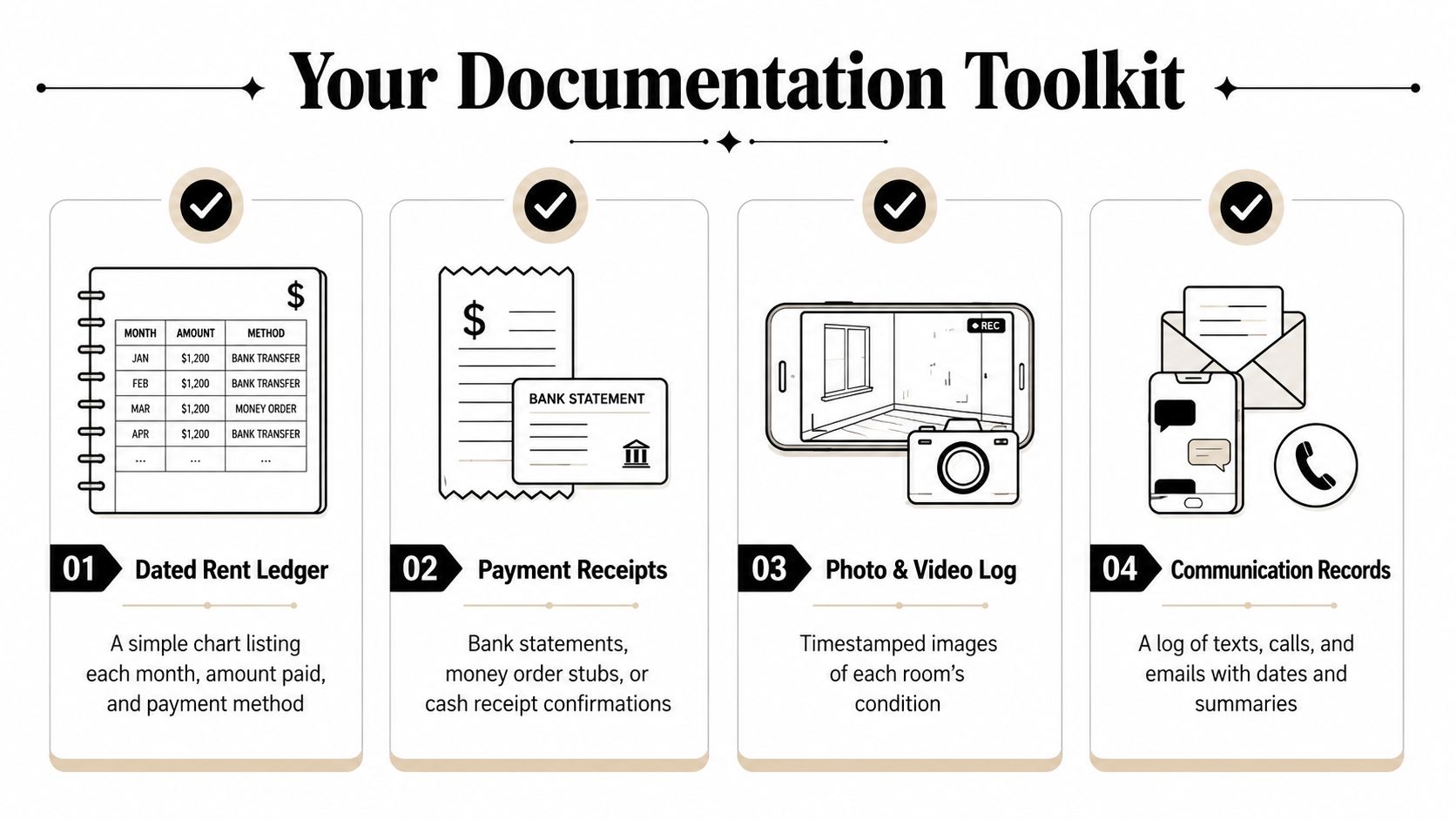
Without a signed lease, evidence becomes the practical substitute for missing terms. Build a file before the disagreement becomes urgent. Use one folder, whether paper or digital, and name each item with its date so you can explain the timeline quickly.
What to preserve
- Dated rent ledger: List each payment, amount, method, and the month it covered.
- Payment proof: Save bank statements, money-order stubs, cash receipts, and messages confirming payment.
- Condition records: Take dated photographs and short videos of each room, repair problem, lock, appliance, or utility issue.
- Communication history: Export texts and emails, and keep a call log with the date, participants, and subject.
Send important repair or entry notices in a trackable way, such as certified mail with a return receipt, while keeping a duplicate by email or text when appropriate. Your notice should identify the condition, state what action you want, cite the relevant Texas Property Code provision, and provide a reasonable response date. Don't exaggerate the facts or threaten an unlawful deduction.
Sample repair request
Subject: Written repair request under Texas Property Code Section 92.056
On [date], I notified you about [specific condition] at [address]. The condition is located at [room or area] and affects [health, safety, water, sewage, security, or another specific concern]. Please arrange the required repair and confirm the planned response in writing. I'm keeping photographs and communication records, and I reserve any remedies available under Texas law.
Sample objection to non-emergency entry
Subject: Written objection to non-emergency entry
I object to the non-emergency entry on [date and time] because [brief reason]. Please provide advance coordination for future non-emergency access and identify the purpose and proposed time before entering. I'm willing to cooperate with reasonable access that complies with our agreement and Texas law.
A sample is not a substitute for a legal review. The correct citation, timing, and remedy may change with the facts, especially if there is an eviction notice, suspected retaliation, or a safety emergency.
Key Takeaways and When to Call a Texas Tenant Lawyer
The absence of a signed lease doesn't end the legal analysis. Start with the facts showing permission and occupancy, then identify whether you're a tenant, guest, or holdover occupant. That classification affects whether the landlord must use formal eviction procedures and whether Chapter 92 protections apply.
The main points are practical:
- Notice matters: Section 24.005 generally requires at least three days' written notice before a landlord files a forcible detainer action against a tenant at will or by sufferance, unless a written agreement provides another period. See the Texas statutory notice requirement.
- Repairs remain important: Section 92.0561 may permit repair-and-deduct remedies when the condition, notice, timing, and expense satisfy the statute.
- Peaceful use is protected: A landlord can't disturb a resident's quiet enjoyment or use self-help methods to bypass the court process.
- Deposits have a deadline: Section 92.103 requires the landlord to refund the security deposit on or before the 30th day after surrender, subject to lawful deductions.
- Retaliation can be a defense: A tenant's repair or habitability complaint may matter if the landlord takes adverse action during the six-month period described in TexasLawHelp's guidance.
Get help quickly if the landlord changes the locks, shuts off utilities, demands a same-day move-out, or threatens to remove your belongings. A roommate dispute can also involve family violence or safety concerns, which may require immediate planning beyond an ordinary landlord-tenant disagreement. If a constable posts a writ of possession, don't wait until the removal is underway to seek advice.
The Law Office of Bryan Fagan, PLLC can review your payment records, messages, notices, repair evidence, and court papers to help clarify your position. If you need an eviction attorney or Texas landlord tenant lawyer for a lease dispute, repair issue, security deposit problem, or threatened removal, schedule a free consultation through The Law Office of Bryan Fagan, PLLC.
If you need help with an eviction, lease issue, or rental dispute, contact The Law Office of Bryan Fagan, PLLC for a free consultation today. Their Texas landlord-tenant attorneys can assess your notice, documentation, and occupancy status, then explain practical next steps for protecting your rights.