Skip to content
Dealing with a broken air conditioner in a Texas summer or a plumbing leak that never gets fixed can leave you feeling trapped. You still owe rent, but your home may be unsafe or unlivable, and your landlord may keep promising to send someone “soon.” Texas law does provide a repair-and-deduct remedy, but it's a narrow legal process, not permission to fix any inconvenience and reduce your rent.
The most expensive mistakes happen before the contractor arrives. Tenants lose protection by sending defective notice, acting too soon, choosing an unsuitable repair provider, or deducting more than the law allows. This guide explains how repair and deduct in Texas works under Texas Property Code § 92.0561, what documentation matters, and when a Texas landlord tenant lawyer should review your situation.
Understanding Your Repair Rights Under Texas Law
A tenant in a July apartment might report that the air conditioner has stopped working. Another tenant might wake up to sewage backing into the bathroom or discover a persistent leak under the kitchen sink. These problems aren't equal under Texas law. The key question is whether the condition materially affects an ordinary tenant's physical health or safety, rather than whether the property is merely inconvenient or unattractive.
Texas Property Code § 92.0561 creates a specific remedy. If the statutory requirements are satisfied, a tenant may have a qualifying repair made and subtract the cost from a later rent payment. The Texas State Law Library explains that the remedy applies only in particular repair situations involving health and safety, and only after the tenant gives proper notice to the landlord. See the broader discussion of Texas Property Code Section 92 tenant rights for related protections.
Practical rule: A repair problem may justify action by the landlord without automatically giving you the right to repair it yourself and deduct the bill.
The difference between maintenance and a statutory remedy
Landlords generally have responsibilities to maintain rental housing, but repair and deduct isn't a blanket maintenance shortcut. Worn carpet, a scratched cabinet, faded paint, or a cosmetic wall defect usually won't meet the health-and-safety threshold. A broken essential system, active sewage problem, dangerous structural condition, or serious leak may present a stronger claim, but the facts and the effect on the home still matter.
A landlord may also need accurate information to respond. Your notice should identify the exact condition, where it appears, and how it affects the household. “The apartment is bad” is weak. “Sewage is backing up through the bathroom drain and contaminating the floor” gives the landlord a meaningful opportunity to investigate and repair.
Why documentation matters from the beginning
Keep photographs, videos, maintenance requests, inspection records, and messages. If the property uses submeters or separate utility allocations, a landlord may also benefit from reviewing practical resources about submetering solutions for landlords, especially when a dispute involves water usage, leaks, or responsibility for a utility-related condition.
Your rights depend on more than proving that something broke. You must show that you notified the right person, used the required process, waited when required, hired an appropriate contractor, and calculated the deduction correctly. Treat the matter like a legal record from the first notice.
Which Repairs Qualify for the Deduct Remedy
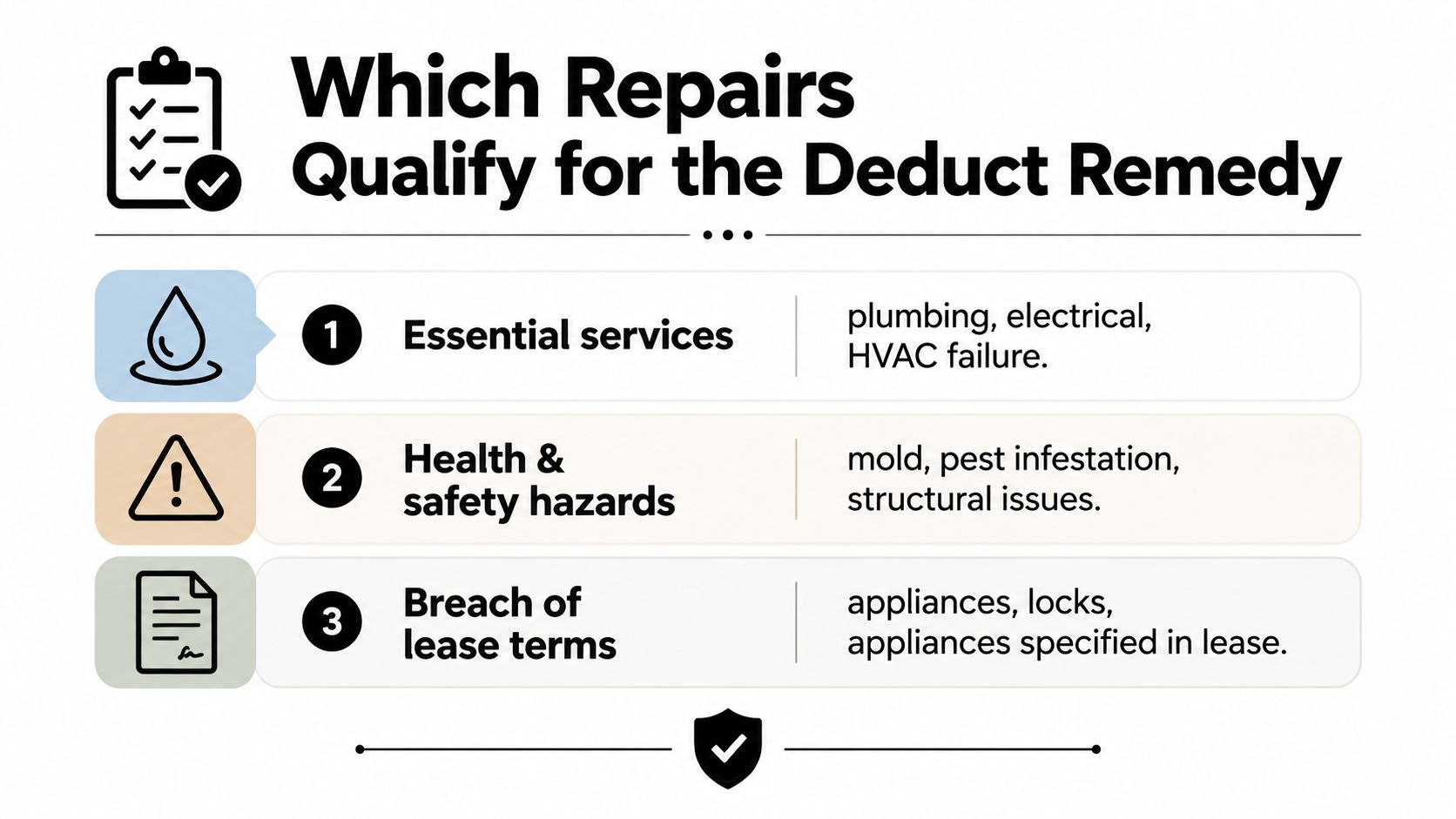
The repair-and-deduct remedy turns on the condition's effect on physical health or safety. A landlord's failure to address a qualifying problem may support statutory remedies, but a tenant shouldn't assume every unresolved maintenance request qualifies. The safest approach is to separate the condition into three questions: what failed, how it affects the home, and whether the lease or law makes the landlord responsible.
Conditions that may meet the threshold
Problems involving essential services can be serious enough to qualify when they materially affect health or safety. Examples include a major plumbing failure, loss of necessary electrical service, or an HVAC failure that creates a dangerous indoor condition. A sewage backup, gas leak, or structural hazard deserves immediate attention and careful documentation.
Other examples can include significant water intrusion, dangerous mold-related conditions, severe pest infestation, or a broken lock that creates a security concern. The facts matter. A small stain on a wall isn't automatically the same as ongoing moisture that threatens the structure or household health.
Conditions that usually don't qualify
Cosmetic damage generally belongs in the ordinary maintenance category, not the repair-and-deduct remedy. Peeling decorative paint, worn flooring, outdated fixtures, or an appliance that isn't required by the lease may not satisfy the statutory standard.
Lease language can also affect responsibility. If the lease promises a particular appliance or service, that promise may matter in a dispute, but you still need to connect the failure to a legal duty and follow the statutory procedure. A lease cannot erase protections that Texas law makes mandatory, but tenants shouldn't rely on a lease clause as a substitute for proper notice.
A useful eligibility review
Before hiring anyone, ask:
- Health or safety impact: Does the condition materially affect the physical health or safety of an ordinary tenant?
- Landlord responsibility: Does the lease or Texas law place the repair obligation on the landlord?
- Specificity: Can you describe the defect, location, and consequences clearly?
- Proof: Can photographs, reports, messages, or contractor observations support your description?
- Procedure: Have you given legally sufficient notice and allowed the landlord the applicable opportunity to respond?
If any answer is uncertain, pause before spending money. A tenant who repairs a cosmetic problem may be left with a bill and a rent dispute.
How to Provide Proper Notice and Follow the Required Steps
Procedure controls this remedy. A tenant can have a genuine emergency and still lose the right to deduct by failing to create proof of notice or acting before the applicable waiting period ends. Texas law guides explain that repair-and-deduct must follow proper notice and apply only to specific situations.
Start with a precise written request
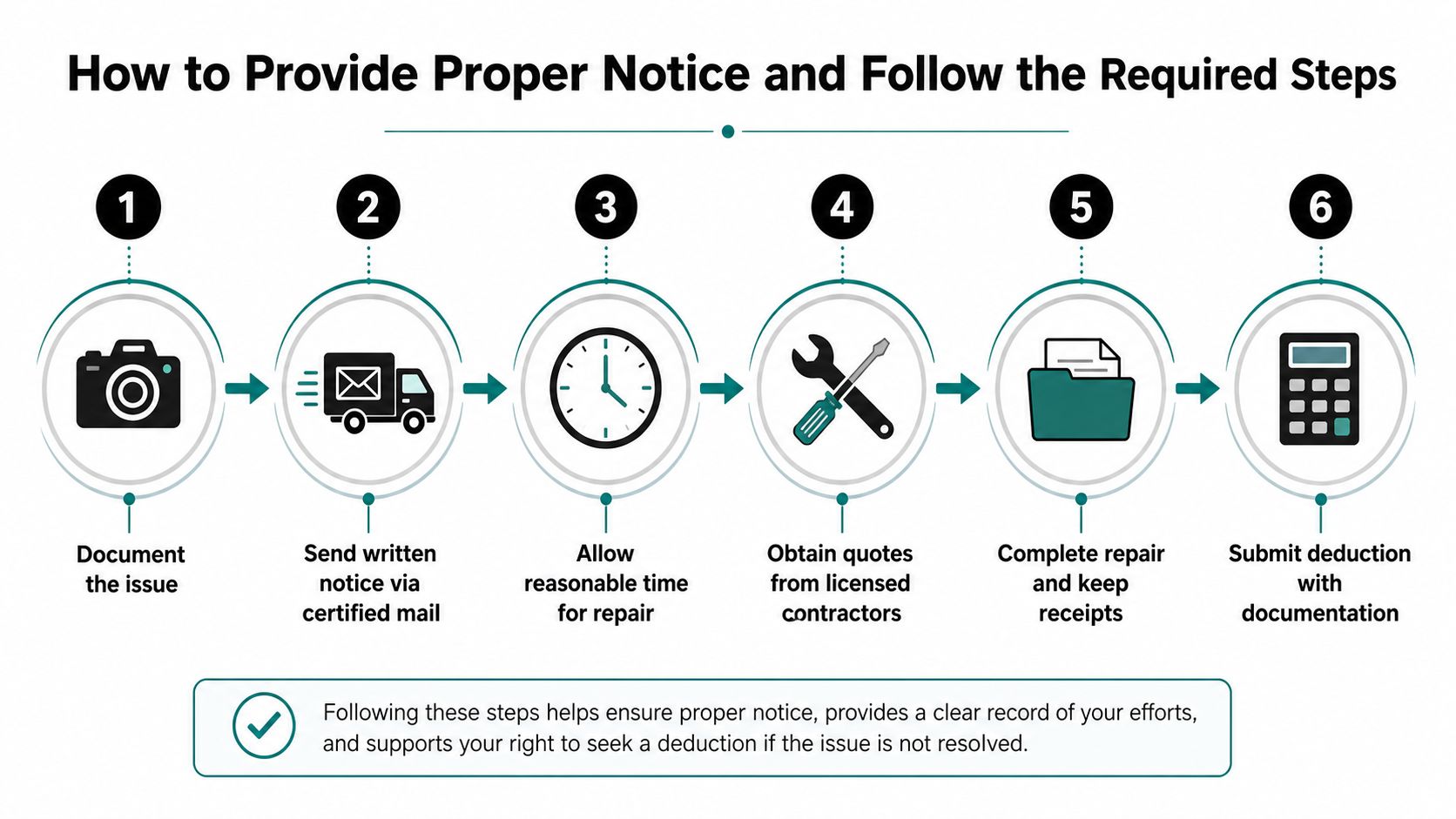
Use the notice method required by your lease and a method that creates reliable delivery evidence. Certified mail can provide a strong paper trail. Keep the receipt, tracking information, and a complete copy of what you sent.
A practical notice can read:
Subject: Written repair request
I'm notifying you that [describe the condition] at [property address and specific location]. The condition began on [date or approximate date] and is affecting [health, safety, essential service, or security]. Please arrange an inspection and repair, and confirm in writing when the contractor will attend. I'm preserving photographs and other records of the condition.
This wording isn't a substitute for legal advice, but it prevents a common problem: a vague message that doesn't identify what the landlord needed to fix. You can also review how to request repairs from a landlord in Texas before sending your communication.
Track delivery, response, and repair activity
The waiting period runs from proper notice and depends on the condition. A sewage backup or flooding from broken pipes or natural drainage inside the dwelling may permit action immediately after notice. Total loss of potable water and inadequate heat or cooling that materially affects health or safety have a shorter statutory period, while other qualifying health-and-safety conditions have a longer one. Because the correct period depends on the facts, don't guess when the clock starts.
A landlord's documented, diligent repair effort can change the analysis. Save appointment confirmations, contractor messages, entry notices, photographs of work, and every proposed repair date. If the landlord hasn't made a diligent effort after the applicable period, a second written notice can state that the condition remains unrepaired and that you intend to evaluate statutory remedies.
Hire carefully and preserve proof
Don't perform the work yourself or use a family member as the contractor. Select a competent contractor appropriate for the repair, obtain an itemized invoice, and retain proof that you paid it. A licensed plumber, electrician, or HVAC professional may be appropriate for work in that trade. For a complicated condition, obtain written estimates and preserve the contractor's description of the work.
Before deducting, send the landlord a written accounting identifying the repair, contractor, amount paid, and documents attached. Separate repair records from other rental paperwork. For a different Chapter 92 issue, Security Deposit Rules in Texas addresses the 30-day return rule and what both parties must know.
Cost Limits and How to Calculate Your Deduction
Texas Property Code § 92.0561 imposes a strict ceiling. The deduction may not exceed one month's rent or $500, whichever is greater, and the statute measures that limit per month, not per repair. The Texas State Law Library summarizes the cap and the requirement that the tenant provide the landlord with the repair bill and proof of payment. The statutory text also permits repeated use when total deductions in a particular month stay within the limit. Texas Property Code § 92.0561 contains the governing language.
The formula in practical terms
If monthly rent is $900, the greater amount is $900. If monthly rent is $2,200, the greater amount is $2,200. Those examples show how the formula works, but they don't authorize a tenant to deduct the full cost of a larger repair bill automatically. Your actual deduction remains limited by the qualifying repair cost, the statutory ceiling, and the reasonableness of the work and charge.
| Monthly Rent | Maximum Deduction | Notes |
|---|---|---|
| $900 | $900 | One month's rent is greater than $500. |
| $2,200 | $2,200 | One month's rent is greater than $500. |
| Less than $500 | $500 | The statutory minimum is greater than one month's rent. |
The cap is not a per-repair allowance. If multiple qualifying repairs occur, the combined deductions in a month must remain within the applicable monthly limit. The statute allows repeated use as needed, but each repair still needs its own qualifying facts, notice, contractor, invoice, and proof of payment.
What to do when the bill is larger
Suppose a qualifying repair costs more than the monthly cap. You cannot subtract the entire invoice from rent. You may need to pay the excess yourself, negotiate with the landlord, pursue another legal remedy, or obtain advice about whether lease termination or a court action is more appropriate.
Don't confuse a repair deduction with ordinary rent collection rules. Late Fees and Rent Rules in Texas explains what Texas law allows regarding late fees and rent collection. A disputed deduction can affect whether the landlord claims rent is unpaid, so your accounting must be exact.
Deferred maintenance can create the underlying condition, and a plain-language explanation of what is deferred maintenance may help landlords and tenants distinguish an ignored building problem from a tenant-caused repair.
Common Mistakes That Invalidate Your Claim
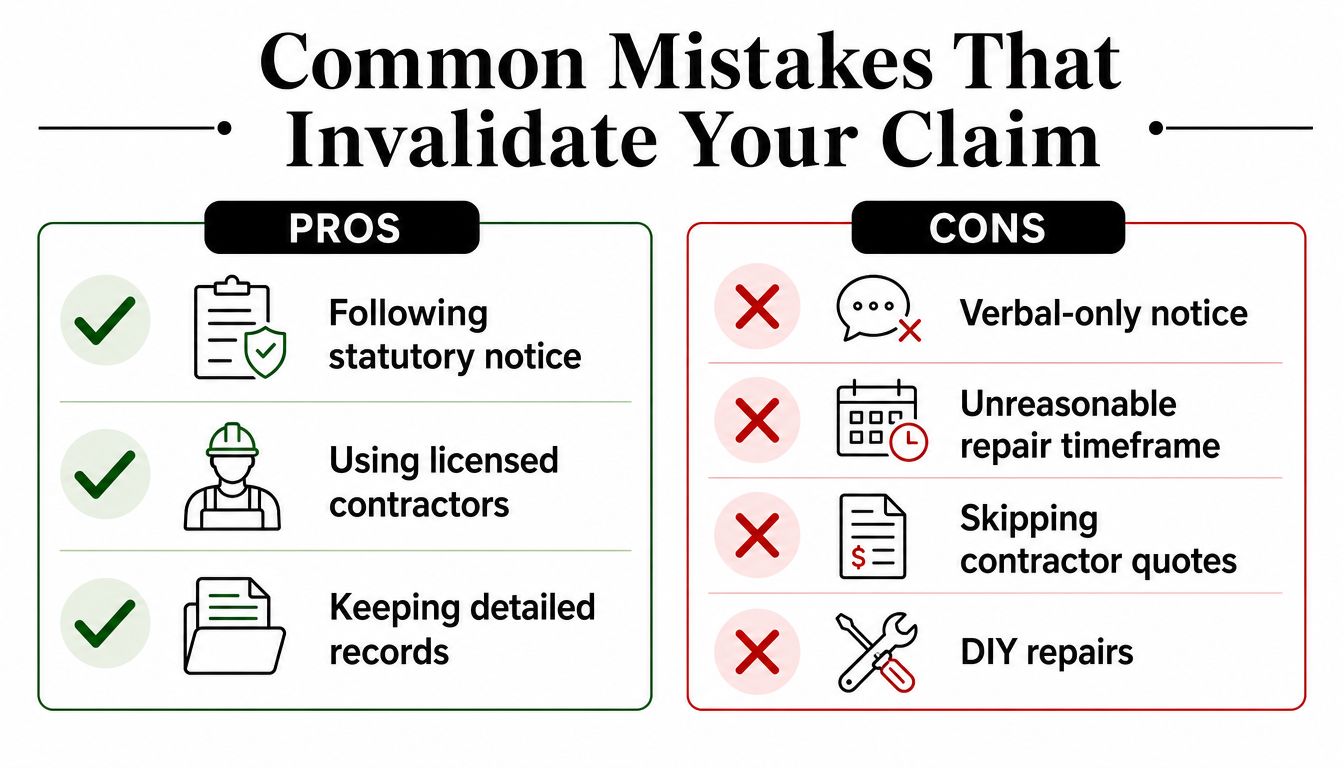
A legitimate repair problem doesn't rescue a defective claim. Courts and landlords will focus on what you did, when you did it, and what proof you can produce. The following comparisons expose the shortcuts that create the most trouble.
Shortcut versus defensible process
| Risky shortcut | Better approach |
|---|---|
| Verbal-only notice: You tell the maintenance worker in a hallway and keep no delivery proof. | Written notice: Send a specific request through a reliable method and preserve evidence of receipt. |
| Immediate work: You hire a contractor before the landlord has the required opportunity to respond. | Wait appropriately: Follow the condition-specific timing rules unless the facts support immediate action. |
| Full rent withholding: You pay nothing because the repair is unresolved. | Itemized deduction: Pay the undisputed rent and deduct only a documented, lawful amount. |
| DIY repair: You replace the part yourself and charge the landlord for your time. | Competent contractor: Use an appropriate arms-length provider and keep the invoice and payment proof. |
| Cosmetic project: You repaint or replace worn materials and call it a safety repair. | Qualifying condition: Limit the remedy to a condition that materially affects physical health or safety. |
Before you deduct: Review the notice, delivery evidence, dates, contractor credentials, invoice, payment proof, and monthly calculation as if you were preparing for an eviction hearing.
Why rent withholding is especially dangerous
Repair-and-deduct isn't the same as stopping rent payments. If the landlord disputes your deduction and you have no statutory documentation, the landlord may characterize the balance as unpaid rent. That can lead to an eviction dispute, late-fee issues, or claims that you violated the lease.
Another common error is treating one large bill as automatically deductible. The law's cap and documentation rules still apply even when the repair felt urgent. If the work exceeds the allowable amount, get advice before subtracting the excess.
Landlord Responses and When to Seek Legal Help
Landlords shouldn't ignore a credible repair request. A prompt inspection, written response, qualified contractor, and repair log can resolve the problem before the tenant considers self-help. A landlord who disputes the claim should explain the reason, identify what has been done, and preserve records rather than threatening eviction.
A landlord may challenge whether the condition affected health or safety, whether notice was proper, whether the repair was necessary, whether the contractor was competent, or whether the tenant exceeded the monthly cap. Those defenses can be legitimate, but the landlord's own conduct matters too. A rushed nonpayment eviction based on a potentially valid statutory deduction can make the dispute harder, not easier.
How tenants should respond to pushback
Keep communications calm and in writing. Send the landlord a packet containing the original notice, delivery proof, photographs, contractor information, itemized bill, proof of payment, and deduction calculation. Don't argue that the entire rent is excused. State precisely what amount you deducted and why.
If the landlord ignores the request, review what to do if a landlord ignores repair requests in Texas and consider legal advice before taking further action. A Texas tenant rights dispute becomes more urgent if you receive a notice to vacate, an eviction filing, a lease-termination threat, or a response that appears retaliatory.
Landlords should also obtain advice when a tenant deducts rent, particularly if the property has recurring maintenance records or multiple occupants reporting the same condition. Tenants should consult an eviction attorney before withholding disputed rent or appearing in court. The Law Office of Bryan Fagan, PLLC handles landlord-tenant disputes, repairs, evictions, lease issues, and related Texas Property Code questions through a free consultation process.
If a repair dispute is putting your housing or rent account at risk, The Law Office of Bryan Fagan, PLLC can review your notices, repair records, invoices, and landlord communications. Schedule a free consultation to understand your rights, evaluate the repair-and-deduct procedure, and choose a practical strategy before the dispute escalates.