Dealing with a landlord dispute in a Texas summer is exhausting. If your apartment feels like an oven, you've probably already done the hard part, you've waited, sweated, called, texted, and still wondered whether the law gives you any real protection. The answer depends on a few sharp legal distinctions, and those distinctions matter more than most renters realize.
In Texas, no AC in apartment Texas law renters rights is not a simple yes or no question. The primary issue is whether your landlord had a duty to install air conditioning at all, or a duty to repair an existing system that was already part of the lease. That difference controls what you can demand, what notice you must give, and what remedies you may have if the landlord ignores you.
Surviving the Texas Heat Your Rights as a Renter
A tenant calls in the middle of a hot August afternoon. The AC went out two days ago, the bedroom never cools down, and the landlord keeps saying someone will “take a look.” The tenant is worried about children in the apartment, worried about missing work, and worried that pushing too hard will lead to an eviction notice. That is a real Texas renter problem, and it's exactly why the law requires a careful, documented approach.
Texas renters often assume that unbearable heat alone automatically means the landlord is breaking the law. That isn't the whole picture. Texas focuses on whether the condition affects health or safety, not whether the apartment is merely uncomfortable. Under Texas Property Code § 92.052, the legal question is whether the problem materially affects the physical health or safety of an ordinary tenant. That standard is what turns a broken cooling system into a repair issue.
Practical rule: If you can't show notice, rent status, and a health-or-safety problem, your claim gets much harder to enforce.
That's why renters in Houston, Dallas–Fort Worth, Austin, and San Antonio need more than frustration. They need a plan. They need to know what the lease says, whether AC was promised, what the city requires, and how to document the situation before the landlord claims there was no real problem. For a broader overview of Texas tenant protections tied to the Property Code, see Texas Property Code 92 tenant rights.
The hardest part for many renters is that heat problems don't always fit neatly into everyday words like “repair.” The law wants proof, not just a bad day. If you're trying to protect your home, the first step is understanding where the landlord's duty begins.
Must a Landlord Provide AC in Texas
Texas state law does not impose a general duty on landlords to install air conditioning in every rental unit. That is the starting point renters need, because it clears up a common misunderstanding. If the apartment was rented without AC, and the lease does not promise it, state law usually does not force the landlord to add a system later.
The important difference is installation versus repair
If AC is already part of the lease, or it came with the unit when you moved in, the landlord usually has a duty to keep it working under the rental agreement and the habitability rules that apply after proper notice. That is a different legal question from a duty to buy and install cooling in a unit that never had it. Texas tenant-rights materials consistently draw that line, and it matters in real disputes because the lease can define what the landlord promised to provide.
Local rules can be stricter than state law. Austin's ordinance history is a good example of how a city may move faster on cooling standards, even though Texas statewide law still centers on repair-and-remedy rights rather than a broad AC installation requirement. Renters should check the city where the property sits instead of assuming every Texas city follows the same approach.
If you are dealing with a commercial space instead of a home, the legal frame changes again. Commercial Lease Disputes in Texas explains how Texas treats commercial tenancies differently under Chapter 93, which is a separate analysis from residential cooling issues.
If AC is in the lease, the landlord's duty is usually to keep it functional. If AC was never part of the deal, the tenant's claim becomes much narrower.
Read the lease before you assume the landlord must act
The lease controls more than many tenants expect. If the landlord expressly promised cooling equipment, the written terms can support a repair demand when the system fails. If the lease excludes AC maintenance, that language can make the claim harder to press. Tenants should not rely on assumptions about what should be included in a Texas apartment.
The short version is simple. Texas generally does not require landlords to provide AC as a standalone appliance, but once AC is part of the rental arrangement, failure to maintain it can create a legal problem. That distinction is where many strong claims begin, and where many weak claims fall apart.
When a Broken AC Violates the Texas Property Code
A broken AC becomes a legal issue when it crosses the line from inconvenience to a condition that materially affects the physical health or safety of an ordinary tenant. That wording comes from Texas Property Code § 92.052, and it is the standard tenants and landlords both need to understand. The law does not say every outage is actionable. It says the condition must affect health or safety in a meaningful way.
What habitability looks like in practice
A hot apartment may support a claim when the indoor temperature stays dangerously high, when airflow is poor, or when the unit creates a health concern for someone who is elderly, very young, or medically vulnerable. A tenant with heat-sensitive health issues has a stronger factual story than a tenant who is merely uncomfortable. That's because the statute centers on an ordinary tenant, but real-world evidence often shows why the condition is serious for the people living there.
The same issue can look different depending on the facts. A short outage during a mild day may be a nuisance. A prolonged failure during extreme Texas heat, especially in an apartment with poor ventilation, looks much more serious. The law gives the tenant a path forward only when the condition rises to that level and the tenant follows the notice rules.
What the landlord must do after notice
Texas repair rights do not begin until the tenant gives proper notice and is current on rent. After that, the landlord must make a diligent effort to repair or remedy the problem. Texas Attorney General guidance treats 7 days as a reasonable repair window after notice, unless the situation calls for faster action because of the danger involved. For a plain-English explanation of the repair standard, tenant notice, and landlord duties, the Texas Housingers guide on extreme heat is helpful, and Houston coverage on the issue is consistent with that framework.
The strongest cases are usually not about whether the apartment felt unbearable. They're about whether the tenant can prove the condition affected health or safety and whether the landlord had notice.
For tenants, that means one question matters more than almost any other. Can you show the AC failure created a habitability problem, not just a comfort problem? If the answer is yes, the repair law may apply. If not, the claim may remain a matter of frustration rather than enforceable rights.
Your Step-by-Step Guide to Demanding AC Repairs
The repair process in Texas is formal for a reason. Landlords respond more seriously when the tenant follows the statute, and courts care a lot about whether the tenant gave notice the right way. If you skip the procedure, even a strong factual complaint can lose force.

Start with proof, then move to notice
The first move is to document the AC problem before you send anything. Take photos and videos of the thermostat, the unit, standing water, or anything else that shows the system is not working. Then review the lease to confirm the cooling system is part of the rental arrangement and that you're not missing a special notice clause.
After that, send a dated written repair request. Texas guidance says tenants should use certified mail, registered mail, or personal delivery, and keep a copy of the notice. The Texas Property Code also expects the tenant to be current on rent before repair remedies are available. That part matters, because a landlord will often argue that the tenant's own payment history undercuts the claim.
What the notice should say
Keep the message direct. Identify the unit, describe the AC problem, explain when it started, and ask for repair. Don't turn the notice into an angry letter. A clean notice is more useful than a long emotional one. If you need a format example or a deeper breakdown of repair notice rules, see Texas tenant rights repairs.
Practical rule: Keep one copy for yourself, one copy for your records, and one mailing receipt if you send it by certified or registered mail.
Know what “reasonable time” means
Texas law presumes seven days is a reasonable time for the landlord to make a diligent repair effort after notice. That doesn't mean the issue must always be solved in seven days, but it does mean the landlord can't sit on the request without action. If the landlord promises repairs and keeps delaying, your documentation becomes even more important.
The repair request is where many tenants win or lose later. If you give good notice, stay organized, and keep your rent current, you preserve the remedies Texas law may give you if the landlord still refuses to fix the problem.
Your Legal Remedies if Your Landlord Refuses to Repair
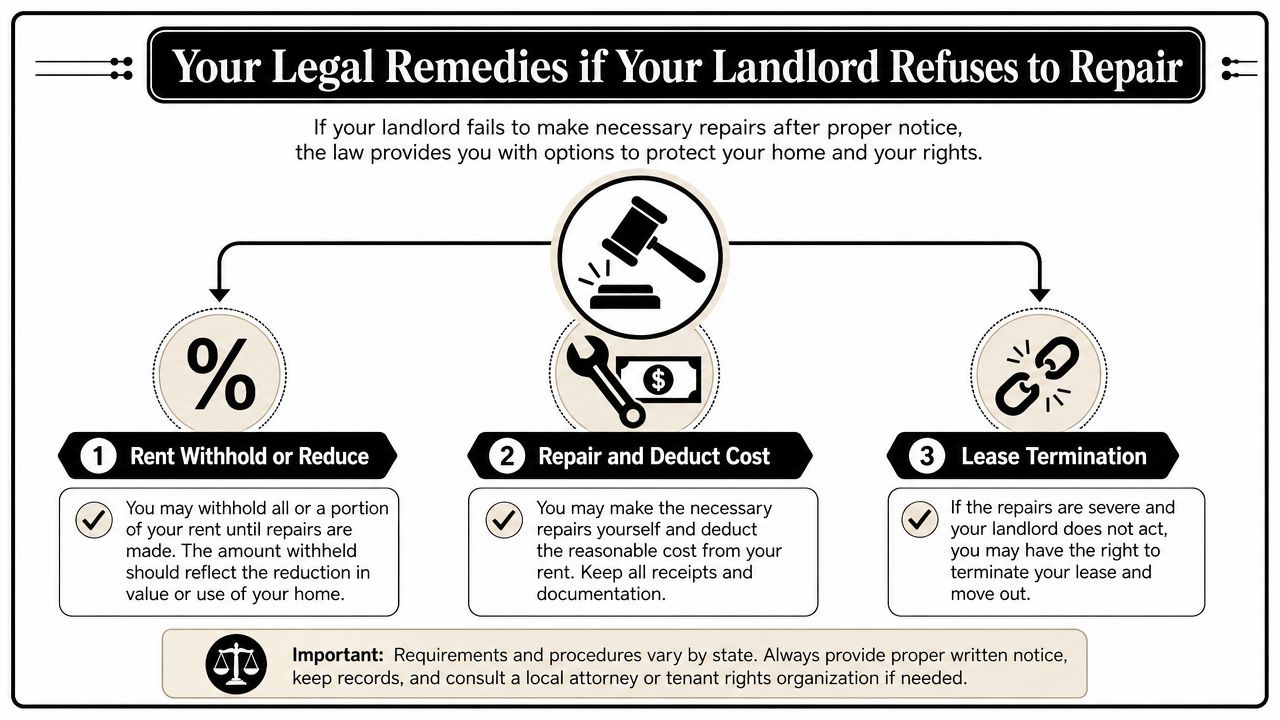
Once proper notice goes out and the landlord still doesn't act, Texas law gives tenants a limited set of remedies. The right choice depends on the facts, the timing, and how serious the AC failure really is. You don't want to guess here, because the wrong move can weaken your position fast.
The three remedies Texas law recognizes
Under the Texas repair-and-remedy rules, a tenant may be able to terminate the lease, repair and deduct, or file suit to compel repairs and pursue other relief. Those are the practical paths that matter most. A separate general overview of landlord-tenant rules is available at Texas landlord tenant law overview.
Lease termination is the cleanest option when the condition is serious enough and the landlord has failed to make the required diligent effort after proper notice. It ends the tenancy, but it also requires the tenant to be very careful about move-out timing and documentation. If the tenant stays too long after claiming a serious defect, the landlord may argue the condition wasn't severe enough to justify ending the lease.
Repair and deduct can be useful, but it's the easiest one to misuse. The tenant must follow the statute closely, and the cost has to fit within the legal limits that apply to repair-and-deduct claims. If you spend money first and ask questions later, you may create a dispute over whether the expense was authorized.
A lawsuit is the broadest option, but also the most formal. It can seek to force repairs or address the landlord's failure to comply with the Property Code. That path is usually best when the facts are contested or the repair problem is part of a larger rental dispute.
What not to do
Do not withhold rent just because the AC is broken. Texas tenant-rights materials and landlord guidance both warn that withholding rent is risky unless the tenant is following the law precisely. Rent issues and repair rights are connected, but they are not the same thing. For a focused discussion of rent issues and repair disputes, see Can you withhold rent for repairs in Texas?.
The smart move is to match the remedy to the facts. A tenant with strong notice, clear evidence, and a serious habitability problem may have options. A tenant who skipped documentation or stayed silent for too long may not. That difference can decide the case.
How to Document a Strong Case for Your AC Claim
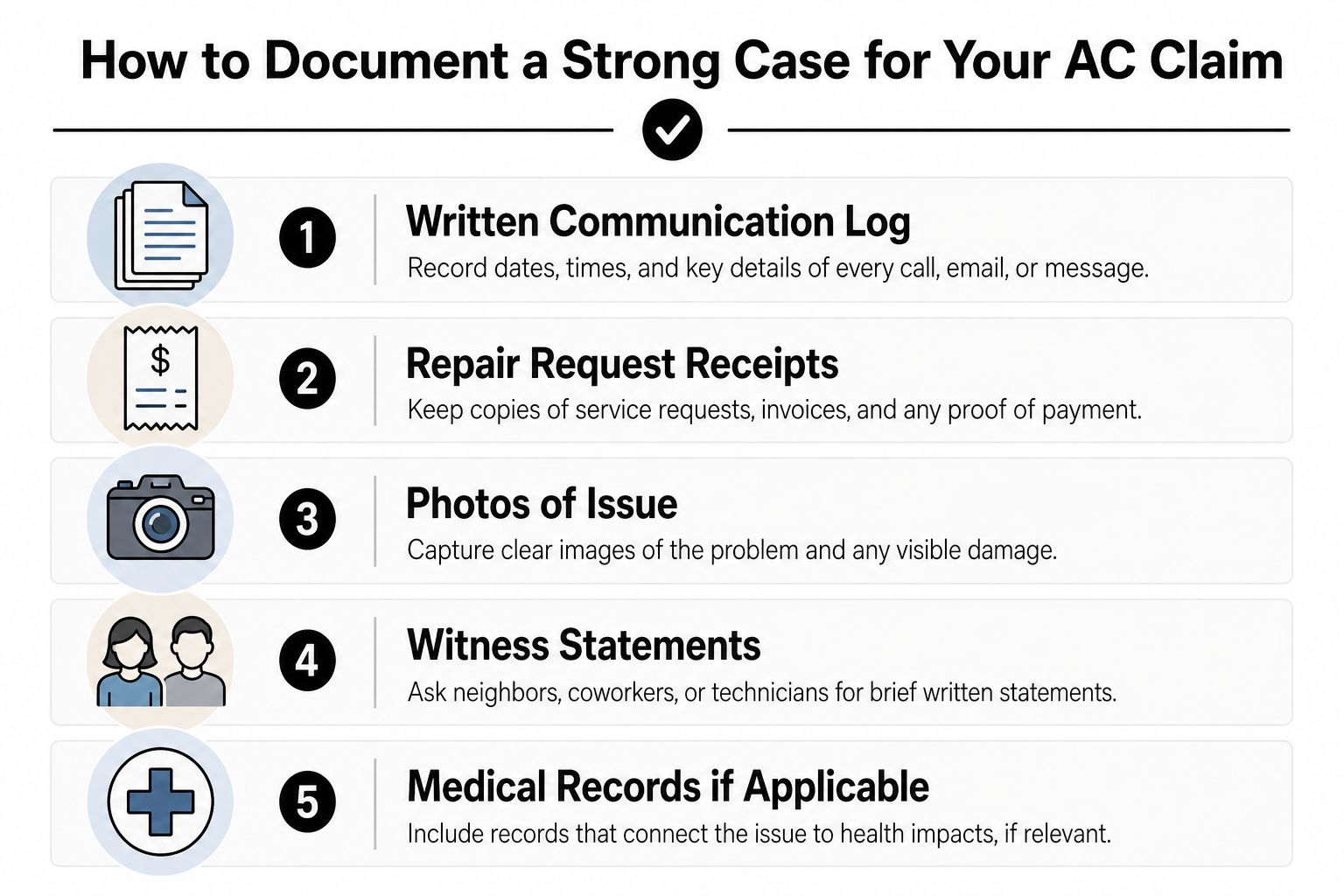
Good documentation makes a weak argument stronger, and it can make a strong argument much harder to ignore. Texas repair claims are evidence-heavy, and the tenant usually needs proof that the AC failed, that notice was given, and that the condition affected health or safety. If you're trying to protect your rights, treat the dispute like a file you may need to show a judge.
Build the record before the argument starts
Keep a written log of each date the AC failed, each time you called or emailed, and each response from the landlord. Save screenshots of texts, voicemail notes, and repair tickets. If the landlord sends a repair tech, write down the name, the date, and what the tech said.
Temperature evidence helps too. Take time-stamped photos or videos of thermostat readings and note the time of day when the apartment is hottest. Indoor logs are useful because they show that the problem lasted over time instead of being a brief inconvenience.
Medical and witness evidence can matter
If the heat affects a medical condition, get a doctor's note or other medical documentation that connects the risk to the apartment conditions. That kind of record can be important when the landlord argues the issue was only uncomfortable. Witness statements from roommates, family members, or neighbors can also help confirm what was happening in the unit.
A separate insurance resource can help renters think through the fallout from property damage or temporary displacement, and renter's insurance protection tips are worth reviewing alongside your repair records. Insurance won't replace your repair rights, but it can help you understand other losses that may arise when a living space becomes unlivable.
Key takeaway: The evidence that matters most is the evidence that proves notice, timing, and the health-or-safety impact.
Keep the proof organized
Put everything in one folder, digital or paper. Include the lease, notices, photos, repair receipts, and any medical or witness records. If the landlord later claims you never complained or that the AC was working, your records become the first line of defense.
A strong AC claim isn't built on outrage. It's built on proof. That's what gives your tenant rights real weight under the Texas Property Code.
Get Help With Your Texas Renters Rights Today
The main points are simple, but the details are unforgiving. Texas does not automatically require every landlord to install AC, but once a cooling system is part of the rental or a broken unit creates a health-and-safety issue, the landlord may have repair duties under the Texas Property Code. Your lease, your written notice, and your evidence will shape the outcome more than your frustration ever will.
If you're dealing with a broken AC, know this. The law works best for renters who act early, keep records, and use the right notice process. It's also easy to make a mistake that gives the landlord an argument, especially when rent is current, the repair window has passed, and the apartment is still too hot to safely live in.
The Law Office of Bryan Fagan, PLLC helps Texas renters and landlords with repair disputes, eviction issues, lease disagreements, and habitability problems across the state. If you want more context on tenant protections and practical next steps, you can also review our guidance on the broader Texas tenant rights repairs process.
If you need help with a broken AC dispute, an eviction threat, or any rental repair issue, contact The Law Office of Bryan Fagan, PLLC for a free consultation today. Visit The Law Office of Bryan Fagan, PLLC to get clear guidance on your rights and a plan for what to do next.